
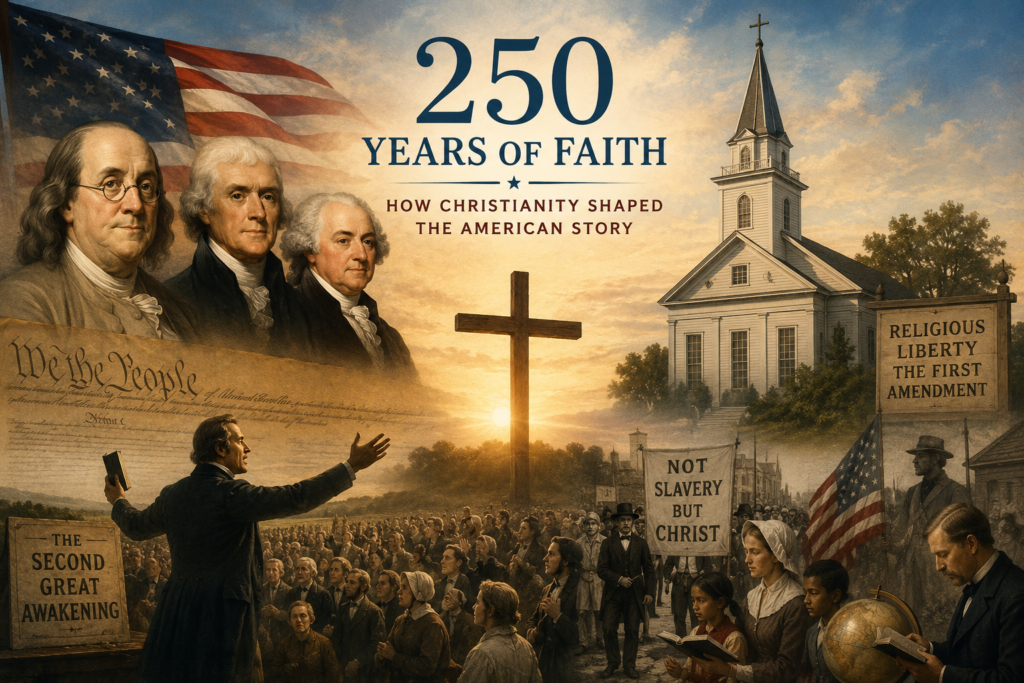
Image Credentials: Image Title: 250 Years of Faith: How Christianity Shaped the American Story. Source: (chatgpt.com) Date: July 2026. Attribution: This image was created using AI-generated imagery (chatgpt.com) by Open Chronicle and does not depict a real-world scene.
By Open Chronicle History Desk
For 250 years, Christianity has remained one of the defining forces in the history of the United States. While historians continue to debate whether America was ever truly founded as a “Christian nation,” few dispute that Christian belief, institutions, and communities have profoundly influenced the country’s political culture, social movements, and national identity since independence in 1776.
The relationship between faith and the American republic has never been straightforward. Many of the nation’s most influential Founding Fathers held complex or unconventional religious beliefs. Benjamin Franklin identified himself as a Deist and questioned core Christian doctrines such as the divinity of Christ. Thomas Jefferson admired Jesus as a moral teacher but rejected many supernatural elements of the Bible, famously producing his own edited version of the Gospels. John Adams supported Christianity’s public role while embracing Unitarian theology rather than traditional Trinitarian belief. These personal convictions illustrate that the architects of the United States were far from uniform in matters of faith.
Yet the strength of Christianity in America did not depend solely on the beliefs of its political leaders. According to church historian Thomas S. Kidd, the nation’s religious vitality emerged primarily through the work of local churches, pastors and ordinary believers operating within a system that protected religious liberty rather than enforcing religious conformity. The First Amendment’s guarantee of the free exercise of religion created an environment in which denominations could expand without direct state control, encouraging competition, missionary activity, and church planting.
This freedom helped fuel one of the most significant religious developments in American history, the Second Great Awakening. During the early nineteenth century, revival movements swept across the expanding nation, dramatically increasing membership in Baptist and Methodist churches while inspiring missionary societies, charitable organizations and educational institutions. By the eve of the Civil War, evangelical Christianity had reached its greatest level of cultural influence in the country’s history.
That influence, however, was accompanied by deep contradictions. American churches were divided over slavery, with many denominations splitting into northern and southern branches. The Civil War exposed these fractures and weakened the moral authority of many religious institutions. At the same time, waves of Catholic, Jewish, and later Muslim, Hindu, and Buddhist immigration transformed the nation’s religious landscape, making it increasingly diverse and reducing the numerical dominance of Protestantism.
The late nineteenth and twentieth centuries brought additional challenges. Scientific developments, including Darwin’s theory of evolution, along with higher biblical criticism, prompted intense theological debates over the authority of Scripture and the relationship between faith and modern scholarship. These controversies reshaped many denominations and contributed to divisions between conservative and liberal theological traditions.
Despite widespread narratives describing America as steadily becoming less religious, Kidd argues that the country’s spiritual history is better understood as a recurring cycle of revival and decline. Throughout its history, periods of weakening church attendance have often been followed by renewed religious energy, suggesting that American Christianity has repeatedly adapted to changing social and cultural conditions rather than simply fading away.
Recent decades have witnessed growing secularization in many areas of public life, particularly within academia, entertainment, business, and parts of government. Nevertheless, evidence indicates that Christian communities remain vibrant in many regions, with new congregations continuing to emerge even as some historic denominations experience membership declines. Rather than disappearing, Christianity in America appears to be evolving into a more diverse and decentralized movement.
As the United States marks its 250th anniversary, the history of Christianity in America remains a story of remarkable resilience. It is a history shaped not only by presidents and political debates, but also by countless churches, missionaries, revivalists and ordinary believers whose influence extended into education, abolitionism, civil rights, charitable work and community life.
Whether viewed through the lens of politics, culture or religious history, Christianity has been inseparable from the American experience. Its role has never been static, nor without controversy, but its influence continues to shape discussions about identity, liberty, morality and the nation’s future, just as it has throughout the past two and a half centuries.