
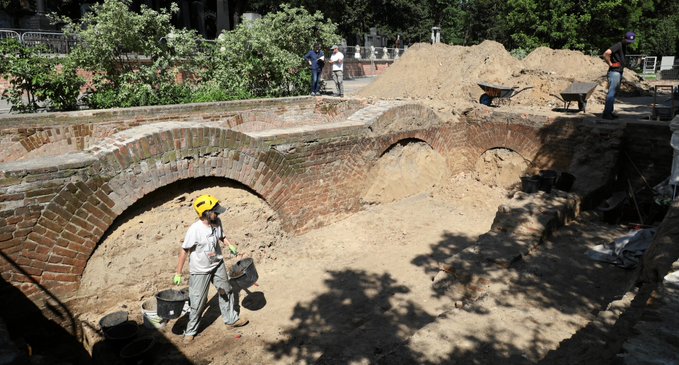
Image: from Notes from Poland X @notesfrompoland
By Open Chronicle News Desk with Agencies
Archaeologists working at Warsaw’s historic Jewish cemetery have uncovered the remains of a long-lost synagogue destroyed during the Second World War, shedding new light on one of the city’s once-thriving Jewish communities and offering a powerful reminder of the cultural heritage erased during the Holocaust.
The discovery was made during archaeological excavations at the Jewish cemetery on Okopowa Street, one of the largest surviving Jewish burial grounds in Europe. Researchers identified the foundations of a cemetery synagogue that had disappeared from the landscape after being destroyed by German occupation forces during World War II.
The find is being hailed as one of the most significant recent archaeological discoveries connected to Warsaw’s pre-war Jewish history.
A place of remembrance rediscovered
The synagogue served visitors attending funerals and memorial ceremonies at the cemetery before the outbreak of the war.
Historical records documented its existence, but after its destruction during the German occupation, little visible evidence remained of the building’s location. Decades of neglect and post-war changes to the cemetery gradually concealed its remains beneath layers of earth and vegetation.
Archaeologists have now uncovered sections of the building’s foundations, walls and structural features, confirming the precise location of the forgotten place of worship.
The excavation also revealed architectural details that will help historians better understand the design and function of the synagogue.
Reconstructing a lost community
Before World War II, Warsaw was home to one of the largest Jewish populations in the world, with more than 350,000 Jews living in the Polish capital.
The city’s Jewish community maintained hundreds of synagogues, schools, cultural institutions and charitable organizations, forming one of Europe’s most vibrant centres of Jewish religious and intellectual life.
Much of that heritage was systematically destroyed following the German invasion of Poland in 1939.
The Warsaw Ghetto, established in 1940, became the largest Nazi ghetto in occupied Europe. Following the 1943 Warsaw Ghetto Uprising, German forces razed much of the district, destroying countless religious and historical buildings.
The cemetery synagogue was among the many structures that disappeared during this period.
Archaeology preserving memory
Researchers say the discovery provides more than architectural information—it restores an important chapter of Warsaw’s cultural history.
By comparing the newly uncovered remains with archival photographs, historical maps and surviving documentation, archaeologists hope to produce a detailed reconstruction of the synagogue and its role within the cemetery.
The excavation is also expected to contribute to broader research into Jewish religious architecture in Poland before the Holocaust.
Conservation specialists are now documenting every element uncovered to ensure the site can be preserved for future generations.
The importance of Warsaw’s Jewish cemetery
Established in 1806, the Jewish cemetery on Okopowa Street remains one of the most significant Jewish cemeteries in Europe.
Despite suffering extensive damage during the Second World War, it still contains more than 200,000 marked graves and many thousands of unmarked burial sites.
Among those buried there are prominent rabbis, scholars, artists, politicians and community leaders whose lives helped shape Jewish culture in Poland over two centuries.
Today the cemetery serves not only as a burial ground but also as one of Warsaw’s most important historical and educational sites.
Recovering history beneath the ground
The discovery highlights the growing role archaeology plays in recovering traces of communities devastated during the Holocaust.
While countless buildings and monuments were destroyed during the war, researchers continue to uncover physical evidence that helps reconstruct the everyday lives, religious traditions and cultural achievements of Europe’s pre-war Jewish population.
For historians, each excavation represents another opportunity to preserve memories that occupying forces attempted to erase.
As work continues at the cemetery, archaeologists hope further discoveries may reveal additional structures connected to the site’s rich history, offering an even deeper understanding of Jewish life in Warsaw before the devastation of World War II.