
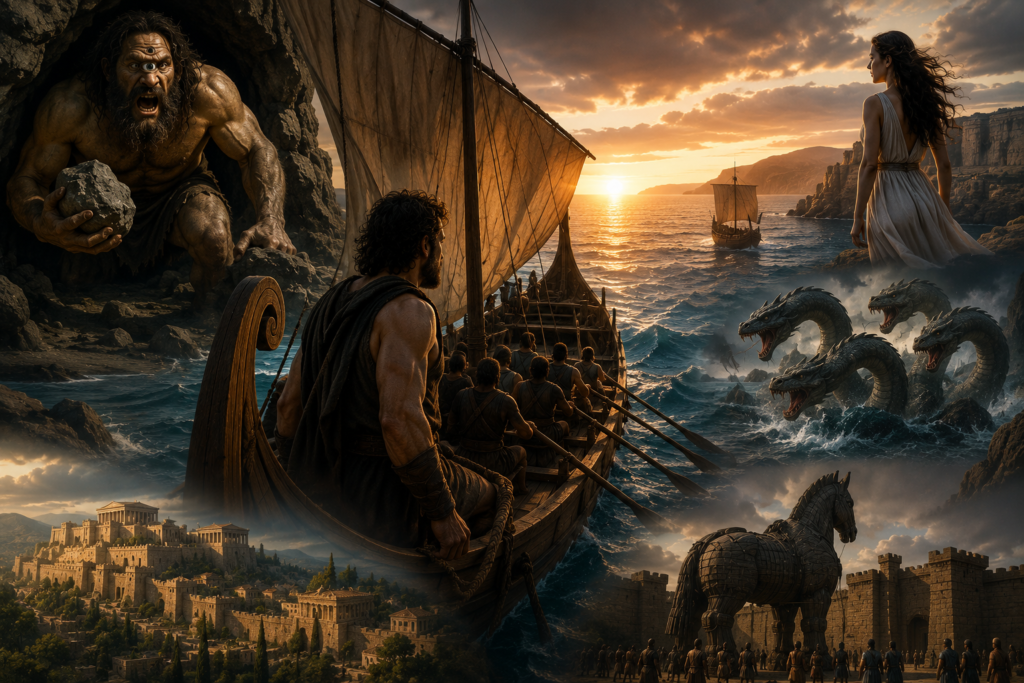
Image Credentials: Image Title: Was Homer’s Odyssey Inspired by Real History? The Truth Behind One of the World’s Greatest Epics. Source: (chatgpt.com) Date: July 2026. Attribution: This image was created using AI-generated imagery (chatgpt.com) by Open Chronicle and does not depict a real-world scene.
By Open Chronicle History Desk
Few stories have endured as powerfully as Homer’s Odyssey. Written nearly three millennia ago, the epic follows the long and perilous journey of the Greek hero Odysseus as he struggles to return home after the Trojan War. Its tales of monsters, gods, enchanted islands and impossible challenges have captivated generations of readers and inspired countless adaptations.
Interest in the ancient masterpiece has grown even further with director Christopher Nolan developing a new cinematic adaptation, prompting many to ask the same question that historians have debated for decades: Was the Odyssey based on a true story?
The answer, scholars say, is both yes and no.
A world built on history
Although the Odyssey is undeniably a work of myth and poetry, historians believe it reflects genuine memories of the Late Bronze Age, a period when powerful kingdoms flourished across the eastern Mediterranean.
The poem itself was probably composed around the 8th century BC, but many of its traditions likely originated several centuries earlier through oral storytelling. Ancient Greek poets passed these stories from one generation to the next long before they were ever written down.
As a result, the world described by Homer contains many features that resemble real Mycenaean Greece, even if the narrative itself became increasingly legendary over time.
The Trojan War: fact or fiction?
The Odyssey begins where the Iliad ends, after the fall of Troy.
For centuries, many believed the Trojan War belonged entirely to mythology. That changed dramatically in the nineteenth century when excavations at Hisarlik, in present-day Türkiye, uncovered the remains of an ancient city that many archaeologists identify as Troy.
Evidence shows the settlement experienced several destructive conflicts during the Late Bronze Age. While no archaeological discovery has confirmed Homer’s version of the war, many historians believe that a real conflict between Mycenaean Greeks and Troy may have inspired the stories that later evolved into the Iliad and the Odyssey.
Was Odysseus a real king?
Unlike Troy itself, there is no historical evidence proving that Odysseus actually lived.
Most classicists believe he is a legendary figure, possibly inspired by one or more Mycenaean rulers whose identities were gradually transformed through centuries of storytelling.
His character represents the qualities admired by ancient Greek audiences: intelligence, courage, resilience, and the ability to overcome impossible odds through wit rather than brute strength.
Whether he was based on a real individual or entirely fictional, Odysseus became one of literature’s defining heroes.
Monsters with possible real-world origins
The Odyssey is famous for its extraordinary creatures and supernatural encounters.
Odysseus battles the one-eyed Cyclops Polyphemus, escapes the seductive songs of the Sirens, sails between Scylla and Charybdis, resists the magic of Circe, and spends years trapped on the island of the nymph Calypso.
Historians generally do not interpret these episodes literally.
Instead, some suggest they may preserve distant memories of dangerous coastlines, unusual geological formations, unfamiliar cultures or unpredictable natural hazards that later became woven into myth.
Others argue that these adventures were intended primarily as symbolic episodes exploring temptation, fear, survival and human endurance.
A journey across the Mediterranean
For centuries, researchers have tried to map Odysseus’ route.
Possible locations have been proposed throughout Greece, Italy, Sicily, Malta, and other parts of the Mediterranean.
Yet no theory has achieved universal acceptance.
Many scholars now believe Homer intentionally blended recognizable geography with fictional landscapes, creating an epic voyage that felt believable to ancient audiences without corresponding to any precise historical route.
The power of oral storytelling
Understanding the Odyssey also means understanding how it was created.
Before writing became widespread in Greece, epic poems were preserved through oral performance. Traveling poets memorized vast narratives, adapting them for different audiences while gradually introducing new characters, themes and episodes.
This process allowed fragments of historical memory to merge with folklore, religious belief and imaginative storytelling, producing a work that is neither straightforward history nor pure fantasy.
Why the Odyssey still matters
The lasting appeal of the Odyssey lies not in whether every event truly happened but in its exploration of timeless human experiences.
It is a story about perseverance, identity, family, loyalty, temptation and the longing for home. Those themes remain as relevant today as they were nearly three thousand years ago.
Modern archaeology continues to reveal new insights into the Bronze Age world that inspired Homer, but the Odyssey ultimately belongs to both history and mythology. It preserves echoes of a real civilization while reminding readers that some of humanity’s greatest stories endure precisely because they transcend historical fact.
As Christopher Nolan prepares to bring the epic to a new generation of audiences, the fascination surrounding Odysseus’ legendary voyage shows no sign of fading.