
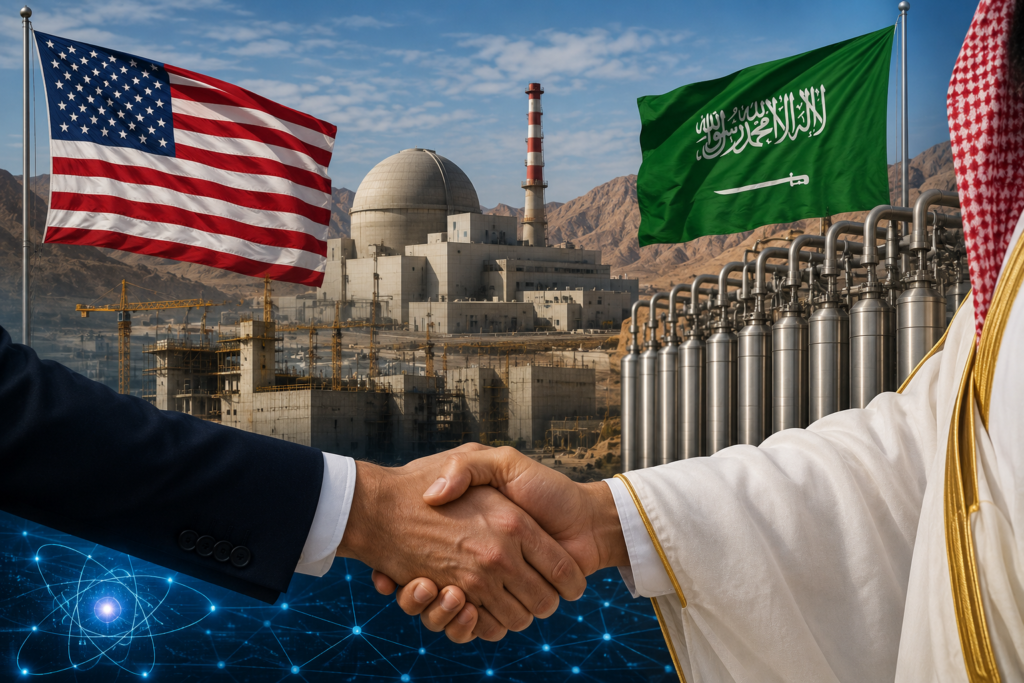
Image Credentials: Image Title: Trump Approves Nuclear Agreement That Could Allow Saudi Arabia to Enrich Uranium. Source: (chatgpt.com) Date: July 2026. Attribution: This image was created using AI-generated imagery (chatgpt.com) by Open Chronicle and does not depict a real-world scene.
By Open Chronicle News Desk with Agencies
U.S. President Donald Trump has approved a landmark nuclear cooperation agreement with Saudi Arabia that could eventually allow the kingdom to develop its own uranium enrichment capability as part of a civilian nuclear energy program.
The proposed agreement, expected to span 30 years, would involve American companies playing a central role in the development of Saudi Arabia’s civilian nuclear sector. According to reports, the deal includes the possibility of constructing a uranium enrichment facility in the kingdom following a joint technical assessment conducted by the United States and Saudi Arabia.
The agreement, first reported by The Wall Street Journal and later confirmed by sources familiar with the matter, had not yet been formally announced by the White House at the time of publication.
Expanding civilian nuclear cooperation
The agreement represents a major step in the long-running effort to establish a comprehensive U.S.-Saudi civilian nuclear partnership.
Both the Trump administration and the previous administration of President Joe Biden sought to negotiate a framework that would allow Washington to share nuclear technology with Riyadh while promoting American participation in the kingdom’s rapidly expanding energy sector.
Saudi Arabia has argued that nuclear power will help diversify its energy mix, reduce domestic oil consumption and support its long-term economic transformation under Vision 2030.
If implemented, the agreement would open the door for U.S. companies to participate in reactor construction, fuel-cycle research and other aspects of Saudi Arabia’s civilian nuclear infrastructure.
Uranium enrichment raises proliferation concerns
The most controversial aspect of the proposed agreement is its potential to permit Saudi Arabia to enrich uranium domestically.
While uranium enrichment is a legitimate component of civilian nuclear energy production, the same technology can also be used to produce highly enriched uranium suitable for nuclear weapons if enrichment levels are significantly increased.
Non-proliferation experts have long warned that allowing additional countries to develop enrichment capabilities could increase the risk of future nuclear weapons programs.
Saudi Crown Prince Mohammed bin Salman has previously stated that if Iran were to acquire a nuclear weapon, Saudi Arabia would seek to do the same, a remark that has heightened international concern over the kingdom’s long-term nuclear ambitions.
Regional security implications
The agreement comes at a time of heightened geopolitical tensions across the Middle East.
Recent military confrontations involving Israel, Iran and regional proxy groups have intensified concerns over the future balance of power in the region.
Security analysts note that any Saudi enrichment capability will inevitably be viewed through the broader context of Iran’s nuclear program, which has been the subject of international sanctions and diplomatic negotiations for more than two decades.
Although uranium enrichment alone does not provide a country with a nuclear weapon, it represents one of the most technically demanding stages of the nuclear fuel cycle and significantly shortens the path should a government decide to pursue military capabilities.
Producing a nuclear weapon would still require additional technologies, including advanced explosives, weapon design and delivery systems.
Pakistan connection draws attention
The announcement also comes amid growing strategic cooperation between Saudi Arabia and Pakistan, one of the world’s nuclear-armed states.
Following recent regional tensions, the two countries strengthened their defence partnership through a mutual security agreement.
Pakistan’s defence minister later suggested that his country’s nuclear deterrent could be made available to Saudi Arabia if circumstances required, remarks widely interpreted as a warning to regional adversaries and an indication of the increasingly close strategic relationship between Islamabad and Riyadh.
While there is no evidence that the proposed U.S.-Saudi agreement involves military cooperation, the broader regional context has attracted considerable international attention.
Comparing the UAE model
The proposed arrangement differs significantly from the agreement previously signed between the United States and the United Arab Emirates.
The UAE’s “123 Agreement”, which enabled construction of the Barakah Nuclear Power Plant with South Korean assistance, included a legally binding commitment by Abu Dhabi not to enrich uranium or reprocess spent nuclear fuel.
Non-proliferation experts have frequently described that approach as the international “gold standard” for civilian nuclear cooperation.
Allowing Saudi Arabia to retain an enrichment option would represent a notable departure from that model and could influence future nuclear cooperation agreements with other countries.
Awaiting formal announcement
Although details of the agreement have emerged through media reports and official sources, the White House had not issued a formal public announcement at the time of writing.
The deal is expected to face scrutiny from members of Congress, international non-proliferation specialists and regional allies, many of whom will seek assurances that any future Saudi enrichment activities remain subject to strict international safeguards and oversight by the International Atomic Energy Agency (IAEA).
If finalized, the agreement would mark one of the most significant developments in Middle Eastern nuclear policy in recent years, carrying implications not only for U.S.-Saudi relations but also for the future of nuclear non-proliferation and regional security.