
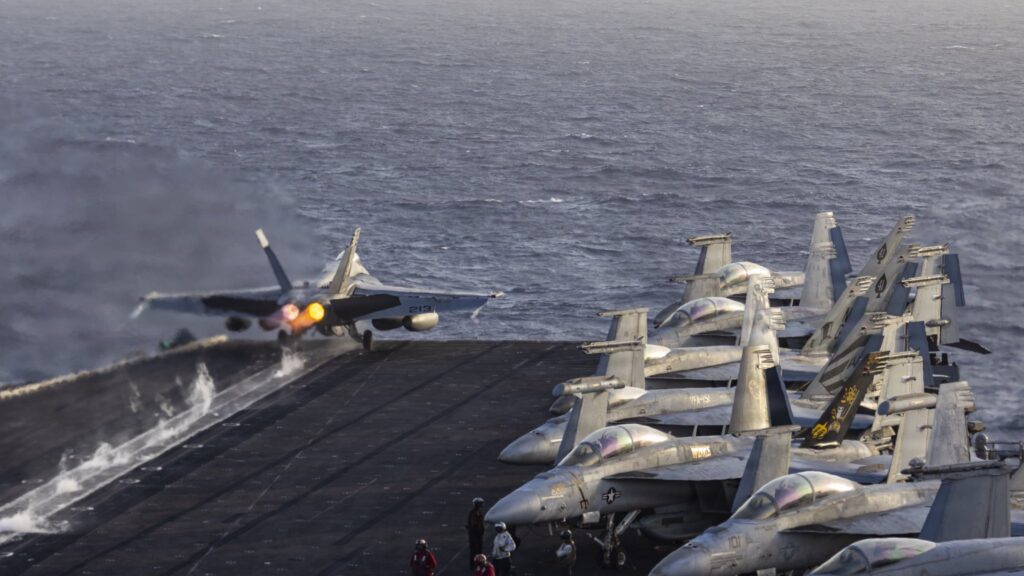
Image: from OSINTdefender X @sentdefender
By Open Chronicle News Desk with Agencies
The United States has carried out its eleventh consecutive night of military strikes against Iran, targeting what U.S. Central Command (CENTCOM) described as key military infrastructure linked to Tehran’s operational capabilities.
According to an official CENTCOM statement, the latest wave of precision strikes concluded at 8:15 p.m. Eastern Time and focused on degrading Iran’s ability to conduct military operations and threaten maritime security in the Persian Gulf.
The attacks come as the confrontation between Washington and Tehran continues to escalate, with both sides exchanging military actions across the region.
The US Central Command said it completed 11 days of strikes on Iran, targeting military sites to reduce threats to shipping in the Strait of Hormuz https://t.co/3PGwzUuWor pic.twitter.com/MvlKB6Ofq9
— Reuters (@Reuters) July 22, 2026
Strategic military targets struck
CENTCOM said the operation targeted a broad range of military assets across Iran.
Among the facilities reportedly hit were military command and operations centres, naval infrastructure, aircraft hangars, drone storage facilities and logistics installations used to support Iranian military activities.
U.S. officials stated that the strikes form part of an ongoing campaign aimed at reducing Iran’s operational capabilities while limiting its capacity to launch attacks against international shipping and regional partners.
No official assessment of battle damage or casualties was immediately released.
Protecting international shipping
American military officials said the campaign is primarily intended to protect freedom of navigation through the Strait of Hormuz, one of the world’s most strategically important maritime corridors.
According to CENTCOM, Iran has attacked more than 30 commercial vessels transiting the Strait of Hormuz and surrounding waters during the past three months.
The command said those incidents endangered civilian seafarers, disrupted international commerce and threatened one of the world’s most critical energy supply routes.
Washington argues that maintaining secure navigation through the Gulf remains a core objective of the current military operation.
Oil shipments continue despite conflict
Despite the continuing hostilities, CENTCOM stated that commercial maritime traffic through the Strait of Hormuz remains open.
The command reported that U.S. naval forces have facilitated the safe transit of nearly 900 commercial vessels since early May.
Military officials also said protective operations have ensured the uninterrupted movement of approximately 450 million barrels of crude oil to international markets, helping to reduce the risk of a broader disruption to global energy supplies.
Energy analysts continue to monitor developments closely, warning that any prolonged closure of the Strait could have significant consequences for world oil prices and international trade.
Iranian Revolutionary Guard claims attacks in Kuwait
In a separate development, Iran’s Islamic Revolutionary Guard Corps (IRGC) announced what it described as the second wave of “Operation Nasr 2.”
In an official communiqué, the IRGC claimed responsibility for strikes against early warning and tactical radar systems in Kuwait, asserting that several installations had been destroyed and rendered inoperable.
According to the Iranian statement, the targets included a major early warning radar and a tactical radar unit near Al Salem Air Base, as well as another radar installation on Bubiyan Island.
The IRGC said the attacks were intended to eliminate regional radar capabilities and warned that operations against what it called the “aggressor” would continue.
The claims have not been independently verified.
Bahrain and Kuwait activate air defences
Following the reported attacks, authorities in both Bahrain and Kuwait announced that Iranian strikes had triggered emergency security measures.
Air defence systems were activated, while government agencies issued urgent public safety warnings instructing residents to remain alert, follow official guidance and avoid exposed areas whenever possible.
The incidents have further heightened security concerns across the Gulf, where several countries host American military facilities and have increased their defensive readiness since the conflict intensified.
Regional conflict continues to widen
The latest exchange underscores the increasingly regional nature of the confrontation between the United States and Iran.
American forces continue to target Iranian military infrastructure, while Tehran has expanded its operations beyond its own territory, claiming attacks against facilities associated with U.S. allies and regional security networks.
Diplomatic efforts to halt the fighting have so far failed to produce a breakthrough, raising concerns that further escalation could threaten maritime trade, energy exports and broader stability across the Middle East.
As military operations continue, international observers remain focused on whether either side is prepared to reduce tensions or whether the conflict will continue to expand into additional theatres across the Gulf.