
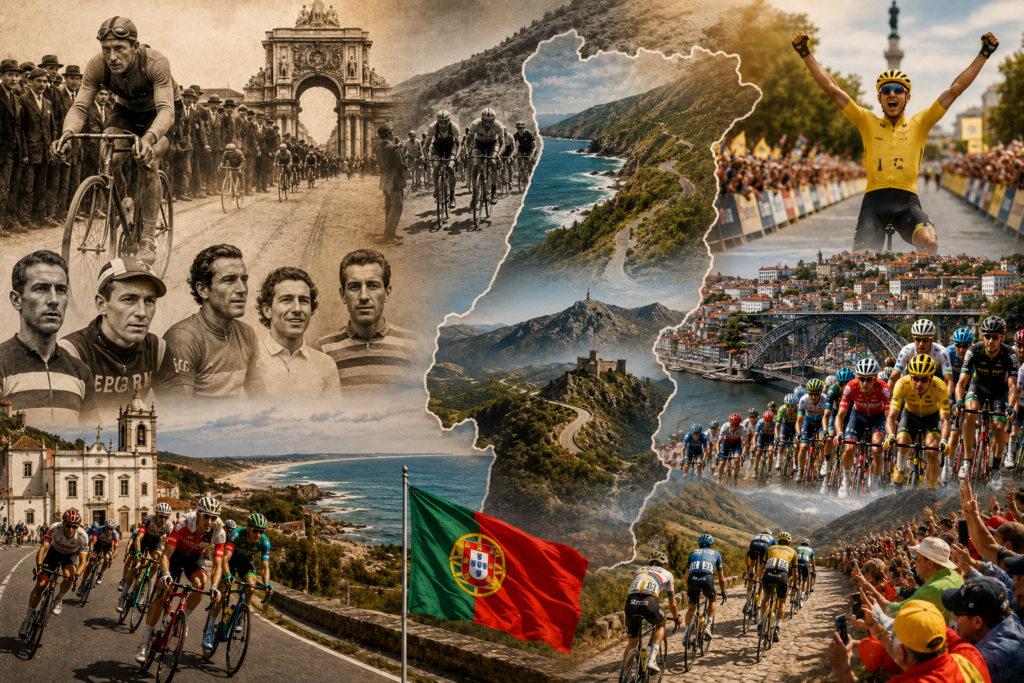
Image Credentials: Image Title: From the First Volta in 1927 to the Road Towards 2027: A Century of Portugal’s Greatest Cycling Race. Source: (chatgpt.com) Date: July 2026. Attribution: This image was created using AI-generated imagery (chatgpt.com) by Open Chronicle and does not depict a real-world scene.
By Open Chronicle History Desk
For nearly a century, the Volta a Portugal has been more than a cycling race. It has become a national tradition, a showcase of Portugal’s landscapes and culture, and a stage upon which generations of riders have written unforgettable sporting stories. As the race moves toward its centenary in 2027, it stands as one of the oldest and most respected stage races in world cycling.
Born during the golden age of European cycling, the Volta has survived wars, political upheaval, economic challenges and profound changes in professional sport while remaining Portugal’s most iconic cycling event.
Inspired by Europe’s great tours
The Volta a Portugal was first held in 1927, inspired by the success of the Tour de France and the Giro d’Italia. Journalists from the newspapers Diário de Notícias and Os Sports envisioned a race capable of uniting the country through sport while showcasing Portugal’s diverse geography.
The inaugural edition began on 26 April 1927, covering approximately 2,000 kilometres over 18 stages during twenty demanding days of racing.
The first winner was António Augusto Carvalho, who etched his name into Portuguese sporting history by becoming the race’s inaugural champion.
A race shaped by history
The Volta’s journey has never been uninterrupted.
Several editions were cancelled because of major historical events, including the Spanish Civil War, the Second World War, periods without an organising body and the political upheaval following Portugal’s Carnation Revolution in 1974.
Despite these interruptions, the race consistently returned stronger, reinforcing its place in Portuguese sporting culture.
From border roads to mountain battles
The earliest editions followed routes close to Portugal’s borders, effectively tracing the country’s outline by bicycle.
As cycling evolved during the 1950s and 1960s, the organisers gradually introduced more challenging terrain and iconic summit finishes.
Some of Portugal’s most famous climbs became permanent features of the race:
- Torre in the Serra da Estrela, Portugal’s highest point.
- Penhas da Saúde.
- Senhora da Graça (Monte Farinha), whose steep final kilometres have produced countless legendary battles.
These climbs transformed the Volta from an endurance challenge into a race where the strongest climbers could make decisive attacks and win the general classification.
Legendary champions
Throughout its history, the Volta has produced some of Portuguese cycling’s greatest heroes.
Among the earliest stars were José Maria Nicolau and Alfredo Trindade, whose fierce rivalry captivated fans during the 1930s.
Later came Alves Barbosa, one of the race’s youngest winners and a dominant force throughout the 1950s, followed by Ribeiro da Silva, whose victories became part of Portuguese sporting folklore.
No rider, however, captured the public imagination quite like Joaquim Agostinho.
The Portuguese legend won the Volta three consecutive times between 1970 and 1972 before establishing himself as one of the world’s finest cyclists through outstanding performances in the Tour de France and other major international races. For many Portuguese fans, Agostinho remains the greatest figure in the history of the Volta.
New generations of champions
The race continued producing unforgettable champions in the decades that followed.
Marco Chagas became one of the event’s defining figures, collecting four victories and remaining one of the most recognisable ambassadors of Portuguese cycling.
Joaquim Gomes thrilled supporters with spectacular climbing performances during the late 1980s and 1990s, while Vítor Gamito became famous as the perennial contender before finally claiming overall victory in 2000.
Perhaps no rider dominated the modern era quite like David Blanco, whose remarkable five overall victories between 2006 and 2012 established a record that still stands today.
More than yellow jerseys
The Volta’s identity has never depended solely on the overall winner.
The race has also celebrated the country’s greatest attackers, climbers and sprinters through distinctive classification jerseys.
Among the most celebrated specialists was Cândido Barbosa, affectionately known as the “Rocket of Rebordosa.”
Although he never won the overall race, Barbosa claimed an extraordinary 25 stage victories and dominated the points classification for years, making him one of the most beloved riders in Portuguese cycling history.
Adapting to a changing sport
Professional cycling has changed dramatically since 1927, and the Volta has evolved alongside it.
Once lasting nearly three weeks, the race now follows modern UCI regulations with 10 stages, an individual time trial and a mandatory rest day.
Television transformed the race’s popularity during the second half of the twentieth century, while today’s broadcasts reach audiences across multiple continents through digital platforms and international broadcasters.
The road to the centenary
The 2026 edition marks the beginning of a new era.
Organisers have introduced a redesigned route stretching from Lisbon to Porto, featuring Portugal’s most famous climbs and expanded international television coverage as the race prepares to celebrate its 100th anniversary in 2027.
The centenary will not simply commemorate one hundred years since the first edition.
It will celebrate a race that has connected generations of Portuguese fans, showcased the country’s landscapes to the world and produced countless unforgettable sporting moments.
As riders once again battle across Portugal’s mountains, coastlines and historic cities, they continue writing new chapters in a story that began almost a century ago and whose greatest pages may still be waiting to be written.