
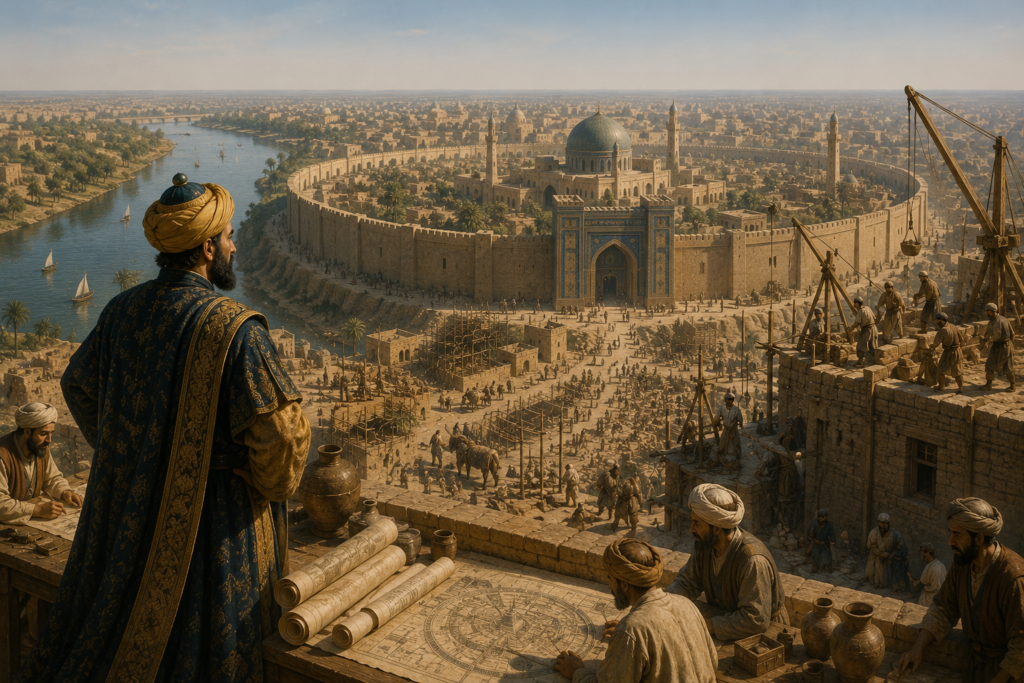
Image Credentials: Image Title: Baghdad Is Founded as the Capital of the Abbasid Caliphate. Source: (chatgpt.com) Date: July 2026. Attribution: This image was created using AI-generated imagery (chatgpt.com) by Open Chronicle and does not depict a real-world scene.
By Open Chronicle
30 July 762
On 30 July 762, the Abbasid Caliph Al-Mansur formally founded the city of Baghdad, establishing what would become the capital of the Abbasid Caliphate and one of the greatest centres of learning, commerce and culture in world history. Over the following centuries, Baghdad grew into the heart of the Islamic Golden Age, attracting scholars, merchants, scientists and artists from across Asia, Africa and Europe.
The establishment of Baghdad followed the Abbasid Revolution of 750, which overthrew the Umayyad Caliphate and brought the Abbasid dynasty to power. Although the Abbasids initially governed from Kufa in present-day Iraq, Caliph Abu Ja’far Al-Mansur, the dynasty’s second ruler, sought a new capital that would better reflect the ambitions of the expanding empire.
Al-Mansur selected a site on the western bank of the Tigris River, strategically located between the Mediterranean world, Persia, Central Asia and the Indian Ocean trade routes. The location offered fertile land, abundant water, strong commercial connections and excellent opportunities for communication throughout the vast caliphate.
Construction officially began on 30 July 762, with thousands of engineers, architects, craftsmen and labourers participating in one of the largest urban projects of the medieval world. Historical sources suggest that workers and materials were gathered from every corner of the Abbasid Empire, reflecting the caliphate’s enormous resources.
Unlike most ancient cities, Baghdad was carefully planned before construction began. The original city was built as a perfect circle approximately two kilometres in diameter and became known as the Round City. Massive double defensive walls surrounded the settlement, while four monumental gates opened toward the empire’s principal regions: Kufa, Basra, Syria and Khurasan.
At the centre of the city stood the Golden Gate Palace, the residence of the caliph, alongside the Great Mosque. From this central core, broad avenues extended toward the city gates, creating a highly organised urban design that symbolised the unity and authority of Abbasid rule.
Baghdad quickly developed into far more than a political capital. Its position along major trade routes attracted merchants from China, India, Persia, Byzantium, North Africa and Europe. Goods including silk, spices, precious metals, paper, textiles and scientific instruments flowed through its markets, making the city one of the wealthiest commercial centres of the medieval world.
During the eighth and ninth centuries, Baghdad emerged as the intellectual capital of the Islamic world. Under later Abbasid caliphs, especially Harun al-Rashid and Al-Ma’mun, scholars from diverse cultural and religious backgrounds gathered in the city to study mathematics, astronomy, medicine, philosophy, geography and engineering.
One of Baghdad’s greatest institutions was the House of Wisdom (Bayt al-Hikma), where Greek, Persian, Indian and Syriac works were translated into Arabic. These translations preserved classical knowledge that might otherwise have been lost and stimulated original scientific discoveries by Muslim scholars.
The city’s physicians established advanced hospitals, astronomers constructed observatories and mathematicians developed concepts that profoundly influenced later scientific thought. Figures such as Al-Khwarizmi, often regarded as the father of algebra, worked within Baghdad’s intellectual environment, contributing ideas that eventually spread throughout Europe.
Baghdad also became a flourishing centre of literature, poetry and the arts. The city’s prosperity inspired many of the stories later collected in One Thousand and One Nights, whose tales of merchants, scholars, travellers and rulers reflected the cosmopolitan character of Abbasid society.
At its height during the ninth century, Baghdad may have been the largest city in the world, with estimates of its population ranging from several hundred thousand to over one million inhabitants. Its influence extended far beyond the Islamic world, shaping developments in science, philosophy, architecture and commerce across multiple civilisations.
The city’s golden age eventually declined because of political fragmentation, economic pressures and repeated conflicts. The most devastating blow came in 1258, when Mongol forces led by Hulagu Khan captured Baghdad, destroying much of the city and bringing an end to the Abbasid Caliphate in Iraq.
Despite centuries of upheaval, Baghdad survived and continued to play an important role in the history of the Middle East. Today, it remains the capital of Iraq and a city whose historical legacy continues to influence global understanding of science, literature, philosophy and urban civilisation.
The foundation of Baghdad in 762 stands as one of the most significant events in medieval history. Conceived as the capital of a new dynasty, it evolved into one of humanity’s greatest centres of knowledge and culture, leaving an enduring legacy that shaped the development of both the Islamic world and global civilisation.