
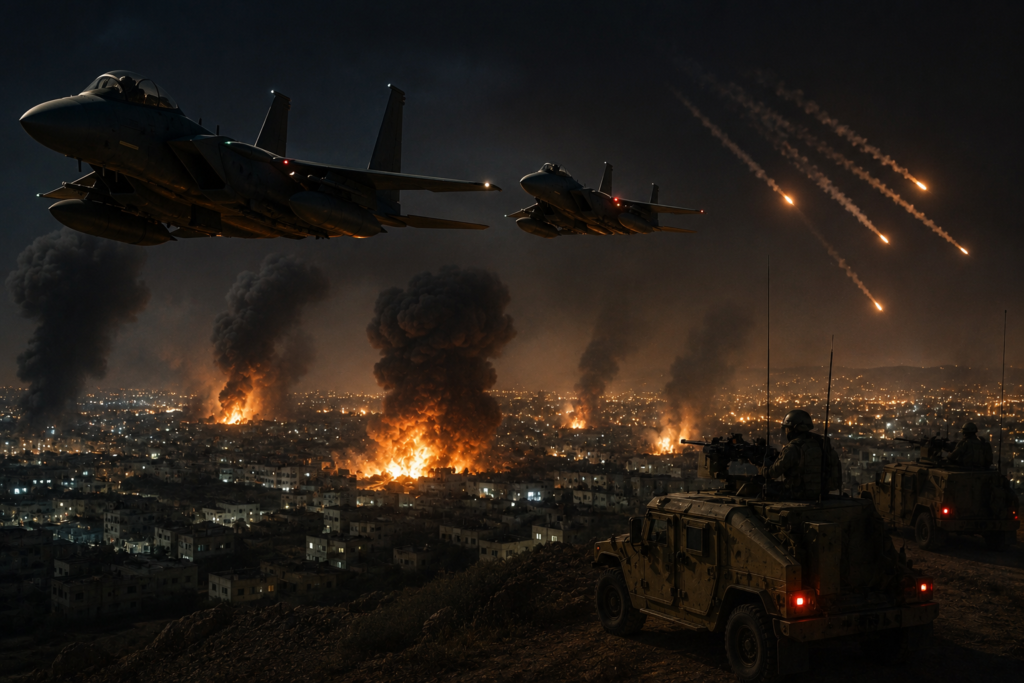
Image Credits: Today in History, July 29: Fire Aboard USS Forrestal Kills 134 Sailors in One of the U.S. Navy’s Worst Peacetime Disasters. AI-generated illustration created by Open Chronicle using ChatGPT (OpenAI). July 2026. This image is illustrative and does not depict a real-world scene.
By Open Chronicle News Desk with Agencies
The United States and Saudi Arabia have launched joint military strikes against Iran-backed militia groups in Iraq, significantly widening the regional conflict and opening a new front in the ongoing confrontation with Tehran.
The overnight operation targeted facilities linked to Iraq’s Popular Mobilization Forces (PMF), an umbrella organisation comprising several militias supported, trained and equipped by Iran. According to the Saudi Ministry of Defence and the U.S. Central Command (CENTCOM), the strikes focused on logistics hubs, weapons depots and infrastructure allegedly used to coordinate attacks against American forces and Saudi energy facilities.
Saudi Arabia stated that the operation was carried out in response to repeated attacks attributed to Iranian proxy groups, while insisting that the kingdom does not seek further escalation.
“The kingdom emphasizes that it does not seek escalation but will respond to any aggression it faces,” the Saudi government said in a statement.
CENTCOM said the targeted sites belonged to organisations responsible for hundreds of attacks on U.S. personnel and facilities across the Middle East earlier this year. American officials argue that the militias have played a central role in Iran’s regional strategy of using proxy forces to pressure its adversaries while avoiding confrontation.
According to Iraqi militia officials, at least 20 members of the Popular Mobilization Forces were killed, and another 32 were wounded during the strikes. They also claimed that six Iranian military advisers were among those killed.
The PMF condemned the operation as a “highly dangerous escalation,” warning that the attacks could further destabilise Iraq and the wider region. Meanwhile, the Islamic Resistance in Iraq, one of the militia groups associated with the PMF, denied responsibility for recent drone attacks against Saudi Arabia.
Iran’s Foreign Ministry strongly condemned the joint operation, accusing Washington and Riyadh of violating Iraq’s sovereignty and territorial integrity.
The strikes prompted an emergency national security meeting chaired by Iraqi Prime Minister Ali al Zaidi. Following the meeting, the Iraqi government criticised both the foreign military action carried out on Iraqi territory and Iran’s continued use of Iraqi-based militias to launch attacks against neighbouring countries.
The operation marks the first major U.S. military strike since President Donald Trump suspended direct attacks against Iran last week in an effort to advance indirect peace negotiations. Despite those diplomatic efforts, tensions have continued to rise.
On the same day as the strikes, Iran reportedly launched several ballistic missiles toward U.S. military installations in Jordan, highlighting the continuing cycle of retaliation that has characterised the conflict in recent months.
Saudi Arabia’s direct participation represents a significant shift in its role. Since the conflict between the United States and Iran intensified earlier this year, Riyadh has largely sought to avoid becoming directly involved while strengthening its defensive posture. However, the kingdom has faced increasing security threats from Iranian-aligned groups, including renewed attacks by Houthi rebels in Yemen targeting Saudi energy infrastructure and shipping.
The latest developments underline the growing regionalisation of the conflict, with Iraq becoming another active theatre in an increasingly complex confrontation involving state militaries, proxy forces and multiple overlapping security crises across the Middle East.