
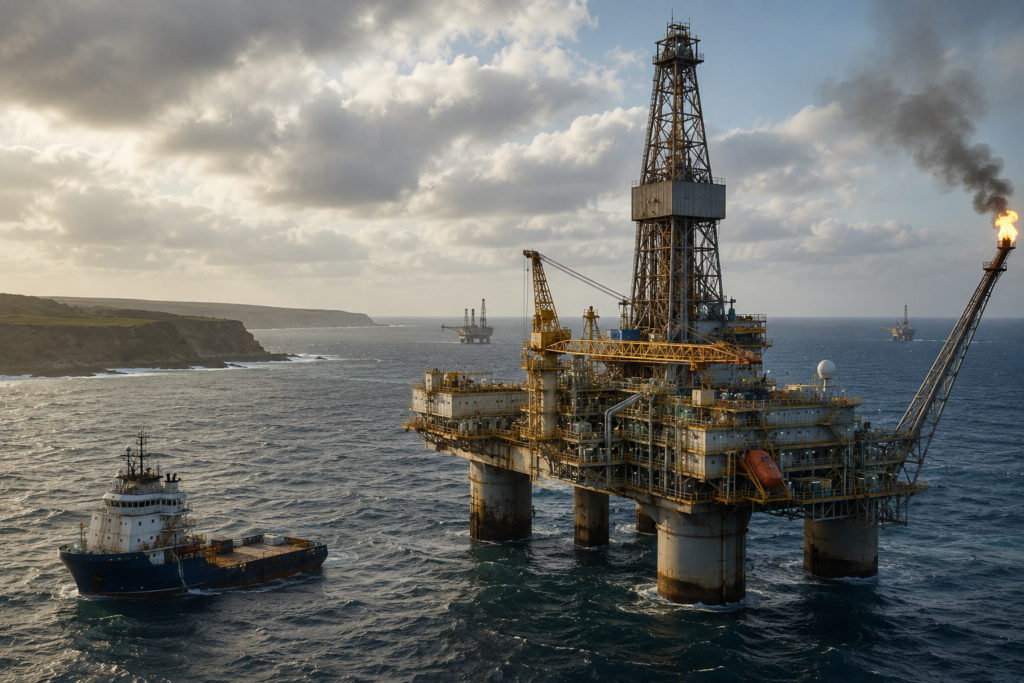
Image Credits: BP puts North Sea oil business up for sale amid growing concerns over UK energy policy. AI-generated illustration created by Open Chronicle using ChatGPT (OpenAI). July 2026. This image is illustrative and does not depict a real-world scene.
By Open Chronicle News Desk with Agencies
BP has announced plans to sell its North Sea oil division in a major strategic shift that reflects growing concerns within the energy industry over the United Kingdom’s fiscal and regulatory environment.
The decision forms part of a wider restructuring programme led by Chief Executive Meg O’Neill, who took over the company earlier this year and has begun redirecting BP’s strategy back towards oil and gas after scaling back its previous emphasis on renewable energy investments.
If the sale is completed, BP would no longer operate upstream oil and petrochemical production in its home market for the first time in decades, marking a historic turning point for one of Britain’s most iconic energy companies.
The company said the proposed sale is part of a broader plan to streamline its global portfolio and achieve approximately US$20 billion in asset divestments by the end of the year.
BP has already sold its Castrol lubricants business along with several lower producing natural gas assets as part of the restructuring.
“The UK has been our home for more than 100 years and will continue to play an important role in our future,” O’Neill said.
“However, as we focus our portfolio and direct capital to our highest value opportunities, we believe our North Sea business will be better positioned as part of another company.”
Policy uncertainty weighs on investment
Although BP has previously described the North Sea as having significant remaining potential, company executives have increasingly expressed concern about operating conditions in the basin.
Industry leaders point to the UK’s windfall taxes on oil and gas producers, restrictions on new drilling licences and broader policy uncertainty as factors reducing investment confidence.
Energy Secretary Miatta Fahnbulleh confirmed that the government is in close contact with BP regarding the proposed transaction.
The announcement comes as the new British government seeks to balance its long term climate ambitions with concerns over domestic energy security and industrial competitiveness.
Industry warns of wider consequences
The planned sale immediately prompted warnings from business leaders that Britain risks losing investment, skilled employment and technical expertise unless greater policy stability is restored.
Chris Beauchamp, Chief Market Analyst at investment platform IG, said BP’s decision reflects a lack of confidence that government policy will become more supportive in the near future.
“It says a lot when BP isn’t prepared to stick around to see if the new government can re energise the UK’s energy policy,” he said.
He argued that the company believes waiting for policy changes would delay investment decisions at a time when developing new energy resources remains strategically important.
Russell Borthwick, Chief Executive of Aberdeen and Grampian Chamber of Commerce, described the announcement as a defining moment for the government.
He said confidence in the UK Continental Shelf has been damaged by years of changing policies, higher taxation and uncertainty over the industry’s future.
According to Borthwick, the North Sea continues to play a critical role in Britain’s economy by supporting hundreds of thousands of jobs, strengthening national energy security and generating billions in tax revenues.
He urged ministers to replace the current Energy Profits Levy with a more predictable long term fiscal framework that would continue to capture additional revenues during periods of exceptionally high energy prices while providing greater certainty for investors.
Future of the North Sea
The potential sale raises wider questions about the future of the UK Continental Shelf as traditional energy companies reassess investment priorities in response to changing government policies and global energy markets.
While Britain continues its transition toward lower carbon energy sources, industry representatives argue that domestic oil and gas production will remain essential for decades as renewable capacity expands.
They warn that unless investor confidence improves, additional companies may reduce their exposure to the North Sea, potentially increasing the country’s dependence on imported energy while weakening one of Britain’s most established industrial sectors.
For BP, the proposed divestment represents another significant milestone in its corporate transformation, reflecting a renewed focus on concentrating investment in assets that the company believes offer the strongest long term returns.