
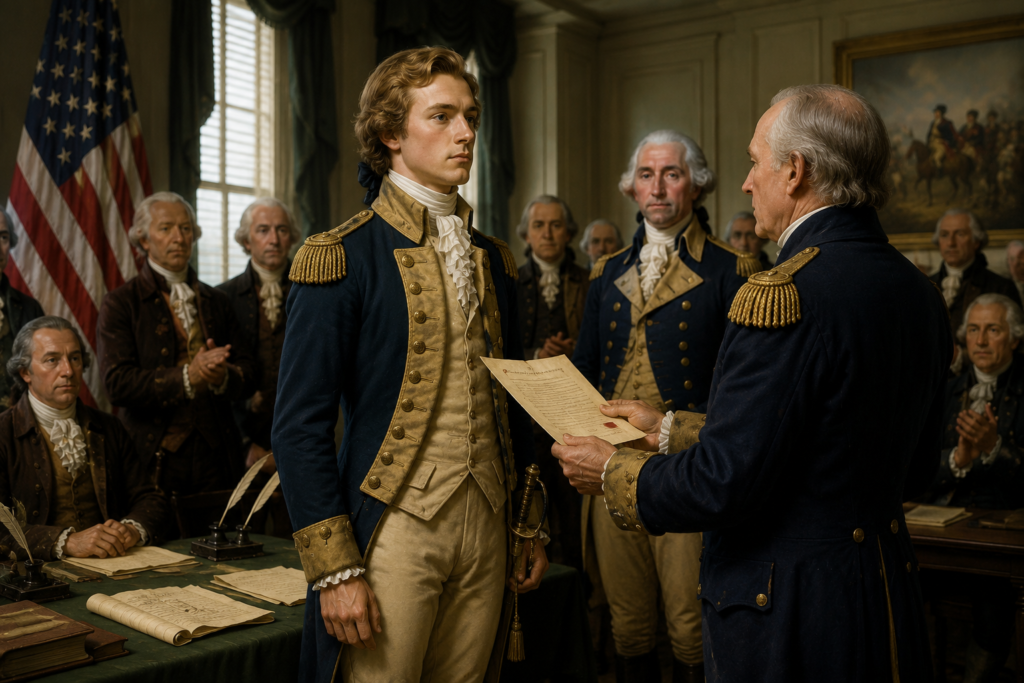
Image Credits: Today in History, July 31: The Marquis de Lafayette Receives a Commission as a Major General in the Continental Army. AI-generated illustration created by Open Chronicle using ChatGPT (OpenAI). July 2026. This image is illustrative and does not depict a real-world scene.
By Open Chronicle
31 July 1777
On 31 July 1777, the young French nobleman Gilbert du Motier, Marquis de Lafayette, received a commission as a major general in the Continental Army, beginning one of the most remarkable military and political partnerships of the American Revolutionary War. Although only nineteen years old, Lafayette would become one of General George Washington’s most trusted officers and play a crucial role in securing American independence while strengthening the alliance between the United States and France.
Born into an aristocratic family in Auvergne in 1757, Lafayette inherited both wealth and military tradition at an early age. He entered the French Army as a teenager and quickly developed an interest in the struggle unfolding across the Atlantic, where thirteen British colonies had declared their independence from Great Britain in July 1776.
Inspired by the ideals of liberty and representative government, Lafayette volunteered to join the American cause despite France remaining officially at peace with Britain. His decision was not encouraged by the French government, which sought to avoid provoking open conflict before it was fully prepared for war.
Determined to reach America, Lafayette secretly purchased and equipped a ship, the Victoire, using his own fortune. Defying orders from the French crown, he sailed across the Atlantic in the spring of 1777 and arrived in South Carolina before travelling to Philadelphia, where the Continental Congress was meeting.
Congress welcomed many foreign officers seeking commissions, but several demanded high rank and generous salaries despite offering little practical value. Lafayette distinguished himself by requesting no pay, declaring that he wished to serve solely in support of American independence.
Impressed by his commitment and encouraged by influential supporters, the Continental Congress appointed Lafayette a major general on 31 July 1777. The rank was largely honorary at first because of his youth and limited battlefield experience, but it reflected both his noble status and the hope that his presence would encourage greater French support for the revolutionary cause.
Lafayette soon earned the confidence of George Washington, who became both his commanding officer and lifelong friend. Washington recognised the young Frenchman’s courage, discipline and willingness to learn. Lafayette, in turn, developed profound admiration for Washington’s leadership and often referred to him as a father figure.
Only weeks after receiving his commission, Lafayette fought in his first major engagement at the Battle of Brandywine on 11 September 1777. Although wounded in the leg while attempting to organise a retreat, he remained on the battlefield until his men had withdrawn safely. His bravery greatly enhanced his reputation within the Continental Army.
During the following years, Lafayette participated in several important campaigns, including operations at Valley Forge, Monmouth and Virginia. Washington increasingly entrusted him with independent commands, while Lafayette worked tirelessly to strengthen cooperation between American and French forces.
His greatest contribution may have come through diplomacy. Returning briefly to France in 1779, Lafayette persuaded King Louis XVI and senior ministers to increase military and naval assistance to the American revolutionaries. French troops, warships, weapons and financial support would prove decisive during the final stages of the war.
In 1781, Lafayette commanded American forces in Virginia, successfully delaying British General Charles Cornwallis until Washington and French forces under Comte de Rochambeau could arrive. Their combined armies surrounded Cornwallis at Yorktown, leading to the British surrender on 19 October 1781. The victory effectively ended major military operations and secured American independence.
After the war, Lafayette returned to France as a celebrated hero. He remained committed to constitutional government and individual liberty, playing an important role during the early years of the French Revolution. Although his political career became increasingly complicated amid the revolution’s radicalisation, he continued to advocate moderate reform throughout his life.
Lafayette maintained close ties with the United States for decades. During his celebrated tour of America in 1824 and 1825, he was welcomed as the “Nation’s Guest,” receiving enthusiastic receptions in every state. His enduring friendship with George Washington and his service during the Revolution secured him a unique place in American history.
Today, the commission granted to Lafayette on 31 July 1777 is remembered as the beginning of a partnership that helped shape the outcome of the American Revolutionary War. His courage on the battlefield, diplomatic influence in France and unwavering support for the cause of independence made him one of the most distinguished foreign volunteers ever to serve in the United States, earning him recognition on both sides of the Atlantic as a champion of liberty.