
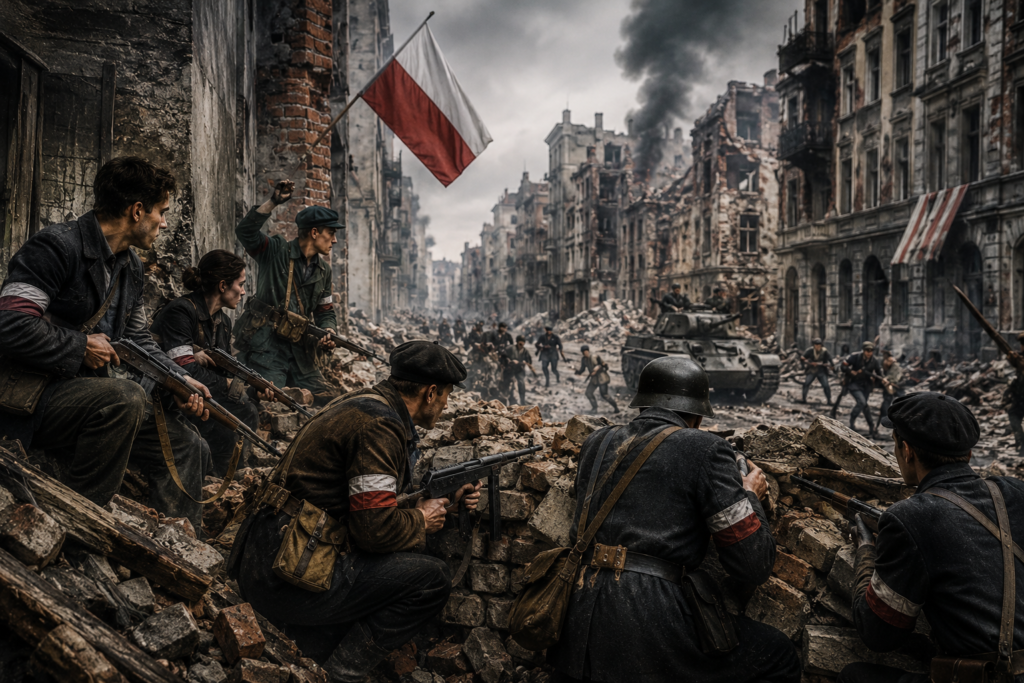
Image Credits: Today in History, August 1: 1944 The Warsaw Uprising Begins Against German Occupation. AI-generated illustration created by Open Chronicle using ChatGPT (OpenAI). July 2026. This image is illustrative and does not depict a real-world scene.
By Open Chronicle
1 August 1944
On 1 August 1944, the Warsaw Uprising began as thousands of fighters from the Polish Home Army (Armia Krajowa) launched a coordinated revolt against the German occupation of Warsaw. The operation aimed to liberate the Polish capital before the advancing Soviet Red Army arrived, demonstrating Poland’s sovereignty and restoring the authority of the Polish government-in-exile. Instead, the uprising developed into one of the largest and most tragic resistance campaigns of the Second World War.
By the summer of 1944, Germany’s military position in Eastern Europe was rapidly collapsing. Following the Soviet Operation Bagration, Red Army forces advanced across Belarus and reached the eastern approaches to Warsaw. Many members of the Polish resistance believed that the liberation of the capital was imminent.
The Home Army had spent years preparing for a nationwide revolt as part of Operation Tempest, a broader strategy intended to liberate Polish territory before Soviet forces established control. Polish leaders hoped that by freeing Warsaw themselves, they could reassert the country’s independence and prevent the Soviet Union from imposing its own political system.
At exactly 5:00 p.m. on 1 August, an hour remembered as “W Hour,” approximately 40,000 Home Army fighters began attacking German military positions throughout the city. Although many resistance members possessed only limited weapons, they relied on surprise, local knowledge and strong civilian support to seize key buildings, barricades and districts.
During the first days of fighting, the insurgents captured large areas of central Warsaw. They established makeshift hospitals, communication networks and administrative offices while volunteers, including women, children and elderly civilians, helped transport supplies, build defences and care for the wounded.
The German response was swift and devastating. Adolf Hitler ordered that Warsaw be destroyed and its inhabitants annihilated. German forces, reinforced by SS units and auxiliary formations, launched massive counterattacks using heavy artillery, tanks, flamethrowers and aircraft.
Some of the worst atrocities occurred in the Wola district, where German troops systematically murdered tens of thousands of civilians within a matter of days. Entire neighbourhoods were burned, hospitals attacked and non-combatants executed regardless of age or gender.
Despite overwhelming odds, the Polish resistance continued fighting for 63 days. Fierce battles were fought street by street and building by building. Underground sewer networks became vital routes for moving fighters and maintaining communication between isolated districts. Throughout the siege, civilians endured constant bombardment, severe food shortages and the destruction of much of the city’s infrastructure.
One of the uprising’s most controversial aspects was the limited assistance received from the Soviet Union. Although Soviet forces had reached the eastern bank of the Vistula River, they halted their advance while the uprising unfolded. Historians continue to debate the reasons for this pause, with many arguing that Soviet leader Joseph Stalin allowed German forces to eliminate the anti-communist Polish resistance before Soviet troops entered the city.
Western Allied aircraft attempted to deliver supplies by air, but long flight distances and heavy German anti-aircraft defences made these missions extremely dangerous. Much of the equipment failed to reach the insurgents.
After more than two months of desperate fighting, the exhausted Home Army surrendered on 2 October 1944. Under the terms of the capitulation, surviving resistance fighters were recognised as prisoners of war, but the civilian population was expelled from the city.
Following the surrender, German forces systematically demolished Warsaw. Historic buildings, churches, museums, libraries and residential districts were destroyed in a deliberate effort to erase the Polish capital. By the end of the war, approximately 85 percent of Warsaw had been reduced to ruins.
The human cost was immense. Around 16,000 Home Army fighters were killed, while between 150,000 and 200,000 civilians lost their lives during the uprising and the massacres that accompanied it.
After the war, Warsaw was painstakingly rebuilt, with many historic districts reconstructed using original plans, paintings and photographs. The city’s Old Town, almost completely destroyed in 1944, was later recognised as a UNESCO World Heritage Site as an exceptional example of post-war reconstruction.
Today, the Warsaw Uprising is commemorated every year on 1 August, when sirens sound across the Polish capital at 5:00 p.m., bringing the city to a standstill in remembrance of those who fought and died. The uprising remains one of the most powerful symbols of Poland’s struggle for freedom, national identity and resistance against tyranny during the darkest years of the twentieth century.