
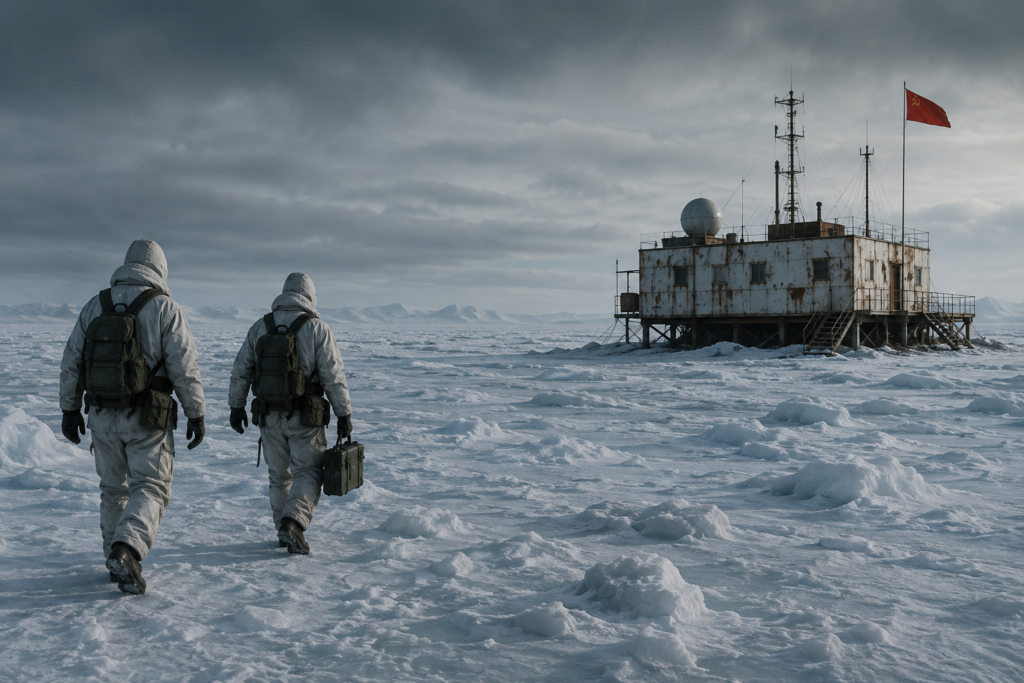
Image Credits: Operation Coldfeet: The CIA Mission That Stole Soviet Secrets from a Ghost Station in the Arctic. AI-generated illustration created by Open Chronicle using ChatGPT (OpenAI). August 2026. This image is illustrative and does not depict a real-world scene.
By Open Chronicle History
In the frozen silence of the Arctic Ocean, where drifting ice sheets can stretch for hundreds of kilometres and temperatures plunge far below freezing, one of the Cold War’s most extraordinary intelligence operations unfolded almost entirely out of public view.
In the spring of 1962, two American operatives parachuted onto an abandoned Soviet research station perched atop a drifting sheet of polar ice. Their objective was simple in theory but almost impossible in practice: recover every piece of intelligence they could before disappearing without a trace.
There was one problem.
No aircraft could land.
No helicopter could reach them.
And the only way home required a passing aircraft to snatch them from the ice while flying at full speed, without ever touching the ground.
The mission became known as Operation Coldfeet, and decades later it remains one of the boldest covert operations ever undertaken by the Central Intelligence Agency.
The Arctic: A Hidden Front in the Cold War
While Berlin, Cuba and Vietnam dominated newspaper headlines, another strategic competition was unfolding thousands of kilometres to the north.
The Arctic had become one of the most valuable military regions on Earth.
For both the United States and the Soviet Union, the shortest route for nuclear bombers and ballistic missiles crossed the North Pole. Even more importantly, the Arctic Ocean became the ideal operating environment for nuclear submarines capable of launching intercontinental missiles while hidden beneath thick sea ice.
Whoever understood the Arctic best possessed a significant strategic advantage.
The Soviet Union invested enormous resources into scientific expeditions that, while presented publicly as peaceful research missions, frequently served military purposes as well.
The Soviet Drifting Stations
Beginning in 1937, Soviet scientists established a series of floating scientific bases known as the North Pole (NP) drifting stations.
Rather than being built on land, these stations were constructed directly on massive floating ice floes that drifted across the Arctic Ocean over periods of months or even years.
Officially they studied:
- Meteorology
- Oceanography
- Sea ice movement
- Climate
- Polar geology
Unofficially, Western intelligence believed they also gathered information useful for Soviet naval operations, submarine navigation and military communications.
Some stations housed advanced radio equipment, underwater acoustic instruments and experimental sensors whose true purpose remained unclear.
An Unexpected Discovery
In 1961 American reconnaissance aircraft noticed something remarkable.
One Soviet drifting station had apparently been abandoned.
The installation remained standing.
Buildings were intact.
Equipment still appeared to be in place.
The Soviets had simply disappeared.
The abandoned base immediately attracted the attention of the CIA and the U.S. Navy.
If valuable equipment remained inside, it could reveal years of Soviet scientific and military research.
The problem was reaching it.
A Mission That Should Have Been Impossible
Landing was impossible.
The drifting ice had no usable runway.
Helicopters lacked the range to travel so deep into the Arctic and return safely.
Ships could not approach because the surrounding pack ice constantly shifted.
Most intelligence planners concluded the opportunity would have to be abandoned.
Others refused to accept that answer.
The Birth of Operation Coldfeet
The CIA assembled a small team together with the Office of Naval Research and the U.S. Air Force.
The operation received the codename Coldfeet.
Its success depended upon a revolutionary extraction system that very few people had ever seen used outside testing.
The invention belonged to engineer Robert Edison Fulton Jr.
Its official name was the Fulton Surface-to-Air Recovery System, although it quickly became better known simply as the Skyhook.
The Incredible Skyhook
The concept sounded almost absurd.
Instead of landing, an aircraft would simply pick someone up while flying.
The operative would wear a special harness connected to a long cable.
A helium balloon inflated on the ground would lift the cable vertically into the air.
A specially modified aircraft flying at around 200 kilometres per hour would intercept the cable using a large V-shaped capture yoke mounted on its nose.
Once the cable was caught, an onboard winch slowly reeled the person into the aircraft.
The entire extraction took only a few minutes.
No runway.
No helicopter.
No landing.
Until Operation Coldfeet, the technique had never been tested during a real intelligence mission.
Landing on Soviet Territory
On 28 May 1962, Major James F. Smith of the U.S. Air Force and Lieutenant Leonard A. LeSchack of the U.S. Navy parachuted onto the drifting ice.
Around them stood an abandoned Soviet settlement frozen in time.
The buildings remained largely intact.
Scientific instruments still occupied laboratories.
Documents were scattered across desks.
Communication equipment had been left behind.
For nearly three days the two men worked almost continuously.
Every room was photographed.
Every instrument inspected.
Every document examined.
Anything considered valuable was packed for extraction.
By the end of the mission they had accumulated roughly 68 kilograms (150 pounds) of intelligence material.
What They Found
Although much of the recovered material remains classified, later disclosures revealed that the Americans obtained:
- Scientific reports on Arctic conditions.
- Oceanographic measurements.
- Ice movement studies.
- Radio communication equipment.
- Navigation systems.
- Electronic components.
- Acoustic monitoring devices.
- Technical manuals.
- Military-related instrumentation.
Much of the information helped American analysts better understand how Soviet submarines could operate beneath Arctic ice and how Moscow conducted long-duration polar operations.
The intelligence value far exceeded initial expectations.
Time Was Running Out
As the mission progressed, Arctic weather rapidly deteriorated.
Visibility collapsed.
Strong winds swept across the drifting ice.
The extraction aircraft had only a narrow window to complete the recovery.
Failure would almost certainly leave the operatives stranded hundreds of kilometres from civilisation.
The First Operational Skyhook Rescue
The modified B-17 Flying Fortress approached the drifting station.
From the ice below, the first operative released the helium balloon.
The cable rose high into the Arctic sky.
Seconds later the aircraft captured it.
The force of the pickup lifted the operative violently into the air before the aircraft’s winch gradually pulled him inside.
Minutes later the same procedure was repeated for the second operative.
Both extractions succeeded perfectly.
Operation Coldfeet became the first successful operational use of the Fulton Skyhook system.
Intelligence Triumph
Once safely returned, specialists from the CIA, Navy and Air Force spent months analysing the recovered material.
The mission provided rare insight into Soviet Arctic capabilities at a time when almost no Western intelligence officers had ever examined such equipment firsthand.
Although the operation did not dramatically alter the balance of the Cold War, it significantly improved American understanding of Soviet polar logistics and military science.
Just as importantly, it demonstrated that seemingly inaccessible intelligence targets could still be reached through innovative technology.
From Secret Mission to Popular Culture
The Skyhook quickly became one of the CIA’s most famous secret technologies.
It later appeared in numerous films and novels.
James Bond famously uses a nearly identical recovery system in Thunderball.
Decades later, Christopher Nolan referenced the technology in The Dark Knight, when Lucius Fox tells Bruce Wayne that the CIA once used the device to extract agents without landing an aircraft.
Unlike many Hollywood gadgets, this one was entirely real.
Why It Still Matters
Operation Coldfeet illustrates one of the defining characteristics of Cold War intelligence.
Victory often depended not on armies, but on imagination.
Rather than abandoning an unreachable objective, American planners invented an entirely new method of reaching it.
The mission combined espionage, aviation, engineering, and extreme survival in one of the harshest environments on Earth.
Today, more than sixty years later, it remains one of the most daring covert operations ever conducted in the Arctic.
It also serves as a reminder that some of the Cold War’s most important battles were fought not in cities or battlefields, but on drifting islands of ice beneath the endless polar sky.
Image credit
Illustration generated by AI for Open Chronicle. Inspired by historical events and created for editorial purposes.