
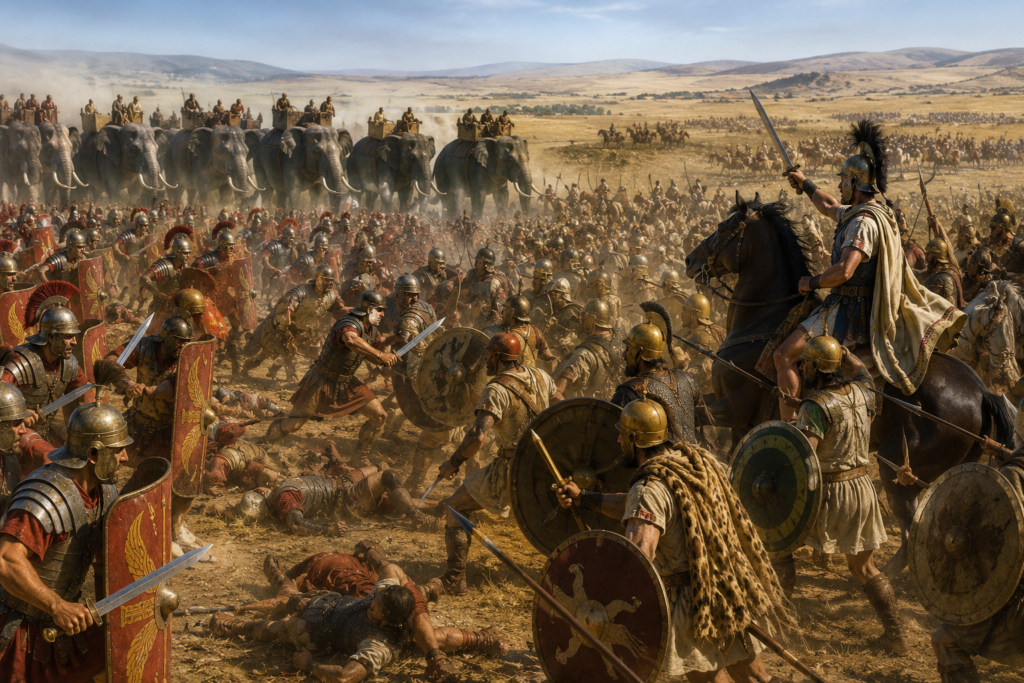
Image Credits: Today in History, August 2: Hannibal Wins a Decisive Victory at the Battle of Cannae. AI-generated illustration created by Open Chronicle using ChatGPT (OpenAI). July 2026. This image is illustrative and does not depict a real-world scene.
By Open Chronicle
2 August 216 BC
On 2 August 216 BC, the Carthaginian general Hannibal Barca inflicted one of the most devastating defeats in military history upon the Roman Republic at the Battle of Cannae in southern Italy. Despite commanding a significantly smaller force, Hannibal destroyed a much larger Roman army through brilliant tactics, creating a masterpiece of battlefield manoeuvre that has been studied by military commanders for more than two thousand years.
The battle formed part of the Second Punic War, a conflict fought between Rome and Carthage from 218 to 201 BC. The war had begun when Hannibal launched his daring campaign against Rome by leading his army, including war elephants, across the Alps into Italy. His victories at the Trebia River in 218 BC and Lake Trasimene in 217 BC shocked Rome and demonstrated his exceptional military skill.
Determined to crush the Carthaginian invasion once and for all, the Roman Senate assembled one of the largest armies in its history. Commanded jointly by the consuls Lucius Aemilius Paullus and Gaius Terentius Varro, the Roman force numbered between 70,000 and 80,000 infantry, supported by thousands of cavalry. Hannibal’s army consisted of roughly 50,000 soldiers, including experienced African infantry, Iberian warriors, Gallic tribesmen and the highly effective Numidian cavalry.
The two armies met near the small village of Cannae in Apulia, close to the Aufidus River. Confident in their overwhelming numerical superiority, the Romans adopted an unusually deep infantry formation, intending to smash directly through Hannibal’s centre.
Hannibal anticipated this strategy. He deliberately placed his less experienced Gallic and Iberian infantry in a slightly curved formation projecting toward the Romans, while his disciplined African veterans waited on both flanks. His cavalry occupied the wings, where they enjoyed a significant qualitative advantage over their Roman counterparts.
As the battle began, the Roman infantry surged forward with tremendous force. Hannibal’s central line slowly gave ground in a controlled withdrawal, gradually changing from a convex formation into a concave one. Believing victory was within reach, the Romans pressed deeper into the Carthaginian position.
At the decisive moment, Hannibal ordered his African infantry on both flanks to pivot inward and attack the exposed sides of the densely packed Roman formation. Meanwhile, the Carthaginian cavalry had already defeated the Roman horsemen on both wings. After driving the Roman cavalry from the battlefield, they rode behind the Roman infantry and completed the encirclement.
The Roman army found itself surrounded on every side.
Unable to manoeuvre and packed tightly together, Roman soldiers were cut down over many hours. The encirclement became one of history’s earliest and most famous examples of a double envelopment, a tactical manoeuvre in which an enemy force is attacked simultaneously from the front, both flanks and the rear.
The slaughter was catastrophic. Ancient sources report enormous casualties, although exact figures remain debated. Modern historians generally estimate that between 50,000 and 70,000 Roman soldiers were killed, with thousands more captured. Among the dead were Consul Lucius Aemilius Paullus, numerous senators and many senior officers. Carthaginian losses were comparatively light.
The defeat plunged Rome into crisis. Several Italian allies defected to Hannibal, and many feared that the Republic itself would collapse. Yet despite the scale of the disaster, Rome refused to surrender. Instead, it adopted a strategy of avoiding large pitched battles while rebuilding its military strength.
Hannibal never marched directly against Rome after Cannae, partly because his army lacked the siege equipment necessary to capture the heavily defended capital. The Roman commander Quintus Fabius Maximus continued his strategy of attrition, gradually wearing down Carthaginian resources while avoiding another decisive engagement.
The Second Punic War eventually turned in Rome’s favour. In 202 BC, the Roman general Publius Cornelius Scipio, later known as Scipio Africanus, defeated Hannibal at the Battle of Zama, bringing the war to an end and establishing Rome as the dominant power in the western Mediterranean.
Despite his ultimate defeat in the war, Hannibal’s achievement at Cannae remains one of the greatest tactical victories ever recorded. Military academies around the world continue to study his use of deception, flexible formations and coordinated cavalry to defeat a numerically superior enemy. Commanders including Frederick the Great, Helmuth von Moltke, Alfred von Schlieffen and Norman Schwarzkopf have all drawn lessons from the battle.
Today, the Battle of Cannae stands as a timeless example of how superior leadership, planning and battlefield tactics can overcome overwhelming numerical disadvantage. More than twenty-two centuries later, Hannibal’s victory continues to be regarded as one of the finest demonstrations of military genius in history.