
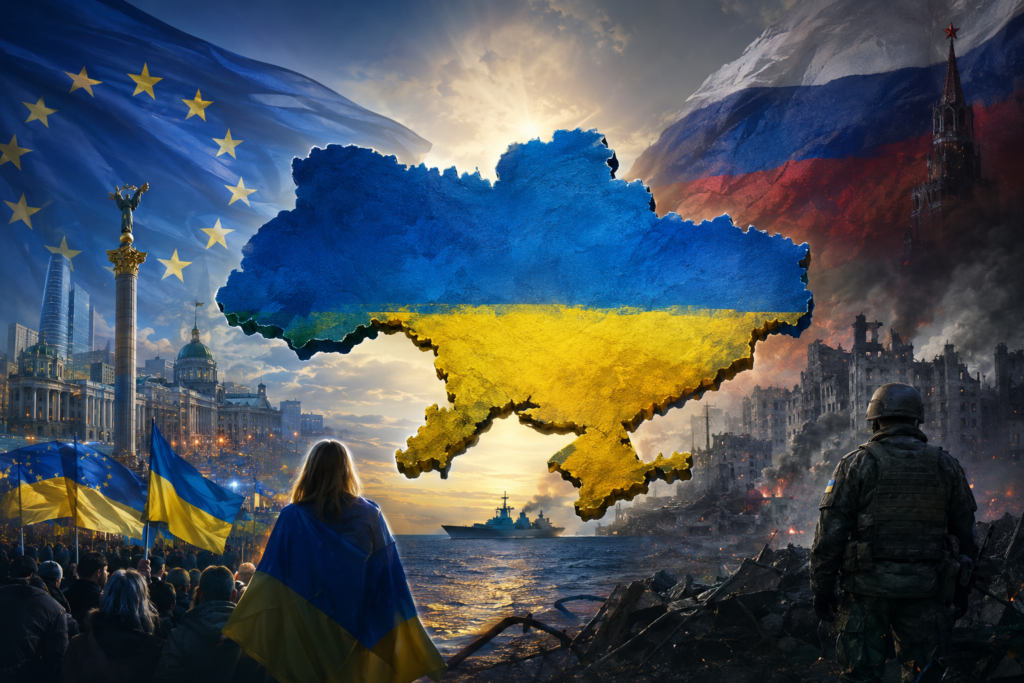
PART I
FOUNDATIONS OF THE CONFLICT
Chapter 2
Ukraine Between East and West
State Building, National Identity and Strategic Geography
Introduction
Understanding the Russia–Ukraine War requires far more than an examination of military campaigns, diplomatic negotiations or geopolitical competition between Russia and the West. At its core, the conflict is also the product of Ukraine’s own historical development as an independent state and of the complex relationship between geography, national identity and political sovereignty. The origins of the present war cannot be separated from the evolution of Ukraine after the collapse of the Soviet Union, nor can they be understood without recognising the strategic importance of a country that has long occupied one of Europe’s most contested geopolitical spaces.
Ukraine is often described as a bridge between East and West. While this description captures an important geographical reality, it oversimplifies the country’s history and political development. For centuries, Ukrainian territory has been influenced by multiple civilisations, kingdoms, empires and competing political traditions. Parts of modern Ukraine were governed at different times by the Kyivan Rus’, the Grand Duchy of Lithuania, the Polish–Lithuanian Commonwealth, the Ottoman Empire, the Austro-Hungarian Empire and the Russian Empire before eventually becoming one of the founding republics of the Soviet Union. These diverse historical experiences produced regional differences in language, political culture, religious traditions and historical memory that continued to shape Ukrainian society long after independence.
The collapse of the Soviet Union in 1991 transformed Ukraine from a Soviet republic into one of Europe’s largest sovereign states. Independence created opportunities that had not existed for generations, allowing the country to establish its own political institutions, armed forces, diplomatic service and economic policies. At the same time, independence also exposed profound structural challenges. Ukraine inherited an economy designed for integration within the Soviet system, an industrial base dependent upon production networks extending across newly independent states, and a population whose cultural, linguistic and historical experiences reflected centuries of imperial rule.
These domestic challenges developed alongside a rapidly changing international environment. Across Central and Eastern Europe, former communist states sought integration with Western political and security institutions. The European Union expanded eastward, NATO admitted new members from the former Warsaw Pact and liberal democracy appeared, for a time, to represent the dominant political model across much of the continent. Ukraine found itself positioned between these expanding Euro-Atlantic institutions and a Russian Federation that was simultaneously attempting to redefine its own role after the dissolution of the Soviet Union.
For successive Ukrainian governments, balancing these competing geopolitical realities proved increasingly difficult. Decisions concerning economic reform, constitutional development, foreign policy, energy security and defence cooperation gradually became linked to broader questions regarding the country’s strategic orientation. Should Ukraine pursue closer integration with European institutions, maintain a privileged relationship with Russia, or attempt to preserve a position of strategic neutrality between competing centres of power? These debates became defining features of Ukrainian politics throughout the first three decades of independence.
The country’s geography amplified every political decision. Stretching across the northern shores of the Black Sea, bordering seven countries and occupying the broad plains that connect Central Europe with Eurasia, Ukraine possesses strategic characteristics that have influenced military planning for centuries. Control of its coastline affects maritime access to the Black Sea and Mediterranean. Its agricultural resources contribute significantly to global food security. Its energy infrastructure historically connected Russian natural gas exports to European consumers. Its industrial regions supported some of the Soviet Union’s most advanced defence industries, while its location between Russia and NATO members increasingly transformed it into one of the principal strategic frontiers of the European continent.
At the same time, questions of national identity assumed growing political importance. Independence required more than the establishment of state institutions; it also demanded the construction of a shared civic identity capable of uniting a diverse population. Language policy, education, historical memory, religious affiliation and interpretations of the past all became central components of Ukraine’s nation-building process. These issues were frequently debated within democratic institutions, influenced electoral politics and occasionally generated significant domestic tensions. External actors, particularly Russia, also viewed these developments through the prism of their own historical narratives and security concerns, adding an additional international dimension to debates that were often deeply domestic in character.
The objective of this chapter is therefore not simply to describe Ukraine’s history after 1991, but to explain how the interaction between state building, national identity and strategic geography created the political environment in which later crises emerged. By examining the foundations of the Ukrainian state, the evolution of its democratic institutions and the strategic significance of its geographical position, it becomes possible to understand why Ukraine gradually moved from the periphery of European politics to the centre of the continent’s most significant security crisis since the end of the Second World War.
The analysis that follows argues that Ukraine’s importance cannot be explained by geography alone, nor solely by historical identity or political transformation. Rather, it is the combination of these factors, interacting over more than three decades, that transformed Ukraine into the principal geopolitical fault line between an expanding Euro-Atlantic security order and a Russia determined to preserve influence within what it regarded as its vital strategic neighbourhood.
2.1 A Country at the Crossroads of Europe
Ukraine occupies one of the most strategically significant geographical positions on the European continent. Extending across more than 603,000 square kilometres, it is the second largest country located entirely within Europe and forms a vast territorial bridge between Central Europe, the Black Sea basin and the western reaches of Eurasia. Its location has shaped its history for centuries, influencing patterns of migration, commerce, imperial expansion and military conflict. Unlike many European states protected by extensive mountain chains or natural defensive barriers, Ukraine is characterised predominantly by open plains, broad river systems and fertile agricultural lands, making it both an economic heartland and a strategic corridor.
Throughout history, these geographical characteristics have offered significant advantages while simultaneously exposing the territory to repeated external intervention. Major trade routes connecting northern Europe, the Baltic region, the Black Sea and the Mediterranean crossed Ukrainian lands long before the emergence of the modern state. The Dnipro River became one of Eastern Europe’s principal commercial arteries, linking the forests of the north with the Byzantine world and contributing to the development of Kyivan Rus’, one of medieval Europe’s earliest political entities.
Yet the same geography that facilitated commerce also facilitated conquest. From the Mongol invasions of the thirteenth century to the campaigns of Charles XII of Sweden, Napoleon Bonaparte and Adolf Hitler, armies repeatedly traversed Ukrainian territory in campaigns directed toward the Russian heartland or Central Europe. The absence of major natural obstacles allowed military forces to manoeuvre across enormous distances, reinforcing Ukraine’s enduring role as a strategic frontier between competing political and military powers.
Esta será a abertura oficial do capítulo. Nas próximas entregas continuaremos a desenvolver a secção 2.1, aprofundando a geografia física, o papel do Mar Negro, a Crimeia, os recursos naturais, a agricultura, a indústria e os corredores energéticos, antes de avançarmos para 2.2 The Birth of an Independent State. Desta forma, o capítulo manterá a mesma profundidade e consistência do primeiro, formando uma obra contínua e de elevado rigor analítico.
2.2 The Birth of an Independent State
The emergence of an independent Ukrainian state in 1991 represented one of the most significant geopolitical transformations of the late twentieth century. While the dissolution of the Soviet Union created fifteen newly independent republics, Ukraine occupied a uniquely important position among them. With a population exceeding fifty million people, vast agricultural resources, one of Europe’s largest industrial economies and the world’s third-largest nuclear arsenal, Ukraine was not simply another successor state. Its independence fundamentally altered the balance of power across Europe and reshaped the strategic environment inherited from the Cold War.
The declaration of Ukrainian independence on 24 August 1991 did not occur in isolation. It formed part of the broader political collapse of the Soviet Union, a process accelerated by years of economic stagnation, institutional decline and political reform under Soviet leader Mikhail Gorbachev. His policies of perestroika and glasnost sought to modernise the Soviet system but instead weakened the authority of the Communist Party while encouraging demands for greater political autonomy across the Union’s constituent republics.
Throughout the late 1980s, nationalist movements, civil society organisations and reformist political groups became increasingly active within Ukraine. Environmental protests following the Chernobyl nuclear disaster of 1986 contributed to growing public criticism of Soviet governance, while historical organisations sought to recover aspects of Ukrainian culture and national history that had often been marginalised during the Soviet period. These developments did not initially constitute a mass movement for complete independence, but they significantly expanded political debate concerning sovereignty and constitutional reform.
The decisive turning point came in August 1991. On 19 August, hard-line members of the Soviet leadership attempted a coup against President Gorbachev in an effort to prevent the planned decentralisation of Soviet authority. The coup collapsed after only three days, largely due to public resistance in Moscow led by Boris Yeltsin and the refusal of many military units to support the conspirators. Although unsuccessful, the coup irreversibly undermined the legitimacy of Soviet institutions.
Recognising that the Soviet Union could no longer function as a unified political entity, the Ukrainian parliament, the Verkhovna Rada, convened on 24 August 1991 and adopted the Act of Declaration of Independence. The declaration asserted that only the Constitution and laws of Ukraine would apply within its territory and called for a nationwide referendum to confirm the decision through popular vote.
The referendum took place on 1 December 1991 and produced a result that exceeded the expectations of many observers. More than 90 percent of participating voters supported independence, with turnout exceeding 84 percent nationwide. Importantly, support extended across every region of the country. Even in eastern and southern oblasts, where Russian was widely spoken and economic ties with Russia remained particularly strong, majorities voted in favour of an independent Ukrainian state. In Crimea, where ethnic Russians formed a majority of the population, independence also received majority support, although by a considerably smaller margin than elsewhere.
The referendum demonstrated that independence enjoyed broad democratic legitimacy rather than representing the project of a single political faction or geographical region. It also provided the international community with clear evidence that Ukraine’s sovereignty reflected the expressed will of its population rather than the temporary collapse of Soviet institutions.
On the same day, Leonid Kravchuk was elected as Ukraine’s first President. A former senior official within the Communist Party who had gradually embraced the independence movement during the final months of the Soviet Union, Kravchuk assumed office under exceptionally challenging circumstances. His administration inherited neither a fully functioning sovereign state nor a stable economic system. Instead, it faced the unprecedented task of constructing almost every major institution required by an independent country while simultaneously managing profound economic uncertainty.
Unlike many newly independent states emerging from colonial rule, Ukraine inherited extensive industrial infrastructure, highly educated human capital and sophisticated scientific institutions. The country possessed major steel plants, coal mines, machine-building industries, aerospace manufacturers and one of the Soviet Union’s most advanced defence industrial complexes. Cities such as Dnipro, Kharkiv, Zaporizhzhia and Kyiv hosted research institutes and industrial facilities capable of producing ballistic missiles, aircraft engines, satellites and advanced military equipment.
Yet these apparent strengths concealed significant structural weaknesses. The Ukrainian economy had been designed as an integral component of the centrally planned Soviet economic system rather than as an independent national economy. Industrial production depended upon supply chains extending across multiple former Soviet republics, while energy supplies remained heavily reliant upon Russian oil and natural gas. Markets, pricing mechanisms, banking systems and trade relationships all required fundamental restructuring.
The transition from central planning to a market economy proved extraordinarily difficult. During the early 1990s, industrial output declined dramatically, inflation reached hyperinflationary levels and living standards fell sharply. Savings accumulated under the Soviet system rapidly lost their value, unemployment increased and many enterprises struggled to survive within newly emerging market conditions.
The introduction of the Ukrainian currency represented another milestone in state building. Initially, temporary coupon-based currencies circulated alongside the collapsing Soviet rouble. Only in September 1996 did Ukraine introduce the hryvnia as its permanent national currency, providing greater monetary stability and symbolising another step towards consolidated sovereignty.
Building effective political institutions proved equally challenging. The Ukrainian state required ministries capable of formulating independent policy, a diplomatic service representing national interests abroad, customs authorities responsible for newly established international borders, intelligence organisations, independent courts, tax administration and professional armed forces operating under civilian control.
One of the most immediate priorities involved creating a national defence establishment. At independence, approximately 780,000 Soviet military personnel were stationed on Ukrainian territory, together with enormous quantities of conventional military equipment. Transforming these forces into a national army required not only administrative restructuring but also the development of entirely new command structures, defence doctrines and political oversight mechanisms. Officers who had previously served the Soviet Union now faced decisions regarding loyalty, citizenship and military service within the newly independent Ukrainian state.
Constitutional development also became a central component of state building. Following several years of political debate, Ukraine adopted its Constitution on 28 June 1996. The Constitution established Ukraine as a sovereign, independent, democratic, social and rule-of-law state while defining the separation of powers between the presidency, parliament and judiciary. Although constitutional disputes would continue throughout subsequent decades, the 1996 Constitution provided an essential legal framework for democratic governance and institutional continuity.
Economic reform progressed more slowly than many policymakers had initially anticipated. Privatisation programmes transferred large segments of the former state-owned economy into private ownership, but the process frequently occurred under conditions of weak regulation, limited transparency and incomplete legal frameworks. As in several other post-Soviet states, a relatively small number of business figures accumulated considerable economic influence through control of strategic industries, particularly in energy, metallurgy, mining and banking. These emerging oligarchic structures would become a defining feature of Ukrainian political economy for many years, shaping electoral politics, media ownership and economic policy.
Despite these considerable difficulties, Ukraine achieved significant successes during its formative years. International recognition came rapidly following the referendum. On 2 December 1991, Poland and Canada became among the first countries to recognise Ukrainian independence, soon followed by numerous European states, the United States and the Russian Federation itself. On 25 December, as the Soviet Union formally ceased to exist, Ukraine had already established diplomatic relations with dozens of countries and assumed its place within the international system as a fully sovereign state.
Membership in the United Nations continued without interruption because Ukraine had already held a separate UN seat since 1945, despite being one of the constituent republics of the Soviet Union. This unusual constitutional arrangement, originally negotiated by Joseph Stalin during the founding of the United Nations, unexpectedly strengthened Ukraine’s international legitimacy after independence by providing continuity within the international legal order.
Foreign policy during the first years of independence reflected a careful balancing strategy. Ukrainian leaders recognised the importance of maintaining constructive relations with Russia, given the extensive economic, cultural and historical ties linking the two countries. At the same time, Kyiv sought closer political and economic cooperation with European institutions while developing partnerships with the United States and other Western democracies. Rather than choosing immediate alignment with one geopolitical bloc, successive governments initially pursued a policy that attempted to maximise strategic autonomy while avoiding unnecessary confrontation.
This balancing approach reflected both domestic political realities and external strategic considerations. Ukrainian society itself contained diverse perspectives regarding the country’s future orientation. Many citizens viewed closer integration with Europe as the natural path towards democratic consolidation and economic modernisation. Others emphasised the importance of preserving close relations with Russia, arguing that centuries of shared history, extensive family connections and deep economic interdependence made such cooperation indispensable.
It would be misleading, however, to interpret these differing perspectives as evidence of a fundamentally divided country. During the first decade of independence, debates concerning foreign policy generally remained within democratic political institutions rather than developing into existential disputes over statehood itself. The overwhelming support for independence demonstrated in the 1991 referendum established sovereignty as the broadly accepted foundation of Ukrainian political life, even if considerable disagreement existed regarding the country’s future strategic orientation.
State building therefore emerged as an ongoing rather than completed process. Independence established the legal existence of Ukraine, but constructing an effective democratic state required decades of institutional development, constitutional reform, economic transformation and nation building. Each election, constitutional amendment and reform programme contributed to the gradual evolution of the Ukrainian state while simultaneously exposing unresolved tensions inherited from both imperial and Soviet history.
These early years of independence also revealed an enduring reality that would shape Ukraine’s future security environment. Geography, history and political identity could not be separated from questions of international strategy. Every domestic reform carried external implications, while every foreign policy decision influenced internal political development. The process of building an independent Ukrainian state therefore became inseparable from the broader transformation of Europe’s post-Cold War security architecture.
By the end of the 1990s, Ukraine had successfully established the essential institutions of sovereign statehood and secured broad international recognition. Yet one issue remained unlike any faced by the other newly independent republics. Ukraine had inherited the world’s third-largest nuclear arsenal, creating an unprecedented challenge at the intersection of national sovereignty, international security and nuclear non-proliferation. The decisions taken during the following years would profoundly influence not only Ukraine’s future security but also the wider European strategic order, making the country’s nuclear legacy one of the defining issues of the post-Cold War era.
2.3 The Nuclear Legacy and the Budapest Memorandum
The collapse of the Soviet Union created one of the most extraordinary security dilemmas in modern international history. Overnight, Ukraine found itself in possession of the world’s third-largest nuclear arsenal, surpassed only by those of the United States and the Russian Federation. No newly independent state had ever inherited such destructive military capabilities, nor had the international community previously confronted the challenge of managing the sudden emergence of multiple nuclear successor states following the dissolution of a global superpower.
For Ukraine, the issue extended far beyond military hardware. It raised fundamental questions concerning sovereignty, national security, international law and the future of the global nuclear non-proliferation regime. Decisions taken during the first years of independence would shape not only Ukraine’s own strategic position but also the broader European security architecture for decades to come.
At the time of independence in 1991, approximately 1,900 strategic nuclear warheads were deployed on Ukrainian territory. In addition to these strategic weapons, thousands of tactical nuclear weapons were also stationed within the country. The strategic arsenal included intercontinental ballistic missiles, known as ICBMs, capable of striking targets thousands of kilometres away, as well as strategic bombers equipped to deliver nuclear weapons over intercontinental distances. Among the systems inherited were SS-19 and SS-24 ballistic missiles together with Tu-95MS and Tu-160 strategic bombers, representing some of the Soviet Union’s most advanced nuclear delivery platforms.
The scale of these forces was immense. Had Ukraine chosen to establish full operational control over the inherited arsenal, it would immediately have become one of the world’s foremost nuclear powers. Such an outcome would have fundamentally transformed European security and profoundly challenged the emerging international consensus surrounding nuclear non-proliferation following the end of the Cold War.
Yet the reality proved considerably more complex than the simple possession of nuclear weapons.
Although the missiles, bombers and warheads were physically located within Ukraine, the Soviet nuclear command-and-control system had been designed as an integrated structure under central authority in Moscow. Launch authorisation remained dependent upon command mechanisms controlled by the former Soviet strategic command, while many technical components required continued cooperation with Russian military institutions. Ukraine therefore possessed nuclear weapons without immediately possessing complete operational independence over their employment.
This distinction became central to subsequent political debates. Some observers argued that Ukraine had never truly possessed an independent nuclear deterrent because operational control remained incomplete. Others emphasised that sovereignty over the territory where the weapons were deployed gave Kyiv considerable leverage during negotiations concerning the future disposition of the arsenal. Regardless of these differing interpretations, there was broad agreement that Ukraine occupied an unprecedented strategic position unlike that of any other newly independent state.
The international community responded with considerable urgency. The United States regarded preventing nuclear proliferation among the former Soviet republics as one of its highest foreign policy priorities. American policymakers feared that the emergence of several new nuclear-armed states could undermine decades of arms control efforts while increasing the risks associated with nuclear instability during a period of profound political transformation across Eurasia.
Russia likewise insisted that the Soviet nuclear inheritance should remain under unified control. Moscow argued that the Russian Federation represented the legal successor to the Soviet Union’s international obligations, including responsibility for its strategic nuclear forces. Russian leaders therefore sought the transfer of all former Soviet nuclear weapons deployed outside Russian territory.
These international priorities coincided with broader efforts to preserve the integrity of the Treaty on the Non-Proliferation of Nuclear Weapons (NPT), which recognised only five nuclear-weapon states under international law. The appearance of additional nuclear powers among the former Soviet republics threatened to weaken the credibility of one of the most important international agreements governing strategic stability.
Within Ukraine itself, however, the issue generated intense debate.
Supporters of nuclear retention argued that the inherited arsenal represented the ultimate guarantee of national sovereignty. They questioned whether a newly independent state situated between Russia and an expanding Euro-Atlantic community could safely surrender its most powerful deterrent without obtaining legally binding security guarantees. Many believed that Ukraine’s geopolitical position required stronger safeguards than diplomatic assurances alone.
Others reached different conclusions. Maintaining a modern nuclear arsenal would have imposed enormous financial, technical and organisational burdens upon a country already confronting severe economic crisis. Ukraine lacked independent facilities for manufacturing replacement warheads, maintaining many specialised nuclear components and sustaining the complex scientific and industrial infrastructure necessary for a long-term strategic deterrent. The costs associated with preserving such capabilities would have been exceptionally high during a period marked by economic contraction, hyperinflation and institutional transformation.
International political considerations also influenced the debate. Ukrainian leaders recognised that rapid integration into European political institutions, access to international financial assistance and the development of constructive relations with Western democracies would likely depend upon demonstrating commitment to nuclear disarmament and responsible participation in the emerging post-Cold War international order.
Negotiations therefore evolved over several years rather than being resolved immediately after independence.
An important milestone occurred in May 1992 with the signing of the Lisbon Protocol to the START I Treaty. Under this agreement, Ukraine, Belarus and Kazakhstan accepted obligations associated with strategic arms reduction while committing to accede to the Nuclear Non-Proliferation Treaty as non-nuclear-weapon states. Although significant disagreements remained regarding implementation, the Lisbon Protocol established the basic framework for future negotiations.
Diplomatic discussions continued throughout 1992 and 1993. Questions concerning compensation for highly enriched uranium contained within the warheads, financial assistance for dismantlement, security guarantees and broader political relations all required careful negotiation. Ukrainian leaders sought recognition that nuclear disarmament should not leave the country strategically vulnerable, while Western governments attempted to balance support for Ukrainian sovereignty with broader non-proliferation objectives.
These negotiations ultimately culminated in one of the most significant diplomatic agreements of the post-Cold War era.
On 5 December 1994, during the summit of the Organization for Security and Co-operation in Europe (OSCE) in Budapest, the leaders of Ukraine, the United States, the United Kingdom and the Russian Federation signed what became known as the Budapest Memorandum on Security Assurances.
The memorandum was not a mutual defence treaty comparable to Article 5 of the North Atlantic Treaty. Instead, it contained a series of political assurances offered in exchange for Ukraine’s accession to the Nuclear Non-Proliferation Treaty as a non-nuclear-weapon state and the transfer of its strategic nuclear arsenal for dismantlement.
The signatories reaffirmed several fundamental principles already contained within the United Nations Charter and the Helsinki Final Act. They committed themselves to respect Ukraine’s independence, sovereignty and existing borders; to refrain from the threat or use of force against Ukraine’s territorial integrity or political independence; to avoid economic coercion designed to influence Ukrainian policy; to seek immediate United Nations Security Council action should Ukraine become the victim of aggression involving nuclear weapons; and to consult if questions arose concerning these commitments.
Although frequently described in public discussion as “security guarantees,” the document itself employed the term security assurances. This distinction would later become the subject of extensive legal and political debate.
Security guarantees generally imply binding obligations requiring states to respond collectively in the event of aggression. Security assurances, by contrast, represent political commitments expressing intended behaviour without necessarily creating automatic military obligations. At the time of signature, many participants viewed the memorandum as an important diplomatic instrument reinforcing international confidence while supporting global nuclear non-proliferation. Nevertheless, the precise legal status of its commitments remained less robust than that of formal alliance treaties.
Following the Budapest Memorandum, Ukraine proceeded with the implementation of its disarmament commitments. During the following years, strategic warheads were transferred to Russia for dismantlement, missile silos were destroyed under international verification procedures and strategic bombers were either dismantled or transferred under subsequent agreements. By June 1996, all strategic nuclear warheads had been removed from Ukrainian territory, making Ukraine the only country in history voluntarily to relinquish such a large nuclear arsenal inherited after independence.
Internationally, the decision received widespread praise. Ukraine became an important example of successful nuclear disarmament and was frequently cited as evidence that cooperative security arrangements could replace nuclear deterrence in the post-Cold War environment. Western governments emphasised Ukraine’s constructive contribution to international stability, while the dismantlement process reinforced the credibility of the global non-proliferation regime.
For many years, the Budapest Memorandum attracted relatively limited public attention outside specialist diplomatic and academic circles. This situation changed dramatically after 2014.
Russia’s annexation of Crimea and the subsequent conflict in eastern Ukraine fundamentally altered international perceptions of the memorandum. Many Ukrainian officials, together with numerous international observers, argued that Russia’s actions violated commitments undertaken in Budapest to respect Ukraine’s sovereignty and existing borders. Debate also intensified regarding the responsibilities of the United States and the United Kingdom as co-signatories. Although both governments condemned Russian actions, imposed sanctions and provided increasing political and military assistance to Ukraine, they maintained that the memorandum did not create legally binding obligations equivalent to collective military defence.
The full-scale Russian invasion launched in February 2022 elevated these debates to an entirely new level. The Budapest Memorandum became one of the most frequently cited diplomatic agreements in discussions concerning international security, nuclear deterrence and the credibility of security assurances. Analysts across the world revisited the decisions made during the early 1990s, asking whether Ukraine’s strategic position would have evolved differently had it retained nuclear weapons or received stronger legally binding guarantees in exchange for disarmament.
Counterfactual questions of this nature remain inherently speculative and cannot be answered with certainty. It is impossible to know how European security would have developed had Ukraine attempted to preserve an independent nuclear arsenal. Such a decision might have produced entirely different diplomatic, economic and military consequences, including international isolation, intensified confrontation with Russia or major challenges to the global non-proliferation regime.
What can be stated with confidence is that Ukraine’s nuclear disarmament became one of the defining strategic decisions of the post-Cold War era. It demonstrated an unprecedented commitment to nuclear non-proliferation while simultaneously illustrating the enduring difficulty of reconciling arms control, state sovereignty and long-term security in an international system where political circumstances can evolve dramatically over time.
The legacy of the Budapest Memorandum therefore extends far beyond Ukraine itself. It continues to influence contemporary debates concerning nuclear deterrence, alliance credibility, international law and the value of diplomatic assurances in an increasingly competitive geopolitical environment. For scholars of international relations and strategic studies, the Ukrainian case remains one of the most important examples of the complex relationship between disarmament and national security in the modern international order.
2.4.1 Civic Identity versus Ethnic Identity
One of the defining characteristics of Ukraine’s post-independence nation-building project has been the development of a civic conception of national identity rather than an exclusively ethnic one. This distinction is essential for understanding both Ukraine’s internal political evolution and the broader strategic context within which the Russia–Ukraine War emerged. Although discussions concerning Ukrainian identity have often been presented in simplified or polarised terms, the reality has been considerably more complex. Since 1991, the Ukrainian state has increasingly sought to construct political legitimacy around shared citizenship, constitutional principles and democratic participation rather than solely upon ethnic origin, language or religion.
The distinction between civic and ethnic nationalism occupies an important place within political science. Ethnic nationalism generally defines membership of the nation through ancestry, common descent, language, religion or cultural heritage. Civic nationalism, by contrast, defines the nation primarily as a political community composed of citizens who share institutions, laws, constitutional values and a commitment to the sovereignty of the state, regardless of their ethnic background.
Following independence, Ukrainian policymakers faced a strategic choice regarding which model should guide the construction of the new republic. This choice was shaped by the country’s demographic reality. Ukraine was, and remains, one of Europe’s most culturally diverse societies. According to the 2001 national census, ethnic Ukrainians represented approximately 77.8 percent of the population, while ethnic Russians accounted for around 17.3 percent. Smaller communities included Crimean Tatars, Belarusians, Moldovans, Hungarians, Romanians, Poles, Bulgarians, Greeks, Armenians, Jews and numerous other minority groups. Linguistic diversity was equally significant, with millions of citizens using both Ukrainian and Russian in their daily lives, often interchangeably depending on family circumstances, education or professional environment.
Constructing a nation-state exclusively around ethnicity would therefore have risked alienating substantial portions of the population at precisely the moment when national cohesion was most essential. Instead, the leadership of the newly independent republic gradually promoted an understanding of citizenship that recognised Ukraine as the common political home of all those who accepted its constitutional order and sovereignty.
This approach became embedded within Ukraine’s constitutional framework. The Constitution adopted in 1996 defines Ukraine as a sovereign, democratic and unitary state while guaranteeing equality before the law irrespective of race, ethnicity, language, religion or other personal characteristics. Citizenship rather than ethnicity became the principal legal basis for political participation, access to public office and protection under the Constitution. This legal framework reflected a deliberate effort to establish a modern European civic state rather than an ethnically exclusive national project.
The development of civic identity was neither immediate nor uncontested. During the 1990s, many Ukrainians continued to identify simultaneously with multiple cultural traditions. A person could consider themselves culturally Russian, speak Russian as a first language, possess family connections across the former Soviet Union and nevertheless support Ukrainian independence and citizenship without perceiving any contradiction. Similarly, many ethnic Ukrainians retained elements of Soviet identity while gradually adapting to the institutions of the independent republic. Identity therefore evolved through overlapping rather than mutually exclusive affiliations.
Political scientists frequently describe post-Soviet Ukraine as an example of multiple identities coexisting within a single constitutional framework. Regional identities remained important, local historical experiences continued to shape political attitudes and linguistic preferences often reflected family history rather than political allegiance. The Ukrainian state generally attempted to integrate these differences rather than eliminate them, emphasising the concept of political citizenship as the foundation of national unity.
This civic approach also distinguished Ukraine from many nationalist movements elsewhere in Europe during the twentieth century. Rather than pursuing extensive programmes of forced assimilation, Ukrainian governments generally sought to strengthen the status of the Ukrainian language and national institutions while preserving constitutional protections for minority communities. Legislation concerning education, public administration and language occasionally generated political controversy, yet the broader constitutional framework consistently recognised Ukraine as a multinational democratic state whose citizens enjoyed equal legal rights regardless of ethnic origin.
The distinction between civic and ethnic identity became increasingly significant during periods of political crisis. The Orange Revolution of 2004 demonstrated that demands for electoral transparency and constitutional government attracted support from citizens representing diverse linguistic and regional backgrounds. Similarly, the Revolution of Dignity in 2013–2014 united participants whose motivations centred primarily upon questions of democratic governance, accountability and European integration rather than ethnic nationalism. Although interpretations of these events varied among domestic and international observers, they illustrated the growing importance of civic participation as a defining characteristic of Ukrainian political identity.
Following the annexation of Crimea and the outbreak of conflict in the Donbas in 2014, the civic dimension of Ukrainian identity strengthened further. Public opinion surveys conducted over the subsequent decade consistently indicated increasing identification with the Ukrainian state across many regions that had previously exhibited more ambiguous geopolitical preferences. Importantly, this evolution did not necessarily correspond to changes in ethnicity or native language. Instead, it reflected growing attachment to the institutions of the independent republic and to the principle of sovereign self-government.
Perhaps the clearest demonstration of this transformation emerged after Russia’s full-scale invasion in February 2022. One of the most widely noted developments during the war was the prominent role played by Russian-speaking Ukrainians in the defence of the country. Cities such as Kharkiv, Mykolaiv, Odesa and Zaporizhzhia, where Russian had long been widely spoken in everyday life, became major centres of military resistance and civilian mobilisation. Thousands of Russian-speaking citizens volunteered for the Armed Forces of Ukraine, territorial defence units and humanitarian organisations, reinforcing the distinction between linguistic preference and political loyalty.
These developments challenged long-standing assumptions that language alone could serve as a reliable indicator of national identity or geopolitical orientation. They also demonstrated the extent to which Ukrainian identity had evolved into a predominantly civic concept grounded in citizenship, constitutional legitimacy and the collective defence of state sovereignty. In this context, speaking Ukrainian or Russian increasingly became a matter of personal, regional or cultural preference rather than a definitive expression of political allegiance.
From the perspective of strategic analysis, this evolution carried profound implications. Russian political discourse frequently portrayed Ukraine as a society fundamentally divided between incompatible identities, suggesting that regional, linguistic and cultural differences rendered the emergence of a cohesive Ukrainian nation unlikely. However, developments following 2014 and especially after 2022 suggested a different trajectory. External military pressure, rather than weakening the cohesion of the Ukrainian state, contributed to accelerating the consolidation of a shared civic identity centred upon national independence and constitutional sovereignty.
This phenomenon reflects a broader pattern observed throughout modern history. Political communities often experience the strongest consolidation of collective identity during periods of external threat. Shared institutions, common sacrifices and collective experiences of crisis frequently strengthen civic solidarity in ways that cannot be achieved through legislation or administrative reform alone. In Ukraine, the defence of independence increasingly became not merely a military objective but a defining element of national identity itself.
The Ukrainian experience therefore illustrates an important principle of contemporary state formation. National identity is not a fixed or immutable characteristic inherited unchanged across generations. Rather, it is a dynamic political and social process shaped by historical experience, democratic participation, institutional development and the evolving relationship between citizens and the state. While Ukraine’s historical diversity remains an enduring feature of its society, the decades following independence demonstrate that civic identity has progressively emerged as one of the principal foundations of the modern Ukrainian nation.
For scholars of strategic studies, this distinction between civic and ethnic identity is more than an academic concept. It helps explain the resilience of the Ukrainian state under conditions of extreme external pressure and provides essential context for understanding both domestic political developments and the broader geopolitical dynamics examined throughout this assessment.
2.4.2 National Symbols and State Legitimacy
The establishment of national symbols following Ukraine’s independence represented far more than an exercise in state protocol or constitutional formality. Throughout history, newly independent states have relied upon symbols, ceremonies and public institutions to reinforce political legitimacy, cultivate civic identity and communicate the continuity of statehood both domestically and internationally. In Ukraine, these functions acquired particular significance because independence followed the sudden collapse of the Soviet Union rather than a gradual process of constitutional evolution. The new republic therefore faced the dual challenge of creating modern state institutions while simultaneously constructing a symbolic framework capable of expressing sovereignty, historical continuity and national unity.
Political scientists have long recognised that state legitimacy depends upon more than constitutional documents or governmental authority. Stable democratic states also derive legitimacy from shared public symbols that embody collective values and provide visible expressions of national identity. Flags, coats of arms, national anthems, public holidays, military ceremonies and state commemorations serve not merely ceremonial purposes but contribute to the formation of a common political culture through which citizens recognise the authority and permanence of their institutions.
For Ukraine, this symbolic reconstruction required reconnecting the modern republic with historical traditions that predated both the Soviet Union and the Russian Empire. Rather than inventing entirely new national symbols, policymakers and historians sought inspiration from earlier periods of Ukrainian statehood, thereby reinforcing the argument that independence represented the restoration of an historical political tradition rather than the creation of an entirely new nation.
Among the most recognisable of these symbols is the blue and yellow national flag. Officially adopted following independence, the flag has historical origins reaching back to the nineteenth century and was widely associated with the Ukrainian national movement during the final decades of imperial rule. Although several interpretations exist regarding its symbolism, the most widely accepted understanding associates the blue stripe with the sky and the yellow stripe with the fertile wheat fields that have long characterised Ukraine’s agricultural landscape. This interpretation reflects both the country’s geographical identity and its historic role as one of Europe’s principal agricultural regions.
Beyond its visual simplicity, the flag acquired increasing political significance after 1991. It became a symbol of constitutional sovereignty, democratic legitimacy and national independence. During moments of political crisis, including the Orange Revolution, the Revolution of Dignity and the full-scale Russian invasion of 2022, the Ukrainian flag emerged as a powerful expression of national resilience. Public buildings, private homes, military positions and humanitarian organisations displayed the flag as a visible affirmation of the state’s continued existence under conditions of extraordinary pressure.
Equally important is the Tryzub, or trident, which serves as Ukraine’s national coat of arms. The origins of this emblem extend to the medieval rulers of Kyivan Rus’, particularly Prince Volodymyr the Great, whose personal seal incorporated variations of the trident motif more than one thousand years ago. Although historians continue to debate the precise symbolic meaning of the design, its association with the earliest traditions of East Slavic statehood made it a natural choice for the independent Ukrainian republic.
The restoration of the Tryzub carried considerable political significance. By adopting an emblem rooted in medieval history rather than Soviet symbolism, Ukraine emphasised historical continuity extending beyond the twentieth century. The coat of arms therefore became a visual statement that Ukrainian statehood possessed deeper historical foundations than the Soviet period alone. It linked the contemporary republic to earlier political traditions while reinforcing claims of historical legitimacy within the broader European historical landscape.
The national anthem, Shche ne vmerla Ukrainy (“Ukraine Has Not Yet Perished”), similarly occupies a central place within the symbolic identity of the state. Originally composed during the nineteenth century by Pavlo Chubynsky, with music by Mykhailo Verbytsky, the anthem expresses themes of perseverance, freedom and national renewal. Following independence, its official adoption reflected a conscious effort to reconnect the modern republic with earlier cultural movements that had sought to preserve Ukrainian language and identity under imperial rule.
The anthem’s lyrics have assumed renewed significance during periods of national crisis. Public performances before sporting events, military ceremonies, parliamentary sessions and civic commemorations reinforce a shared sense of belonging while emphasising the resilience of the Ukrainian state. During the Russian invasion of 2022, spontaneous public performances of the anthem in cities across Ukraine and among Ukrainian communities abroad illustrated the capacity of national symbols to strengthen morale and reinforce collective identity during wartime.
National holidays likewise contribute to the consolidation of state legitimacy. Independence Day, celebrated annually on 24 August, commemorates the parliamentary declaration of independence adopted in 1991. Beyond marking a constitutional event, the holiday serves as an annual reaffirmation of Ukrainian sovereignty and democratic self-government. Military parades, official ceremonies, cultural events and public commemorations highlight both the achievements and continuing responsibilities associated with independent statehood.
Constitution Day, observed on 28 June, celebrates the adoption of the 1996 Constitution and reinforces the principle that political authority derives from constitutional law rather than personal rule or external domination. By commemorating the Constitution separately from independence itself, Ukraine emphasises that sovereignty requires not only territorial control but also stable legal institutions and democratic governance.
Public memorials have become another important component of Ukraine’s symbolic landscape. Since independence, monuments dedicated to Taras Shevchenko, Mykhailo Hrushevsky, Lesya Ukrainka and numerous other historical figures have reinforced public awareness of Ukraine’s literary, cultural and political heritage. Museums, archives and memorial institutions have likewise expanded efforts to preserve historical documentation while encouraging public engagement with the country’s past.
Particular attention has been devoted to commemorating the Holodomor, the catastrophic famine of 1932–1933. Following independence, Ukraine increasingly recognised the Holodomor as a defining event within its national historical memory. Memorial complexes, museums, annual remembrance ceremonies and educational initiatives sought not only to honour the victims but also to strengthen public understanding of one of the twentieth century’s most devastating humanitarian catastrophes. Although interpretations of the Holodomor continue to generate international debate, its commemoration occupies an important place within Ukraine’s national identity and collective historical consciousness.
The process of replacing Soviet-era monuments with symbols reflecting independent Ukrainian statehood has also formed part of broader efforts to redefine public space. Programmes of decommunisation introduced during the twenty-first century led to the removal or renaming of numerous monuments, streets and public institutions associated with the Soviet regime. Supporters argued that these measures represented an essential aspect of national decolonisation and democratic renewal. Critics occasionally questioned the pace or implementation of such policies. Nevertheless, the broader objective remained the creation of a symbolic landscape more closely aligned with the values and historical narratives of the independent republic.
State legitimacy has also been reinforced through military ceremony and public recognition of national service. Military parades, honours systems, remembrance events and commemorations of those killed defending Ukrainian sovereignty increasingly occupy a prominent place within national public life. Particularly after 2014, the Armed Forces of Ukraine evolved not only into an institution responsible for national defence but also into a powerful symbol of state resilience and constitutional continuity.
International recognition further strengthened the legitimacy of these national symbols. Ukrainian embassies, participation in international organisations and representation at diplomatic events ensured that the flag, coat of arms and anthem became recognised globally as the official symbols of a sovereign European state. Such international visibility reinforced domestic perceptions of Ukraine’s place within the international community while strengthening the symbolic authority of its institutions.
The importance of national symbols became particularly evident during periods of external challenge. Throughout the Russian invasion launched in 2022, images of the Ukrainian flag flying above government buildings, schools, hospitals and military positions acquired global significance. The Tryzub appeared on military insignia, humanitarian aid, official communications and countless expressions of solidarity around the world. These symbols no longer represented only constitutional authority; they became internationally recognised representations of national resistance, democratic sovereignty and the defence of territorial independence.
From the perspective of strategic analysis, the evolution of Ukraine’s national symbols demonstrates that legitimacy is constructed through the interaction of law, history, institutions and public memory. Constitutional documents establish the legal framework of the state, but symbols translate abstract political principles into shared public experience. They provide continuity across generations, reinforce democratic legitimacy and strengthen the relationship between citizens and their institutions.
For Ukraine, whose independence emerged from one of the most significant geopolitical transformations of the twentieth century, national symbols have performed an essential strategic function. They have helped transform a newly independent republic into a recognised political community united by common institutions, shared historical references and an increasingly consolidated civic identity. As subsequent chapters will demonstrate, the defence of these symbols became inseparable from the defence of the Ukrainian state itself, illustrating how symbolic legitimacy and national security can become closely interconnected during periods of profound geopolitical conflict.
2.4.3 Education as an Instrument of Nation Building
Education has long been recognised as one of the most influential instruments available to modern states in shaping civic identity, transmitting historical memory and strengthening democratic institutions. For Ukraine, independence in 1991 transformed the education system from an administrative branch of the Soviet state into one of the principal mechanisms through which the newly sovereign republic could cultivate a shared understanding of citizenship, constitutional values and national history. Building an independent education system therefore became an essential component of the broader process of state building.
Unlike infrastructure or military institutions, whose construction can often be measured through physical development, education influences society across generations. Schools and universities do not simply transfer knowledge; they shape historical consciousness, civic responsibility and collective perceptions of the nation. In newly independent states, educational reform frequently becomes one of the earliest priorities because it determines how future generations understand both their country’s past and its place within the international community.
At the moment of independence, Ukraine inherited an extensive educational infrastructure developed during the Soviet period. The country possessed thousands of schools, dozens of universities, specialised research institutes and one of the highest literacy rates in Europe. Scientific education, mathematics, engineering and technical disciplines had traditionally received considerable emphasis within the Soviet system, providing Ukraine with a highly educated workforce that would later contribute significantly to sectors such as aerospace engineering, information technology, agriculture and heavy industry.
However, the educational content itself reflected Soviet ideological priorities. History curricula largely presented Ukraine within the broader narrative of Soviet development, while political education emphasised Marxist-Leninist ideology and the leading role of the Communist Party. Ukrainian history, literature and cultural development were taught within carefully defined political limits, and many subjects concerning national independence, the Holodomor, political repression or pre-Soviet statehood received limited attention or were interpreted according to official Soviet historical narratives.
Following independence, one of the principal objectives of educational reform became the creation of a curriculum reflecting Ukraine’s own historical experience as a sovereign nation. This process did not simply involve replacing one narrative with another. Rather, it sought to expand historical scholarship, encourage academic freedom and provide students with a broader understanding of Ukraine’s political, cultural and social development within both European and global contexts.
History education occupied a particularly important place within these reforms. New textbooks increasingly examined the medieval state of Kyivan Rus’, the Cossack Hetmanate, the Ukrainian People’s Republic, the Holodomor and other periods that had previously received limited treatment. Greater emphasis was placed upon primary historical sources, critical analysis and comparative approaches rather than ideological interpretation. Universities likewise expanded research programmes dedicated to Ukrainian history, archaeology, political development and international relations, contributing to a rapidly growing body of academic scholarship.
Language education represented another central aspect of nation building. Ukrainian became the principal language of instruction within public education, reflecting its constitutional status as the state language and its importance for public administration. This policy sought to strengthen linguistic cohesion across the country while ensuring that all citizens possessed proficiency in the official language of the republic. At the same time, minority-language education remained available in various regions, particularly where significant Hungarian, Romanian, Crimean Tatar and other minority communities were concentrated. The balance between promoting the state language and protecting minority linguistic rights became an important feature of Ukrainian educational policy and occasionally generated domestic and international debate.
Higher education underwent equally significant transformation. Universities acquired greater institutional autonomy, expanded cooperation with European academic institutions and gradually integrated into the Bologna Process, which sought to harmonise higher education standards across Europe. Student exchange programmes, international research partnerships and participation in European academic networks increasingly connected Ukrainian universities with the wider international academic community. These developments reflected broader national aspirations for closer integration with European educational, scientific and cultural institutions.
Education also played a central role in developing civic responsibility. Courses in constitutional law, democratic governance, human rights and public administration introduced students to the principles underpinning modern democratic states. Rather than emphasising ideological conformity, schools increasingly encouraged critical thinking, public debate and active citizenship. Civic education became particularly important following the adoption of the 1996 Constitution, reinforcing understanding of democratic institutions and the responsibilities associated with citizenship in an independent republic.
Museums, archives and cultural institutions complemented formal education by preserving historical documents and expanding public access to Ukraine’s historical heritage. National museums dedicated to history, literature, art and the Holodomor became increasingly important educational resources, while digital archives and historical research projects broadened opportunities for scholarly investigation. Public history therefore became an extension of classroom education, strengthening collective understanding of the country’s historical development.
The events of the Orange Revolution in 2004 and the Revolution of Dignity in 2013–2014 further influenced educational priorities. These political movements highlighted the importance of democratic participation, constitutional accountability and civil society, themes that increasingly appeared within civic education programmes. Educational institutions became important spaces for public discussion concerning democratic governance, European integration and constitutional reform, illustrating the close relationship between education and political development within contemporary Ukraine.
Russia’s annexation of Crimea in 2014 and the subsequent conflict in the Donbas accelerated reforms aimed at strengthening civic resilience. Educational programmes increasingly addressed questions of information literacy, critical evaluation of media sources and democratic citizenship in response to the growing importance of information warfare and strategic communication. These developments reflected broader international recognition that modern security extends beyond military capabilities to include the resilience of democratic institutions and informed public participation.
The full-scale Russian invasion in 2022 placed extraordinary pressures upon Ukraine’s education system. Thousands of schools suffered damage or destruction, millions of students experienced displacement and educators were forced to adapt rapidly to remote learning, temporary facilities and emergency educational arrangements. Despite these unprecedented challenges, educational continuity became a national priority. Teachers, universities and local authorities implemented distance learning programmes, digital platforms and international partnerships to ensure that education continued wherever possible. This resilience reinforced the symbolic importance of education as an essential component of national endurance rather than merely a public service.
From a strategic perspective, Ukraine’s educational reforms demonstrate that nation building depends not only upon constitutional institutions but also upon the long-term cultivation of informed and engaged citizens. Schools and universities became central to strengthening democratic legitimacy, preserving historical memory and preparing future generations to participate actively in public life. Rather than functioning solely as institutions of knowledge, they evolved into key pillars supporting the consolidation of Ukrainian statehood.
The experience of Ukraine also illustrates a broader principle of state development. Durable sovereignty cannot rely exclusively upon military power or diplomatic recognition. It also requires educational institutions capable of transmitting constitutional values, encouraging critical thought and fostering a shared understanding of national identity grounded in democratic citizenship. Over the three decades following independence, education became one of the most important instruments through which Ukraine transformed legal sovereignty into an increasingly resilient civic nation, providing intellectual and institutional foundations that would prove indispensable during the profound security challenges of the twenty-first century.
2.4.4 The Armed Forces and National Identity
The creation of the Armed Forces of Ukraine represented one of the most significant challenges confronting the newly independent state after 1991. Beyond their primary responsibility for national defence, the armed forces gradually evolved into one of the country’s most important state institutions, contributing not only to military security but also to the consolidation of national identity, civic responsibility and political sovereignty. Over the three decades following independence, the Ukrainian military underwent a profound transformation, evolving from a former component of the Soviet Armed Forces into an institution increasingly identified with the defence of an independent democratic state.
When Ukraine declared independence in August 1991, it inherited one of the largest military concentrations in Europe. Approximately 780,000 Soviet military personnel were stationed on Ukrainian territory, together with thousands of tanks, armoured vehicles, combat aircraft, naval vessels and sophisticated missile systems. Numerous military academies, logistics centres, air bases and defence industries were also located within the republic, reflecting Ukraine’s strategic importance during the Cold War.
The inheritance of such an extensive military infrastructure presented both opportunities and considerable difficulties. On one hand, Ukraine possessed the foundations for establishing one of Europe’s largest armed forces. On the other, these forces had been designed to operate within the integrated command structure of the Soviet Union rather than under an independent national government. Military doctrine, command procedures, logistics, intelligence and operational planning all remained closely connected to Soviet institutions that no longer existed.
One of the first priorities of the new government was therefore to establish civilian control over the military. In accordance with democratic principles adopted throughout Europe after the Cold War, the Armed Forces of Ukraine were placed under the authority of constitutionally elected civilian leadership rather than functioning as an autonomous political institution. This principle became a cornerstone of Ukraine’s democratic development and distinguished the country’s military reforms from traditions of political intervention that had characterised armed forces in various other parts of the world.
Equally challenging was the question of personnel. Thousands of officers serving on Ukrainian territory had built their careers within the Soviet military establishment. Following independence, each officer faced a personal decision regarding future allegiance. Many accepted Ukrainian citizenship and swore an oath to defend the newly independent republic, while others chose to continue their careers within the Russian Armed Forces or retired from military service altogether. This transition required not only administrative reorganisation but also the gradual development of a distinctly Ukrainian military culture.
During the 1990s, defence reform proceeded under severe financial constraints. The collapse of the Soviet economy, declining industrial production and broader fiscal pressures significantly reduced available defence spending. Large numbers of military installations were closed, personnel levels declined substantially and procurement programmes were postponed or cancelled. Throughout much of the decade, the principal objective became maintaining a capable but financially sustainable military rather than preserving the enormous force structure inherited from the Soviet Union.
Despite these limitations, Ukraine remained committed to professionalising its armed forces and strengthening international military cooperation. Participation in the North Atlantic Treaty Organization’s Partnership for Peace programme, established in 1994, allowed Ukrainian officers to develop closer relationships with Western armed forces through joint exercises, educational exchanges and interoperability programmes. Ukraine also became an active contributor to international peacekeeping operations under United Nations and NATO mandates, deploying personnel to missions in the Balkans, Africa and the Middle East. These operations provided valuable operational experience while demonstrating Ukraine’s commitment to international security.
Military education likewise underwent significant transformation. Soviet-era academies gradually revised their curricula to reflect the requirements of an independent democratic state. Greater emphasis was placed upon civilian oversight, operational planning, international humanitarian law and cooperation with foreign military institutions. Officer education increasingly incorporated Western military doctrine alongside lessons derived from Ukraine’s own strategic environment.
Nevertheless, by the beginning of the twenty-first century, structural weaknesses remained evident. Many units continued to rely upon ageing Soviet equipment, maintenance budgets remained insufficient and defence reforms progressed unevenly. Political instability, changing defence priorities and persistent economic constraints frequently delayed modernisation efforts. Although Ukraine possessed considerable military potential, much of its inherited capability had deteriorated through years of underinvestment.
The events of 2014 fundamentally altered this trajectory.
Russia’s annexation of Crimea and the outbreak of armed conflict in the Donbas exposed serious deficiencies within Ukraine’s defence establishment. Operational readiness proved lower than anticipated, command structures required rapid adaptation and logistical shortcomings became immediately apparent. At the same time, the crisis generated an unprecedented national commitment to rebuilding military capability.
The response extended well beyond government institutions. Thousands of volunteers joined newly established territorial defence formations and volunteer battalions, while civil society organisations mobilised to provide equipment, medical supplies and humanitarian assistance to military personnel. Public fundraising campaigns supported the acquisition of protective equipment, communications technology and vehicles at a time when state resources remained limited.
This interaction between the armed forces and civil society represented a significant development in Ukraine’s nation-building process. The military increasingly came to be viewed not simply as an instrument of state authority but as an institution representing society itself. Citizens participated directly in supporting national defence, while military service acquired growing social prestige as a symbol of civic responsibility and constitutional loyalty.
The years between 2014 and 2022 witnessed one of the most comprehensive military reform programmes in modern Ukrainian history. Defence spending increased substantially, command structures were reorganised and training standards progressively aligned with NATO operational procedures. International cooperation expanded through advisory missions, joint exercises and the provision of defensive military assistance by numerous partner countries. Particular emphasis was placed upon improving leadership, decentralising tactical decision-making and developing a more flexible force capable of responding rapidly to evolving operational conditions.
Professionalisation became another central objective. While conscription continued to play an important role, increasing attention was devoted to developing a professional non-commissioned officer corps, strengthening operational planning and improving the education of officers at every level. Lessons derived from ongoing operations in eastern Ukraine contributed directly to doctrinal innovation, particularly regarding artillery coordination, intelligence integration, electronic warfare and combined-arms operations.
The full-scale Russian invasion launched on 24 February 2022 represented the greatest challenge in the history of the independent Ukrainian Armed Forces. Facing one of the world’s largest military powers, Ukraine implemented nationwide mobilisation while simultaneously coordinating regular military formations, territorial defence units, reserve personnel and civilian volunteers. Initial expectations among many international observers that Ukrainian resistance would collapse rapidly proved incorrect. Instead, Ukrainian forces demonstrated considerable operational flexibility, effective decentralised command and high levels of morale.
The performance of the Armed Forces during the defence of Kyiv, the Kharkiv counteroffensive and subsequent operations transformed their standing within Ukrainian society. Soldiers became national symbols of resilience, while military service acquired unprecedented public respect. Streets, schools and public institutions increasingly honoured fallen service members, reinforcing the relationship between national identity and military sacrifice.
Equally significant was the integration of civilians into the broader national defence effort. Engineers, teachers, doctors, university students, business leaders and local volunteers all contributed to sustaining military operations through logistics, medical care, technological innovation and humanitarian assistance. This comprehensive mobilisation reflected the evolution of national defence from a purely military function into a collective societal responsibility.
From the perspective of strategic studies, the Ukrainian experience illustrates an important principle concerning the relationship between armed forces and democratic legitimacy. Effective militaries derive strength not solely from equipment or numerical superiority but from the confidence of the society they defend. Political legitimacy, professional leadership, public trust and civic participation together form essential components of national resilience during prolonged conflict.
The transformation of the Ukrainian Armed Forces also demonstrates how military institutions can contribute to nation building. Throughout the decades following independence, the armed forces evolved into one of the principal symbols of Ukrainian sovereignty, constitutional continuity and democratic statehood. Military service increasingly represented not only defence against external threats but also participation in the preservation of the political community established in 1991.
By the mid-2020s, the Armed Forces of Ukraine had become far more than a conventional military organisation. They represented one of the central pillars of the modern Ukrainian state, embodying the relationship between citizenship, democratic legitimacy and national independence. Their evolution illustrates how the defence of territory can become inseparable from the defence of constitutional order, civic identity and the broader principles upon which sovereign statehood ultimately depends.
This transformation also highlights a broader lesson relevant to contemporary strategic studies. National resilience is built over decades through institutions, education, civic participation and professional armed forces. In Ukraine’s case, the military became not only an instrument of national defence but one of the most visible expressions of an independent political community whose identity continued to strengthen in response to extraordinary external pressure. The following section examines another essential pillar of this process by exploring the expanding role of civil society in consolidating democracy, supporting national resilience and shaping the evolution of the modern Ukrainian state.
2.4.5 Civil Society
The development of a vibrant civil society has been one of the defining characteristics of Ukraine’s post-independence transformation. While constitutions establish the legal foundations of a state and governments exercise political authority, the long-term resilience of democratic societies depends equally upon the strength of institutions that exist beyond the formal structures of government. Voluntary organisations, independent media, professional associations, academic institutions, religious communities, charitable foundations and local initiatives collectively form what political scientists describe as civil society. In Ukraine, these institutions gradually became essential pillars of democratic consolidation, national resilience and state legitimacy.
The emergence of civil society after 1991 represented a profound departure from the political culture inherited from the Soviet Union. Under Soviet rule, independent civic organisations operated within strict ideological and administrative constraints. Most public associations functioned under the supervision of the Communist Party, while opportunities for autonomous political participation remained limited. Independence therefore created an entirely new environment in which citizens could organise voluntarily around shared interests, social causes and public policy without direct state control.
During the 1990s, civil society developed gradually alongside Ukraine’s democratic institutions. Economic hardship and political uncertainty often limited the resources available to non-governmental organisations, yet thousands of local associations emerged across the country. Environmental groups, human rights organisations, youth movements, professional associations, cultural foundations and charitable initiatives expanded steadily, reflecting the broader liberalisation of public life. Although many remained relatively small, they contributed to the gradual development of democratic participation beyond formal electoral politics.
Independent media played an especially important role during this period. Newspapers, radio stations and later television networks provided new platforms for public debate, investigative journalism and political discussion. While media ownership would later become increasingly concentrated among influential business groups, the emergence of a pluralistic information environment nevertheless represented a significant departure from Soviet practices. Public access to diverse political viewpoints strengthened democratic accountability while encouraging broader civic engagement.
Civil society also became closely connected to the development of local government. Community organisations increasingly participated in urban planning, education, healthcare, cultural preservation and local economic development. These initiatives strengthened relationships between citizens and municipal authorities while encouraging greater public involvement in decision-making processes. Rather than relying exclusively upon central government institutions, many communities developed local solutions to social and economic challenges, reinforcing democratic participation at the grassroots level.
The growing importance of civil society became particularly visible during periods of political crisis.
The Orange Revolution of 2004 marked one of the first major demonstrations of organised civic mobilisation in independent Ukraine. Following widespread allegations of electoral fraud during the presidential election, hundreds of thousands of citizens gathered peacefully in Kyiv and other cities demanding transparent elections and constitutional procedures. The demonstrations united students, academics, business leaders, religious organisations, journalists and ordinary citizens from diverse social backgrounds.
While political parties undoubtedly played important roles, the Orange Revolution also demonstrated the organisational capacity of civil society itself. Volunteer networks coordinated logistics, legal assistance, medical support and public communication on a scale previously unseen in post-Soviet Ukraine. The movement reinforced the principle that democratic legitimacy derived not only from electoral institutions but also from active citizen participation in defending constitutional processes.
Nearly a decade later, civil society again assumed a central role during the Revolution of Dignity, commonly known as Euromaidan. Beginning in late 2013 following the government’s decision to suspend preparations for the signing of an Association Agreement with the European Union, demonstrations rapidly evolved into a broader movement demanding political accountability, constitutional reform and respect for democratic principles.
The scale of civic participation during Euromaidan reflected the remarkable maturation of Ukrainian civil society since independence. Volunteers established medical facilities, legal aid centres, food distribution networks, media coordination teams and educational initiatives within the protest movement itself. Universities, religious organisations, professional associations and local communities all contributed resources and expertise. This spontaneous capacity for self-organisation illustrated the extent to which democratic participation had become embedded within Ukrainian public life.
Regardless of differing international interpretations regarding the political consequences of Euromaidan, the movement demonstrated the growing ability of Ukrainian society to organise independently of state institutions. It also reinforced public expectations concerning governmental accountability, transparency and constitutional governance, principles that would continue to influence Ukrainian politics in subsequent years.
The annexation of Crimea and the outbreak of armed conflict in eastern Ukraine in 2014 transformed the role of civil society once again.
The sudden deterioration of the security environment exposed significant challenges facing state institutions, particularly during the early months of the conflict. Civil society organisations responded with remarkable speed. Volunteer groups raised funds to purchase protective equipment, communications systems, medical supplies and transport vehicles for military personnel. Humanitarian organisations provided assistance to internally displaced persons, while local communities organised accommodation, education and healthcare for families affected by the fighting.
These initiatives became known collectively as the volunteer movement, one of the most significant expressions of civic participation in modern Ukrainian history. Thousands of individuals contributed time, expertise and financial resources without direct government coordination. Business owners donated equipment, engineers developed technical solutions, medical professionals established rehabilitation programmes and ordinary citizens organised fundraising campaigns across the country.
The volunteer movement performed functions extending well beyond humanitarian assistance. It strengthened public trust, reinforced solidarity across regional boundaries and demonstrated that national resilience depended upon cooperation between state institutions and civil society rather than government action alone. Political scientists frequently identify this period as a decisive stage in the consolidation of Ukrainian civic identity.
Digital technology further expanded opportunities for civic participation. Social media platforms, crowdfunding initiatives and online communication networks enabled rapid coordination between volunteers, government agencies and local communities. Information could be disseminated quickly, resources mobilised efficiently and public campaigns organised on a national scale. Ukraine increasingly demonstrated how digital technologies could strengthen democratic participation during periods of crisis.
Civil society also contributed significantly to anti-corruption efforts. Independent investigative journalists, transparency organisations and legal advocacy groups promoted institutional reform while monitoring public administration and government procurement. International partnerships with European and North American organisations provided additional expertise in areas such as judicial reform, public accountability and democratic governance. Although corruption remained a persistent challenge, the expansion of civic oversight strengthened public expectations regarding transparency and institutional responsibility.
The full-scale Russian invasion launched in February 2022 represented the greatest test of Ukrainian civil society since independence.
Almost immediately, citizens across the country organised an extraordinary nationwide mobilisation. Volunteer networks established humanitarian corridors, distributed food and medicine, evacuated civilians from combat zones and supported internally displaced persons on an unprecedented scale. Local governments worked closely with community organisations, while businesses adapted production to support military and humanitarian requirements.
Universities transformed research facilities to assist defence industries. Technology companies developed software supporting logistics, communications and intelligence analysis. Cultural institutions documented evidence of wartime destruction while preserving historical archives. Religious organisations expanded humanitarian assistance programmes, and countless local initiatives emerged to support both civilians and military personnel.
Perhaps most remarkably, the distinction between state institutions and civil society became increasingly collaborative rather than hierarchical. Public authorities frequently relied upon the organisational capacity, innovation and flexibility of volunteer organisations, while civil society benefited from closer cooperation with government agencies. This relationship illustrated a broader principle of democratic resilience: effective responses to national emergencies often depend upon partnerships between public institutions and engaged citizens rather than the exclusive action of either sector alone.
Internationally, Ukrainian civil society also became an important element of the country’s diplomatic presence. Academic institutions, humanitarian organisations, journalists and cultural figures engaged actively with international audiences, explaining developments on the ground while strengthening international awareness of Ukraine’s political and humanitarian situation. Civil society therefore contributed not only to domestic resilience but also to the country’s international visibility and diplomatic engagement.
From the perspective of strategic studies, Ukraine’s experience demonstrates that national resilience cannot be measured solely through military capability or economic resources. Societies possessing strong civic institutions often prove better able to withstand prolonged crises because citizens actively participate in supporting essential state functions. Volunteerism, public trust, community organisation and democratic participation become strategic assets that complement conventional instruments of national power.
The evolution of Ukrainian civil society also illustrates an important characteristic of modern democratic states. Legitimate political authority is strengthened, rather than weakened, by an active and independent civic sphere. Citizens who participate voluntarily in public life develop stronger attachment to democratic institutions, greater confidence in constitutional governance and increased willingness to contribute to the common good during periods of national emergency.
Over the three decades following independence, Ukrainian civil society evolved from a relatively modest collection of emerging organisations into one of the country’s most significant strategic resources. It became a source of democratic legitimacy, social resilience and institutional innovation, reinforcing the broader process of nation building examined throughout this chapter. As later developments would demonstrate, the strength of civil society would play a decisive role in shaping Ukraine’s response to both internal political challenges and the largest military conflict experienced by Europe in the twenty-first century.
2.4.6 Identity After 2014
The events of 2014 marked one of the most significant turning points in the evolution of modern Ukrainian national identity. While the foundations of an independent civic nation had been developing steadily since 1991, Russia’s annexation of Crimea and the outbreak of armed conflict in the Donbas fundamentally altered the relationship between Ukrainian society, the state and the broader question of national sovereignty. Rather than weakening the cohesion of the Ukrainian republic, these developments accelerated processes of political, civic and cultural integration that had been evolving gradually since independence.
Prior to 2014, Ukrainian identity remained characterised by considerable regional diversity. Differences in language use, historical experience, voting behaviour and cultural traditions reflected centuries of complex historical development rather than clear political divisions. Public opinion surveys frequently revealed varying preferences regarding relations with the European Union, NATO and Russia, while successive governments attempted to balance competing domestic and international priorities through policies designed to preserve strategic flexibility.
The annexation of Crimea in March 2014 fundamentally transformed this political landscape.
For many Ukrainians, the loss of territory represented more than a geopolitical crisis. It challenged assumptions concerning the permanence of internationally recognised borders established after the dissolution of the Soviet Union and raised profound questions regarding the future security of the independent Ukrainian state. The subsequent emergence of armed conflict in parts of the Donetsk and Luhansk regions reinforced the perception that Ukraine faced not merely an internal political dispute but an external challenge to its sovereignty and territorial integrity.
These developments produced significant changes in public attitudes.
Opinion surveys conducted after 2014 consistently indicated growing identification with the Ukrainian state across much of the country. Support for independence, already overwhelming since the 1991 referendum, became increasingly associated with the defence of democratic institutions, constitutional order and national sovereignty. Citizens who had previously regarded geopolitical orientation as a matter of foreign policy increasingly viewed it as directly connected to the future of the Ukrainian state itself.
One of the most remarkable developments during this period concerned the relationship between language and identity.
Before 2014, public debate frequently portrayed the use of Ukrainian or Russian as an indicator of political orientation. However, the conflict demonstrated that linguistic preference did not necessarily determine national loyalty. Large numbers of Russian-speaking Ukrainians actively supported the sovereignty of the Ukrainian state, volunteered for military service and participated in humanitarian initiatives. Cities such as Kharkiv, Dnipro, Odesa and Mykolaiv, where Russian remained widely spoken in everyday life, became important centres of resistance to separatism and strong supporters of Ukrainian independence.
This evolution challenged longstanding assumptions regarding the relationship between ethnicity, language and political identity. Increasingly, national identity became defined by citizenship, constitutional loyalty and commitment to state sovereignty rather than by linguistic background alone. Political scientists frequently described this transformation as the strengthening of a civic nation in which democratic participation and shared political institutions assumed greater importance than inherited cultural distinctions.
The conflict also transformed public perceptions of the Armed Forces of Ukraine.
Before 2014, confidence in military institutions had generally remained modest, reflecting years of underinvestment and limited public visibility. The defence of the country against armed aggression fundamentally changed this relationship. Soldiers, reservists and volunteers increasingly came to symbolise the defence of national independence, while military service acquired renewed social prestige. Public trust in the armed forces rose substantially, making them one of the most respected institutions within Ukrainian society.
Civil society experienced a similarly profound transformation.
The volunteer movement that emerged following the outbreak of conflict demonstrated extraordinary levels of public mobilisation. Citizens organised fundraising campaigns, delivered humanitarian assistance, supplied military units with essential equipment and supported internally displaced persons. Thousands of Ukrainians who had never previously participated in political or civic organisations became actively involved in national relief efforts.
This mobilisation strengthened horizontal connections across society. Communities from different regions cooperated more closely, professional organisations expanded their activities and local initiatives increasingly complemented the work of state institutions. Rather than relying exclusively upon government agencies, national resilience became a shared responsibility involving citizens, businesses, universities, religious organisations and local authorities.
Historical memory also assumed greater political significance.
Following 2014, Ukraine accelerated efforts to reassess aspects of its Soviet past while expanding public discussion concerning earlier periods of national history. Programmes of decommunisation sought to remove symbols associated with the Soviet regime from public spaces through the renaming of streets, the replacement of monuments and the revision of commemorative practices. These measures aimed to reinforce the symbolic independence of the Ukrainian state while encouraging broader public engagement with national history.
Supporters regarded these initiatives as an essential component of democratic decolonisation and historical renewal. Critics occasionally questioned the implementation of specific policies or expressed concern regarding the complexity of historical interpretation. Nevertheless, there was broad recognition that historical memory had become an increasingly important element of contemporary political identity.
Educational institutions likewise adapted to the changing security environment.
School curricula placed greater emphasis upon constitutional values, democratic citizenship and contemporary Ukrainian history. Universities expanded research concerning security studies, international relations and regional history, while new educational initiatives sought to strengthen media literacy and critical thinking in response to the growing importance of information warfare. Public awareness of hybrid threats, disinformation campaigns and cyber security increased considerably, reflecting the changing character of modern conflict.
Foreign policy debates also evolved during this period.
Prior to 2014, public opinion concerning NATO membership had remained relatively divided. The experience of armed conflict significantly altered these attitudes. Growing numbers of Ukrainians came to view closer cooperation with Euro-Atlantic institutions as an important component of national security. Support for European integration likewise increased, reflecting the perception that democratic governance, economic modernisation and international partnerships formed part of a broader strategy for strengthening national resilience.
These developments should not be interpreted as the disappearance of regional diversity within Ukrainian society. Differences in historical experience, cultural traditions and local political priorities continued to exist. However, the framework within which these differences were expressed changed fundamentally. Debates increasingly took place within a broadly accepted consensus supporting the continued existence of an independent Ukrainian state and the legitimacy of its constitutional institutions.
International observers likewise noted important changes in the perception of Ukraine abroad. Before 2014, the country was often viewed primarily through the lens of post-Soviet transition, economic reform and relations with Russia. Following the annexation of Crimea and the conflict in the Donbas, Ukraine increasingly came to be recognised as a frontline state within the evolving European security order. Questions concerning its sovereignty, democratic development and territorial integrity acquired growing significance within international diplomacy and strategic planning.
From the perspective of strategic studies, the developments following 2014 illustrate how external pressure can influence the internal evolution of national identity. Rather than producing political fragmentation, the experience of territorial loss and armed conflict contributed to strengthening civic solidarity, reinforcing democratic participation and deepening public attachment to state institutions. National identity became increasingly associated with the defence of constitutional sovereignty, democratic governance and collective resilience.
This transformation did not occur overnight. It represented the cumulative result of more than two decades of institution building, educational reform, civic participation and democratic development. The events of 2014 acted as a catalyst, accelerating processes that had already been underway since independence while fundamentally reshaping the relationship between Ukrainian society and the state.
By the beginning of the 2020s, Ukraine had evolved into a markedly different political community from the republic that emerged following the dissolution of the Soviet Union. Civic identity had become more deeply rooted, democratic participation more resilient and public commitment to national sovereignty more widely shared. Yet an even greater test remained ahead. The full-scale Russian invasion launched in February 2022 would place every aspect of Ukraine’s political institutions, national identity and societal resilience under unprecedented pressure, transforming not only the course of the war but also the future development of the Ukrainian nation itself. The following section examines how these extraordinary events further reshaped Ukrainian identity during one of the most consequential periods in modern European history.
2.4.7 Identity After 2022
The full-scale Russian invasion of Ukraine on 24 February 2022 marked one of the most significant moments in the country’s modern history. While the events of 2014 had already strengthened civic cohesion and accelerated the consolidation of Ukrainian national identity, the invasion fundamentally transformed the relationship between society, the state and the concept of nationhood itself. Faced with an existential threat to its sovereignty, Ukraine experienced an unprecedented mobilisation of political institutions, civil society and ordinary citizens that reshaped national identity in ways few observers had anticipated before the war.
From the earliest hours of the invasion, Ukrainian society confronted a reality that differed profoundly from the limited regional conflict that had characterised much of the preceding eight years. Russian military operations targeted multiple regions simultaneously, extending from the northern approaches to Kyiv through eastern Ukraine and along the southern coastline. Cities that had previously experienced relative stability suddenly found themselves under missile attack, while millions of civilians faced displacement, occupation or direct exposure to combat operations.
The scale of the invasion transformed the conflict from a regional security crisis into a nationwide struggle for the survival of the Ukrainian state. Under these conditions, political differences that had characterised democratic life during previous decades became secondary to the broader objective of preserving national independence. Government institutions, opposition parties, local authorities, civil society organisations, private businesses and ordinary citizens increasingly united around the defence of constitutional sovereignty.
One of the most remarkable aspects of this transformation was the unprecedented mobilisation of society.
Within days of the invasion, hundreds of thousands of Ukrainians volunteered for military service, joined Territorial Defence Forces or contributed to the national war effort through humanitarian assistance, logistics, engineering, healthcare and countless other forms of public service. Citizens with no previous military experience undertook training, while professionals from every sector of society adapted their expertise to support national defence. Engineers designed unmanned aerial systems, software developers created digital platforms for logistics and intelligence, doctors organised emergency medical networks and teachers continued educational activities under extraordinarily difficult conditions.
This nationwide mobilisation demonstrated that Ukrainian identity had evolved beyond traditional concepts of nationality defined primarily through ethnicity, language or regional affiliation. Instead, citizenship itself became the central expression of belonging. The defence of democratic institutions, constitutional government and territorial integrity increasingly served as the common foundation uniting individuals from widely differing cultural, linguistic and historical backgrounds.
The experience of cities such as Kharkiv illustrates this transformation particularly clearly. Historically one of Ukraine’s largest Russian-speaking urban centres, Kharkiv became one of the principal symbols of Ukrainian resistance during the invasion. Despite extensive bombardment and repeated military pressure, local authorities, civilian volunteers and military personnel maintained determined resistance while continuing to identify themselves firmly with the Ukrainian state. Similar patterns emerged in Mykolaiv, Odesa, Zaporizhzhia and numerous other cities where linguistic diversity had long formed part of everyday life.
These developments significantly challenged longstanding assumptions concerning the relationship between language and political identity. Throughout the decades following independence, external observers had often interpreted Russian language use as evidence of political orientation towards Moscow. The events of 2022 demonstrated that such assumptions greatly oversimplified Ukrainian society. Millions of Russian-speaking citizens actively participated in the defence of Ukraine, illustrating that civic loyalty had become increasingly independent of linguistic preference.
Public opinion surveys conducted during the war reflected this broader transformation. Levels of national identification reached unprecedented levels across virtually every region under Ukrainian government control. Confidence in state institutions, particularly the Armed Forces, emergency services and local administrations, increased substantially. Trust in volunteer organisations and civil society likewise remained exceptionally high, reinforcing the close relationship between public participation and democratic resilience.
The presidency also assumed renewed symbolic importance. During the initial stages of the invasion, President Volodymyr Zelenskyy’s decision to remain in Kyiv despite significant personal risk became a powerful symbol of institutional continuity. His public communications emphasised constitutional legitimacy, national unity and international cooperation, reinforcing the perception that Ukraine’s elected institutions continued to function despite the extraordinary pressures imposed by war.
International support further influenced the evolution of national identity.
Military assistance, humanitarian aid, economic support and diplomatic backing from numerous countries reinforced public perceptions that Ukraine’s struggle extended beyond national defence to broader questions concerning international law, state sovereignty and the European security order. The granting of European Union candidate status in June 2022 acquired particular symbolic significance, strengthening the perception that Ukraine’s long-term future remained closely connected to the European political community.
At the same time, the war accelerated changes within Ukraine’s cultural landscape.
Interest in Ukrainian history, literature, music and artistic expression expanded considerably. Cultural institutions devoted increased attention to preserving historical heritage threatened by military operations, while museums, archives and universities launched extensive initiatives documenting the conflict for future generations. The protection of cultural heritage increasingly became understood as an integral component of defending national sovereignty itself.
Language usage also evolved during this period. Many citizens who had previously spoken Russian in everyday life chose to increase their use of Ukrainian as an expression of solidarity with the state. Importantly, this transition generally occurred through individual choice rather than legal coercion. For others, continued use of Russian remained entirely compatible with strong Ukrainian patriotism, further reinforcing the civic character of national identity that had developed over previous decades.
The Ukrainian diaspora likewise assumed a more prominent role than at any previous moment since independence. Millions of Ukrainians temporarily displaced by the war established communities throughout Europe and beyond, while maintaining close social, cultural and economic links with their homeland. Diaspora organisations expanded humanitarian assistance, cultural diplomacy, educational programmes and advocacy efforts, strengthening international awareness of Ukraine while reinforcing transnational dimensions of Ukrainian identity.
Another defining characteristic of the post-2022 period has been the emergence of resilience as a central element of national self-understanding.
Resilience extends beyond military resistance. It encompasses the continued functioning of democratic institutions, the adaptation of economic activity under wartime conditions, the preservation of education and healthcare, the maintenance of public administration and the determination of ordinary citizens to sustain daily life despite persistent security challenges. Throughout the conflict, Ukrainian society demonstrated a remarkable capacity to adapt rapidly to changing operational conditions while preserving institutional continuity.
From the perspective of strategic studies, this resilience represents an essential component of modern national power. Contemporary conflict increasingly involves not only military confrontation but also economic pressure, cyber operations, information warfare and attempts to undermine public confidence. Ukraine’s experience illustrates that societies possessing strong civic institutions, active public participation and broad confidence in democratic governance are often better equipped to withstand prolonged strategic competition than those relying solely upon conventional military capabilities.
The transformation of Ukrainian identity after 2022 also holds important implications for international security more broadly. The war demonstrated that national identity remains neither static nor predetermined. Rather, it continues to evolve in response to historical experience, political institutions and external events. In Ukraine’s case, the defence of sovereignty became inseparable from the defence of democratic self-government, constitutional legitimacy and the right of citizens to determine their own political future.
This process should not be understood as the elimination of regional diversity or cultural pluralism. Ukraine continues to comprise multiple historical traditions, linguistic communities and regional identities. What changed after 2022 was the framework within which this diversity existed. Increasingly, these differences operated within a broadly shared civic commitment to the independent Ukrainian state and its constitutional institutions.
For scholars of international relations, the Ukrainian experience provides an important case study in the relationship between external aggression and nation building. Contrary to assumptions that military pressure inevitably fragments politically diverse societies, the events following February 2022 demonstrate that external threats can, under certain conditions, strengthen civic solidarity, reinforce democratic legitimacy and accelerate the consolidation of national identity.
The evolution of Ukrainian identity after 2022 therefore represents not merely a social or cultural development but a strategic transformation with lasting implications for European security. It illustrates how the interaction between democratic institutions, civic participation and collective resilience can fundamentally reshape the political cohesion of a nation confronted with existential challenges. This transformation forms one of the most significant legacies of the war and provides essential context for understanding Ukraine’s continuing role within the evolving European and international security order.
2.4.8 Analytical Assessment
The evolution of Ukrainian national identity since 1991 demonstrates that nation building is neither a linear historical process nor an inevitable consequence of political independence. Rather, it reflects the continuous interaction between institutions, historical memory, democratic participation, external security pressures and the choices made by political leaders and ordinary citizens alike. Ukraine’s experience illustrates that sovereignty is sustained not solely through constitutional recognition or international diplomacy, but through the gradual development of a political community that recognises the legitimacy of its own institutions and accepts collective responsibility for their preservation.
From the perspective of strategic studies, one of the most important lessons emerging from Ukraine’s post-independence development is the distinction between statehood and nationhood. Independence in 1991 established the legal existence of the Ukrainian state within the international system. It provided recognised borders, diplomatic representation, constitutional authority and sovereign institutions. Yet these formal attributes alone did not automatically produce a unified national identity. The construction of nationhood required decades of institutional development, educational reform, democratic participation and civic engagement.
This distinction is frequently overlooked in simplified interpretations of the conflict. States may exist without possessing strong civic cohesion, while nations may retain powerful identities even in the absence of independent political institutions. Ukraine’s post-Soviet evolution demonstrates that successful state building depends upon strengthening both simultaneously. Constitutional legitimacy and civic identity developed together, reinforcing one another through democratic processes rather than through authoritarian centralisation.
Another significant conclusion concerns the relationship between diversity and political cohesion.
Throughout much of its modern history, Ukraine has been characterised by regional, linguistic, religious and cultural diversity. External observers have often interpreted these differences as evidence of structural political fragmentation or competing national loyalties. Such interpretations underestimated the capacity of democratic institutions to integrate diversity within a common constitutional framework.
The Ukrainian experience suggests that pluralism should not automatically be interpreted as weakness. On the contrary, democratic systems frequently derive resilience from their ability to accommodate multiple identities while maintaining loyalty to shared political institutions. Regional diversity remained a permanent characteristic of Ukrainian society, but over time it increasingly existed within a broader framework of civic citizenship rather than competing conceptions of statehood.
The evolution of language policy further illustrates this point.
Language undoubtedly occupies an important place within national identity, yet Ukraine demonstrates that linguistic preference does not necessarily determine political allegiance. Millions of citizens who continued to use Russian as their primary language consistently supported Ukrainian independence, participated actively in democratic institutions and contributed directly to the country’s defence. The experience of cities such as Kharkiv, Odesa and Mykolaiv after 2022 clearly demonstrated that political loyalty cannot be inferred solely from linguistic practice.
This distinction carries important implications for strategic analysis.
Modern conflicts increasingly involve efforts to influence perceptions of identity through information operations, historical narratives and political messaging. Simplified assumptions concerning ethnic or linguistic divisions may therefore produce misleading assessments of political behaviour. Ukraine illustrates the importance of distinguishing between cultural characteristics and civic loyalty when evaluating national resilience under conditions of strategic competition.
A further analytical observation concerns the role of democratic participation in strengthening national identity.
Political legitimacy within modern democratic societies is not created exclusively through elections or constitutional procedures. It also depends upon active civic engagement between elections. Volunteer organisations, independent media, educational institutions, local governments and civil society associations collectively contribute to strengthening trust between citizens and public institutions. Ukraine’s experience demonstrates that societies characterised by active civic participation often prove considerably more resilient during periods of external crisis than those relying exclusively upon centralised state authority.
The Orange Revolution, the Revolution of Dignity and the nationwide mobilisation following both 2014 and 2022 illustrate this broader principle. Each episode strengthened the relationship between citizens and the constitutional order, reinforcing the perception that democratic institutions represented the collective interests of society rather than the authority of political elites alone. From the perspective of national resilience, these developments proved strategically significant.
The relationship between external pressure and national identity represents another important analytical theme.
Historical experience demonstrates that external threats may produce different political outcomes depending upon domestic institutional conditions. In some states, external pressure contributes to fragmentation and political instability. In others, it strengthens civic solidarity and reinforces support for existing institutions. Ukraine belongs largely to the latter category.
Rather than weakening Ukrainian national identity, successive external challenges accelerated its consolidation. The annexation of Crimea in 2014, the conflict in the Donbas and the full-scale invasion of 2022 each strengthened public attachment to constitutional sovereignty, democratic governance and national independence. Political scientists frequently describe this process as the consolidation of a civic nation through shared historical experience.
This development also illustrates a broader principle concerning national resilience.
Modern warfare extends far beyond conventional military operations. Cyber attacks, economic coercion, disinformation campaigns, diplomatic pressure and attacks upon civilian infrastructure increasingly seek to weaken the political cohesion of societies rather than merely destroy military capability. Under these conditions, national resilience depends as much upon social cohesion and institutional legitimacy as upon conventional military strength.
Ukraine’s response demonstrated that democratic resilience can become an important component of national power. Public trust in institutions, effective cooperation between government and civil society, decentralised decision-making and widespread citizen participation collectively enhanced the country’s capacity to withstand prolonged military and political pressure.
From an international perspective, Ukraine’s experience has also influenced broader debates concerning European security.
Prior to 2014, many analysts viewed questions of national identity primarily as domestic political issues. Subsequent developments demonstrated that identity, sovereignty and democratic legitimacy possess direct strategic implications for regional stability. The evolution of Ukrainian civic identity became closely connected to broader discussions concerning NATO enlargement, European integration, international law and the future security architecture of the European continent.
This interaction between domestic political development and international security forms one of the central themes of the present assessment.
Ukraine’s experience demonstrates that the internal consolidation of democratic institutions cannot be separated from the wider geopolitical environment. Domestic reforms influenced foreign policy, while international security developments reshaped domestic political identity. Rather than existing independently, these two dimensions evolved through continuous interaction over more than three decades.
Perhaps the most significant conclusion emerging from this chapter concerns the concept of national resilience itself.
Resilience should not be understood simply as the capacity to absorb military attack. It represents the ability of political institutions, civil society, economic structures and ordinary citizens to continue functioning effectively under conditions of extraordinary pressure. Ukraine’s experience since independence demonstrates that resilience is not created during war. It is constructed gradually through constitutional development, education, civic participation, professional public institutions and sustained democratic practice.
The events of 2022 therefore did not create Ukrainian national identity from nothing. Instead, they revealed the cumulative effects of three decades of state building, democratic consolidation and civic development. The resilience displayed during the full-scale invasion reflected institutional and societal foundations established over many years rather than spontaneous mobilisation alone.
For students of international relations, Ukraine provides one of the most significant contemporary examples of how state formation, democratic legitimacy and national identity interact within an increasingly competitive international system. The country’s experience demonstrates that sovereignty cannot be measured solely by territorial control or military capability. It also depends upon the strength of civic institutions, the legitimacy of democratic governance and the willingness of citizens to defend the constitutional order under conditions of existential threat.
The construction of Ukrainian national identity therefore represents far more than a domestic historical process. It forms one of the central explanatory factors underlying the broader strategic transformation examined throughout this assessment. Understanding how Ukraine evolved from a newly independent post-Soviet republic into a resilient democratic state provides essential context for analysing not only the origins of the Russia–Ukraine War but also the wider evolution of European security in the twenty-first century.
With the foundations of Ukrainian statehood, civic identity and national resilience established, the analysis now turns to the external dimension of Ukraine’s strategic environment. The following chapter examines how Russian political leadership interpreted the post-Cold War order, the evolution of Russian strategic culture and the development of Moscow’s concept of the Near Abroad, providing the broader geopolitical context within which relations between Russia and Ukraine would increasingly deteriorate during the decades following the collapse of the Soviet Union.
2.5 Language, Culture and Historical Memory
Language, culture and historical memory occupy a central place in the development of modern states because they shape how societies understand their past, define their present and imagine their future. In Ukraine, these dimensions acquired particular significance following independence in 1991, when the newly sovereign republic sought to strengthen its own national institutions while addressing the complex historical legacy inherited from centuries of imperial rule and seven decades within the Soviet Union.
Unlike states whose national narratives evolved within long-established political boundaries, Ukraine entered independence carrying multiple historical traditions that reflected the country’s position at the crossroads of Europe. Different regions experienced distinct political, religious and cultural influences over several centuries. Consequently, questions concerning language policy, interpretations of historical events and the preservation of cultural heritage became closely linked to the broader process of state building examined throughout this chapter.
Understanding these issues requires recognising that historical memory is not merely the study of past events. It represents the collective interpretation of history within public life, influencing education, political discourse, public commemorations and national identity. Competing historical narratives can therefore shape contemporary political debates just as profoundly as economic or security considerations.
Language and the Development of the Ukrainian State
Language has long served as one of the most visible expressions of Ukrainian cultural identity. The Ukrainian language developed over centuries within the broader East Slavic linguistic family while absorbing influences from neighbouring cultures through trade, migration and changing political frontiers. During periods of imperial administration, however, opportunities for its official use frequently fluctuated according to prevailing political circumstances.
Throughout the nineteenth century, various restrictions limited the public use of Ukrainian within the Russian Empire. Educational institutions, publishing and public administration often favoured Russian, while Ukrainian intellectuals worked to preserve literary traditions and promote the development of a modern written language. Writers such as Taras Shevchenko, Ivan Franko and Lesya Ukrainka played particularly important roles in demonstrating that Ukrainian possessed the richness and sophistication necessary for literature, scholarship and public life.
The Soviet period introduced a more complex linguistic environment. During certain periods, policies encouraged the development of Ukrainian-language education and cultural institutions, while at other times Russian increasingly became the dominant language of higher education, scientific research, military service and central administration. Urbanisation, industrialisation and internal migration further contributed to widespread bilingualism across much of the republic.
As a result, by the time Ukraine achieved independence in 1991, linguistic reality differed considerably from simplified political narratives frequently presented abroad. Millions of citizens spoke Ukrainian as their first language, millions spoke Russian and many others regularly used both languages according to professional, educational or family circumstances. Bilingualism became a normal characteristic of everyday life across large parts of the country.
Recognising both the symbolic importance of the Ukrainian language and the country’s linguistic diversity, the 1996 Constitution established Ukrainian as the sole state language while simultaneously guaranteeing the free development, use and protection of Russian and other minority languages. This constitutional approach reflected an attempt to strengthen the institutions of the independent state without denying the multilingual character of Ukrainian society.
Subsequent language legislation occasionally generated political controversy, particularly regarding education, public administration and broadcasting. Supporters argued that strengthening the state language represented an essential component of consolidating sovereignty after centuries during which Ukrainian had frequently occupied a subordinate position within imperial administrative structures. Critics, particularly in some regions and neighbouring states, expressed concern regarding the practical implications for minority-language communities.
Despite these debates, everyday linguistic practice remained considerably more flexible than political discourse sometimes suggested. Many Ukrainians continued to alternate naturally between Ukrainian and Russian depending upon social context. Surveys consistently demonstrated that language use alone could not reliably predict political attitudes, regional identity or foreign policy preferences.
The experience following 2014 reinforced this conclusion. Large numbers of Russian-speaking citizens actively participated in the defence of Ukraine, illustrating that civic loyalty and constitutional commitment had become increasingly independent of linguistic preference. The relationship between language and political identity therefore proved considerably more nuanced than many external observers had previously assumed.
Culture as a Foundation of National Continuity
Cultural development played an equally important role in strengthening Ukrainian statehood after independence. Literature, music, theatre, visual arts, cinema and architecture became important instruments through which society explored questions of identity while reconnecting with aspects of national heritage that had received limited public attention during the Soviet era.
Government institutions and cultural organisations invested significantly in restoring historical monuments, preserving archives and expanding museums dedicated to Ukrainian history, literature and art. Public libraries, universities and research institutes likewise increased efforts to document regional traditions, oral histories and historical sources, contributing to a broader understanding of the country’s cultural diversity.
The revival of cultural institutions extended beyond preserving historical heritage. Contemporary Ukrainian artists increasingly engaged with themes of democracy, European integration, social change and historical memory, reflecting the country’s evolving political landscape. International cultural exchanges expanded substantially, enabling Ukrainian writers, musicians, filmmakers and academics to participate more actively within European and global cultural networks.
Cinema also emerged as an important medium through which contemporary Ukrainian society examined questions of identity and historical experience. Films addressing the Holodomor, the Second World War, Soviet repression and more recent political developments contributed to public discussion while encouraging wider international awareness of Ukraine’s historical development.
Cultural policy therefore became closely connected to nation building. Rather than serving purely artistic objectives, cultural institutions contributed to strengthening civic identity, preserving historical continuity and reinforcing the legitimacy of the independent state through public engagement with shared historical experiences.
Historical Memory and the Interpretation of the Past
Perhaps no aspect of Ukraine’s post-independence development generated more sustained debate than historical memory.
Modern Ukrainian history encompasses periods of extraordinary achievement alongside episodes of immense human suffering. The challenge confronting independent Ukraine was therefore not simply to recover forgotten history but to integrate multiple historical experiences into a coherent national narrative capable of supporting democratic statehood while acknowledging historical complexity.
Among the most significant events within Ukrainian historical memory is the Holodomor of 1932–1933. The famine resulted in the deaths of millions of people within Soviet Ukraine and remains one of the defining tragedies of twentieth-century European history. Following independence, scholarly research expanded considerably, archives became increasingly accessible and public commemoration assumed greater national importance.
The Ukrainian Parliament formally recognised the Holodomor as genocide in 2006, while numerous countries have subsequently adopted similar positions. Other states and scholars continue to debate the appropriate legal classification while broadly recognising the catastrophic humanitarian consequences of the famine. Regardless of differing international interpretations, the Holodomor occupies a central place within Ukrainian national consciousness and serves as an enduring symbol of the suffering experienced under Stalinist rule.
The Second World War likewise remains a complex element of Ukrainian historical memory.
Ukraine experienced some of the largest military operations conducted on the Eastern Front, suffering enormous civilian and military losses during both Nazi occupation and subsequent Soviet offensives. Millions of Ukrainians served within the Red Army, while others joined various resistance movements under dramatically different political circumstances. These experiences produced diverse regional memories that continue to influence historical scholarship and public discussion.
One of the most debated historical figures remains Stepan Bandera, leader of a faction of the Organisation of Ukrainian Nationalists (OUN). For some Ukrainians, Bandera symbolises resistance against Soviet domination and the pursuit of national independence. For others, including many historians outside Ukraine, his legacy remains highly controversial because of the activities of nationalist organisations during the Second World War and allegations concerning collaboration, political violence and ethnic atrocities.
Successive Ukrainian governments have approached these questions differently, reflecting broader political debates concerning national memory. International scholarship likewise presents a wide range of interpretations. This complexity illustrates the broader challenge of constructing historical narratives within societies whose past includes competing political traditions and deeply contested historical experiences.
Decommunisation and Public Space
Following the Revolution of Dignity and particularly after 2014, Ukraine accelerated programmes of decommunisation aimed at transforming the symbolic landscape inherited from the Soviet period.
Legislation adopted during the mid-2010s encouraged the removal of monuments associated with Soviet political leadership, the renaming of streets and public institutions and the opening of previously restricted historical archives. These reforms sought to reduce the symbolic presence of Soviet ideology within public space while promoting greater public understanding of Ukraine’s own historical development.
Supporters argued that decommunisation represented an important stage in completing the country’s post-colonial transition and strengthening democratic historical memory. Critics occasionally questioned the implementation of particular measures or emphasised the importance of preserving historical complexity rather than replacing one official narrative with another.
Regardless of these debates, the reforms reflected a broader trend observable throughout post-communist Europe, where numerous states reassessed the symbolic legacy of twentieth-century authoritarian regimes following democratic transition.
Historical Memory as Strategic Competition
Historical memory increasingly acquired international significance as relations between Russia and Ukraine deteriorated after 2014.
Political leaders, historians and media organisations in both countries frequently advanced differing interpretations concerning the origins of Ukrainian statehood, the legacy of Kyivan Rus’, the Soviet period and the historical relationship between the two nations. These competing narratives extended beyond academic debate, influencing diplomacy, public opinion and strategic communication.
Within the broader context of contemporary information warfare, historical interpretation became one component of geopolitical competition. Competing narratives concerning the past sought not only to explain history but also to influence contemporary perceptions of legitimacy, sovereignty and national identity.
For scholars of strategic studies, this development illustrates an increasingly important feature of twenty-first-century conflict. Modern strategic competition frequently extends beyond military capabilities into the domains of history, culture, education and public memory. The ability of societies to preserve confidence in their own historical institutions therefore forms part of broader national resilience.
Ultimately, Ukraine’s experience demonstrates that language, culture and historical memory cannot be understood as peripheral aspects of state development. They constitute essential components of political legitimacy, democratic citizenship and national cohesion. Over the three decades following independence, these elements contributed significantly to the consolidation of the Ukrainian state while simultaneously becoming central features of the wider strategic competition shaping European security in the twenty-first century. The next section examines how these cultural and historical foundations interacted with political institutions through Ukraine’s democratic transformation and constitutional development.
2.5 Language, Culture and Historical Memory
Language, culture and historical memory occupy a central place in the development of modern states because they shape how societies understand their past, define their present and imagine their future. In Ukraine, these dimensions acquired particular significance following independence in 1991, when the newly sovereign republic sought to strengthen its own national institutions while addressing the complex historical legacy inherited from centuries of imperial rule and seven decades within the Soviet Union.
Unlike states whose national narratives evolved within long-established political boundaries, Ukraine entered independence carrying multiple historical traditions that reflected the country’s position at the crossroads of Europe. Different regions experienced distinct political, religious and cultural influences over several centuries. Consequently, questions concerning language policy, interpretations of historical events and the preservation of cultural heritage became closely linked to the broader process of state building examined throughout this chapter.
Understanding these issues requires recognising that historical memory is not merely the study of past events. It represents the collective interpretation of history within public life, influencing education, political discourse, public commemorations and national identity. Competing historical narratives can therefore shape contemporary political debates just as profoundly as economic or security considerations.
Language and the Development of the Ukrainian State
Language has long served as one of the most visible expressions of Ukrainian cultural identity. The Ukrainian language developed over centuries within the broader East Slavic linguistic family while absorbing influences from neighbouring cultures through trade, migration and changing political frontiers. During periods of imperial administration, however, opportunities for its official use frequently fluctuated according to prevailing political circumstances.
Throughout the nineteenth century, various restrictions limited the public use of Ukrainian within the Russian Empire. Educational institutions, publishing and public administration often favoured Russian, while Ukrainian intellectuals worked to preserve literary traditions and promote the development of a modern written language. Writers such as Taras Shevchenko, Ivan Franko and Lesya Ukrainka played particularly important roles in demonstrating that Ukrainian possessed the richness and sophistication necessary for literature, scholarship and public life.
The Soviet period introduced a more complex linguistic environment. During certain periods, policies encouraged the development of Ukrainian-language education and cultural institutions, while at other times Russian increasingly became the dominant language of higher education, scientific research, military service and central administration. Urbanisation, industrialisation and internal migration further contributed to widespread bilingualism across much of the republic.
As a result, by the time Ukraine achieved independence in 1991, linguistic reality differed considerably from simplified political narratives frequently presented abroad. Millions of citizens spoke Ukrainian as their first language, millions spoke Russian and many others regularly used both languages according to professional, educational or family circumstances. Bilingualism became a normal characteristic of everyday life across large parts of the country.
Recognising both the symbolic importance of the Ukrainian language and the country’s linguistic diversity, the 1996 Constitution established Ukrainian as the sole state language while simultaneously guaranteeing the free development, use and protection of Russian and other minority languages. This constitutional approach reflected an attempt to strengthen the institutions of the independent state without denying the multilingual character of Ukrainian society.
Subsequent language legislation occasionally generated political controversy, particularly regarding education, public administration and broadcasting. Supporters argued that strengthening the state language represented an essential component of consolidating sovereignty after centuries during which Ukrainian had frequently occupied a subordinate position within imperial administrative structures. Critics, particularly in some regions and neighbouring states, expressed concern regarding the practical implications for minority-language communities.
Despite these debates, everyday linguistic practice remained considerably more flexible than political discourse sometimes suggested. Many Ukrainians continued to alternate naturally between Ukrainian and Russian depending upon social context. Surveys consistently demonstrated that language use alone could not reliably predict political attitudes, regional identity or foreign policy preferences.
The experience following 2014 reinforced this conclusion. Large numbers of Russian-speaking citizens actively participated in the defence of Ukraine, illustrating that civic loyalty and constitutional commitment had become increasingly independent of linguistic preference. The relationship between language and political identity therefore proved considerably more nuanced than many external observers had previously assumed.
Culture as a Foundation of National Continuity
Cultural development played an equally important role in strengthening Ukrainian statehood after independence. Literature, music, theatre, visual arts, cinema and architecture became important instruments through which society explored questions of identity while reconnecting with aspects of national heritage that had received limited public attention during the Soviet era.
Government institutions and cultural organisations invested significantly in restoring historical monuments, preserving archives and expanding museums dedicated to Ukrainian history, literature and art. Public libraries, universities and research institutes likewise increased efforts to document regional traditions, oral histories and historical sources, contributing to a broader understanding of the country’s cultural diversity.
The revival of cultural institutions extended beyond preserving historical heritage. Contemporary Ukrainian artists increasingly engaged with themes of democracy, European integration, social change and historical memory, reflecting the country’s evolving political landscape. International cultural exchanges expanded substantially, enabling Ukrainian writers, musicians, filmmakers and academics to participate more actively within European and global cultural networks.
Cinema also emerged as an important medium through which contemporary Ukrainian society examined questions of identity and historical experience. Films addressing the Holodomor, the Second World War, Soviet repression and more recent political developments contributed to public discussion while encouraging wider international awareness of Ukraine’s historical development.
Cultural policy therefore became closely connected to nation building. Rather than serving purely artistic objectives, cultural institutions contributed to strengthening civic identity, preserving historical continuity and reinforcing the legitimacy of the independent state through public engagement with shared historical experiences.
Historical Memory and the Interpretation of the Past
Perhaps no aspect of Ukraine’s post-independence development generated more sustained debate than historical memory.
Modern Ukrainian history encompasses periods of extraordinary achievement alongside episodes of immense human suffering. The challenge confronting independent Ukraine was therefore not simply to recover forgotten history but to integrate multiple historical experiences into a coherent national narrative capable of supporting democratic statehood while acknowledging historical complexity.
Among the most significant events within Ukrainian historical memory is the Holodomor of 1932–1933. The famine resulted in the deaths of millions of people within Soviet Ukraine and remains one of the defining tragedies of twentieth-century European history. Following independence, scholarly research expanded considerably, archives became increasingly accessible and public commemoration assumed greater national importance.
The Ukrainian Parliament formally recognised the Holodomor as genocide in 2006, while numerous countries have subsequently adopted similar positions. Other states and scholars continue to debate the appropriate legal classification while broadly recognising the catastrophic humanitarian consequences of the famine. Regardless of differing international interpretations, the Holodomor occupies a central place within Ukrainian national consciousness and serves as an enduring symbol of the suffering experienced under Stalinist rule.
The Second World War likewise remains a complex element of Ukrainian historical memory.
Ukraine experienced some of the largest military operations conducted on the Eastern Front, suffering enormous civilian and military losses during both Nazi occupation and subsequent Soviet offensives. Millions of Ukrainians served within the Red Army, while others joined various resistance movements under dramatically different political circumstances. These experiences produced diverse regional memories that continue to influence historical scholarship and public discussion.
One of the most debated historical figures remains Stepan Bandera, leader of a faction of the Organisation of Ukrainian Nationalists (OUN). For some Ukrainians, Bandera symbolises resistance against Soviet domination and the pursuit of national independence. For others, including many historians outside Ukraine, his legacy remains highly controversial because of the activities of nationalist organisations during the Second World War and allegations concerning collaboration, political violence and ethnic atrocities.
Successive Ukrainian governments have approached these questions differently, reflecting broader political debates concerning national memory. International scholarship likewise presents a wide range of interpretations. This complexity illustrates the broader challenge of constructing historical narratives within societies whose past includes competing political traditions and deeply contested historical experiences.
Decommunisation and Public Space
Following the Revolution of Dignity and particularly after 2014, Ukraine accelerated programmes of decommunisation aimed at transforming the symbolic landscape inherited from the Soviet period.
Legislation adopted during the mid-2010s encouraged the removal of monuments associated with Soviet political leadership, the renaming of streets and public institutions and the opening of previously restricted historical archives. These reforms sought to reduce the symbolic presence of Soviet ideology within public space while promoting greater public understanding of Ukraine’s own historical development.
Supporters argued that decommunisation represented an important stage in completing the country’s post-colonial transition and strengthening democratic historical memory. Critics occasionally questioned the implementation of particular measures or emphasised the importance of preserving historical complexity rather than replacing one official narrative with another.
Regardless of these debates, the reforms reflected a broader trend observable throughout post-communist Europe, where numerous states reassessed the symbolic legacy of twentieth-century authoritarian regimes following democratic transition.
Historical Memory as Strategic Competition
Historical memory increasingly acquired international significance as relations between Russia and Ukraine deteriorated after 2014.
Political leaders, historians and media organisations in both countries frequently advanced differing interpretations concerning the origins of Ukrainian statehood, the legacy of Kyivan Rus’, the Soviet period and the historical relationship between the two nations. These competing narratives extended beyond academic debate, influencing diplomacy, public opinion and strategic communication.
Within the broader context of contemporary information warfare, historical interpretation became one component of geopolitical competition. Competing narratives concerning the past sought not only to explain history but also to influence contemporary perceptions of legitimacy, sovereignty and national identity.
For scholars of strategic studies, this development illustrates an increasingly important feature of twenty-first-century conflict. Modern strategic competition frequently extends beyond military capabilities into the domains of history, culture, education and public memory. The ability of societies to preserve confidence in their own historical institutions therefore forms part of broader national resilience.
Ultimately, Ukraine’s experience demonstrates that language, culture and historical memory cannot be understood as peripheral aspects of state development. They constitute essential components of political legitimacy, democratic citizenship and national cohesion. Over the three decades following independence, these elements contributed significantly to the consolidation of the Ukrainian state while simultaneously becoming central features of the wider strategic competition shaping European security in the twenty-first century. The next section examines how these cultural and historical foundations interacted with political institutions through Ukraine’s democratic transformation and constitutional development.
Strategic Assessment No. 001
The Russia–Ukraine War
Return to the complete assessment, explore the table of contents and follow the publication of future chapters.
The Grand Strategy Institute
Continue Exploring Strategic Analysis
Return to The Grand Strategy Institute for strategic assessments, long-form analysis and research examining geopolitics, military affairs, international security, emerging technologies and the changing international order.
← Back to The Grand Strategy Institute