
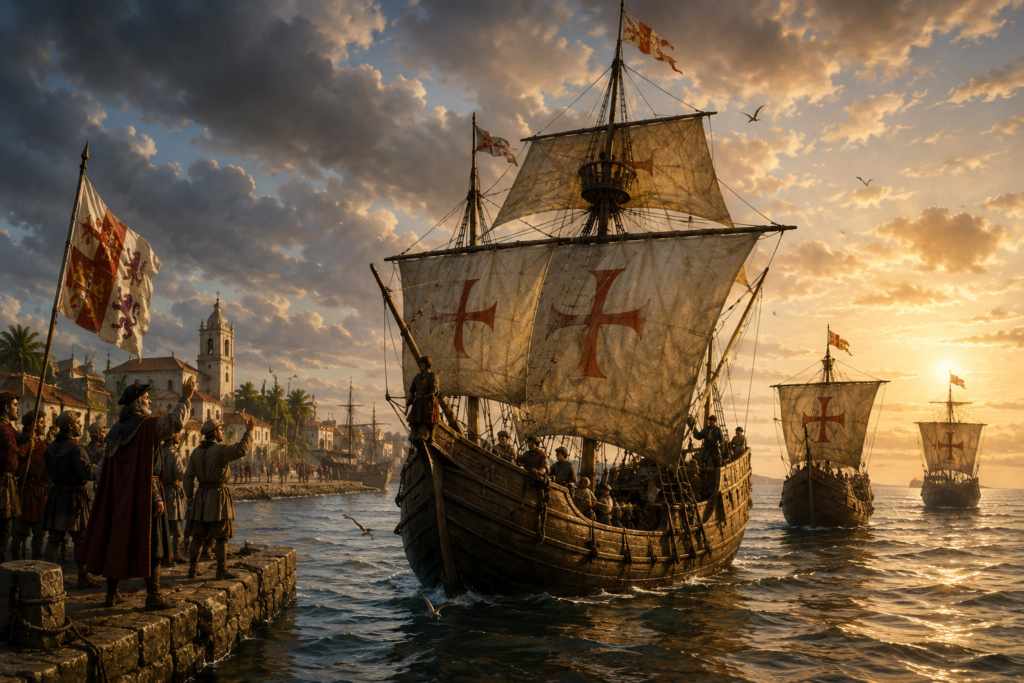
Image Credits: Today in History, August 3: Christopher Columbus Sets Sail on His First Voyage Across the Atlantic. AI-generated illustration created by Open Chronicle using ChatGPT (OpenAI). August 2026. This image is illustrative and does not depict a real-world scene.
By Open Chronicle
3 August 1492
On 3 August 1492, the Genoese navigator Christopher Columbus departed from the Spanish port of Palos de la Frontera, beginning a voyage that would permanently alter the course of world history. Sailing under the patronage of the Catholic Monarchs of Spain, Queen Isabella I of Castile and King Ferdinand II of Aragon, Columbus sought a western sea route to Asia. Instead, his expedition led to the European encounter with the Americas and initiated an era of global exploration, exchange and conquest.
For centuries, European merchants had relied on overland and eastern maritime routes to obtain valuable goods from Asia, including spices, silk and precious stones. Following the expansion of the Ottoman Empire and increasing competition for trade, European kingdoms searched for alternative routes to the markets of the East.
Columbus believed that Asia could be reached by sailing west across the Atlantic Ocean. Although he correctly understood that the Earth was spherical, he greatly underestimated its circumference and significantly overestimated the eastward extent of Asia. As a result, he believed the voyage would be considerably shorter than it actually was.
After years of seeking financial support from several European courts, Columbus finally secured royal backing from the Spanish Crown in 1492, shortly after the completion of the Reconquista with the capture of Granada. The agreement granted him noble titles and a share of future profits should his expedition succeed.
The fleet consisted of three vessels. The Santa María, a larger carrack, served as Columbus’s flagship. It was accompanied by the smaller caravels Niña and Pinta, whose speed and manoeuvrability made them well suited for long-distance exploration. Together, the ships carried approximately 90 crew members, including sailors, navigators, interpreters, craftsmen and servants.
Leaving Palos de la Frontera on the morning of 3 August 1492, the expedition first sailed south to the Canary Islands, where repairs were carried out and supplies replenished. On 6 September, the fleet departed the Canaries and entered the open Atlantic, venturing into waters unknown to European navigators.
The crossing tested the endurance of both ships and crew. For weeks, no land appeared on the horizon. Unfamiliar ocean currents, floating seaweed in the Sargasso Sea and steadily increasing distance from Europe caused growing anxiety among the sailors. According to later accounts, some crew members feared they might never return home.
Columbus carefully managed morale by maintaining confidence in the expedition and, on some occasions, reportedly recording shorter sailing distances in the official log than those actually travelled, reducing concern among the crew about how far they had ventured from Spain.
In the early hours of 12 October 1492, after more than two months at sea, lookout Rodrigo de Triana aboard the Pinta sighted land. The expedition had reached an island in the Bahamas, which Columbus named San Salvador. Believing he had arrived in islands near Asia, Columbus referred to the Indigenous inhabitants as “Indians”, a term that persisted for centuries despite the geographical misunderstanding.
During the following months, the expedition explored parts of the Caribbean, including present-day Cuba and Hispaniola. On Christmas Day 1492, the Santa María ran aground and was lost, forcing Columbus to establish the small settlement of La Navidad using timber salvaged from the wreck. He later returned to Spain aboard the Niña, arriving in March 1493 to widespread acclaim.
Columbus’s first voyage transformed European understanding of the world. Although Norse explorers led by Leif Erikson had reached North America around five centuries earlier, their settlements did not establish lasting contact between Europe and the Americas. Columbus’s expedition initiated continuous interaction between the two hemispheres.
The consequences were profound. The encounter led to the Columbian Exchange, the large-scale transfer of plants, animals, diseases, technologies and cultures between the Old World and the New World. Crops such as maize, potatoes and tomatoes spread to Europe, while horses, cattle and wheat were introduced to the Americas. At the same time, European diseases devastated many Indigenous populations, while colonisation, warfare and forced labour fundamentally reshaped the continents.
Columbus completed four voyages across the Atlantic between 1492 and 1504. Although he never realised that he had encountered previously unknown continents rather than Asia, his expeditions opened the way for the European exploration and colonisation of the Americas.
Today, Columbus’s first voyage remains one of history’s most consequential expeditions. It marked the beginning of sustained contact between Europe and the Americas, an event that reshaped global trade, politics, cultures and populations. While his legacy continues to generate debate because of the lasting impact of European colonisation on Indigenous peoples, the voyage from Palos de la Frontera stands as a defining turning point in world history.