
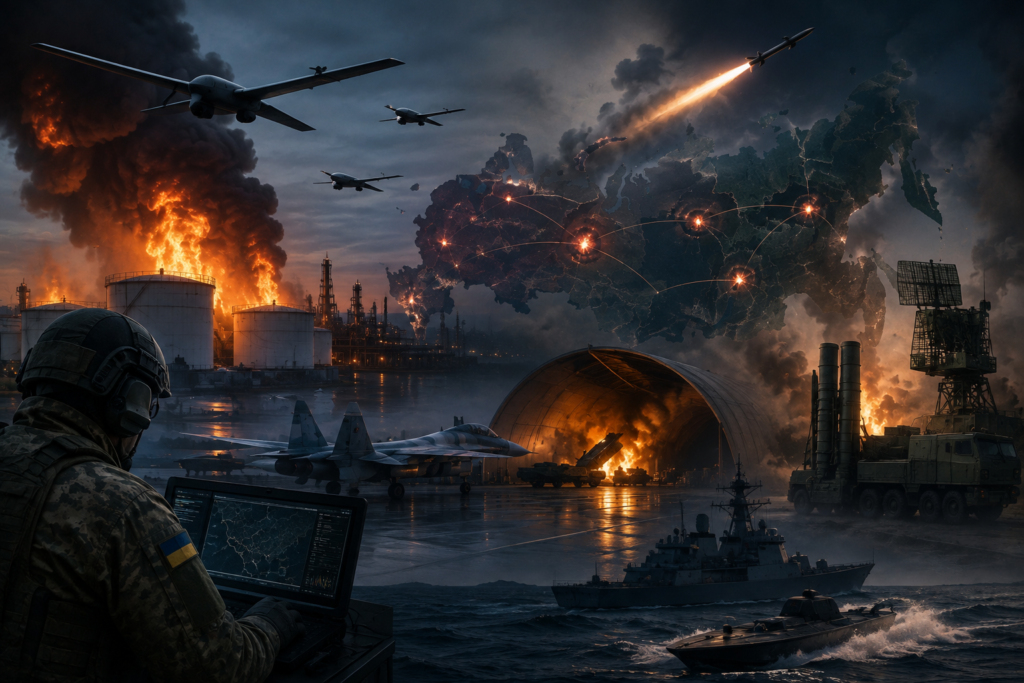
Image Credits: Ukraine’s 40-Day Strike Campaign Forces Russia onto the Defensive, but War Continues. AI-generated illustration created by Open Chronicle using ChatGPT (OpenAI). August 2026. This image is illustrative and does not depict a real-world scene.
By Open Chronicle with agencies
Forty days after President Volodymyr Zelenskyy tasked Ukraine’s Security Service (SBU) with intensifying pressure on Russia to help force an end to the war, military analysts say the campaign has achieved significant operational success, even if its ultimate political objective remains out of reach.
During the operation, Ukrainian forces carried out an extensive series of long-range strikes against oil refineries, military airfields, logistics hubs, air defence systems and industrial facilities across Russia and occupied Crimea. The campaign reflects Kyiv’s evolving strategy of weakening Russia’s military and economic capacity far beyond the front line.
A campaign targeting Russia’s war machine
Announced on 25 June, the operation was designed as a coordinated effort involving the SBU and other branches of Ukraine’s Defence Forces.
Rather than focusing on a single objective, the campaign combined attacks on fuel infrastructure, military installations, logistics networks, industrial sites and support vessels while increasing economic and psychological pressure on Russia’s rear areas.
According to Ukrainian officials and publicly available information, dozens of strategic facilities were struck during the forty days, including multiple oil refineries, fuel storage sites, military airfields, drone facilities, air defence systems, aircraft and infrastructure linked to Russia’s military-industrial complex.
Ukraine also intensified efforts against Russia’s so-called “shadow fleet,” expanding sanctions and enforcement measures targeting vessels believed to support Moscow’s ability to circumvent international restrictions.
Fuel infrastructure becomes a primary target
Among the most visible effects of the campaign were repeated attacks on Russia’s fuel sector.
Oil refineries and petroleum terminals across several regions were damaged, contributing to fuel shortages in some areas, long queues at petrol stations and logistical challenges acknowledged by Russian authorities.
Military analysts argue that disrupting fuel supplies can have a cumulative effect on military operations by increasing transportation costs, delaying deliveries and forcing resources to be diverted toward repairing damaged infrastructure.
Rather than seeking immediate battlefield gains, the strategy aims to steadily increase the economic burden of sustaining Russia’s military campaign.
Deep strikes reach hundreds of kilometres inside Russia
Throughout the operation, Ukrainian drones struck targets far from the battlefield.
Among the facilities targeted were refineries in Nizhny Novgorod, Omsk, Perm, Volgograd, Ufa and other industrial centres, several located more than 1,500 kilometres from Ukrainian territory.
Military airfields in occupied Crimea, including Saki, Gvardeyskoye, Dzhankoy and Belbek, were repeatedly attacked, alongside ports, radar stations and logistics centres.
The campaign also extended to the Caspian Sea, where Ukrainian naval drones reportedly targeted Russian vessels supporting military operations.
Air defence and combat aircraft under increasing pressure
Military analyst Ivan Stupak believes some of the campaign’s most significant achievements involved attacks on Russian aviation and air defence assets.
He highlighted reports that two Su-35 fighter aircraft were destroyed or seriously damaged, describing such losses as particularly important because replacing experienced crews and operational aircraft is considerably more difficult than replacing standard military equipment.
Stupak also argued that systematic attacks against Russian air defence systems increase the likelihood that future long-range drone strikes will successfully penetrate Russian airspace.
Every destroyed radar or missile battery, he said, forces Russia to reposition additional equipment from other regions, gradually stretching its defensive resources.
Logistics become the decisive battlefield
According to Stupak, the greatest long-term value of the campaign lies in its impact on Russia’s logistics.
He argues that wars are not won solely through combat on the front line but by disrupting an opponent’s ability to move fuel, ammunition, spare parts and reinforcements.
Repeated strikes against refineries, fuel depots, transport infrastructure and supply routes force Russia to reroute logistics, strengthen rear-area security and allocate additional personnel and resources away from combat operations.
Particular emphasis has been placed on occupied Crimea, which continues to serve as one of Russia’s principal military logistics hubs supporting operations in southern Ukraine.
Political objective remains unfulfilled
Despite its operational successes, the campaign has not achieved its stated political objective of compelling Russia to end the war.
Stupak argues that expecting a forty-day operation alone to force Moscow into peace negotiations was unrealistic from the outset.
Instead, he views the campaign as one component of a broader strategy involving the SBU, military intelligence, unmanned systems and conventional armed forces working together to gradually erode Russia’s military and economic capacity.
A strategy of long-term attrition
Analysts caution that Russia retains significant industrial capacity and continues adapting to Ukrainian strikes by repairing damaged facilities, relocating air defence systems and shifting logistics routes.
Nevertheless, they argue that the cumulative effect of repeated attacks is becoming increasingly costly.
Each strike forces Russia to invest additional resources in protecting infrastructure, restoring damaged facilities and reinforcing rear areas, creating pressure that extends well beyond the battlefield.
While the first forty days have not altered Moscow’s political position, the campaign has demonstrated Ukraine’s growing ability to project force deep inside Russian territory and sustain pressure on critical elements of Russia’s wartime economy.
Military observers believe this approach is likely to remain a central feature of Ukraine’s strategy as the conflict continues, combining long-range precision strikes with economic disruption in an effort to gradually reduce Russia’s ability to sustain prolonged military operations.
The Grand Strategy Institute
Continue Exploring Strategic Analysis
Return to The Grand Strategy Institute for strategic assessments, long-form analysis and research examining geopolitics, military affairs, international security, emerging technologies and the changing international order.
← Back to The Grand Strategy Institute