
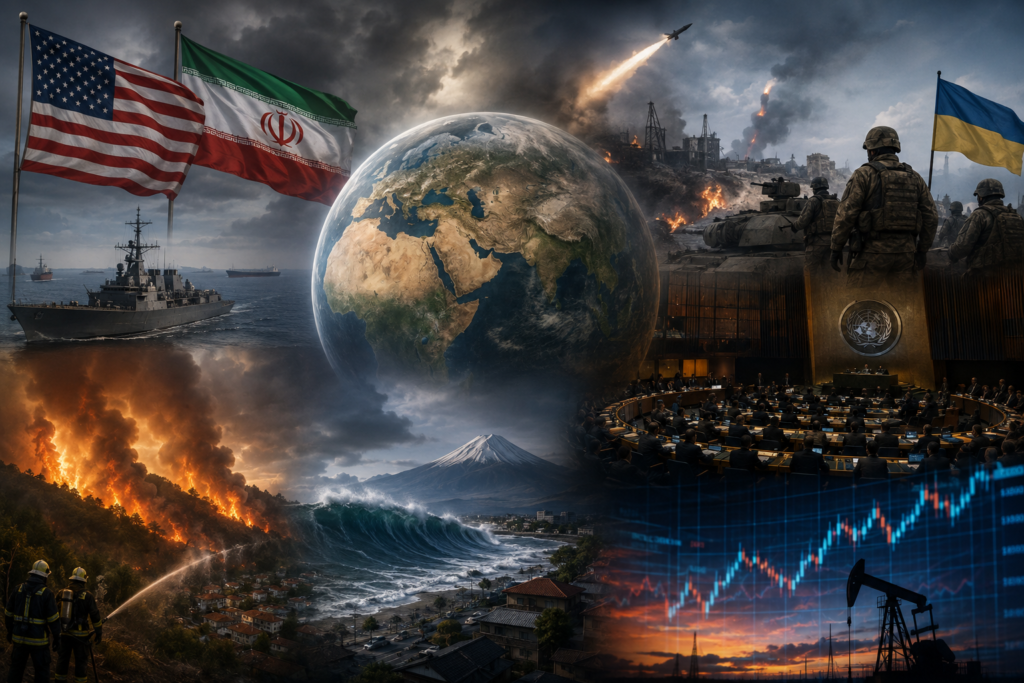
Image Credits: World News Brief: The Top Global Stories Shaping August 4, 2026. AI-generated illustration created by Open Chronicle using ChatGPT (OpenAI). August 2026. This image is illustrative and does not depict a real-world scene.
By Open Chronicle with agencies
Geopolitical tensions, natural disasters and strategic competition continue to dominate the global agenda as governments respond to an increasingly complex international environment. From the Middle East and Eastern Europe to Asia and Europe, today’s developments highlight the interconnected challenges influencing global security, diplomacy and economic stability.
U.S.- Iran confrontation remains at the centre of global attention
The confrontation between the United States and Iran remains the world’s most closely watched geopolitical crisis.
Diplomatic uncertainty persists after U.S. President Donald Trump paused planned military action, saying negotiations should be given another opportunity. Tehran, however, maintains that no direct talks are currently taking place and continues to reject claims that a breakthrough is imminent.
The Strait of Hormuz remains a central concern for governments and financial markets alike. As one of the world’s most important maritime trade routes, any disruption to shipping through the strategic waterway could have immediate consequences for global energy supplies, inflation and international commerce.
Ukraine expands long-range strikes inside Russia
The conflict between Russia and Ukraine continues to evolve as Kyiv intensifies long-range drone attacks against strategic targets deep inside Russian territory.
Recent operations have focused on logistics centres, industrial facilities and infrastructure that Ukrainian officials say support Moscow’s military operations. Russia has responded with large-scale missile and drone attacks against Ukrainian cities and infrastructure, underscoring the increasingly strategic nature of the conflict.
Military analysts note that both sides are placing greater emphasis on disrupting each other’s ability to sustain prolonged military operations rather than focusing solely on front line engagements.
Powerful earthquake strikes southern Japan
A major earthquake struck Japan’s southern island of Kyushu, prompting tsunami advisories, transport disruption and precautionary evacuations.
Emergency services continue assessing damage while authorities monitor the risk of aftershocks. Rail services were temporarily suspended in several areas, and residents in coastal communities were urged to remain alert until tsunami warnings were lifted.
The earthquake has become one of today’s most significant breaking news stories across the Asia-Pacific region.
Europe battles worsening wildfire emergency
Southern Europe remains under severe pressure as extreme heat and prolonged drought continue to fuel destructive wildfires.
France, Greece and Spain are among the countries deploying thousands of firefighters while evacuation orders remain in place for communities threatened by rapidly spreading fires.
Authorities warn that high temperatures, strong winds and exceptionally dry vegetation continue to complicate firefighting efforts, with concerns growing over the impact on agriculture, energy supplies and public health.
United Nations prepares to choose its next leader
The United Nations has entered a critical stage in selecting its next Secretary-General.
The Security Council is expected to conduct another round of informal voting later this month as member states seek a successor to António Guterres.
The selection comes at a time when the organisation faces growing pressure to respond effectively to armed conflicts, humanitarian emergencies, climate change and institutional reform.
Indo-Pacific rivalry continues to intensify
Strategic competition across the Indo-Pacific remains one of the defining long-term issues in international affairs.
China continues naval and coast guard operations in the South China Sea while neighbouring countries deepen defence cooperation with regional and Western partners.
Beyond territorial disputes, competition increasingly encompasses technology, maritime security, critical minerals and strategic infrastructure, reinforcing the region’s importance to global security.
Markets remain cautious despite recent stability
Global financial markets have stabilised following recent volatility linked to Middle East tensions.
Lower oil prices have supported investor confidence, but markets remain highly sensitive to geopolitical developments, particularly those affecting the Strait of Hormuz and international energy supplies.
Economists continue to warn that renewed instability could quickly affect inflation, supply chains and global economic growth.
As multiple geopolitical crises, environmental emergencies and strategic rivalries unfold simultaneously, governments around the world continue balancing immediate responses with long term planning in an increasingly uncertain international landscape.