
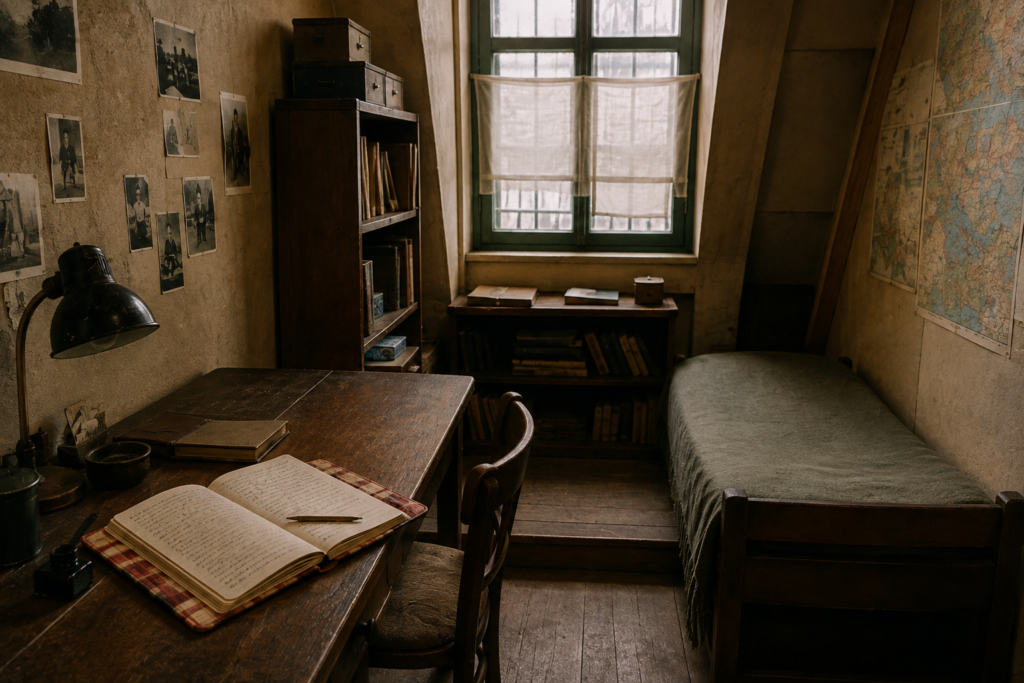
Image Credits: Today in History, August 4: Anne Frank Is Arrested After the Secret Annex Is Discovered. AI-generated illustration created by Open Chronicle using ChatGPT (OpenAI). August 2026. This image is illustrative and does not depict a real-world scene.
By Open Chronicle
4 August 1944
On 4 August 1944, Anne Frank, her family and the other occupants of the Secret Annex in Amsterdam were arrested after their hiding place was discovered by German security forces and Dutch collaborators. The arrest ended more than two years in concealment and ultimately led to the deaths of nearly all those in hiding. Anne’s diary, preserved by helpers after the raid, would later become one of the world’s most powerful testimonies to the Holocaust.
Anne Frank was born on 12 June 1929 in Frankfurt, Germany. As the Nazi Party rose to power and antisemitic persecution intensified, her parents, Otto and Edith Frank, moved the family to the Netherlands in 1934, hoping to find safety in Amsterdam.
That hope was shattered in May 1940, when Nazi Germany invaded and occupied the Netherlands. Anti-Jewish measures were introduced step by step, restricting every aspect of Jewish life. Jews were excluded from schools, public places and many professions, while deportations to concentration and extermination camps began in 1942.
On 6 July 1942, shortly after Anne’s sister Margot received a summons for forced labour, the Frank family went into hiding in concealed rooms behind Otto Frank’s business premises at 263 Prinsengracht. The hidden living quarters later became known as the Secret Annex.
The Franks were joined by four others: Hermann, Auguste and Peter van Pels, together with Fritz Pfeffer, a German Jewish dentist. For more than two years, the eight occupants relied entirely on the courage of trusted employees and friends, including Miep Gies, Johannes Kleiman, Victor Kugler, Bep Voskuijl and Jan Gies, who secretly supplied food, books, clothing and news despite the enormous personal risk.
During this period, Anne kept a diary that she had received as a birthday present shortly before going into hiding. She wrote about daily life in the Annex, her fears, hopes, ambitions and relationships with those around her. As the war continued, her writing became increasingly thoughtful and mature, reflecting on human nature, identity and the meaning of freedom.
On the morning of 4 August 1944, officers led by SS-Oberscharführer Karl Silberbauer entered the building after receiving information about the hiding place. The precise circumstances surrounding the discovery remain uncertain. Historians have proposed several theories, including betrayal by an informant or the possibility that German investigators uncovered the Annex while pursuing unrelated activities. No definitive explanation has ever been established.
The eight people in hiding were arrested along with two of their helpers, Victor Kugler and Johannes Kleiman. Anne’s diary and loose papers were left behind in the Annex, where Miep Gies and Bep Voskuijl later collected and preserved them, hoping to return them after the war.
Following their arrest, the prisoners were taken first to Westerbork transit camp and then deported on 3 September 1944 aboard the last transport from the Netherlands to Auschwitz-Birkenau.
In October 1944, Anne and Margot Frank were transferred to the Bergen-Belsen concentration camp in Germany. Harsh conditions, overcrowding, starvation and disease devastated the camp population. Both sisters contracted typhus and died in early 1945, only weeks before British forces liberated Bergen-Belsen. Their mother, Edith, had already died in Auschwitz in January 1945.
Of the eight people who hid in the Secret Annex, Otto Frank was the only survivor. Returning to Amsterdam after the war, he received Anne’s preserved diary from Miep Gies. Reading it for the first time, he discovered the depth of his daughter’s thoughts and her dream of becoming a writer.
Anne’s diary was first published in Dutch in 1947 under the title Het Achterhuis (The Secret Annex). It has since been translated into more than seventy languages and has become one of the most widely read books in the world. Its deeply personal account has helped generations understand the human consequences of Nazi persecution and the Holocaust.
Today, the building at Prinsengracht 263 is preserved as the Anne Frank House, a museum visited by millions of people each year. Anne Frank’s story continues to symbolise the countless children whose lives were destroyed during the Holocaust and serves as a powerful reminder of the importance of defending human dignity, tolerance and freedom.
The arrest of Anne Frank on 4 August 1944 marked the tragic end of her years in hiding, but her words survived where millions of voices were silenced. Through her diary, Anne remains one of the most enduring witnesses to one of history’s darkest chapters.