
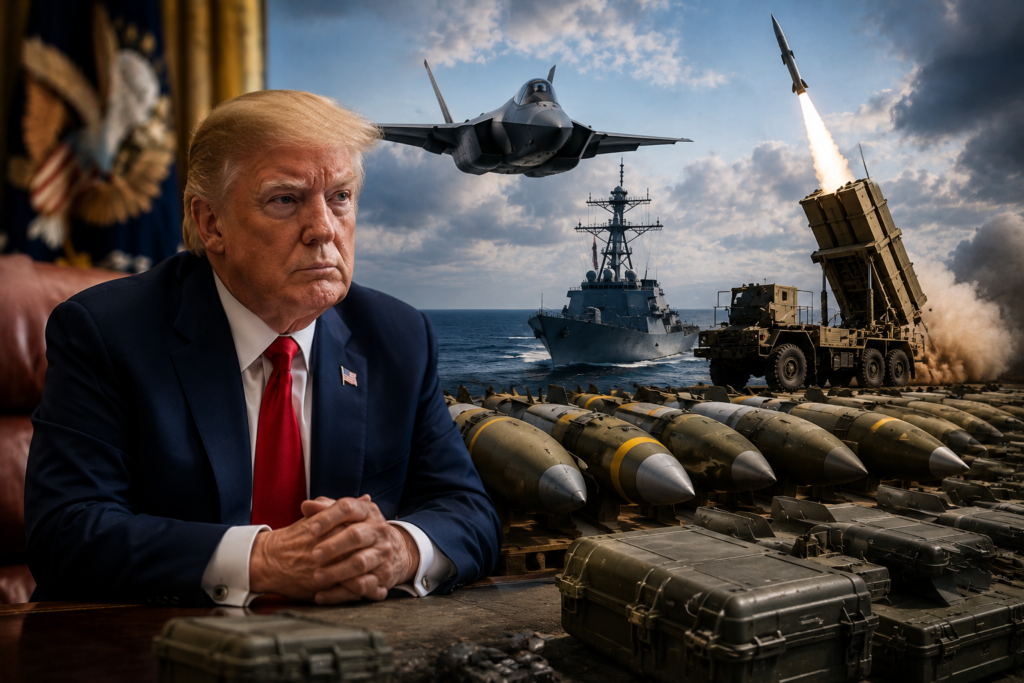
Image Credits: Trump Rejects Claims of U.S. Munitions Shortages as Debate Over Military Stockpiles Intensifies. AI-generated illustration created by Open Chronicle using ChatGPT (OpenAI). August 2026. This image is illustrative and does not depict a real-world scene.
By Open Chronicle with agencies
U.S. President Donald Trump has forcefully dismissed reports suggesting that the United States is running low on key military munitions, insisting that the country’s armed forces possess “massive amounts” of weapons and that defence manufacturers are rapidly expanding production.
The president’s comments come amid growing media scrutiny over the state of U.S. military stockpiles following months of military operations linked to the conflict with Iran, as well as broader concerns about America’s ability to sustain prolonged high-intensity warfare.
Trump rejects shortage reports
Writing on his Truth Social platform, Trump described reports of depleted missile inventories as false and politically motivated.
“The United States has massive amounts of munitions, especially of certain types,” the president wrote, adding that large quantities are continuing to be manufactured and delivered as required.
Trump also highlighted ongoing investment in the American defence industrial base, saying companies are constructing new factories and expanding production capacity at what he described as an unprecedented pace.
Without providing specific figures, the president maintained that the U.S. military remains fully equipped to respond to any future crisis.
Reports raise questions about missile inventories
Trump’s statement followed reports by several U.S. media organisations suggesting that the White House had become increasingly concerned about the availability of precision-guided weapons.
According to The Washington Post, Trump questioned Defence Secretary Pete Hegseth during a cabinet meeting at Camp David about reports that key missile stockpiles had declined significantly after months of military operations.
The newspaper reported that the president believed the issue had already been resolved and sought clarification from Pentagon officials.
The White House has categorically denied that the exchange took place.
Pentagon dismisses reports
White House Press Secretary Karoline Leavitt, who attended the Camp David meeting, described the reports as entirely inaccurate.
She stated that no such confrontation occurred between Trump and Hegseth, calling the published accounts “fake news.”
Chief Pentagon spokesman Sean Parnell likewise rejected claims of tensions within the administration, describing reports of both the alleged dispute and ammunition shortages as fictional.
The administration has consistently argued that the United States maintains sufficient military capabilities to defend its interests around the world.
Long-range missile supplies under scrutiny
Despite the official denials, several media outlets have reported that supplies of advanced long-range precision weapons and missile defence interceptors have been heavily consumed during recent military operations.
CNN reported that stocks of THAAD missile interceptors and other advanced defensive systems had declined substantially during the conflict with Iran, influencing operational planning within the Pentagon.
Other reports suggested that concerns over available inventories contributed to the administration’s decision not to authorise an additional round of large-scale strikes against Iranian targets.
Neither the Pentagon nor the White House has publicly confirmed these claims.
Trump vows action against leaks
The president also directed sharp criticism toward those responsible for disclosing information about military readiness.
Trump accused unnamed officials of leaking sensitive information and warned that his administration was actively seeking those responsible.
He characterised the disclosures as harmful to national security and said lengthy prison sentences should be pursued against anyone found guilty of releasing classified information.
The remarks underline the administration’s increasingly aggressive stance toward unauthorised disclosures involving defence and intelligence matters.
Hormuz negotiations continue
Trump’s comments came as diplomatic efforts surrounding the Strait of Hormuz continued to develop.
Iran and Oman have reportedly finalised a draft agreement covering new shipping arrangements through the strategically important waterway.
Iranian officials say the agreement includes legal, technical, environmental and security provisions, although Tehran maintains that any full reopening of maritime traffic will depend on the United States lifting restrictions affecting Iranian ports.
At the same time, Iranian authorities continue to deny that direct negotiations with Washington are currently taking place, despite Trump’s repeated assertions that diplomatic discussions remain active.
Defence production remains a strategic priority
Regardless of the current debate over stockpile levels, defence analysts broadly agree that rebuilding munitions inventories has become a major strategic priority for the United States and many of its allies.
The conflicts in Ukraine and the Middle East have demonstrated the enormous consumption rates associated with modern high-intensity warfare, prompting governments to expand production of missiles, artillery ammunition and air defence systems.
For Washington, the controversy highlights the growing importance of balancing current military commitments with maintaining sufficient reserves to deter future crises involving other major powers.