
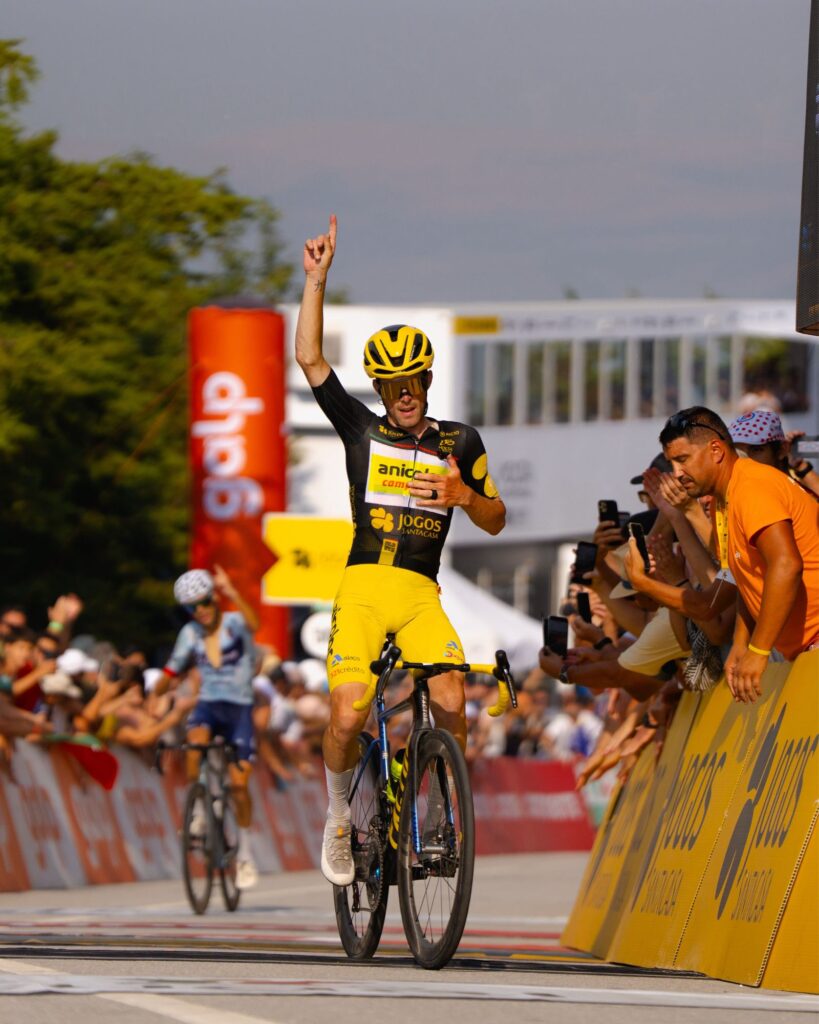
Image: from Volta a Portugal X @VoltaPortugal
How Anicolor Campicarn controlled the queen stage, why Artem Nych remains the perfect tactical ally, and how Senhora da Graça transformed the final battle for the 2026 Volta.
By Open Chronicle Cycling
The road to Senhora da Graça was supposed to provide the final great test of Alexis Guérin’s Yellow Jersey.
Instead, Stage 9 of the 2026 Volta a Portugal became the clearest demonstration yet of why Guérin and Anicolor Campicarn have taken control of the race.
Guérin won on Monte Farinha. Artem Nych finished third. Together, they preserved the first two positions in the general classification and left the rest of the field fighting over increasingly distant places.
With only the final stage from Maia to Porto remaining, Guérin leads Nych by 1:02.
Pedro Silva, the first rider outside Anicolor, is already 4:30 behind.
Those numbers tell part of the story.
The way Anicolor produced them tells much more.
A different kind of queen stage
There was no normal atmosphere around Stage 9.
The Volta resumed following the death of 19-year-old Finlay Tarling during the previous day’s stage, and the sporting contest unfolded in a race still deeply affected by tragedy.
The NSN Development Team withdrew from the race.
A minute of silence preceded the start.
Guérin raced in black rather than displaying the traditional Yellow Jersey.
The usual celebration surrounding one of the defining days of the Volta was therefore absent.
Within that context, the peloton still faced one of the most important competitive stages of the race.
And tactically, Senhora da Graça delivered.
Anicolor’s greatest weapon was not Guérin alone
Guérin has been the strongest rider of the race, but Anicolor’s tactical advantage comes from having two potential winners.
Nych entered the Volta as the defending champion.
He won the race in both 2024 and 2025.
Ordinarily, a rider with that record would demand complete leadership.
Instead, the 2026 race developed into a situation in which Guérin took yellow while Nych remained close enough to become both a threat to his teammate and a tactical weapon against everyone else.
That distinction matters.
Whenever a rival attacks Guérin, he also has to consider Nych.
Whenever Nych follows an acceleration, Guérin can measure his response.
Whenever Guérin attacks, the opposition cannot simply allow Nych to sit behind.
Anicolor has effectively forced its rivals to race against two leaders.
Stage 9 was another demonstration of that advantage.
The first ascent changed the tactical equation
The double encounter with Monte Farinha made Stage 9 fundamentally different from a conventional summit finish.
The first passage exposed weaknesses long before the decisive kilometres.
The new approach through Carvalhais, followed by the gravel section, added another element of uncertainty.
It was not necessarily the place where the Volta would be won.
It was a place where it could easily be lost.
That is precisely what happened to Adrià Pericas.
The UAE Team Emirates XRG youngster had entered the stage third overall after his victory at Termas do Gerês.
A puncture around the gravel sector changed his afternoon.
Once mechanical trouble forced Pericas away from the principal contenders, he was immediately placed in a difficult tactical position.
He had to chase while the riders ahead could concentrate on racing.
On mountain stages, that difference can become enormous.
Pericas illustrates the cruelty of stage racing
Pericas’ fall from third to fifth overall was not the result of a dramatic collapse.
That makes his experience particularly revealing.
Stage races are often decided by small incidents occurring at precisely the wrong moment.
A puncture.
A positioning mistake.
A few seconds of hesitation.
Once Pericas was forced to chase, the energy equation changed.
Instead of conserving strength for Senhora da Graça, he was spending it trying to return to the race.
By the time the decisive climbing began, he had already paid a price.
He eventually limited the damage sufficiently to retain the White Jersey, but his hopes of finishing on the overall podium suffered a major blow.
José Neves chose the right moment
One of the strongest tactical performances of the stage came from José Neves.
The Portuguese rider did not simply survive with Guérin and Nych.
He placed himself directly inside the decisive contest.
That was important because the Anicolor pair had repeatedly been able to isolate rivals.
Neves refused to allow the final ascent to become an internal Anicolor battle exclusively.
His presence changed the dynamic.
For a period, three riders could realistically think about the stage victory.
Neves ultimately finished only three seconds behind Guérin.
That performance moved him to fourth overall at 4:36 and demonstrated how much could still be gained by attacking the dominant team rather than simply attempting to defend a classification position.
Guérin waited
Perhaps the most impressive part of Guérin’s performance was his patience.
There was little reason for the Yellow Jersey to launch a speculative attack far from the finish.
He already controlled the race.
Nych was alongside him.
His major rivals were either losing contact or already several minutes behind overall.
Guérin therefore allowed the race to become increasingly selective.
The longer the decisive group remained small, the more favourable the situation became.
Then he attacked when the potential reward was greatest and the tactical risk smallest.
The result was another stage victory.
It was also another extension of his overall lead.
That is the behaviour of a rider racing to win a stage race rather than simply a mountain stage.
Nych remains crucial
Nych crossed the line nine seconds behind Guérin.
On paper, he lost another small amount of time to his teammate.
Tactically, however, his presence remains enormously valuable.
He is now 1:02 behind Guérin.
The third-placed rider is at 4:30.
Anicolor therefore has a buffer of more than three minutes between its second rider and its nearest external challenger.
That transforms the final stage.
If another team tries something ambitious, Anicolor has multiple options.
Guérin does not have to react to every move.
Nych can cover attacks.
Other teams cannot easily exploit a numerical advantage because the strongest numerical advantage belongs to Anicolor.
The defending champion may no longer be the favourite to win a third consecutive Volta, but he remains one of the principal reasons his team is so difficult to defeat.
Pedro Silva quietly reaches the podium
While much of the attention focused on Guérin, Nych and Neves, Pedro Silva emerged from Stage 9 in third overall.
That is significant.
The Feira dos Sofás Boavista rider sits 4:30 behind Guérin and only six seconds ahead of Neves.
The Yellow Jersey may therefore be relatively secure, but the final podium is not completely settled.
Silva and Neves are separated by almost nothing.
Pericas is another 1:02 behind Neves.
For the overall victory, Stage 10 should be about protection.
For the final podium positions, there remains something to defend.
Guérin now controls two competitions
The Yellow Jersey is not Guérin’s only prize.
His performances in the mountains have also taken him to the top of the climbing classification.
After Stage 9 he leads the Mountains Classification with 72 points.
Pedro Silva has 62.
Nych has 61.
That creates an unusual situation heading into Porto.
Guérin is simultaneously the strongest rider in the general classification and the leader of the mountain competition.
His two victories, at Torre and Senhora da Graça, explain why.
The major mountains of the 2026 Volta have consistently produced the same conclusion.
When the road has become most difficult, Guérin has been among the strongest riders in the race.
Rui Oliveira still has something to fight for
Not every classification belongs to Anicolor.
Rui Oliveira leads the Points Classification with 80 points.
Guérin and Nych both have 66.
Unlike the battle for yellow, the points competition gives the final stage additional sporting significance.
A finish in Porto offers a very different challenge from Senhora da Graça.
For Oliveira, the objective is clear.
Protect the Orange Jersey and, if the opportunity emerges, contest the final stage.
The former Yellow Jersey has already played an important role in this Volta.
Winning the points classification would provide a significant conclusion to his race.
The general classification tells the tactical story
After Stage 9:
1. Alexis Guérin, Anicolor Campicarn, 27:14:30
2. Artem Nych, Anicolor Campicarn, +1:02
3. Pedro Silva, Feira dos Sofás Boavista, +4:30
4. José Neves, GI Group Holding Simoldes UDO, +4:36
5. Adrià Pericas, UAE Team Emirates XRG, +5:38
6. Tiago Antunes, Efapel Cycling, +5:53
The important gap is not necessarily the 1:02 separating Guérin and Nych.
It is the 3:28 between Nych and Pedro Silva.
That is Anicolor’s defensive wall.
Two riders from the same team occupy a different competitive zone from everyone else.
What can happen in Porto?
Stage 10 runs from Maia to Porto.
Under normal circumstances, Guérin does not need to attack.
He does not even need to prove that he is the strongest rider again.
His objective is simpler.
Stay out of trouble.
Remain with the relevant group.
Allow his team to control dangerous moves.
Reach Porto with the Yellow Jersey.
The tactical responsibility therefore changes.
Until Senhora da Graça, Guérin needed to defend his lead against the mountains.
Now he needs to defend it against uncertainty.
Crashes, mechanical problems, splits and unexpected attacks represent greater threats than a conventional climbing battle.
Anicolor’s job will be to remove as much uncertainty as possible.
The race Anicolor wanted
Stage 9 did not simply make Guérin the overwhelming favourite to win the Volta.
It created an almost ideal tactical scenario for Anicolor Campicarn.
Guérin leads.
Nych is second.
The team leads the collective classification.
Guérin leads the mountains competition.
And every external challenger is more than four minutes from yellow.
There is still one road to travel.
Cycling never guarantees an outcome before the finish line.
But Anicolor has reduced the number of ways it can lose this race.
That may be the greatest tactical achievement of all.
The Open Chronicle verdict
Stage winner: Alexis Guérin
Biggest tactical winner: Anicolor Campicarn
Best Portuguese performance: José Neves
Key setback: Adrià Pericas’ puncture
Most important number: 1:02, Guérin’s advantage over Nych
Hidden tactical number: 3:28, the gap separating second placed Nych from third placed Pedro Silva
Final stage objective for Guérin: control, not aggression
Rider to watch in Porto: Rui Oliveira
The 2026 Volta a Portugal has one stage remaining.
Guérin has done almost everything required to win it.
Now Anicolor must finish the job.