
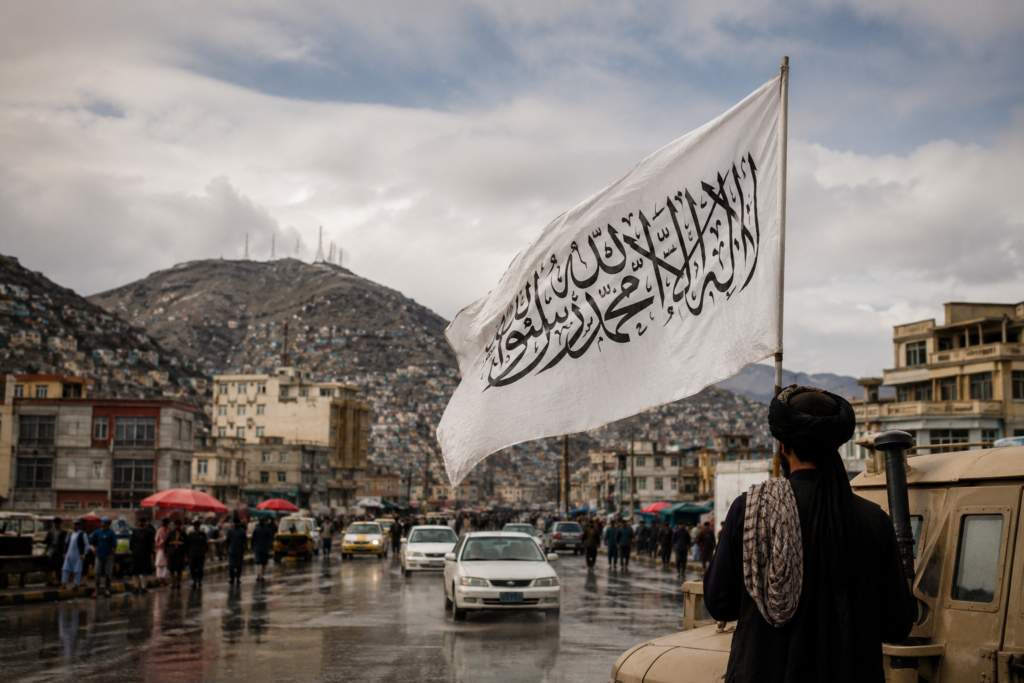
Image Credits: Five Years of Taliban Rule: Afghanistan Gains Diplomatic Space but Its Crisis Deepens. AI-generated illustration created by Open Chronicle using ChatGPT (OpenAI). August 2026. This image is illustrative and does not depict a real-world scene.
By Open Chronicle
Five years after the Taliban returned to power in Afghanistan, the movement has consolidated its political control and gradually rebuilt relationships with neighbouring and regional powers. Yet behind the image of greater stability projected by Kabul lies a country still struggling with poverty, international isolation, restrictions on women and girls, unemployment and an enormous humanitarian burden.
The Taliban marked the fifth anniversary of its takeover on August 15 with celebrations in Kabul, including a parade near the former United States embassy. Armoured vehicles moved through the capital as the authorities commemorated what they regard as their victory over Western forces after two decades of war.
The anniversary highlighted how dramatically Afghanistan has changed since August 2021. The Taliban is now more secure domestically and more engaged internationally than during the chaotic months immediately following the collapse of the previous government.
But political survival has not translated into broad economic recovery.
More than half of Afghanistan’s population of around 45 million requires humanitarian assistance, according to figures cited by India Today, while unemployment has nearly doubled over the past five years.
From the fall of Kabul to five years in power
On August 15, 2021, Taliban forces entered Kabul as the Western-backed Afghan government collapsed with extraordinary speed.
The Taliban’s advance coincided with the final phase of the American withdrawal, producing chaotic scenes as Afghans who had worked with Western governments and military forces attempted to leave the country.
Images from Kabul airport quickly became symbolic of the end of America’s 20-year intervention.
The collapse followed a conflict that began with the United States-led invasion in 2001, launched after the September 11 attacks and the Taliban’s refusal to surrender al Qaeda leader Osama bin Laden.
Twenty years later, the Taliban returned to Kabul.
Five years after that victory, it remains firmly in control.
Taliban celebrates its survival
The anniversary offered the Taliban an opportunity to present its continued rule as evidence of political and military success.
Interior Minister Sirajuddin Haqqani attributed the movement’s return to power to morale, courage and what he described as divine assistance.
But even during the commemorations, Haqqani acknowledged that Afghanistan continues to face serious problems.
Those problems have changed considerably since the Taliban’s insurgency years.
The movement no longer needs to overthrow a government.
It now has to govern one.
That requires maintaining public services, managing borders, raising revenue, encouraging trade and dealing with neighbouring governments while attempting to rebuild an economy devastated by decades of conflict.
The transition from insurgency to government has proved far more difficult than securing military control.
Women and girls remain at the centre of the crisis
Perhaps the clearest divide between the Taliban and much of the international community concerns the treatment of women and girls.
Since 2021, Taliban authorities have imposed extensive restrictions affecting women’s education, employment and participation in public life.
Approximately 2.5 million Afghan girls are barred from secondary schools and universities, according to figures cited in the report.
UN Women data released around the anniversary also indicated that half of Afghan women now leave their homes only once or twice each month.
The restrictions have transformed everyday life for millions of people and remain one of the biggest obstacles preventing broader international recognition of the Taliban government.
For the Taliban, the diplomatic consequences have been substantial.
Countries may speak with Kabul, trade with Afghanistan or accept Taliban diplomats without formally recognising the government.
That distinction has allowed international engagement to grow while leaving the fundamental political dispute unresolved.
Russia remains the exception
Five years after the Taliban takeover, Russia remains the only country to have formally recognised the Taliban government, according to India Today.
That does not mean Afghanistan is diplomatically isolated in the same way it was immediately after August 2021.
Quite the opposite.
Several governments have gradually increased contacts with Kabul.
India, China, Iran, Qatar and Central Asian countries have engaged Taliban officials and developed varying levels of diplomatic and economic cooperation.
For these countries, geography makes ignoring Afghanistan difficult.
The country sits at the intersection of Central Asia, South Asia and the Middle East.
It borders Pakistan, Iran, China and several Central Asian republics.
That makes Afghanistan relevant to regional trade, security, migration and infrastructure regardless of whether governments approve of Taliban rule.
Kabul wants geography to become an economic asset
The Taliban has increasingly attempted to use Afghanistan’s location as a diplomatic and economic advantage.
Kabul wants the country to become a trade and connectivity bridge between surrounding regions.
The strategy has some logic.
Afghanistan occupies territory between energy-rich Central Asian states and the enormous markets of South Asia. New transport corridors could potentially connect countries that currently depend on longer or politically complicated routes.
After decades in which Afghanistan’s geography often made it a battlefield between competing powers, the Taliban would like geography to become a source of revenue.
Regional governments also have practical incentives to cooperate.
A more economically stable Afghanistan could reduce migration pressures, strengthen trade and potentially reduce cross-border security threats.
The challenge is turning those strategic possibilities into economic improvements visible to ordinary Afghans.
So far, that transformation remains limited.
The humanitarian emergency has not disappeared
Afghanistan’s humanitarian crisis remains immense.
More than half the country’s roughly 45 million inhabitants require humanitarian assistance, according to the figures cited by India Today.
Years of war left Afghanistan with damaged infrastructure, displaced communities and a fragile economy.
Since the Taliban takeover, the country has also faced repeated natural disasters.
Drought has damaged agriculture and rural livelihoods.
Earthquakes have devastated already vulnerable communities.
At the same time, large numbers of Afghans have been deported or returned from neighbouring Iran and Pakistan, placing additional pressure on communities with limited employment, housing and public services.
The international response has also become more difficult.
Foreign aid has declined
For years, Afghanistan depended heavily on international assistance.
The political order that existed before August 2021 was supported by enormous amounts of foreign money, much of it provided by the United States and its allies.
That financial structure changed dramatically after the Taliban takeover.
International aid has subsequently declined, with the United States sharply reducing assistance.
Humanitarian organisations therefore face an uncomfortable equation.
Afghanistan continues to have enormous humanitarian needs, but international resources available to address them are shrinking.
Donor fatigue, competing global crises and political opposition to Taliban policies have all complicated efforts to maintain assistance.
The result is that ordinary Afghans can become caught between international pressure on the Taliban and the economic consequences of isolation.
Afghanistan’s economy remains disconnected
The economy remains another fundamental weakness.
Afghanistan is still largely isolated from the international financial system, making normal banking, investment and international commercial activity considerably more difficult.
Imports have increasingly exceeded exports since the Taliban takeover.
Government finances also illustrate how much the economic environment has changed.
The Taliban’s most recently published budget, covering the 2023 fiscal year, was approximately $2.44 billion.
Afghanistan’s budget in 2021 had been around $6 billion.
The difference reflects the disappearance of much of the foreign financial support that sustained the previous government.
The Taliban has therefore inherited a state expected to provide services with dramatically fewer resources.
Pakistan relationship comes under pressure
Another complication is Afghanistan’s increasingly difficult relationship with Pakistan.
Pakistan was historically one of the countries most closely associated with the Taliban, but relations between Islamabad and Kabul have become strained.
Border disruptions have affected what remains Afghanistan’s most important trade route.
That matters enormously for a landlocked country.
Afghanistan depends on neighbouring states for access to international markets.
Disruptions at border crossings can therefore affect food prices, exports, fuel supplies and commercial activity far beyond the frontier itself.
The tensions demonstrate another transformation since 2021.
The Taliban may have won the war inside Afghanistan, but governing the country requires diplomatic relationships far more complicated than those required during an insurgency.
Security has improved, but threats remain
The Taliban can point to one important difference between Afghanistan today and the country it inherited in 2021.
The nationwide war involving Taliban insurgents, Afghan government forces and Western militaries has ended.
For many Afghans, particularly those who lived in rural areas that experienced repeated fighting, the end of that conflict represents a meaningful change.
Yet Afghanistan is not free from violence.
The Islamic State’s regional affiliate, commonly known as ISIS-K, has remained capable of carrying out attacks.
The threat creates an unusual area of overlapping interest between the Taliban and foreign governments.
Both want to prevent Afghanistan from becoming a base for transnational terrorist organisations capable of attacking other countries.
That shared concern has encouraged some governments to maintain security contacts with Kabul even while refusing formal diplomatic recognition.
The Taliban’s central contradiction
Five years after the takeover, Afghanistan presents a striking contradiction.
The Taliban government is stronger.
The country it governs remains extraordinarily weak.
Kabul has greater diplomatic space than it possessed in 2021.
Regional governments increasingly accept that the Taliban is unlikely to disappear and that practical engagement is necessary.
Yet Afghanistan remains economically isolated, dependent on humanitarian assistance and unable to offer millions of citizens basic opportunities.
The Taliban has therefore succeeded at the first objective of any political movement that takes power: survival.
The more difficult test is governance.
International recognition remains the prize
Formal diplomatic recognition would represent a breakthrough for the Taliban.
Recognition could potentially facilitate greater international investment, banking relationships and government-to-government cooperation.
But the restrictions imposed on Afghan women and girls remain a fundamental barrier.
Many governments have made clear that engagement does not equal endorsement.
This has produced an unusual diplomatic landscape in which Taliban officials travel internationally, hold negotiations and maintain relationships with foreign governments while their administration remains largely unrecognised.
Russia’s recognition has broken the previous diplomatic consensus, but it has not yet produced a wider wave of governments following Moscow’s example.
The Taliban therefore faces a strategic choice.
It wants the benefits associated with international legitimacy while maintaining domestic policies that make such legitimacy politically difficult for many governments.
Five years later, Afghanistan remains at a crossroads
The fifth anniversary of the Taliban takeover is therefore neither simply a story of victory nor one of complete isolation.
The Taliban survived.
It consolidated power.
It expanded diplomatic contacts.
It persuaded regional governments to deal with Kabul as a political reality.
But Afghanistan remains poorer and more isolated than its rulers would like, while millions depend on humanitarian assistance and millions of women and girls face severe restrictions on their lives.
The military struggle that defined Afghanistan for two decades has largely ended.
A different struggle has replaced it.
It concerns economic survival, international legitimacy, women’s rights, regional integration, and whether a government built through insurgency can construct a functioning state.
Five years after Kabul fell, the Taliban has demonstrated that it can hold power.
Whether it can build a stable and economically viable Afghanistan remains a far more difficult question.