
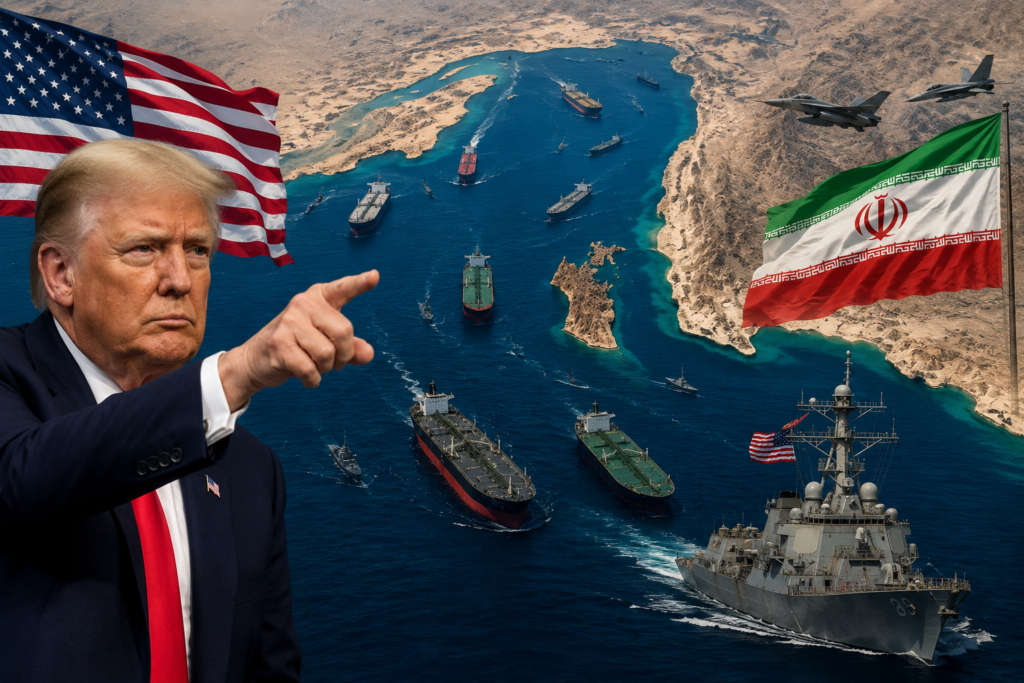
Image Credits: Trump Threatens to Declare Strait of Hormuz US Territory, but International Law Stands in the Way. AI-generated illustration created by Open Chronicle using ChatGPT (OpenAI). August 2026. This image is illustrative and does not depict a real-world scene.
By Open Chronicle with agencies
US President Donald Trump has threatened to declare the Strait of Hormuz a territory of the United States, escalating his rhetoric toward Iran as Washington and Tehran remain locked in a military and diplomatic confrontation over one of the world’s most strategically important waterways.
Speaking in New York on Friday, Trump said that once the United States had finished what he described as defeating Iran, he would move toward declaring the Strait of Hormuz American territory.
Trump also suggested that, in practical terms, the United States already exercises control over the passage because of its naval blockade. Iran has strongly rejected the claim, while international law specialists say a unilateral presidential declaration could not legally transfer sovereignty over the strait to Washington.
The confrontation is far more than a dispute over geography. Roughly one fifth of global oil and gas supplies normally pass through the Strait of Hormuz, making any prolonged disruption capable of affecting energy prices and economies around the world.
Trump escalates rhetoric over Hormuz
Trump made the declaration during a speech at a police academy in New York on August 14.
The president argued that the American naval blockade already gives Washington effective control over traffic through the waterway, saying vessels cannot pass unless the United States permits them to do so.
Maritime data, however, indicates that some vessels have continued moving through the strait despite the blockade.
The latest remarks represent another escalation in Trump’s increasingly confrontational language toward Tehran.
Since the war began on February 28, Washington has repeatedly threatened further military action while simultaneously pursuing negotiations intended to reduce the fighting.
The Strait of Hormuz has gradually moved to the centre of those negotiations.
Iran rejects Trump’s territorial claim
Iranian officials responded sharply.
Deputy Foreign Minister Kazem Gharibabadi rejected the idea that sovereignty over the strait could be changed through a presidential declaration or military power.
Tehran continues to insist that it controls part of the waterway and has used restrictions on shipping as leverage against the United States during the conflict.
Iran and Oman are simultaneously negotiating arrangements concerning maritime traffic through Hormuz.
Iranian Foreign Minister Abbas Araghchi has indicated that those discussions could soon produce an agreement. But reopening the waterway more broadly remains connected to Tehran’s demands that Washington lift its naval blockade and sanctions against Iran.
That leaves two related but distinct negotiations underway.
Iran and Oman are discussing how traffic could be managed through the strait, while the larger dispute between Iran and the United States concerns the conditions required for restoring normal commercial navigation.
The June agreement is reaching a critical point
The confrontation is also complicated by the breakdown of an earlier diplomatic effort.
Washington and Tehran signed a memorandum of understanding in June intended to reduce military operations. One element called for Iran to make efforts to guarantee safe passage for commercial shipping.
Both countries subsequently accused the other of violating the agreement, and fighting resumed before the end of June.
The memorandum is now expiring, increasing pressure on negotiations.
The result is an unusual situation in which Washington and Tehran continue talking indirectly about de-escalation while simultaneously imposing maritime restrictions on each other.
Iran has restricted shipping through Hormuz.
The United States has imposed a naval blockade against Iranian ports.
Neither side appears willing to surrender its principal source of leverage first.
Can Trump actually make Hormuz American territory?
Legally, the answer is overwhelmingly no.
A US president cannot simply annex foreign territory through a unilateral declaration.
Bruce Fein, who served as an associate deputy attorney general during the Reagan administration, told Al Jazeera that American constitutional procedures would require congressional or treaty based authority for territorial acquisition.
Historical American territorial acquisitions involved treaties, legislation, war settlements or other formal legal processes.
The international legal obstacles would be even greater.
Natalie Klein, an international law specialist at the University of New South Wales, said an American territorial claim would only become remotely plausible if Washington exercised the type of extensive military occupation associated with control of foreign territory following a war.
That would require something dramatically beyond the naval presence the United States currently maintains around Hormuz.
The geography itself presents a problem
Hormuz cannot easily be separated from the countries surrounding it.
The strait lies between Iran to the north and Oman to the south.
At its narrowest point, it is approximately 21 nautical miles, or 39 kilometres, wide.
International maritime law generally allows coastal states territorial seas extending up to 12 nautical miles from their coastlines.
Because Hormuz is so narrow, the territorial waters of Iran and Oman effectively meet across the passage.
That means there is no geographically independent strip of ocean sitting between Iran and Oman that Washington could simply claim.
There is another important legal distinction.
Even where the waters belong to coastal states, international straits used for global navigation are subject to rights of passage.
The United Nations Convention on the Law of the Sea provides rules governing such transit.
Neither Iran nor the United States has ratified UNCLOS, but many of its provisions governing international straits are widely considered part of customary international law.
Iran cannot exercise unlimited control either
The legal argument therefore cuts both ways.
Trump cannot simply declare the Strait of Hormuz American.
But Iran also cannot claim unrestricted sovereignty over the entire waterway.
Iran possesses territorial waters along its coastline, as does Oman.
International maritime rules nevertheless protect passage through straits connecting different parts of the high seas or exclusive economic zones.
This is why the dispute is not simply about who possesses the surrounding coastline.
It is also about the rights of international shipping.
Before the current war, Hormuz functioned as one of the world’s most heavily travelled energy corridors.
Shipping has collapsed since the war
The economic consequences are already substantial.
Before the conflict, approximately 130 to 140 vessels crossed the Strait of Hormuz on a typical day, according to figures cited by Al Jazeera.
By August 12, that number had fallen to just eight vessels during one day.
That extraordinary decline demonstrates how dramatically the war has transformed maritime traffic.
Tankers carrying oil and liquefied natural gas from Gulf producers depend heavily on Hormuz to reach international markets.
Saudi Arabia, the United Arab Emirates, Qatar, Kuwait and Iraq all have major energy interests connected to the passage.
Some oil can bypass Hormuz through pipelines, but those alternatives do not have enough capacity to replace normal maritime flows entirely.
A prolonged closure therefore has consequences far beyond Iran and the United States.
Hormuz is an economic weapon
Iran’s ability to disrupt shipping gives Tehran leverage that its conventional military capabilities alone might not provide.
The Strait of Hormuz is effectively a global economic pressure point.
Interfering with maritime traffic can raise shipping insurance costs, disrupt energy supplies and push oil prices higher without requiring Iran to attack every country affected by those consequences.
Washington faces the opposite problem.
The United States wants to prevent Tehran from using Hormuz as leverage while simultaneously maintaining military and economic pressure on Iran.
The American naval blockade is part of that strategy.
Trump has described the blockade as extremely effective and argued that the United States is providing a service to countries dependent on international shipping.
The US blockade carries its own risks
Maintaining that pressure indefinitely is difficult.
The American military commitment requires warships, aircraft, surveillance systems, air defence capabilities and thousands of personnel.
Questions have already emerged over the sustainability of the US naval deployment.
The USS Abraham Lincoln has experienced an exceptionally long period at sea, prompting members of Congress to raise concerns about conditions aboard the carrier and the strain imposed on sailors.
Defense Secretary Pete Hegseth has rejected reports suggesting that conditions aboard the carrier have been dangerously mismanaged and has maintained that the United States can sustain the blockade.
Nevertheless, prolonged naval operations consume resources.
Ships require maintenance.
Aircraft accumulate flight hours.
Munitions must be replenished.
Crews eventually require rest.
An indefinite confrontation therefore creates costs for Washington as well as Tehran.
Domestic pressure is growing on Trump
The war is also becoming an American political issue.
According to a Reuters/Ipsos poll cited by Al Jazeera, only around 35 percent of Americans approve of the conflict.
Fuel prices have risen above an average of $4 per gallon, adding another politically sensitive dimension as the United States approaches the November midterm elections.
Trump’s Republican Party is attempting to defend narrow congressional majorities.
That makes the Strait of Hormuz both a foreign policy problem and a domestic economic issue.
Higher oil prices eventually reach American consumers through petrol, transport, and other costs.
Vice President JD Vance recently indicated that controlling rising petrol prices had become the administration’s leading priority in the conflict, according to Al Jazeera.
Military rhetoric and negotiations continue simultaneously
Trump’s threat also fits a pattern that has emerged during the conflict.
The president frequently uses extremely aggressive rhetoric while leaving room for negotiations.
He has previously threatened major strikes against Iran and discussed the possibility of taking control of Kharg Island, the country’s principal oil export hub.
Some threatened operations have not occurred.
Analysts therefore disagree about how literally individual statements should be interpreted.
Paul Musgrave, an associate professor of government at Georgetown University in Qatar, argued that Trump’s language is often directed toward his domestic political audience and reflects his preference for dramatic public positioning.
But rhetoric can still have strategic consequences.
Even an impractical territorial threat can harden Iranian positions, complicate negotiations, and increase uncertainty among regional governments.
Oman could become crucial
That makes Oman’s diplomatic role particularly important.
Muscat has historically maintained channels with both Iran and Western governments, allowing it to serve as an intermediary during periods when direct communication becomes politically difficult.
Its geographical position is equally important because Oman controls the southern side of the Strait of Hormuz.
Any durable arrangement governing maritime traffic therefore requires Omani participation.
The ongoing Iranian-Omani negotiations may prove more important to the waterway’s practical future than Trump’s territorial declaration.
If Tehran and Muscat establish an acceptable framework for navigation, the next question will be whether Washington and Iran can reach the broader political concessions required to restore normal shipping.
The real battle is over control, not sovereignty
Trump’s declaration may therefore distract from the more consequential issue.
The United States does not need legal sovereignty over the Strait of Hormuz to exercise enormous military influence there.
The US Navy already possesses the capability to monitor shipping, escort vessels and conduct military operations throughout the region.
Iran, meanwhile, does not need undisputed sovereignty over the entire strait to disrupt navigation.
Its geography, coastal forces, missiles, drones and naval capabilities give Tehran substantial ability to threaten shipping.
The struggle is therefore fundamentally about operational control and freedom of navigation, rather than formal ownership.
That distinction explains why the current confrontation is so difficult to resolve.
Both sides possess enough power to interfere with the other’s objectives.
Neither possesses an easy method for imposing a lasting solution without substantial escalation.
A territorial declaration would not change the map
Whatever Trump ultimately announces, a presidential statement cannot transform the Strait of Hormuz into American territory.
Iran and Oman remain the coastal states.
International maritime law continues to govern navigation.
And any attempt to impose American sovereignty militarily would represent an enormous escalation with consequences extending far beyond the current naval confrontation.
The more immediate question is whether Washington, Tehran and Muscat can establish a practical arrangement that restores commercial shipping.
Hormuz does not need a new owner.
The global economy needs ships to be able to cross it safely.
With traffic reduced to a fraction of normal levels and negotiations still unresolved, that objective remains one of the most consequential diplomatic challenges of the Iran war.