
Image: from OSINTdefender X @sentdefender
By Open Chronicle Defence with agencies
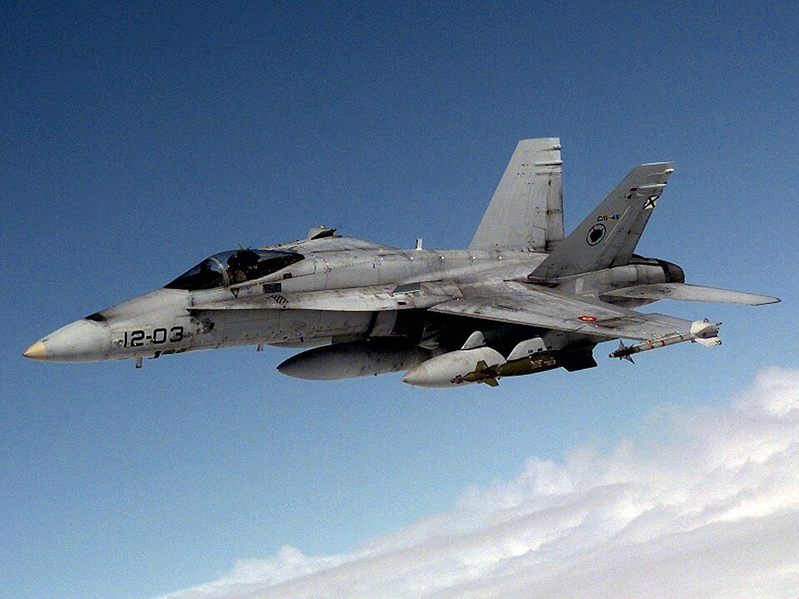
A Spanish F-18 fighter operating under NATO command has shot down a suspected Russian drone after it entered Romanian airspace from the direction of Moldova early on Sunday, in another incident highlighting the growing pressure on NATO’s eastern air defences.
Romania’s Ministry of Defence said surveillance systems detected the unidentified aerial target at 4:44 am local time on August 16, approximately 24 kilometres north of Galați in southeastern Romania.
Two Spanish F-18 fighters deployed at Mihail Kogălniceanu Air Base had already been launched as a precaution. After establishing radar contact, the aircraft were authorised to engage the intruder.
At 5:01 am, one of the fighters destroyed the drone over an uninhabited area of Galați County. Romanian authorities reported no casualties or property damage.
Two Spanish 🇪🇸 F-18 fighter jets, on enhanced Air Defence mission in Romania, were scrambled this morning and shot down a drone over Romanian airspace.
The F-18s are part of a larger contingent from the Spanish Air and Space Force. They arrived at Mihail Kogălniceanu Air Base… pic.twitter.com/YkWdDjGUXB
— NATO Air Command (@NATO_AIRCOM) August 16, 2026
Drone entered from the direction of Moldova
According to Romania’s Defence Ministry, the drone crossed into Romanian airspace from the direction of neighbouring Moldova.
After detecting the target, Romanian and NATO command structures coordinated the response through NATO’s Combined Air Operations Centre at Torrejón in Spain.
A possible debris field was subsequently identified between the communities of Băleni and Cudalbi, and helicopters were sent to search for wreckage.
Recovering the remains will be important because investigators may be able to identify the drone’s model, components and likely origin.
NATO has not yet formally established where the aircraft came from.
However, Supreme Headquarters Allied Powers Europe said preliminary information suggested that it was Russian.
“Further details of Sunday’s incident remain under investigation, but the drone appears to be Russian,” NATO spokesperson Colonel Martin O’Donnell said.
Spanish fighters protecting Romanian airspace
The interception provides a particularly visible example of NATO’s integrated air defence system.
The aircraft that destroyed the drone was Spanish, the airspace was Romanian, and the engagement was coordinated through a NATO command centre in Spain.
Spain has deployed fighters to Romania as part of NATO’s efforts to reinforce the eastern flank and provide additional air policing and air defence capacity.
The mission means aircraft from one allied country can protect another member’s airspace when required.
Romanian presidential adviser Marius Lazurca publicly thanked Madrid following the interception, expressing Romania’s gratitude for Spain’s participation in NATO Air Policing.
Romania has become a frontline NATO state
Romania’s geographical position has become increasingly important since Russia launched its full-scale invasion of Ukraine in 2022.
The country shares approximately 614 kilometres of border with Ukraine.
Part of that frontier lies close to the Danube River, where Russia has repeatedly attacked Ukrainian port infrastructure.
Those strikes have created a recurring danger that drones or fragments of weapons could cross into NATO territory.
Romania’s acting Foreign Minister Oana Țoiu described the country as being on the front line of NATO and European Union border defence following Sunday’s incident.
She said Bucharest had informed its allies and would continue strengthening defence and deterrence along NATO’s eastern flank.
The third shootdown in three weeks
The frequency of recent incidents is becoming particularly significant.
According to Țoiu, Sunday’s interception was the third drone to enter Romanian airspace illegally and be shot down within three weeks.
Reuters described Sunday’s incident as the fourth such event involving Romania this year.
The growing number of incursions raises questions about whether they are accidental consequences of the war, the result of electronic warfare, deliberate tests of NATO’s defences, or a combination of different circumstances.
Without analysis of the recovered wreckage and flight data, attributing the latest incident definitively would be premature.
NATO’s preliminary assessment nevertheless makes the possibility of Russian origin particularly sensitive.
Another NATO interception just two days after Latvia
The Romanian incident follows another significant interception on NATO’s eastern flank.
On August 14, an Italian Eurofighter operating under NATO command destroyed a drone after it violated Latvian airspace near the Russian border.
Two Italian Eurofighters were scrambled from Lithuania, while two Turkish F-16s based in Estonia were also deployed. One of the Italian aircraft destroyed the unmanned aircraft.
The incidents in Latvia and Romania occurred only two days apart.
They also demonstrate the multinational nature of NATO’s current air defence posture.
Italian aircraft protected Latvia.
Spanish aircraft protected Romania.
Turkish fighters supported the Latvian response.
The alliance’s eastern airspace is increasingly being defended through a distributed network of allied aircraft, radar systems and command centres rather than solely by each country’s national air force.
The war in Ukraine increasingly spills toward NATO airspace
The Romanian interception occurred during another intense period of aerial warfare between Russia and Ukraine.
Russia launched missile and drone strikes against several Ukrainian targets overnight, while Ukraine conducted one of its largest drone attacks against Russia.
Russian authorities reported hundreds of Ukrainian drones during the attack, with targets extending deep into Russian territory and toward Moscow.
The extraordinary scale of drone warfare creates an increasingly complicated environment for neighbouring NATO countries.
Hundreds of unmanned aircraft can be airborne during major strike waves.
Some may malfunction.
Others may lose navigation.
Electronic warfare can interfere with satellite positioning.
Damaged drones can continue flying after being intercepted.
Aircraft may consequently cross borders even when those borders were not their intended destination.
But NATO cannot assume that every incursion is accidental.
Each unidentified aircraft must be treated as a potential threat until its behaviour and origin can be established.
The electronic warfare problem
Modern drone warfare has also introduced a less visible danger to European airspace.
Both Russia and Ukraine employ extensive electronic warfare systems designed to interfere with drone navigation and communications.
GPS jamming can prevent an aircraft from accurately determining its position.
Spoofing can feed navigation equipment false location information.
A drone that loses reliable navigation may consequently deviate significantly from its intended route.
The Baltic region has experienced extensive satellite navigation interference since the beginning of the war, affecting both military and civilian activity.
Romania faces a somewhat different geographical environment, but the basic challenge remains the same: NATO air defence networks must distinguish between deliberate incursions and unmanned aircraft that have entered allied territory because battlefield conditions disrupted their flight.
Fighter jets are effective but expensive drone interceptors
The incident also illustrates one of NATO’s emerging air defence problems.
A fighter such as the F-18 can detect, identify and destroy an unmanned aircraft.
But using high-performance combat aircraft against relatively inexpensive drones is not necessarily an efficient long-term solution.
Every interception requires pilots, ground crews, fuel, radar coverage, and potentially an air-to-air missile whose cost may dramatically exceed that of the target.
That economic imbalance becomes more serious when drones appear in large numbers.
A handful of incursions can be handled with fighters.
Dozens or hundreds simultaneously would create a fundamentally different challenge.
NATO countries are consequently investing in additional ground-based air defence, electronic warfare and dedicated counter-drone technologies.
Romania is strengthening its defences
The repeated incursions are accelerating Romania’s efforts to improve its ability to protect its airspace.
Romania already hosts significant NATO infrastructure, including allied forces and aircraft at Mihail Kogălniceanu Air Base near the Black Sea.
The country has also become increasingly important to NATO logistics and reinforcement planning because of its proximity to Ukraine and the Black Sea.
Recent drone incidents have added another mission: defending Romanian territory against relatively small unmanned aircraft arriving from an active war zone.
That requires a different defensive architecture from the traditional task of intercepting Russian fighters or bombers.
Small drones can fly lower and slower than conventional aircraft, making them more difficult for radar networks optimised for traditional aviation threats to detect and track.
Black Sea security is becoming increasingly complicated
Romania is also confronting unmanned threats at sea.
On August 11, Romanian military divers destroyed two unidentified Gerbera-type drones discovered drifting close to the Neptun Deep offshore gas development in Romania’s Black Sea exclusive economic zone.
The drones were destroyed in a controlled operation because of the potential danger to shipping and critical energy infrastructure.
Their origin had not been established.
The incident demonstrated how the drone problem is expanding beyond air defence.
Unmanned systems and remnants of weapons can threaten ports, offshore infrastructure, commercial vessels and energy installations.
Romania, Bulgaria and Turkey have already been cooperating to remove mines drifting through the Black Sea as a consequence of the war in Ukraine.
Drones now add another layer to that security challenge.
NATO’s eastern flank is adapting to a drone battlefield
For much of its history, NATO air policing concentrated on conventional aircraft.
Fighters would scramble to identify Russian military aircraft approaching or entering allied airspace.
That mission still exists.
But the alliance increasingly has to deal with an entirely different category of target.
Small unmanned aircraft can be difficult to detect.
They may not follow predictable flight paths.
Their origin may not immediately be obvious.
And destroying them with conventional fighter aircraft can be disproportionately expensive.
The events over Latvia and Romania suggest that drone interception is becoming a routine component of NATO air defence rather than an exceptional mission.
A clear demonstration of collective defence
Sunday’s operation ultimately demonstrated why NATO maintains multinational forces along its eastern frontier.
Romania detected the intrusion.
Spanish fighters intercepted it.
A NATO command centre coordinated the engagement.
The target was destroyed without casualties or damage.
That is precisely the type of integrated response NATO’s air policing system is designed to provide.
But the success of the interception also reveals a growing strategic problem.
The war in Ukraine is generating an increasingly crowded and unpredictable aerial environment immediately beside NATO territory.
As drones become cheaper, more numerous and more capable, defending European airspace will require more than fighter aircraft.
It will require layered sensors, electronic warfare, inexpensive interceptors, ground-based systems and increasingly sophisticated command networks capable of deciding within minutes whether an unidentified aircraft is lost, malfunctioning or hostile.
The Spanish F-18’s successful interception over Romania prevented Sunday’s incident from becoming something more serious.
The larger challenge is ensuring NATO can respond just as effectively when the next drone crosses the border, especially if it does not come alone.