
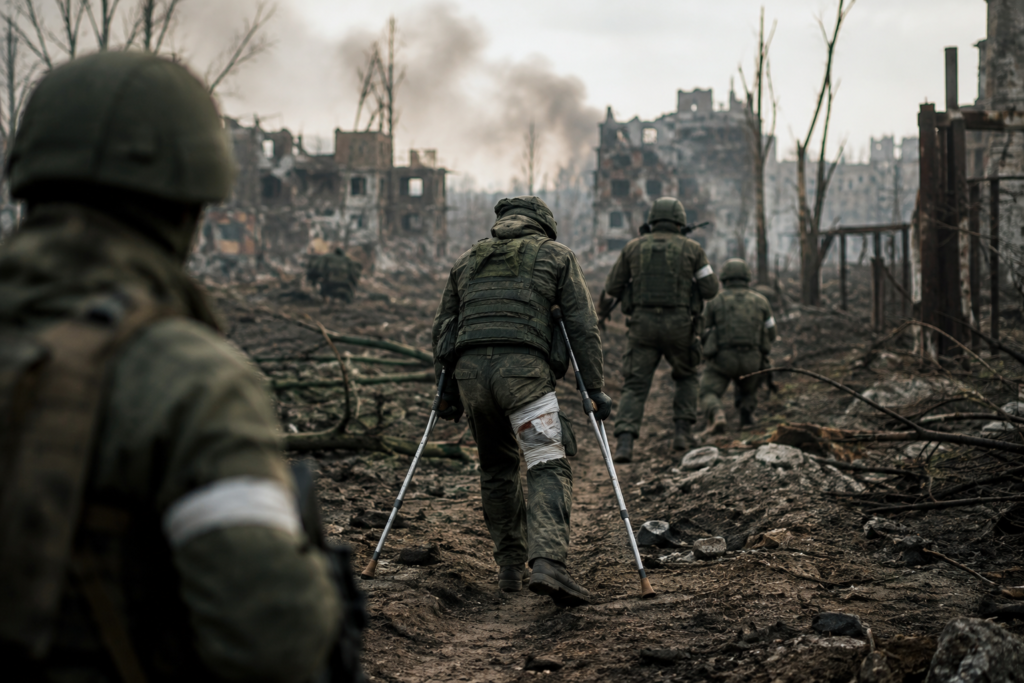
Image Credits: Russia Accused of Sending Severely Wounded Soldiers Back Into Frontline Assaults in Ukraine. AI-generated illustration created by Open Chronicle using ChatGPT (OpenAI). August 2026. This image is illustrative and does not depict a real-world scene.
By Open Chronicle Defence with agencies
Russia is facing renewed scrutiny over reports that severely wounded and disabled soldiers are being returned to frontline combat in Ukraine, including men suffering from injuries that would ordinarily be expected to remove them from assault duties.
A report published by Forbes on August 16 describes cases in which injured Russian servicemen, including soldiers reportedly moving with crutches, have been sent toward Ukrainian positions as Moscow attempts to sustain offensive operations despite heavy battlefield losses.
Some accounts go further, alleging that wounded troops have been deliberately sent into exposed areas where their movement could attract Ukrainian drones and reveal defensive positions. Such specific battlefield claims are difficult to independently verify, particularly when they originate from frontline footage or individual testimony. However, separate reporting has documented a broader pattern of seriously injured Russian soldiers being returned to combat despite significant medical limitations.
The reports provide another indication of the extraordinary manpower pressures generated by a war now dominated by drones, artillery, small infantry assaults and extremely high casualty rates.
Wounded soldiers reportedly returned to combat
The most disturbing allegations concern soldiers who have already suffered serious injuries.
According to the Forbes report, Russian commanders have continued sending wounded and disabled personnel toward frontline positions despite their physical limitations. Some soldiers have reportedly participated in operations while relying on crutches or dealing with injuries that severely restrict their mobility.
Separate reporting by Radio Free Europe/Radio Liberty in June documented cases involving Russian servicemen who were returned to the war despite major injuries.
One reportedly had suffered head and chest wounds, lost an eye and experienced severe hearing loss. Another had major visual impairment. A third suffered broken bones, shrapnel wounds, nerve damage and extremely limited use of one arm.
Relatives, activists and others interviewed in those cases said the men were nevertheless returned to military service near the front.
The accounts suggest that the problem is not limited to soldiers recovering from relatively minor wounds.
Instead, some servicemen with substantial physical disabilities may be returning to environments where mobility, situational awareness and rapid reaction can determine whether a soldier survives.
Allegations of soldiers being used to expose Ukrainian positions
The Forbes report raises an even more serious allegation: that some wounded soldiers may be used to provoke Ukrainian attacks.
On a battlefield saturated with drones, exposing a soldier can potentially reveal much more than the location of one individual.
When Ukrainian operators identify Russian troops, they may launch FPV drones, adjust artillery fire or activate other surveillance and strike systems.
Observing where those weapons originate can potentially provide Russian forces with information about Ukrainian positions.
The allegation is therefore that vulnerable troops can effectively become a form of battlefield reconnaissance, drawing enemy fire that helps other Russian units identify Ukrainian operators or defensive positions.
Open Chronicle cannot independently establish how widespread such a practice may be.
But the allegation reflects the increasingly brutal relationship between manpower and reconnaissance in the drone war.
Ukraine has transformed the infantry battlefield
The battlefield confronting Russian infantry in 2026 bears little resemblance to conventional infantry operations before the widespread deployment of inexpensive drones.
Small reconnaissance drones continuously search roads, tree lines, trenches, and ruined buildings.
FPV aircraft can pursue individual soldiers.
Thermal cameras allow observation at night.
Loitering munitions can remain airborne while operators search for targets.
Electronic warfare systems attempt to disrupt those aircraft, while opposing reconnaissance teams search for the antennas and operators controlling them.
Simply reaching an enemy position can therefore become extraordinarily dangerous.
Large mechanised formations are particularly vulnerable when detected, encouraging both sides to disperse their forces and rely increasingly on small infantry groups.
Small assault groups have become increasingly important
Russian forces have adapted by frequently using small groups to infiltrate Ukrainian positions.
Instead of concentrating large numbers of troops and armoured vehicles, soldiers can advance individually or in small teams, attempting to exploit gaps between Ukrainian defensive positions.
Recent assessments from the Institute for the Study of War indicate that Russia has continued relying heavily on infiltration operations while struggling to achieve major operational breakthroughs.
ISW assessed that Russian forces advanced only about 37.85 square kilometres in July 2026, despite continuing offensive operations across multiple sectors. Even including areas of infiltration, Russian progress remained dramatically below the rate achieved during the equivalent period in 2025.
The result is an attritional equation in which significant numbers of soldiers are being consumed for relatively limited territorial gains.
July brought exceptionally heavy Russian casualties
The manpower pressure behind these practices is becoming increasingly important.
According to Ukrainian General Staff figures cited by ISW, Russian forces suffered approximately 42,860 casualties during July 2026, including killed and wounded personnel.
That was the highest monthly Russian casualty figure reported so far during 2026.
Ukrainian casualty estimates cannot be independently verified in full and should be treated as wartime claims.
But Western analysis also points toward extremely heavy Russian losses.
Recent reporting indicates that Russia is struggling to maintain recruitment while attempting to avoid another politically disruptive mass mobilisation.
That creates enormous pressure on the military personnel system.
Every soldier who can be returned to duty reduces the immediate requirement to find a replacement.
The danger is that medical standards become increasingly subordinate to manpower requirements.
Moscow wants to avoid another mobilisation
Russia’s September 2022 partial mobilisation produced substantial political consequences.
Hundreds of thousands of men were called into military service, while large numbers of Russians left the country to avoid mobilisation.
The Kremlin has since attempted to sustain the war largely through contract recruitment rather than another large compulsory mobilisation.
Financial incentives have played a central role.
Regional governments have offered increasingly substantial signing bonuses, while recruitment campaigns have concentrated heavily on poorer regions where military pay can dramatically exceed civilian incomes.
But the system appears to be under growing strain.
Recent reporting from the Guardian and Financial Times describes recruiters using increasingly aggressive methods while struggling to meet manpower requirements.
Recruitment increasingly targets vulnerable populations
Russia has drawn soldiers from an extraordinarily broad range of sources during the war.
Prisoners have been recruited.
Foreign nationals have been offered military contracts.
Financially vulnerable Russians have been targeted with large signing payments.
Regional governments have faced pressure to fulfil recruitment quotas.
Recent reporting has also described coercive recruitment tactics involving threats, detention and pressure against potential recruits.
Returning wounded personnel to duty therefore fits into a larger manpower problem.
Russia wants enough soldiers to maintain continuous pressure across a frontline extending for hundreds of kilometres without imposing another nationwide mobilisation.
That becomes increasingly difficult when tens of thousands of troops are being killed or wounded every month.
Medical classification becomes strategically important
Normally, military medicine is concerned with determining whether a wounded soldier can safely return to service.
The Ukraine war complicates that calculation.
A soldier might be incapable of performing infantry assault duties but still capable of carrying out logistics, communications, administrative or rear area tasks.
A military suffering severe manpower shortages therefore has strong incentives to retain wounded personnel wherever possible.
The controversy begins when soldiers whose injuries severely limit their ability to fight are nevertheless returned to combat roles.
The RFE/RL investigation documented allegations that Russian military medical procedures had allowed seriously injured soldiers to be sent back despite conditions that appeared incompatible with frontline service.
If such cases are becoming systematic rather than exceptional, they would provide another measure of the strain affecting Russia’s force generation system.
Drones make disability particularly dangerous
Physical disability creates obvious disadvantages in any combat environment.
Drone warfare magnifies them.
A soldier moving with difficulty cannot rapidly cross exposed ground.
Someone using crutches cannot easily dive into cover when an FPV drone approaches.
Severe hearing loss can prevent a soldier from recognising warnings or detecting nearby aircraft.
Visual impairment can make identifying drones or threats almost impossible.
Damaged limbs can prevent a soldier from carrying heavy equipment or rapidly abandoning a position.
Modern battlefield conditions therefore make some of the injuries described in recent reports particularly incompatible with frontline assault operations.
Attrition has become central to Russia’s strategy
Russia retains important advantages in manpower, artillery, missiles and industrial capacity.
But those advantages have not produced rapid territorial breakthroughs during 2026.
ISW’s August assessment concluded that Russia’s spring and summer offensive had failed to generate operationally significant gains despite continuing attacks.
Ukrainian counterattacks, long-range strikes and extensive drone operations have helped constrain Russian movement and mechanised operations.
Russia has consequently continued relying heavily on positional warfare and incremental advances.
That strategy can work only if Moscow can replace losses faster than the casualty rate undermines its combat units.
The treatment of wounded soldiers becomes part of that equation.
The economics of manpower
Much of the discussion surrounding modern warfare concentrates on weapons.
How many artillery shells can Russia manufacture?
How many drones can Ukraine produce?
How many missiles remain available?
But soldiers are also a finite military resource.
Training an infantryman requires time.
Replacing experienced troops is more difficult than simply filling a vacancy with a recruit.
Experienced junior commanders are even harder to replace.
As casualties accumulate, the quality of replacement personnel can deteriorate even if the total number of soldiers remains relatively stable.
Returning partially recovered troops to combat may temporarily help maintain unit strength.
It can also create additional casualties and reduce overall combat effectiveness.
Russia continues to absorb enormous losses
One of the defining characteristics of the war has been Russia’s ability to absorb casualty levels that would create severe political pressure in many other countries.
Its much larger population gives Moscow an important demographic advantage over Ukraine.
The Kremlin has also structured recruitment in ways that distribute the burden unevenly across Russian society.
Large financial payments encourage volunteers from economically disadvantaged areas, while Moscow and other major urban centres have generally experienced the war differently from regions supplying disproportionate numbers of recruits.
But the ability to absorb losses is not unlimited.
The increasingly aggressive recruitment campaign suggests the Kremlin understands that maintaining its current force structure requires constant replenishment.
Disabled soldiers expose the hidden cost of attritional warfare
The reports of wounded Russian soldiers returning to frontline operations therefore reveal something larger than individual military decisions.
They expose the human consequences of an attritional strategy.
Territory measured in kilometres can obscure what is required to capture it.
Behind every advance are infantry teams crossing exposed ground under drones, artillery and mines.
Behind every casualty statistic are soldiers entering hospitals, rehabilitation systems or cemeteries.
And when a military begins returning severely injured personnel to those same battlefields, the distinction between maintaining combat strength and consuming manpower becomes increasingly difficult to ignore.
Russia still possesses substantial military resources and continues to conduct offensive operations across Ukraine.
But its advances during 2026 have come at considerable cost, while recruitment pressures appear to be growing.
The allegation that disabled soldiers are being sent into assault operations represents one of the starkest indications yet of that pressure.
It also illustrates one of the darkest realities of the modern drone battlefield.
Technology may be transforming how armies detect and destroy targets, but the final burden of attritional warfare continues to fall on individual soldiers, including, according to mounting reports, some who have already been badly wounded once.