
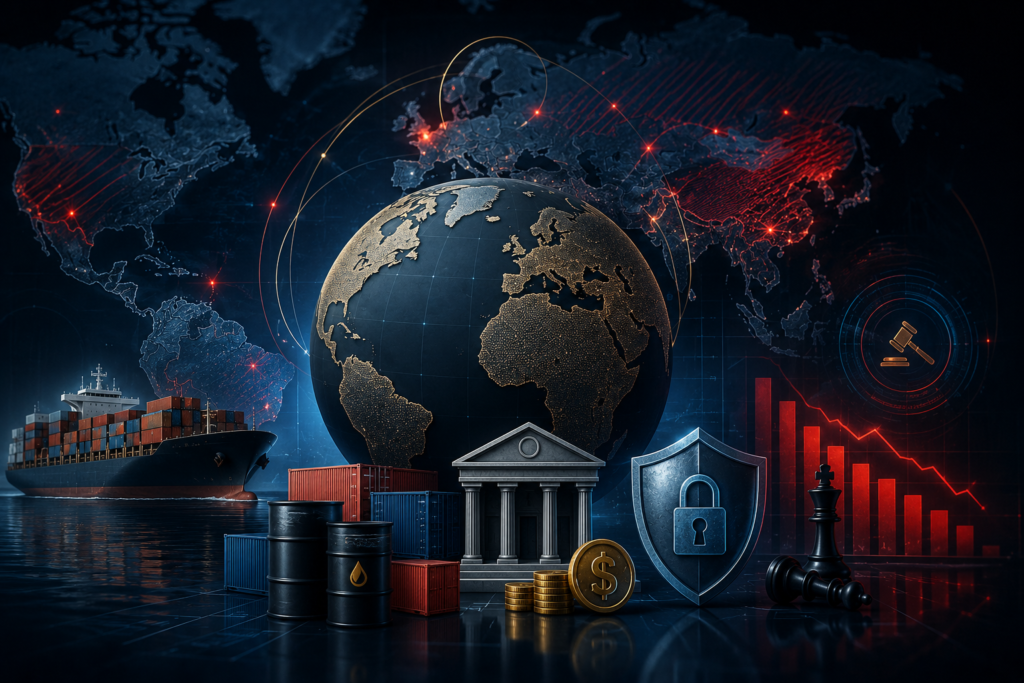
Image Credits: Open Chronicle Launches the Sanctions & Economic Warfare Tracker. AI-generated illustration created by Open Chronicle using ChatGPT (OpenAI). August 2026. This image is illustrative and does not depict a real-world scene.
By Open Chronicle
Open Chronicle has expanded its Intelligence Tools platform with the launch of the Sanctions & Economic Warfare Tracker, a new interactive tool designed to help readers understand how sanctions, export controls, financial restrictions and strategic dependencies shape international power.
The new platform examines economic pressure as a component of modern statecraft, allowing users to explore how governments use financial systems, trade restrictions, energy measures, technology controls and asset freezes to influence the behaviour of other states.
Understanding Economic Pressure
Sanctions are no longer limited to traditional trade restrictions. Modern economic warfare can involve banking access, advanced technologies, transport, defence supply chains, energy exports, dual use goods and the freezing of assets.
The Sanctions & Economic Warfare Tracker brings these dimensions together into a single analytical interface.
Each country receives an Open Chronicle Sanctions Exposure Score from 0 to 100, supported by nine separate pressure indicators:
- Financial Pressure
- Energy Restrictions
- Technology Controls
- Trade Restrictions
- Export Controls
- Asset Freezes
- Transport Restrictions
- Defence Restrictions
- Dual Use Controls
Higher scores indicate a greater level of sanctions exposure and economic pressure.
Explore Countries Under Sanctions Pressure
The tool includes a growing collection of countries affected by different sanctions regimes and targeted economic measures.
Users can search by country, filter by region and examine individual profiles including states such as Russia, Iran, North Korea, Belarus, Venezuela, Myanmar, Syria, Cuba, Sudan, Libya and Yemen.
Each profile includes the country’s sanctions exposure score, pressure level, trend, analytical confidence and the sectors most affected by restrictions.
Sanctioning Authorities
The tracker also identifies the principal authorities associated with each sanctions environment.
Depending on the country, these can include:
- United States
- European Union
- United Kingdom
- United Nations
- Canada
- Japan
- Australia
This allows users to see whether a country faces a largely unilateral sanctions framework or a broader international coalition of economic pressure.
Strategic Dependencies
One of the most important elements of the tracker is its focus on strategic dependencies.
Sanctions can be particularly effective when they target sectors that are difficult to replace.
The tool highlights vulnerabilities associated with areas such as:
- Energy
- International finance
- Advanced technology
- Shipping
- Defence production
- Trade routes
- Industrial components
- Critical imports
Understanding these dependencies helps explain why similar sanctions can produce very different effects across different countries.
Circumvention Risk
Economic restrictions rarely operate in isolation.
Targeted states may attempt to reduce the impact of sanctions through alternative financial systems, intermediary countries, re-export networks, informal trade routes and new commercial relationships.
The Sanctions & Economic Warfare Tracker therefore includes a Circumvention Risk assessment designed to highlight how easily restrictions may be bypassed or weakened.
This provides users with an additional analytical layer beyond simply identifying whether sanctions exist.
Follow the Evolution of Sanctions
Each country profile also contains a Sanctions Timeline highlighting selected milestones in the evolution of economic restrictions.
Users can follow how sanctions frameworks have expanded, changed or been restructured over time.
This is especially important because sanctions are not static. Governments frequently introduce new measures, remove restrictions, issue licences or change enforcement priorities in response to diplomatic, military and political developments.
Compare Economic Pressure
The tool also introduces a comparison system allowing users to examine up to three countries simultaneously.
For example, users can compare the sanctions exposure of Russia, Iran and North Korea through a consistent 0 to 100 scale.
The comparison provides a quick visual overview of how different sanctions environments vary in intensity.
Part of the Open Chronicle Intelligence Tools Platform
The Sanctions & Economic Warfare Tracker becomes the seventh tool in the expanding Open Chronicle Intelligence Tools ecosystem.
The platform currently includes:
- Conflict Map
- Geopolitical Risk Analyzer
- Future Scenario Builder
- Strategic Crisis Simulator
- Country Risk Monitor
- Threat Intelligence Center
- Sanctions & Economic Warfare Tracker
Together, these tools are designed to provide different ways of exploring geopolitical risk, conflict, strategic competition and international security.
Intelligence Beyond the Headlines
Economic pressure has become one of the central instruments of modern geopolitical competition.
States increasingly use access to markets, financial systems, technologies, energy resources and global supply chains as sources of strategic leverage.
The Sanctions & Economic Warfare Tracker is designed to help readers explore these relationships through a structured and accessible intelligence framework.
Open Chronicle will continue expanding the tool with additional countries, improved analytical models and new capabilities as the Intelligence Tools platform develops.