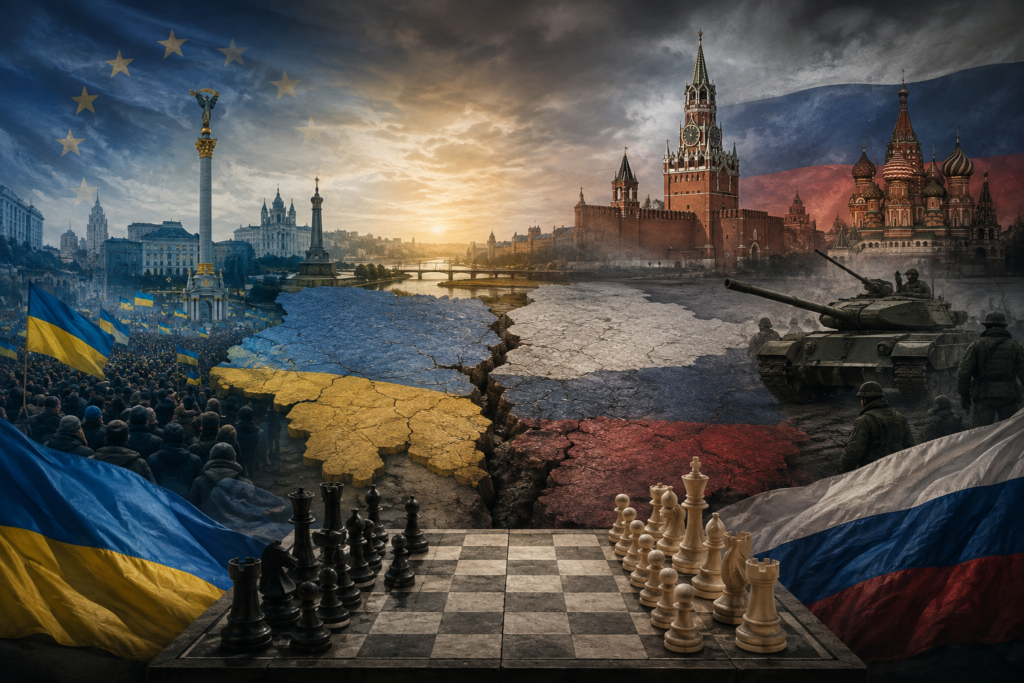
The dissolution of the Soviet Union in December 1991 represented far more than the disappearance of a political system. For the Russian Federation, it constituted a profound geopolitical, institutional, and psychological rupture that transformed almost every dimension of national power.
Within a remarkably short period, a state that had exercised political authority across much of Eurasia, maintained military forces throughout Eastern Europe, commanded one of the world’s two principal alliance systems, and competed globally with the United States ceased to exist.
The Russian Federation inherited much of the Soviet Union’s international status, including its permanent seat on the United Nations Security Council and the largest share of its strategic military capabilities. Yet the geopolitical environment surrounding Moscow had changed fundamentally.
Russia remained a major power.
But the strategic system within which Russian power had operated had disappeared.
Understanding this distinction is essential to understanding the foreign and security policies that developed during the following three decades.
At the height of the Cold War, the Soviet Union possessed many of the characteristics traditionally associated with a global superpower.
Its territory extended across approximately one sixth of the Earth’s land surface. Its armed forces numbered in the millions. Soviet nuclear forces maintained strategic parity with the United States, while the Warsaw Pact provided Moscow with a military alliance extending deep into Central Europe.
Soviet political influence reached far beyond Europe. Moscow maintained strategic partnerships, military relationships and ideological allies across Asia, Africa, Latin America and the Middle East.
The collapse of this system occurred with extraordinary speed.
The political transformations of 1989 removed communist governments throughout Central and Eastern Europe. The Warsaw Pact formally dissolved in 1991. Within the Soviet Union itself, nationalist movements and republican governments increasingly challenged the authority of the central state.
The failed coup of August 1991 dramatically accelerated the process.
Hard-line Soviet officials attempted to remove Gorbachev and reverse the political transformation of the preceding years. The coup collapsed within days, but the political consequences were irreversible. Boris Yeltsin emerged significantly strengthened, while republican governments accelerated their declarations of sovereignty and independence.
Ukraine’s declaration of independence on 24 August and the overwhelming endorsement of independence in the referendum of 1 December were particularly consequential.
Without Ukraine, maintaining a viable Soviet federation became extraordinarily difficult.
On 8 December 1991, the leaders of Russia, Ukraine and Belarus signed the Belavezha Accords, declaring that the Soviet Union had ceased to exist and establishing the Commonwealth of Independent States.
Gorbachev resigned as President of the Soviet Union on 25 December.
The Soviet flag was lowered over the Kremlin.
The following day, the Soviet Union formally ceased to exist.
For much of the world, this represented the end of the Cold War.
For Russia, it represented the beginning of an entirely new strategic problem.
The geopolitical consequences were enormous.
Russia retained by far the largest territory among the former Soviet republics, but its effective strategic perimeter contracted dramatically.
Fourteen other Soviet republics became internationally recognised sovereign states.
Estonia, Latvia and Lithuania regained independence on the Baltic Sea.
Belarus and Ukraine became independent states along Russia’s western approaches.
Moldova emerged between Ukraine and Romania.
Georgia, Armenia and Azerbaijan became independent in the South Caucasus.
Kazakhstan, Uzbekistan, Turkmenistan, Kyrgyzstan and Tajikistan became sovereign states across Central Asia.
The political map surrounding Russia had been fundamentally redrawn.
Territories that Soviet strategic planners had previously considered part of the internal political and military geography of the USSR were suddenly located beyond the borders of the Russian Federation.
The consequences were particularly important in the west.
During the Cold War, Soviet military strategy benefited from extraordinary geographical depth. Soviet territory was protected not only by the western republics of the USSR but also by Warsaw Pact states extending across Eastern and Central Europe.
After 1991, much of that strategic depth disappeared.
Poland, Hungary, Czechoslovakia, Romania, Bulgaria and the former East Germany were no longer Soviet allies.
The Baltic republics were independent.
Belarus and Ukraine were sovereign countries.
The western frontier of Russian political control had therefore moved hundreds, and in some areas more than a thousand, kilometres eastward.
From the perspective of Russian strategic culture, geography mattered enormously.
Russia’s historical experience had repeatedly demonstrated the vulnerability of the broad European plain. Major invasions associated with Napoleon in 1812 and Nazi Germany in 1941 became deeply embedded within Russian historical memory and military thinking.
Consequently, strategic depth traditionally occupied an important place in Russian concepts of national defence.
The post-Soviet territorial settlement dramatically reduced that depth.
This did not automatically make conflict with neighbouring states inevitable. It did, however, create a structural condition that would increasingly influence Russian security thinking.
The collapse of the Soviet Union also fragmented one of the largest military establishments ever constructed.
Soviet military installations, weapons systems, aircraft, naval facilities and personnel were distributed across the territories of multiple newly independent states.
The nuclear question was particularly sensitive.
Strategic nuclear weapons were located not only in Russia but also in Ukraine, Belarus and Kazakhstan. Their disposition became one of the most urgent security questions confronting the international community during the early 1990s.
Russia eventually emerged as the sole internationally recognised nuclear successor to the Soviet Union, while Ukraine, Belarus and Kazakhstan relinquished the nuclear weapons stationed on their territories.
Yet conventional military assets presented equally complicated challenges.
Military districts that had previously formed components of a single command structure were divided among sovereign governments. Officers were required to decide where their political allegiance belonged. Defence industries previously integrated across republican boundaries became separated by international borders.
Ukraine was particularly important.
Some of the Soviet Union’s most sophisticated aerospace, missile, shipbuilding and military industrial facilities were located on Ukrainian territory. The Black Sea Fleet became the subject of prolonged negotiations between Moscow and Kyiv, while the status of Sevastopol acquired immediate strategic significance.
The Soviet military machine had been designed as an integrated continental system.
After 1991, that system had to be dismantled, divided or reconstructed.
Russia’s geopolitical contraction coincided with a severe economic crisis.
The transition from Soviet central planning to a market economy produced extraordinary social and economic disruption during the 1990s. Industrial production declined dramatically. Inflation destroyed savings. State revenues collapsed. Wage and pension payments were frequently delayed.
The defence establishment was particularly affected.
Military procurement declined substantially. Training hours were reduced. Infrastructure deteriorated. Officers sometimes went months without receiving salaries. Numerous military units remained equipped with increasingly ageing Soviet-era systems that the Russian government lacked sufficient resources to modernise.
For a state accustomed to measuring itself against the United States, this deterioration was strategically and psychologically significant.
Russia retained thousands of nuclear weapons and remained capable of destroying any adversary in a strategic nuclear exchange.
Yet conventional military capability, economic influence and political reach declined substantially.
This produced an unusual strategic condition.
Russia remained too powerful to be treated as an ordinary regional state, but it was no longer capable of exercising the global influence previously enjoyed by the Soviet Union.
The tension between these two realities would become one of the defining characteristics of post-Soviet Russian foreign policy.
The collapse also created a profound problem of political identity.
The Soviet Union had never simply been Russia under another name. It was formally a multinational federation incorporating numerous republics and nationalities under a common ideological and political system.
When that system disappeared, the Russian Federation was forced to answer a fundamental question:
Or did its history, military power, economic size and geopolitical position give it a special role within the former Soviet space?
No immediate consensus existed.
During the early Yeltsin period, influential figures within the Russian government initially favoured extensive cooperation with the United States and Western Europe. Foreign Minister Andrei Kozyrev became associated with an Atlanticist approach that sought Russia’s integration into the political and economic institutions of the post-Cold War international system.
There were substantial reasons for pursuing such a strategy.
Russia required Western investment.
It required economic assistance.
Its government sought membership in major international institutions.
Many reformers believed that confrontation between Russia and the West had ended permanently with the disappearance of Soviet communism.
For a brief period, the possibility of constructing a cooperative European security order encompassing both Russia and the Western democracies appeared plausible.
But another debate was already developing beneath the surface.
The new borders also created a major demographic question.
Tens of millions of ethnic Russians and Russian speakers suddenly found themselves living outside the borders of the Russian Federation.
Large Russian-speaking populations existed in Ukraine, Kazakhstan, Latvia, Estonia, Belarus and other former Soviet republics.
These populations had not necessarily migrated across international borders.
The borders had moved around them.
This distinction became politically important.
Questions concerning citizenship, language rights and the political status of Russian-speaking communities increasingly entered Russian domestic debate. Politicians from across the ideological spectrum argued that Moscow retained responsibilities toward what became known as Russian “compatriots abroad.”
The issue gradually became incorporated into Russian strategic thinking.
Protecting Russian citizens and Russian-speaking communities outside the Federation would eventually become an increasingly prominent component of Moscow’s foreign policy discourse.
The concept would later play an important role in Russian policy toward several post-Soviet states, including Ukraine.
It was within this environment that one of the most consequential concepts in post-Soviet Russian foreign policy emerged:
The term referred broadly to the independent states that had previously constituted the Soviet Union.
Its significance extended beyond geography.
Calling these states the Near Abroad implicitly distinguished them from ordinary foreign countries. Poland, Germany or China belonged to the conventional international environment. Ukraine, Belarus, Kazakhstan, Moldova, Georgia and the other former Soviet republics occupied a different conceptual category.
They were foreign.
But they were not perceived as entirely foreign in the conventional strategic sense.
Economic networks remained interconnected.
Military infrastructure had been constructed as part of a common system.
Millions of families crossed the newly established borders.
Russian remained widely spoken.
Energy pipelines, railways and industrial supply chains connected the region.
Most importantly, Russian policymakers increasingly concluded that developments within these states could directly affect Russian national security.
The concept therefore gradually acquired strategic meaning.
By the early 1990s, Russian foreign policy increasingly identified stability within the former Soviet space as a particularly important national interest.
This development occurred before Vladimir Putin became president.
That chronology is critical.
The idea that Russia possessed special interests in the former Soviet space was not created by Putin. It emerged during the Yeltsin era and eventually attracted support across substantial sections of the Russian foreign policy establishment.
What changed under Putin was the degree of state power available to pursue those interests and the increasingly expansive interpretation of what those interests required.
The Commonwealth of Independent States represented the first institutional attempt to manage the post-Soviet environment.
Established initially by Russia, Ukraine and Belarus and subsequently joined by most other former Soviet republics, the CIS provided mechanisms for consultation and cooperation across areas including trade, security and migration.
Its political significance was ambiguous from the beginning.
For many newly independent states, participation offered a practical mechanism for managing the enormous economic and administrative consequences of Soviet dissolution.
For sections of the Russian establishment, however, the CIS also represented a potential framework for preserving Russian influence within the former Soviet space.
These interpretations were not identical.
Many former Soviet republics sought cooperation without surrendering their newly acquired sovereignty.
Russia increasingly sought regional leadership.
The tension between these two objectives would become a recurring feature of post-Soviet politics.
The early optimism surrounding Russia’s relationship with the West gradually weakened.
Several factors contributed.
Economic reforms associated in the public imagination with Western advice produced enormous social hardship.
Russia’s international influence declined.
Conflicts erupted within several former Soviet republics.
Questions concerning NATO’s future increasingly entered European diplomacy.
Domestic political opposition criticised the Yeltsin government’s perceived weakness toward Washington.
Even policymakers initially committed to Western integration began arguing that Russian national interests could not simply be equated with those of the United States and Western Europe.
The 1993 Russian Foreign Policy Concept already reflected this evolution. It simultaneously sought Russia’s integration into the international community and described the country as a great power possessing a distinctive geopolitical position and significant military capabilities.
The contradiction would become increasingly important.
Russia wanted integration.
But it also wanted recognition.
It wanted partnership.
But it expected that partnership to reflect its status as a major power.
It accepted the sovereignty of the newly independent post-Soviet republics.
But substantial parts of its political establishment increasingly believed Russia possessed exceptional interests within their territory.
These tensions were never fully resolved.
The shock operated simultaneously across several dimensions.
These dimensions interacted.
Economic weakness reinforced military weakness.
Military weakness intensified concerns regarding geopolitical contraction.
Geopolitical contraction strengthened arguments favouring the preservation of influence within the former Soviet space.
The loss of international status reinforced political movements demanding restoration of Russian power.
Over time, these forces contributed to a strategic worldview increasingly focused upon sovereignty, great-power status, regional influence and resistance to a European security system perceived as developing without sufficient Russian participation.
It would be a mistake to draw a straight line from the dissolution of the Soviet Union in 1991 to the invasion of Ukraine in 2022.
History was not predetermined.
Russia possessed multiple possible strategic trajectories after the Soviet collapse. Cooperation with Western institutions remained substantial during different periods. Russian leaders made political choices, as did the governments of Ukraine, the United States, European states and the other former Soviet republics.
Nevertheless, 1991 created the structural environment within which those later choices would be made.
The central strategic contradiction was already visible.
The Soviet empire had disappeared, but Russia’s conception of itself as a major power had not.
The former Soviet republics had become sovereign states, but Russian policymakers increasingly regarded developments within those states as matters affecting fundamental Russian security interests.
The Cold War had ended, but no universally accepted security architecture emerged capable of reconciling the sovereignty of the newly independent states with Russia’s demand for recognition as the principal strategic power within much of the former Soviet space.
Ukraine stood at the centre of this unresolved contradiction.
Its population, industrial capacity, Black Sea coastline, geographical position and historical connections to Russia gave it an importance unlike that of almost any other former Soviet republic.
For Kyiv, 1991 represented the restoration of sovereign political choice.
For Moscow, Ukrainian independence formed part of a much larger geopolitical contraction whose long-term consequences remained unresolved.
The difference between these two perspectives would become progressively more consequential.
The first task of the Russian Federation after the Soviet collapse was therefore not simply to develop a new foreign policy.
It was to determine what kind of state Russia intended to become, where its legitimate security interests ended, and what relationship it expected to maintain with the territories that had previously formed part of a common political system.
Those questions lead directly to the next section.
The collapse of Soviet ideology left Russia without the political doctrine that had defined both its domestic system and international mission for most of the twentieth century. The struggle to replace that identity would produce competing visions of Russia as a European state, a Eurasian civilisation and an autonomous great power, shaping the strategic debate that eventually transformed Moscow’s relationship with both the West and its former Soviet neighbours.
3.8 Kosovo and the Crisis of the Post Cold War Settlement
The Kosovo intervention of 1999 became one of the most consequential episodes in the deterioration of relations between Russia and the Western powers. Its importance extended far beyond the Balkans. For Moscow, the crisis raised fundamental questions concerning sovereignty, the authority of the United Nations Security Council, the legitimacy of humanitarian intervention and the circumstances under which military force could be used against a sovereign state.
These questions would later reappear in Russian arguments concerning Georgia, Crimea, the Donbas and the wider post Soviet security order.
The significance of Kosovo therefore lies not only in what happened in Yugoslavia, but also in how the intervention reshaped Russian interpretations of the emerging international system.
The Balkan Context
The violent dissolution of Yugoslavia during the 1990s produced some of the most serious armed conflicts in Europe since the Second World War.
Wars in Croatia and Bosnia and Herzegovina demonstrated the destructive consequences of ethnic nationalism, state collapse and competing territorial claims.
By the late 1990s, attention increasingly focused on Kosovo.
The province possessed an overwhelmingly ethnic Albanian population but remained formally part of the Federal Republic of Yugoslavia, dominated politically by Serbia.
Tensions escalated rapidly between Serbian security forces and the Kosovo Liberation Army.
Violence against civilians increased.
Large numbers of people were displaced.
Western governments increasingly argued that a humanitarian catastrophe was developing.
Diplomatic negotiations failed to produce a durable settlement.
NATO subsequently concluded that military intervention was necessary.
Operation Allied Force
On 24 March 1999, NATO launched Operation Allied Force, an air campaign against Yugoslav military and strategic targets.
The campaign lasted seventy eight days.
NATO governments presented the intervention as necessary to prevent further humanitarian catastrophe and compel Belgrade to withdraw security forces from Kosovo.
Russia strongly opposed the operation.
The disagreement concerned both the specific circumstances in Kosovo and the broader principles governing the international use of force.
Moscow argued that military action against a sovereign state required explicit authorisation from the United Nations Security Council.
No such authorisation had been obtained.
Russia, together with China, would almost certainly have opposed a resolution explicitly authorising the air campaign.
NATO therefore acted without a specific Security Council mandate permitting military force.
For Moscow, this was a decisive development.
Sovereignty Versus Humanitarian Intervention
The Kosovo crisis highlighted an unresolved tension within the post Cold War international order.
One principle emphasised sovereignty.
States possessed territorial integrity and political independence.
External military intervention was generally prohibited except in cases of self defence or Security Council authorisation.
Another principle increasingly emphasised the international responsibility to prevent mass atrocities.
Western governments argued that sovereignty could not provide absolute protection for governments committing or permitting severe humanitarian abuses against civilian populations.
Kosovo therefore forced policymakers to confront a difficult question.
Could humanitarian necessity justify military intervention when the Security Council was unable to reach agreement?
NATO governments increasingly answered yes, at least under exceptional circumstances.
Russia strongly disagreed.
This dispute became one of the earliest major fractures in the supposedly cooperative post Cold War order.
The Russian Legal Perspective
Russia placed particular emphasis on the United Nations Charter.
Moscow argued that the Security Council represented the principal legitimate authority for authorising military force in situations not involving direct self defence.
This interpretation served several Russian interests simultaneously.
It defended traditional principles of sovereignty.
It limited the ability of stronger military coalitions to intervene unilaterally.
And it preserved the importance of Russia’s permanent Security Council seat.
That final point was strategically significant.
After the collapse of the Soviet Union, Russia had lost much of its conventional military and economic influence.
But its Security Council veto remained one of the principal institutional mechanisms preserving its global status.
If Western governments could bypass the Council when consensus proved impossible, Russia’s ability to influence major international security decisions would be significantly reduced.
Kosovo therefore appeared to Moscow not merely as a legal dispute, but as a challenge to the institutional foundations of Russian great power status.
The Question of Precedent
Russian policymakers repeatedly warned that intervention in Kosovo could establish a dangerous precedent.
If NATO could intervene militarily in support of an ethnic minority seeking separation from a sovereign state, Moscow argued, similar claims might later emerge elsewhere.
The concern was not theoretical.
The former Soviet space contained numerous unresolved territorial disputes.
Abkhazia.
South Ossetia.
Transnistria.
Nagorno Karabakh.
Crimea.
The North Caucasus.
Several regions contained ethnic communities whose political aspirations crossed internationally recognised borders.
Russian officials therefore argued that weakening the principle of territorial integrity could eventually destabilise other parts of Europe and Eurasia.
This argument would later acquire considerable irony.
After opposing Kosovo’s separation from Serbia, Russia would invoke aspects of the Kosovo precedent when defending its own recognition of Abkhazia and South Ossetia in 2008 and later when attempting to justify the annexation of Crimea in 2014.
The Russian Serbian Relationship
Russia’s opposition to NATO intervention was also influenced by its relationship with Serbia.
Historical, religious and cultural ties between Russians and Serbs contributed to public sympathy for Belgrade.
Both societies possessed strong Orthodox Christian traditions.
Russian nationalist and conservative groups often portrayed Serbia as a traditional Slavic partner confronting Western pressure.
However, Russian policy was not based solely upon cultural solidarity.
The broader strategic question remained more important.
If NATO could conduct a major military operation against Yugoslavia despite Russian opposition, Moscow’s influence over European security appeared increasingly limited.
The intervention therefore became another symbol of Russian weakness during the Yeltsin era.
The Pristina Airport Crisis
The final stages of the Kosovo war produced one of the most dramatic moments in Russian NATO relations.
In June 1999, as Yugoslav forces prepared to withdraw from Kosovo, approximately two hundred Russian troops moved rapidly from Bosnia into Kosovo and occupied Pristina International Airport before NATO forces arrived.
The operation surprised Western commanders.
For several tense hours, uncertainty existed regarding whether NATO forces would attempt to remove the Russians.
The confrontation was ultimately resolved peacefully.
Russia participated in the subsequent international peacekeeping presence under arrangements coordinated with NATO.
Nevertheless, the incident acquired symbolic importance.
Moscow had demonstrated that despite its political and military weakness, it would not accept complete exclusion from decisions concerning European security.
The message was clear.
Russia still expected recognition as a major power.
Kosovo and the Russian Domestic Debate
The intervention also influenced Russian domestic politics.
Public attitudes towards the United States and NATO deteriorated sharply.
For many Russians, images of NATO aircraft bombing Belgrade reinforced the perception that Western governments were willing to use overwhelming military power regardless of Russian objections.
The timing was especially important.
Russia was still recovering from the financial crisis of 1998.
Its military had experienced humiliation in Chechnya.
Its international influence had declined substantially.
NATO had just admitted Poland, Hungary and the Czech Republic.
Kosovo therefore appeared to connect several trends into a single narrative.
Western institutions were expanding.
American military superiority was increasing.
Russia was becoming weaker.
And Moscow’s objections were being ignored.
This interpretation would become increasingly influential during the following decade.
Kosovo in Russian Strategic Memory
Kosovo gradually became a reference point within Russian strategic discourse.
When Russian officials later criticised Western military interventions in Iraq and Libya, Kosovo was frequently cited as an earlier example of Western willingness to circumvent or reinterpret international legal constraints.
The lesson drawn by Moscow was increasingly pessimistic.
International law alone could not protect weaker states.
Security Council authority could be bypassed.
Power ultimately mattered.
This conclusion reinforced the broader strategic transformation already underway within Russia.
If military capability determined whether a state’s objections were taken seriously, then restoring Russian power became essential not only for prestige but for sovereignty itself.
Georgia and the Kosovo Analogy
The Kosovo precedent became particularly important following the Russian Georgian War of August 2008.
After defeating Georgian forces, Russia recognised the independence of Abkhazia and South Ossetia.
Western governments strongly rejected the decision and reaffirmed Georgia’s territorial integrity.
Russian officials responded partly by referring to Kosovo.
If Western states could recognise Kosovo’s independence from Serbia, Moscow argued, why could Russia not recognise Abkhazia or South Ossetia?
The analogy was politically powerful but legally and historically contested.
The circumstances differed substantially.
Kosovo had experienced extensive international administration following armed conflict and NATO intervention.
Abkhazia and South Ossetia possessed their own distinct conflict histories and had remained closely dependent upon Russian military and political support.
Nevertheless, the argument revealed how deeply Kosovo had entered Russian strategic thinking.
Moscow increasingly used Western precedents to challenge Western interpretations of international law.
Crimea and the Return of Kosovo
The same pattern appeared again in 2014.
Following the occupation of Crimea by Russian forces and the disputed referendum organised under Russian military control, Moscow annexed the peninsula.
Russian officials again invoked Kosovo.
The argument centred on self determination.
If Kosovo Albanians could claim independence from Serbia, why could Crimea not separate from Ukraine?
The comparison was again highly contested.
Ukraine had not consented to the presence of Russian military forces beyond existing basing arrangements.
The referendum occurred during military occupation.
The international community overwhelmingly rejected the annexation.
Nevertheless, the rhetorical significance remained important.
Russia was no longer simply complaining about what it regarded as Western precedents.
It was actively appropriating them.
International Law as Strategic Argument
This development illustrates a broader characteristic of contemporary strategic competition.
International law functions not only as a system of rules.
It also functions as a language of political legitimacy.
States seek to justify their actions through legal principles.
They emphasise precedents favourable to their position.
They distinguish circumstances when precedents appear unfavourable.
Russia and Western governments increasingly accused one another of selective interpretation.
Moscow highlighted Kosovo, Iraq and Libya.
Western governments highlighted Russian actions in Georgia and Ukraine.
The resulting contest concerned more than legal doctrine.
It concerned who possessed the authority to define legitimate uses of force within the international system.
Kosovo and the Crisis of Trust
The lasting importance of Kosovo therefore lies partly in its impact upon trust.
Russian officials concluded that Western assurances regarding a cooperative European order could coexist with military decisions taken over Moscow’s objections.
Western governments increasingly concluded that Russian insistence upon strict sovereignty could sometimes serve to protect authoritarian governments from international pressure.
The two sides were developing different understandings of the rules governing international security.
This divergence would become progressively more dangerous because it affected expectations.
If states do not agree upon the rules governing intervention, sovereignty and territorial integrity, they are more likely to interpret each other’s actions as illegitimate.
Once that occurs, cooperation becomes increasingly difficult.
The Intervention Paradox
Russia’s later behaviour created an important contradiction.
Moscow strongly defended sovereignty and territorial integrity during the Kosovo crisis.
Yet Russian policy towards neighbouring states increasingly incorporated support for separatist territories.
This inconsistency has often been described as hypocrisy.
From a strategic perspective, however, it also reflects the instrumental use of legal principles by major powers.
When sovereignty protected Russian interests, Moscow emphasised sovereignty.
When self determination or protection of minorities could advance Russian interests, Moscow increasingly emphasised those principles.
Western governments have likewise faced criticism for applying humanitarian intervention doctrines inconsistently across different conflicts.
This does not make all cases morally or legally equivalent.
It demonstrates that strategic interests frequently influence which legal principles governments emphasise.
Kosovo and the Evolution of Russian Military Thinking
The intervention also influenced Russian military analysis.
NATO’s air campaign demonstrated the effectiveness of precision guided weapons, advanced intelligence, command networks and sustained air operations against a conventionally inferior opponent.
Russian officers studied the campaign closely.
The lesson was troubling.
A technologically superior military coalition could impose strategic costs from distance while limiting its own casualties.
Russia’s weakened conventional forces appeared poorly prepared for such a confrontation.
Kosovo therefore reinforced demands for military modernisation.
Air defence.
Electronic warfare.
Long range precision strike.
Command and control.
Intelligence.
Professional military formations.
All would become important components of subsequent Russian defence reform.
The strategic lesson was again clear.
Russia required greater military capability if it wanted its political objections to carry greater weight.
A Turning Point, Not an Endpoint
Kosovo should not be treated as the moment when Russian Western relations became permanently adversarial.
Cooperation resumed.
Putin initially developed constructive relations with Western leaders.
Russia supported aspects of the American response after the attacks of 11 September 2001.
The NATO Russia Council was established in 2002.
Economic ties expanded dramatically.
The relationship therefore remained fluid.
Nevertheless, Kosovo became part of the accumulated memory through which later disputes were interpreted.
When new disagreements emerged, Russian policymakers did not evaluate them in isolation.
They remembered NATO enlargement.
They remembered Kosovo.
They remembered the weakness of the 1990s.
Each crisis was increasingly incorporated into a broader narrative of Western unilateralism.
Analytical Assessment
Kosovo mattered strategically because it challenged the assumption that the end of the Cold War had produced a universally accepted international security order.
Three disagreements became particularly important.
First, the authority to use force.
Western governments demonstrated that under exceptional circumstances they were prepared to act without explicit Security Council authorisation.
Russia rejected this principle.
Second, sovereignty versus humanitarian necessity.
NATO governments increasingly accepted the argument that severe humanitarian crises could justify intervention.
Russia remained strongly committed, at least rhetorically, to traditional sovereignty.
Third, precedent.
Moscow concluded that Western actions could later be cited to challenge Western interpretations of international law.
These disputes would survive long after the Kosovo war ended.
Kosovo therefore became part of the intellectual foundation of a more assertive Russian strategy.
The lesson drawn by Moscow was not merely that NATO possessed overwhelming military power.
It was that rules without power might offer insufficient protection for Russian interests.
That conclusion reinforced the growing political argument that Russia needed to rebuild the state, modernise the military and restore its position as an independent centre of power.
The political leader who would oversee that transformation had already begun his rise.
3.9 Vladimir Putin and the Restoration of the State
When Vladimir Putin assumed the presidency in 2000, he inherited a Russian Federation marked by economic crisis, institutional weakness, military deterioration and declining international influence.
His initial project was not primarily one of territorial expansion.
It was the restoration of state capacity.
The next section examines how political centralisation, economic recovery, energy revenues, military reform and the reconstruction of federal authority transformed Russia during the first decade of the Putin era, creating the material foundations for a foreign policy increasingly capable of challenging the post Cold War order.
When Vladimir Putin entered the Kremlin at the beginning of 2000, Russia was emerging from one of the most destabilising decades in its modern history. The Soviet Union had disappeared, the economy had contracted sharply, state authority had weakened, the armed forces had deteriorated and Moscow’s international influence had declined. For many Russians, the 1990s had become associated not with liberal transformation but with disorder, inequality, corruption and national humiliation.
Putin’s early political project was therefore built around a simple but powerful idea: the restoration of the state.
This objective shaped almost every dimension of his first years in power. Federal authority would be strengthened. Oligarchic influence over politics would be reduced. State revenues would be restored. The military would be rebuilt. Strategic industries would return under greater governmental influence. And Russia would gradually regain the capacity to influence international events rather than simply respond to decisions made elsewhere.
The consequences of this transformation extended far beyond domestic politics.
By rebuilding the institutional and economic capacity of the Russian state, Putin created the foundations for a more assertive foreign policy. Russia’s strategic ambitions had existed during the Yeltsin period, but Moscow frequently lacked the resources required to pursue them effectively.
During the 2000s, that began to change.
The Political Context of Putin’s Rise
Putin emerged from the Russian security establishment rather than from the political movements that had dominated the first years after Soviet collapse.
A former officer in the KGB, he had served in East Germany before returning to Russia during the final years of the Soviet Union. During the 1990s, he entered municipal government in Saint Petersburg before moving into the presidential administration in Moscow.
His rise accelerated rapidly.
In 1998, he became director of the Federal Security Service, the principal domestic successor to the KGB.
In March 1999, he became secretary of the Russian Security Council.
In August, Boris Yeltsin appointed him prime minister.
On 31 December 1999, Yeltsin unexpectedly resigned, making Putin acting president.
He subsequently won the presidential election in March 2000.
The speed of this ascent reflected both political calculation and the condition of the Russian state.
The ruling establishment required a successor capable of maintaining political continuity while responding to growing public demands for stability.
Putin appeared to offer both.
The Second Chechen War
The renewed conflict in Chechnya became central to Putin’s early political identity.
Following the First Chechen War, Russia had effectively lost control over much of the republic. The subsequent instability, armed groups operating from the region and incursions into neighbouring Dagestan reinforced concerns regarding the territorial integrity of the Russian Federation.
In 1999, Russian forces launched a major military campaign to restore federal control.
Putin adopted uncompromising rhetoric.
The message was political as well as military.
The Russian state would no longer tolerate the loss of sovereign authority within its borders.
The Second Chechen War therefore became an early demonstration of the principle that territorial integrity and state power would occupy a central position within the new administration.
The campaign also helped establish Putin’s image as a leader capable of restoring order after what many Russians regarded as the chaos of the Yeltsin era.
The Vertical of Power
One of the defining concepts of Putin’s domestic governance became the construction of what Russian political discourse described as the vertical of power.
The Russian Federation had formally remained a highly decentralised political system during the 1990s.
Regional governors possessed substantial autonomy.
Some republics had negotiated bilateral agreements granting extensive privileges.
Local political and business networks often operated with considerable independence from Moscow.
Putin viewed this fragmentation as a threat to state cohesion.
His administration therefore began systematically strengthening federal authority.
Russia was divided into federal districts overseen by presidential representatives.
The autonomy of regional governors was gradually reduced.
Federal law increasingly took precedence over regional arrangements.
The presidency gained greater control over the implementation of national policy.
The objective was clear.
Russia would remain a federation, but the central government would once again exercise effective authority across the entire state.
From the perspective of Putin’s administration, this represented institutional reconstruction.
From the perspective of critics, it marked the beginning of democratic centralisation and the erosion of federal pluralism.
Both interpretations became increasingly important as the political system evolved.
The Oligarchs and the State
The relationship between political authority and the oligarchs represented another major transformation.
During the 1990s, a relatively small number of business leaders had acquired enormous economic assets through privatisation while developing extensive influence over media organisations and political institutions.
Several played important roles in Yeltsin’s re election campaign in 1996.
Putin signalled that this arrangement would no longer continue on the same terms.
Business leaders could retain wealth.
But they would no longer be permitted to operate as independent centres of political power capable of challenging the presidency.
The confrontation with Mikhail Khodorkovsky, head of the Yukos oil company, became particularly symbolic.
Khodorkovsky had accumulated enormous wealth and increasingly supported political organisations and civil society initiatives.
He was arrested in 2003 and later convicted on financial charges.
Yukos was dismantled, with significant assets eventually transferred to state controlled companies.
The episode sent a clear message to the wider business elite.
Economic influence would remain possible.
Political autonomy from the Kremlin would be far more limited.
Energy and the Recovery of the State
Russia’s economic recovery provided the material foundation for this political centralisation.
The country benefited substantially from rising global oil and natural gas prices during the 2000s.
Energy revenues strengthened the federal budget.
Foreign currency reserves increased.
Government debt declined.
Public sector salaries and pensions became more reliable.
Living standards improved for significant parts of the population.
Economic growth therefore contributed directly to political legitimacy.
For many Russians, the contrast with the 1990s was dramatic.
The state appeared capable once again of paying its obligations.
Government authority strengthened.
International confidence increased.
The Kremlin increasingly associated political stability with economic recovery.
Energy also possessed strategic significance.
Russia controlled some of the world’s largest reserves of natural gas and oil.
European economies depended significantly upon Russian energy supplies.
Companies such as Gazprom and Rosneft therefore became not merely commercial enterprises but important components of Russian national power.
The boundary between economic policy and foreign policy increasingly narrowed.
Strategic Industries and State Capitalism
The economic model that developed during the Putin era was neither a return to Soviet central planning nor a fully liberal market system.
Private ownership continued.
Foreign investment remained important.
Russian companies participated extensively in global markets.
But the state gradually restored substantial influence over sectors considered strategically important.
Energy.
Defence production.
Nuclear technology.
Transportation.
Aerospace.
Large financial institutions.
This system has often been described as state capitalism.
The strategic logic was clear.
Certain sectors were considered too important to national security and geopolitical influence to remain beyond effective state control.
The recovery of these industries increased the Kremlin’s capacity to coordinate economic resources with broader national strategy.
Early Relations with the West
The transformation of Russia under Putin did not initially produce immediate confrontation with Western governments.
On the contrary, the early years of his presidency included substantial cooperation.
Putin developed working relationships with American President George W. Bush and several European leaders.
After the terrorist attacks against the United States on 11 September 2001, Russia provided important diplomatic support for American operations against al Qaeda and the Taliban.
Moscow accepted a temporary American military presence in parts of Central Asia supporting operations in Afghanistan.
Intelligence cooperation expanded.
The NATO Russia Council was established in 2002.
Economic relations with Europe continued to grow.
These developments demonstrate that Putin did not enter office with an immediately fixed strategy of confrontation with the West.
His early foreign policy combined cooperation with a strong insistence that Russian interests receive greater international consideration.
The emerging strategy was therefore transactional rather than inherently isolationist.
Russia would cooperate where interests aligned.
It would resist where Moscow believed those interests diverged.
The United States Withdraws from the ABM Treaty
One early disagreement concerned strategic arms control.
In 2002, the United States withdrew from the Anti Ballistic Missile Treaty, originally signed with the Soviet Union in 1972.
Washington argued that the treaty limited the development of missile defence systems required to address emerging threats from states such as North Korea and Iran.
Russia criticised the withdrawal.
For Moscow, the ABM Treaty had represented an important component of strategic stability.
The logic was based upon mutual vulnerability.
If neither side could protect itself effectively from nuclear retaliation, both possessed strong incentives to avoid nuclear confrontation.
Large scale missile defence could theoretically alter that balance.
Although Russia’s nuclear arsenal remained far too extensive for contemporary American missile defences to neutralise, Moscow increasingly treated missile defence as part of a broader pattern in which Washington appeared willing to revise strategic arrangements unilaterally.
The episode added another layer to the growing Russian concern regarding American predominance.
Iraq and the Limits of Partnership
The United States led invasion of Iraq in 2003 created additional disagreement.
Russia opposed the war, as did France and Germany.
The intervention occurred without a new Security Council resolution explicitly authorising the invasion.
For Moscow, Iraq reinforced concerns already generated by Kosovo.
The United States appeared increasingly willing to employ military force without broad international consensus.
The strategic question became larger than the fate of Iraq itself.
What limits existed upon American power in a unipolar international system?
Russia’s advocacy of multipolarity became increasingly relevant.
The Colour Revolutions
Perhaps no development during the early Putin era influenced Moscow’s perception of Western intentions more profoundly than the series of political movements commonly described as the colour revolutions.
The Rose Revolution occurred in Georgia in 2003.
The Orange Revolution followed in Ukraine in 2004.
The Tulip Revolution occurred in Kyrgyzstan in 2005.
Each developed within distinct domestic circumstances.
Election disputes, corruption, authoritarian governance and public dissatisfaction played central roles.
Western governments generally viewed these movements as expressions of democratic political participation.
Russian leaders became increasingly suspicious.
Moscow observed that governments emerging from these revolutions often pursued closer relationships with NATO, the European Union or the United States.
Western democracy assistance organisations supported civil society groups.
International observers monitored elections.
Western media celebrated democratic mobilisation.
From the Kremlin’s perspective, the distinction between democracy promotion and geopolitical competition became increasingly difficult to sustain.
Regime Security and Foreign Policy
The colour revolutions also introduced a domestic dimension to Russian strategic thinking.
If public mobilisation supported by civil society organisations could remove governments in Georgia or Ukraine, could similar movements eventually occur inside Russia?
This question linked international security with regime security.
The Kremlin increasingly treated foreign democracy promotion not simply as an ideological preference but as a potential instrument of political influence.
Western support for independent media, nongovernmental organisations and electoral monitoring acquired new strategic meaning.
Political liberalisation in neighbouring states could therefore be interpreted simultaneously as geopolitical realignment and as a possible model for political challenge inside Russia.
This perception would become increasingly important during subsequent years.
The Transformation of the Russian Political System
Domestic politics continued to centralise throughout the 2000s.
Major national television networks came increasingly under state control or the influence of businesses aligned with the Kremlin.
Political competition narrowed.
Independent opposition parties faced growing institutional difficulties.
The power of regional governors was reduced.
Following the Beslan school hostage crisis in 2004, the direct election of governors was suspended and replaced by a system giving the presidency substantially greater influence over appointments.
These changes strengthened executive authority.
They also progressively weakened the pluralistic political environment that had existed during much of the Yeltsin period.
The connection between domestic centralisation and foreign policy should not be overstated.
Authoritarian governments do not automatically pursue aggressive foreign policies.
Nevertheless, political centralisation altered the Russian decision making environment.
A smaller group around the presidency gained increasing influence over national security and foreign policy.
The institutional constraints capable of challenging strategic decisions became progressively weaker.
This development would acquire greater significance during later crises.
Military Recovery Begins
The restoration of military capability proceeded more slowly than the consolidation of political power.
The armed forces remained heavily dependent upon Soviet equipment.
Personnel problems continued.
The Second Chechen War revealed operational improvements in some areas but also persistent weaknesses.
Nevertheless, defence budgets began increasing.
Training improved.
Procurement gradually recovered.
Military exercises became more frequent.
Strategic nuclear forces continued to receive priority.
The Kremlin increasingly concluded that restoring Russia’s great power status required rebuilding conventional military capability.
The lessons of Kosovo and the American campaigns in Afghanistan and Iraq reinforced this conclusion.
Precision strike.
Intelligence integration.
Communications.
Professional forces.
Air power.
Electronic warfare.
These capabilities increasingly shaped Russian military reform discussions.
The State and the Strategic Narrative
By the middle of the decade, a broader political narrative had emerged.
Russia had nearly collapsed during the 1990s.
The state had been restored.
Economic stability had returned.
The oligarchs had been brought under control.
Separatism had been defeated or contained.
The military was being rebuilt.
International influence was returning.
This narrative became central to Putin’s political legitimacy.
It also created expectations.
If Russia was becoming stronger, why should it continue accepting international arrangements established during its period of weakness?
This question increasingly connected domestic restoration with revision of the international order.
From Recovery to Assertiveness
As Russian state capacity improved, foreign policy became progressively more assertive.
Moscow resisted Western political influence more openly.
Relations with governments in Georgia and Ukraine became increasingly difficult.
Energy disputes acquired greater geopolitical significance.
Russia strengthened relationships with China and other non Western powers.
Military aircraft resumed more visible long range patrols.
Strategic exercises expanded.
The Kremlin increasingly spoke of the need for a multipolar world.
Russian leaders argued that international law should prevent unilateral domination by any one state.
The transformation was gradual.
But by the second half of the 2000s, the direction was increasingly clear.
Russia no longer sought simply to adapt to the post Cold War order.
It increasingly sought to change aspects of that order.
Strategic Restoration and the Post Soviet Space
The restoration of state power had particularly significant implications for the Near Abroad.
During the 1990s, Russia often lacked the economic and military capacity to shape developments throughout the former Soviet space decisively.
By the mid 2000s, Moscow possessed considerably greater resources.
Energy revenues created economic leverage.
Russian companies expanded investment.
Military capabilities improved.
Regional institutions strengthened.
The Kremlin became more willing to intervene politically in neighbouring states.
Ukraine and Georgia therefore confronted a Russia substantially stronger than the state that had emerged from Soviet collapse.
This changing balance of power altered the strategic environment.
The assumption that Russia would gradually accept the continuing expansion of Western institutions into the post Soviet space became increasingly questionable.
Ukraine Becomes Central
The Orange Revolution was particularly important.
The contested Ukrainian presidential election of 2004 had initially produced an official victory for Viktor Yanukovych, the candidate favoured by Moscow.
Mass demonstrations and legal challenges led to a repeat vote.
Viktor Yushchenko ultimately became president.
For supporters of the Orange Revolution, the outcome represented defence of electoral integrity.
For the Kremlin, the geopolitical implications were deeply troubling.
Ukraine appeared to be moving politically closer to the West through a process in which Western governments and civil society organisations had openly supported democratic activism.
The Russian interpretation increasingly connected domestic Ukrainian politics to international strategic competition.
This would become a recurring feature of Moscow’s policy towards Kyiv.
The Restoration Paradox
Putin’s restoration of the Russian state produced an important strategic paradox.
A stronger Russia possessed greater capacity to defend its interests.
But the return of Russian power also increased anxiety among neighbouring states.
Countries such as Georgia, Ukraine, Poland and the Baltic states became more concerned that Russia might seek to recover political influence lost after the Soviet collapse.
Their response was often to strengthen relationships with Western institutions.
Moscow interpreted those relationships as strategic encirclement.
Russian opposition then reinforced the neighbours’ fears.
The security dilemma intensified.
The stronger Russia became, the more some neighbouring states sought protection.
The more those states sought protection, the more Moscow concluded that Russia needed to become stronger still.
Analytical Assessment
The first decade of Putin’s rule fundamentally altered Russia’s strategic position.
The transformation occurred across several dimensions.
Political authority was centralised.
The Kremlin regained control over regional administration and reduced the independent political influence of major oligarchs.
Economic capacity recovered.
Energy revenues strengthened state finances and restored resources for strategic investment.
Military reconstruction began.
Defence spending, training and procurement gradually increased.
Strategic industries returned under greater state influence.
Energy and defence sectors became important instruments of national policy.
Foreign policy became more autonomous.
Moscow increasingly resisted what it regarded as unilateral Western power.
The post Soviet space became more strategically contested.
Colour revolutions and Western integration challenged Russia’s regional influence.
Together, these developments created a Russia fundamentally different from the country of the 1990s.
The strategic grievances examined earlier in this chapter had not disappeared.
NATO enlargement.
Kosovo.
The loss of strategic depth.
The decline of Russian influence.
The disagreement concerned what Russia could do about them.
During the Yeltsin era, Moscow often protested.
Under Putin, a recovering Russian state increasingly possessed the capacity to act.
The distinction between resentment and revisionism therefore became increasingly narrow.
By 2007, Putin was prepared to articulate Russia’s dissatisfaction with the international order publicly and comprehensively before many of the world’s most senior political and security leaders.
The venue was the Munich Security Conference.
The speech delivered there would become one of the defining documents of post Cold War Russian foreign policy.
3.10 From Partnership to Strategic Competition
Before examining Munich itself, it is necessary to understand an important analytical point.
The transition from cooperation to confrontation was not immediate.
Even as disagreements accumulated, Russia and NATO continued to cooperate in counterterrorism, arms control, Afghanistan, peacekeeping and other areas.
The next section examines this intermediate period, when partnership remained institutionally alive while the strategic assumptions underlying that partnership were progressively diverging.
The deterioration of relations between Russia and the West during the first decade of the twenty first century was neither immediate nor inevitable. Even as disagreements accumulated over NATO enlargement, Kosovo, Iraq, missile defence and political change within the post Soviet space, substantial areas of cooperation remained.
Russia was not yet an adversary of NATO in the sense that would become familiar after 2014.
Nor had Moscow abandoned the possibility of working with the United States and European powers where interests overlapped.
The strategic relationship was instead entering a transitional period.
The institutions of partnership remained in place, but the assumptions sustaining that partnership were beginning to diverge.
Western governments generally believed that the post Cold War European order could continue expanding while incorporating Russia through consultation and economic integration.
The Kremlin increasingly concluded that consultation without meaningful influence was insufficient.
This difference would gradually transform disagreement into strategic competition.
The Putin Presidency Begins with Cooperation
Vladimir Putin’s first years in office did not initially suggest an inevitable confrontation with the West.
Russia maintained extensive economic relations with Europe.
Moscow continued participating in NATO’s Partnership for Peace.
Arms control remained an important component of relations with Washington.
Putin also cultivated personal relationships with several Western leaders.
The terrorist attacks against the United States on 11 September 2001 created an especially important moment of cooperation.
Putin was among the first foreign leaders to contact President George W. Bush following the attacks.
Russia supported the broader international campaign against terrorism and accepted a temporary American military presence in Central Asia to support operations in Afghanistan.
Moscow also provided intelligence cooperation and facilitated logistical arrangements connected with the campaign against the Taliban.
The significance was considerable.
Central Asia had previously formed part of the Soviet Union and remained within the strategic environment Russia regarded as particularly sensitive.
Accepting American military access demonstrated that Moscow was still prepared to tolerate substantial Western security involvement near its borders when Russian and American interests appeared to coincide.
The Possibility of Strategic Partnership
For a brief period after September 2001, some policymakers believed that counterterrorism might provide the foundation for a fundamentally new Russian American relationship.
Both governments faced threats from transnational Islamist militant organisations.
Russia had fought Islamist groups in the North Caucasus.
The United States had launched a global campaign against al Qaeda.
Moscow and Washington therefore possessed genuine overlapping interests.
Putin appeared willing to explore whether cooperation could produce broader recognition of Russia as an important security partner.
The central Russian expectation, however, extended beyond tactical cooperation.
Moscow wanted reciprocity.
If Russia accommodated important American security interests, Russian leaders expected Washington to take Russian strategic concerns more seriously.
This expectation would become increasingly important as disagreements returned.
The NATO Russia Council
The creation of the NATO Russia Council in May 2002 represented perhaps the high point of institutional cooperation.
The new body replaced the earlier Permanent Joint Council and was intended to allow Russia and NATO members to meet as equal participants in areas of common interest.
Cooperation covered subjects including terrorism, crisis management, arms control, theatre missile defence, military reform and civil emergencies.
Symbolically, the arrangement was significant.
Russia was not becoming a NATO member.
But it was being incorporated into a formal mechanism through which major security questions could be discussed.
The Council suggested that NATO enlargement and Russian partnership might still coexist.
Yet the institution contained a structural limitation.
Russia could participate in consultation.
It could not veto decisions made independently by NATO members.
This distinction would become increasingly problematic as the strategic disagreements deepened.
Cooperation Without Integration
The emerging relationship therefore occupied an unusual position.
Russia was neither inside the Western alliance system nor completely outside the European security architecture.
It participated in the G8.
It maintained a permanent seat on the UN Security Council.
It cooperated with NATO.
Its economy became increasingly integrated with Europe.
Russian citizens travelled, invested and studied throughout Western countries.
European companies expanded operations inside Russia.
Energy trade grew enormously.
Yet Moscow remained institutionally separate from the organisations increasingly defining European political and military integration.
Russia had partnership.
It did not possess membership.
It possessed consultation.
It did not possess co decision.
For the Kremlin, the distinction became increasingly consequential.
The European Economic Relationship
Economic relations with Europe represented one of the strongest foundations of cooperation.
Russia possessed enormous energy resources.
European economies required reliable supplies of oil and natural gas.
The resulting relationship appeared mutually beneficial.
Russia obtained revenue, investment and access to European markets.
European countries received large quantities of relatively inexpensive energy delivered through established infrastructure.
Germany became particularly important.
Russian German economic relations expanded significantly, while major pipeline projects promised to deepen energy interdependence.
The underlying assumption was that economic integration would contribute to political stability.
Interdependence would raise the costs of confrontation.
Commercial interests would encourage moderation.
Russia would become progressively embedded within the wider European economy.
For many European policymakers, this represented a strategic investment in long term peace.
The assumption would eventually be tested severely.
Energy as Strategic Power
Moscow increasingly understood energy through a broader strategic framework.
Oil and natural gas were commercial products.
But they were also instruments of state power.
Russia’s position as a major supplier gave Moscow influence over neighbouring transit states and European consumers.
Disputes with Ukraine became particularly important.
Russian gas traditionally travelled through Ukrainian pipelines towards European markets.
Pricing disagreements, debt disputes and political tensions repeatedly affected negotiations between Moscow and Kyiv.
Interruptions to supplies in the 2000s demonstrated that energy relationships could have geopolitical consequences extending far beyond bilateral commerce.
Western governments increasingly worried that Moscow might use energy dependence as political leverage.
Russia rejected many such accusations, arguing that commercial disagreements were being politicised.
Nevertheless, energy had clearly become part of the strategic relationship.
The American Unipolar Moment
At the same time, the international distribution of power appeared extraordinarily favourable to the United States.
The Soviet Union had disappeared.
The American economy remained dominant.
US military capabilities had no equivalent.
NATO was expanding.
American forces operated across Europe, the Middle East and Asia.
Washington increasingly appeared capable of acting internationally without requiring the agreement of another comparable great power.
For Russian strategists committed to multipolarity, this was deeply uncomfortable.
The problem was not simply American strength.
It was the possibility that American power could establish international rules without sufficient constraints from other major states.
Kosovo had already demonstrated the issue.
Iraq would reinforce it.
The Iraq War
Russia opposed the American led invasion of Iraq in 2003.
France and Germany also opposed the intervention, meaning Moscow was not isolated in its criticism.
The dispute nevertheless reinforced Russian concerns regarding the international use of force.
Washington and its allies invaded Iraq without a new Security Council resolution explicitly authorising the operation.
For Moscow, this appeared to confirm an emerging pattern.
Military power was increasingly allowing the United States and its allies to act without consensus among the major powers.
The Kremlin’s emphasis on sovereignty and Security Council authority therefore strengthened.
The contrast between Russian weakness during the 1990s and American military activism during the early 2000s reinforced the conclusion that international law required a balance of power capable of supporting it.
The Enlargement of 2004
The second major wave of NATO enlargement occurred in March 2004.
Bulgaria, Estonia, Latvia, Lithuania, Romania, Slovakia and Slovenia joined the Alliance.
The accession of Estonia, Latvia and Lithuania was particularly sensitive because all three had previously been constituent republics of the Soviet Union.
Yet Russia’s response remained relatively controlled.
Moscow criticised enlargement.
It expressed concern regarding NATO military infrastructure.
But it did not terminate cooperation with the Alliance.
The NATO Russia Council continued operating.
This point is analytically important.
The accession of the Baltic states did not automatically produce strategic confrontation.
The deterioration of relations resulted from the cumulative interaction of multiple developments.
The next one would prove particularly consequential.
The Orange Revolution
Ukraine’s 2004 presidential election became a major turning point.
Viktor Yanukovych received strong political support from Moscow.
His opponent, Viktor Yushchenko, advocated closer integration with European institutions while maintaining relations with Russia.
The initial election result declaring Yanukovych the winner was challenged by widespread allegations of electoral fraud.
Mass demonstrations filled central Kyiv.
The movement became known as the Orange Revolution.
Ukraine’s Supreme Court ordered a repeat of the decisive second round.
Yushchenko won.
Western governments generally interpreted the events as a democratic response to electoral manipulation.
Moscow increasingly interpreted them through geopolitical competition.
From the Kremlin’s perspective, Western governments, democracy organisations and civil society networks had supported political mobilisation that ultimately removed a Moscow preferred candidate from power in one of the most strategically important states of the former Soviet Union.
The implications extended far beyond Ukraine.
Democracy Promotion Becomes a Security Issue
The Orange Revolution contributed to a profound change in Russian thinking.
During the 1990s, democracy promotion had often been treated as part of Russia’s own political transition.
Increasingly, the Kremlin regarded Western democracy assistance as a potential instrument of geopolitical influence.
Funding for nongovernmental organisations.
Election monitoring.
Independent media.
Civil society training.
Political foundations.
International advocacy.
Each could now be interpreted not simply as support for democratic institutions but as part of a broader mechanism capable of encouraging political change.
The distinction between external security and internal regime stability consequently weakened.
If political movements supported by Western institutions could remove governments in Georgia or Ukraine, Russian leaders feared that similar mechanisms might eventually be directed against the Kremlin.
This perception would influence both domestic repression and foreign policy.
The Rose Revolution and Georgia
Georgia had already experienced a similar transformation.
The Rose Revolution of 2003 brought Mikheil Saakashvili to power following protests over disputed parliamentary elections.
Saakashvili pursued an ambitious programme of domestic reform while seeking closer integration with NATO and the European Union.
Relations with Moscow deteriorated.
Georgia also sought restoration of central government authority over separatist territories.
The combination was strategically alarming from the Russian perspective.
A former Soviet republic was moving politically towards the West while simultaneously challenging territorial arrangements in areas where Russian peacekeepers and influence were deeply established.
Georgia therefore became another focal point of the emerging strategic competition.
Sovereign Democracy
Russian political thinking responded partly through the concept of sovereign democracy.
Associated particularly with Kremlin political strategist Vladislav Surkov, the concept argued that Russia possessed its own democratic political system and should resist external attempts to define or influence its domestic political development.
The term reflected a broader transformation.
Sovereignty was no longer understood only as protection against foreign military intervention.
It increasingly meant protection against external political influence.
Election assistance.
Foreign funded organisations.
International media.
Political activism supported from abroad.
All could potentially be interpreted as challenges to sovereign authority.
This expanded conception of sovereignty connected domestic political control directly to national security.
The Kremlin’s Fear of Political Contagion
The colour revolutions were especially significant because they suggested that authoritarian or semi authoritarian governments could be challenged through mass political mobilisation without conventional military intervention.
From the Kremlin’s perspective, this represented a new form of strategic vulnerability.
A state might possess nuclear weapons.
It might possess strong armed forces.
Yet its political system could still be destabilised through domestic protest amplified by external political support.
Russian strategic thinking increasingly incorporated this possibility.
Later Russian military and security discourse would place growing emphasis upon information operations, political destabilisation, foreign supported protest movements and what Moscow sometimes described as externally engineered regime change.
The experience of the colour revolutions contributed substantially to this worldview.
Western Intentions and Russian Perceptions
A central analytical difficulty arises here.
Western governments did support democratic institutions and civil society organisations.
But this does not establish that the Rose or Orange Revolutions were simply Western operations.
Both movements emerged from substantial domestic political grievances.
Millions of citizens possessed their own political motivations.
Reducing these events to foreign manipulation removes the agency of Georgian and Ukrainian societies.
Yet Russian policymakers increasingly interpreted them through precisely this externalised framework.
The distinction between objective intention and perceived intention therefore becomes critical.
Strategic behaviour is often shaped by what governments believe other actors are attempting to achieve.
By the middle of the 2000s, Moscow increasingly believed Western political influence in the post Soviet space was directed towards reducing Russian power.
The Post Soviet Region Becomes Contested Space
The result was a transformation in how Moscow understood the Near Abroad.
During the 1990s, the region had been a space in which Russia sought to preserve influence.
By the mid 2000s, it was increasingly understood as a geopolitical arena contested between Russia and Western institutions.
Georgia and Ukraine stood at the centre of this competition.
Moldova also sought closer European relations.
Western energy projects attempted to reduce dependence upon Russian transit networks.
NATO partnerships expanded.
The European Union’s political influence moved eastward.
Russia responded by strengthening its own regional institutions and political networks.
The post Soviet space was becoming less a zone of incomplete transition and more a zone of strategic competition.
The Energy Disputes with Ukraine
Russian Ukrainian energy relations demonstrated how economic and geopolitical questions increasingly overlapped.
Disputes over gas prices and debts intensified following the Orange Revolution.
In January 2006, Gazprom temporarily cut supplies to Ukraine during a pricing dispute.
Because major pipelines carrying Russian gas to Europe crossed Ukrainian territory, the dispute affected supplies elsewhere in Europe.
Another major gas crisis followed in 2009.
The episodes damaged Russia’s reputation as an entirely reliable energy supplier and Ukraine’s reputation as a secure transit state.
They also encouraged both sides to seek alternatives.
Russia pursued pipeline routes reducing dependence upon Ukrainian transit.
Ukraine increasingly viewed energy diversification as a matter of national security.
European governments began paying greater attention to energy security.
Commercial interdependence, rather than eliminating geopolitical competition, was becoming another arena through which that competition operated.
Military Modernisation Accelerates
The changing international environment reinforced Russian efforts to rebuild the armed forces.
Energy revenues provided resources that had been unavailable during the 1990s.
Military exercises increased.
Strategic bomber patrols eventually resumed.
Procurement programmes expanded.
Nuclear forces remained a priority.
Russia also invested in air defence, missile systems and conventional capabilities.
The military remained burdened by significant structural weaknesses.
But the trajectory had changed.
The Russian state was recovering the capacity to translate strategic preferences into military power.
This development would become crucial after 2008.
The Emerging Ideological Divide
By the middle of the decade, relations between Russia and Western governments increasingly reflected different conceptions of international order.
Western political discourse emphasised democratic governance, sovereign alliance choice and an expanding Euro Atlantic institutional community.
Russian discourse increasingly emphasised sovereignty, non intervention, multipolarity and the legitimacy of distinct centres of power.
These principles were not always applied consistently by either side.
But they increasingly structured political disagreement.
The dispute was therefore becoming more than a conventional competition over military geography.
It was acquiring an ideological dimension.
Not a revival of the Cold War conflict between capitalism and communism.
Rather, a disagreement over sovereignty, political order and who possessed the authority to define legitimate international behaviour.
The Breakdown of Strategic Optimism
By 2006 and 2007, the optimism surrounding the early Putin years had largely disappeared.
Several disputes had accumulated.
NATO had expanded.
The United States had withdrawn from the ABM Treaty.
The Iraq War had occurred despite Russian opposition.
Colour revolutions had transformed governments in Georgia and Ukraine.
American influence had expanded temporarily into Central Asia.
Missile defence proposals generated further Russian concerns.
Western criticism of Russia’s domestic political system intensified.
Moscow increasingly criticised American unilateralism.
No single dispute caused the deterioration.
Together, however, they transformed the strategic relationship.
Russia increasingly concluded that cooperation had failed to produce the international influence Moscow believed it deserved.
Western governments increasingly concluded that Russia’s domestic political evolution and regional behaviour were moving away from the cooperative assumptions of the 1990s.
The Return of Balance of Power Thinking
Russian foreign policy therefore returned increasingly to traditional balance of power concepts.
International stability required multiple centres of power.
No state should possess overwhelming dominance.
Great powers possessed legitimate strategic interests.
Military capability remained essential to sovereignty.
Regional influence mattered.
International institutions should constrain unilateral action.
This worldview closely resembled the ideas associated with Primakov during the 1990s.
The difference was that Russia now possessed considerably greater economic and military resources with which to pursue them.
The transformation from weakness to capability was beginning to change the practical meaning of Russian foreign policy.
Putin’s Munich Speech
The accumulated grievances reached their clearest public expression on 10 February 2007.
Speaking at the Munich Security Conference, Vladimir Putin delivered an unusually direct critique of the international order.
He criticised what he described as a unipolar system.
He challenged American dominance.
He criticised NATO enlargement.
He questioned the deployment of military infrastructure near Russian borders.
And he argued that the use of force without proper international legal authority was destabilising the international system.
The speech surprised many Western observers because of its confrontational tone.
But the ideas themselves were not new.
They had developed gradually throughout the preceding decade.
Munich was significant because Putin assembled them into a coherent strategic argument and presented that argument publicly before the Western security establishment.
It represented less the beginning of Russian dissatisfaction than its formal declaration.
Analytical Assessment
The transition from partnership to strategic competition occurred because cooperation never resolved the fundamental disagreements inherited from the end of the Cold War.
Russia and the West could cooperate against terrorism.
They could trade.
They could negotiate arms control.
They could conduct diplomatic consultations.
But they increasingly disagreed over the architecture within which those relationships operated.
For Western governments, the post Cold War system rested increasingly upon sovereign political choice, NATO enlargement and the expansion of European institutions.
For Moscow, the same process appeared to consolidate a unipolar order in which Russian influence was progressively constrained.
The colour revolutions added a further dimension.
The Kremlin increasingly believed that Western power operated not only through military alliances but through political influence capable of transforming governments from within.
This linked geopolitical competition to regime security.
The consequences were profound.
Russian leaders increasingly interpreted developments in neighbouring states not simply according to what those societies wanted, but according to how those developments affected the balance between Russia and the West.
Ukraine consequently became more than a neighbouring country.
Its domestic politics became part of Russia’s wider strategic competition with the Euro Atlantic system.
By 2007, Moscow was prepared to state openly that the trajectory of the post Cold War order was unacceptable.
The next section examines the speech that articulated this conclusion.
3.11 The 2007 Munich Speech: Russia Signals Its Objection
Putin’s address to the Munich Security Conference represented one of the clearest warnings that Russia no longer accepted the direction of the post Cold War security architecture.
It did not announce a war.
It did not terminate cooperation with the West.
But it articulated a coherent Russian critique of unipolarity, NATO enlargement, military intervention and the strategic predominance of the United States.
The speech deserves close analysis because many of the arguments that would later appear during the crises over Georgia and Ukraine were already present.
The next section will therefore examine what Putin actually argued at Munich, what Western governments heard, what the speech revealed about Russia’s changing strategic doctrine and why 2007 should be understood as a warning point rather than an inevitable point of no return.
Vladimir Putin’s address to the Munich Security Conference on 10 February 2007 became one of the most frequently cited speeches in the history of post Cold War relations between Russia and the West. Delivered before senior political leaders, defence officials and security specialists from Europe and North America, the speech represented a striking departure from the language of partnership that had characterised much of Russian diplomacy during the previous decade.
Its importance, however, has often been misunderstood.
The Munich speech was not a declaration that war with the West was inevitable.
Nor did it announce the abandonment of cooperation with NATO, the European Union or the United States.
Instead, it marked the moment when Russia’s leadership publicly assembled a series of long developing grievances into a coherent strategic critique of the international order that had emerged after the collapse of the Soviet Union.
The themes were familiar.
Unipolarity.
American military predominance.
NATO enlargement.
Missile defence.
The use of military force without broad international consent.
The declining authority of international institutions.
And the expectation that Russia’s status as a major power should be reflected more directly within the architecture of European and global security.
Munich mattered because Moscow was no longer presenting these concerns quietly through diplomatic channels.
Russia was announcing them publicly.
The Setting
The Munich Security Conference provided an unusually significant platform.
Since the Cold War, the conference had developed into one of the principal annual forums for discussion among senior Western political and defence leaders.
Putin therefore addressed an audience deeply connected to the institutions he intended to criticise.
German Chancellor Angela Merkel was present.
Senior American officials attended.
NATO representatives participated.
European defence ministers and parliamentarians filled the audience.
The setting amplified the message.
The Russian president was not speaking primarily to a domestic audience.
He was speaking directly to the political establishment responsible for shaping the Western security order.
A Rejection of Unipolarity
The central conceptual target of the speech was unipolarity.
Putin argued that the post Cold War international system had become excessively concentrated around a single centre of power.
The United States was not merely the world’s strongest country.
From Moscow’s perspective, it increasingly possessed the military, economic and political capacity to shape international outcomes without sufficient constraint from other major powers.
This was precisely the international structure Russian strategists associated with instability.
The critique reflected ideas that had been developing since the Primakov era.
Russia preferred a multipolar system in which several major centres of power constrained one another.
The United States.
Europe.
Russia.
China.
India.
Potentially other emerging actors.
Within such a system, international decisions would require negotiation among major powers rather than unilateral action by a single dominant state.
Putin’s argument therefore concerned more than American policy.
It concerned the structure of the international system itself.
Power Without Restraint
Putin connected unipolarity directly to the international use of force.
He argued that military power was increasingly being employed outside established international legal frameworks.
The underlying examples were obvious.
Kosovo.
Iraq.
And the broader pattern of Western military intervention following the end of the Cold War.
From the Russian perspective, the United Nations Security Council should remain the principal institution capable of legitimising coercive international action outside direct self defence.
Russia’s permanent seat and veto power gave Moscow a formal role within this structure.
When military coalitions acted without Security Council authorisation, Russian leaders increasingly interpreted such behaviour as an attempt to bypass the mechanisms through which great power interests were supposed to be reconciled.
The argument therefore connected international law to Russian status.
A strong Security Council constrained American unilateralism.
It also guaranteed Russia a voice.
NATO Enlargement
The speech’s discussion of NATO generated particular attention.
Putin directly questioned the strategic logic of continuing enlargement.
The Soviet Union had disappeared.
The Warsaw Pact had dissolved.
Russia was cooperating with Western states.
Yet NATO was continuing to expand towards Russian territory.
From Moscow’s perspective, this appeared contradictory.
If NATO no longer regarded Russia as an adversary, why should its military and political infrastructure continue moving eastward?
Putin framed enlargement not simply as an administrative expansion of membership but as a transformation of the strategic geography surrounding Russia.
This argument drew directly upon the strategic depth concerns examined earlier in this chapter.
The Russian Security Question
The underlying Russian complaint could be reduced to a broader question:
Did Russia’s security concerns have meaningful weight within the post Cold War European system?
Western governments generally answered that they did.
Russia participated in the NATO Russia Council.
The Founding Act provided consultation.
Arms control remained active.
Economic integration expanded.
Yet Moscow increasingly judged the system according to outcomes rather than mechanisms.
NATO continued enlarging.
Military intervention occurred despite Russian opposition.
American strategic systems expanded.
Governments in the post Soviet space pursued closer relationships with Western institutions.
Russian leaders therefore increasingly concluded that consultation did not translate into influence.
NATO’s Different Interpretation
NATO governments interpreted enlargement through a fundamentally different framework.
The Alliance was not forcing countries into membership.
States were requesting accession.
Membership decisions required political and military reforms.
New allies joined voluntarily.
The principle involved was therefore not expansion at Russia’s expense but sovereign political choice.
This difference is critical.
Russia increasingly viewed NATO enlargement through balance of power.
NATO viewed enlargement through institutional integration.
For Moscow, alliance geography mattered.
For candidate states, membership represented protection from geopolitical vulnerability.
The same development therefore appeared defensive to one side and threatening to another.
The Broken Promise Narrative
Putin also referred indirectly to the diplomatic history surrounding German reunification and NATO’s subsequent movement eastward.
The argument increasingly prominent in Russian discourse was that Western leaders had offered assurances at the end of the Cold War suggesting NATO would not expand towards Russia.
As discussed earlier in this assessment, the historical record is more complicated.
Diplomatic reassurances were discussed in 1990.
But no comprehensive treaty subsequently prohibited NATO enlargement across Central and Eastern Europe.
The significance of Munich lies less in settling the legal dispute than in showing how Russian leadership had come to interpret the history.
By 2007, Moscow increasingly regarded enlargement as evidence that political expectations established during the end of the Cold War had been violated.
That narrative would become progressively more important within Russian strategic discourse.
Missile Defence
Another major source of disagreement involved American plans for missile defence infrastructure in Europe.
Washington argued that proposed systems were intended to counter emerging ballistic missile threats from states such as Iran rather than neutralise Russia’s strategic nuclear capability.
Moscow remained deeply sceptical.
Russian planners evaluated missile defence through both present capabilities and future potential.
A limited system might not threaten Russian nuclear deterrence immediately.
But technology could develop.
Infrastructure could expand.
Strategic balances could change.
The debate therefore reflected broader distrust.
Western assurances focused on declared intent.
Russian strategic thinking focused increasingly on future capability.
This distinction repeatedly undermined attempts at reassurance.
Arms Control and Strategic Stability
Putin’s concerns about missile defence connected to a wider problem.
The strategic arms control architecture inherited from the Cold War was beginning to weaken.
The United States had already withdrawn from the Anti Ballistic Missile Treaty.
Questions surrounded conventional force limitations in Europe.
New military technologies were changing strategic calculations.
Russia increasingly worried that the institutional system governing strategic stability was becoming less predictable.
This concern was not entirely one sided.
Western governments also criticised Russia’s compliance with some arms control commitments and its military posture.
Nevertheless, Munich reflected Moscow’s growing conclusion that the strategic rules established during the late Cold War were eroding precisely when American military superiority was greatest.
The Conventional Forces in Europe Regime
The Treaty on Conventional Armed Forces in Europe represented another important source of tension.
Originally negotiated at the end of the Cold War, the treaty imposed limits on major categories of conventional military equipment across Europe.
The strategic environment subsequently changed dramatically.
The Warsaw Pact disappeared.
NATO enlarged.
Former Soviet and Warsaw Pact countries joined the Alliance.
Russia increasingly argued that the original conventional arms control structure no longer reflected contemporary geography.
Moscow would later suspend implementation of the CFE Treaty.
This development reinforced the broader breakdown of the institutional architecture designed to regulate military competition across Europe.
The International Economic Dimension
The Munich speech was not exclusively military.
Putin also criticised attempts to concentrate international economic and political authority within narrow groups of states.
Russia increasingly advocated a wider distribution of international influence reflecting the rise of new economic powers.
China and India were growing rapidly.
Emerging markets were acquiring greater weight.
The argument again supported multipolarity.
The global political system, Moscow argued, should evolve alongside the changing distribution of economic power.
From the Russian perspective, institutions constructed during periods of Western predominance required adaptation.
Energy and Sovereignty
Although energy did not dominate the speech, the broader Russian strategic model increasingly treated control over national economic resources as inseparable from sovereignty.
The recovery of the Russian state had depended substantially upon energy revenues.
Foreign access to strategic industries therefore carried political significance.
Putin’s government increasingly resisted arrangements that appeared to reduce Russian control over oil, gas and infrastructure.
Economic sovereignty thus formed part of the same broader worldview.
A state capable of defending its own interests required control over the material foundations of national power.
Democracy and Political Influence
Munich also reflected an increasingly sceptical Russian attitude towards Western democracy promotion.
The colour revolutions had fundamentally changed the Kremlin’s interpretation of political activism in the post Soviet space.
Moscow increasingly suspected that Western support for civil society and electoral reform could serve geopolitical objectives.
Consequently, political sovereignty became connected to freedom from external political influence.
This approach created a widening normative divide.
Western governments increasingly criticised authoritarian trends inside Russia.
The Kremlin responded that such criticism represented interference in Russian domestic affairs.
The dispute was therefore becoming simultaneously geopolitical and ideological.
How the West Heard Munich
Western reactions to the speech varied.
Some officials interpreted it as unusually confrontational but primarily rhetorical.
Others recognised it as a serious warning that Russian dissatisfaction with the post Cold War order had reached a new stage.
Still others concluded that Moscow was reverting towards traditional great power politics and an increasingly adversarial view of the West.
The fundamental problem was that Russian grievances were often acknowledged without producing major changes in Western strategy.
NATO enlargement remained possible.
American missile defence planning continued.
Western democracy promotion continued.
Russian Western cooperation remained active.
The speech therefore changed rhetoric more quickly than policy.
What Moscow Expected
It is difficult to identify a single outcome Putin expected from Munich.
The speech appears instead to have served several purposes.
It signalled dissatisfaction.
It established Russia’s preferred principles.
It tested Western reaction.
It reinforced domestic political narratives concerning restored national strength.
And it demonstrated that Russia no longer intended to avoid confrontation over issues it considered strategically important.
The message was therefore partly diplomatic and partly performative.
The Russia of the 1990s had often protested from a position of weakness.
The Russia of 2007 wanted Western governments to understand that this period was ending.
Not Yet a Break
Despite the tone, Munich did not immediately end cooperation.
Russia continued participating in international institutions.
Economic relations with Europe remained extensive.
Arms control negotiations continued.
The NATO Russia Council remained active.
Moscow and Washington continued discussing strategic issues.
The speech therefore should not be interpreted retrospectively as a declaration of inevitable conflict.
Multiple political pathways remained available.
Yet the strategic assumptions underlying the relationship had become increasingly incompatible.
The Importance of Audience
The speech also possessed an important domestic dimension.
Putin’s political legitimacy increasingly rested upon the narrative that Russia had recovered from the weakness of the 1990s.
Standing before Western security elites and openly challenging the international order reinforced that narrative.
Russia was no longer requesting acceptance.
It was demanding recognition.
The distinction reflected the transformation of Putin’s presidency itself.
The first years had emphasised restoration.
The second phase increasingly emphasised autonomy and status.
Historical Memory Returns
The logic of Munich also connected closely with Russian historical memory.
Great powers, within the traditional Russian understanding of international politics, expected their interests to receive serious consideration.
The post Cold War system had appeared to Moscow increasingly hierarchical.
The United States possessed greater freedom of action.
Russia possessed formal status but limited ability to shape outcomes.
Putin’s speech challenged this imbalance.
In that sense, Munich represented the return of an older Russian diplomatic principle.
European stability required accommodation among major powers.
A security system constructed without Russian agreement would ultimately be unstable.
Whether this conclusion accurately described European security depended heavily upon perspective.
For Poland or Estonia, allowing Moscow special authority over alliance decisions could itself create instability.
The fundamental contradiction therefore remained unresolved.
Munich and Ukraine
Although Ukraine was not the sole focus of the speech, the strategic arguments presented at Munich had direct implications for Kyiv.
If NATO enlargement threatened Russian security, Ukrainian membership would be particularly sensitive.
If Western political influence in the post Soviet space represented geopolitical competition, Ukraine would become a central arena.
If great powers possessed legitimate interests in their immediate neighbourhoods, Russia would expect those interests to constrain Ukrainian geopolitical choices.
If sovereignty prohibited outside interference, however, Ukraine possessed an equally strong argument that Moscow should not determine its foreign policy.
The conceptual collision was already visible.
The Warning Before Bucharest
The timing of Munich was especially important.
Fourteen months later, NATO leaders would meet in Bucharest and declare that Ukraine and Georgia would eventually become members of the Alliance.
From the Russian perspective, Munich had clearly communicated opposition to continued expansion.
From the NATO perspective, Russian objections did not override the sovereign aspirations of candidate countries.
Neither side changed its underlying principle.
The next confrontation therefore became increasingly predictable.
Analytical Assessment
The Munich speech should be understood as a strategic warning, not as an operational blueprint for later Russian actions.
It revealed several fundamental beliefs that had become increasingly influential within the Kremlin.
The international system had become excessively unipolar.
American military power required greater constraint.
The Security Council should remain central to international legitimacy.
NATO enlargement affected Russian national security.
Strategic military infrastructure near Russian territory could not be treated as politically neutral.
The post Soviet space possessed exceptional importance.
Russia expected recognition as an independent great power.
And Moscow was increasingly willing to challenge arrangements it considered inconsistent with these principles.
The significance of Munich lies in the fact that these arguments were articulated openly before the subsequent crises in Georgia and Ukraine.
Western governments therefore cannot reasonably be described as completely unaware of Russian objections.
The more difficult question is whether accommodating those objections would have required restricting the sovereignty of neighbouring states.
This dilemma remained unresolved.
Munich exposed the problem.
Bucharest intensified it.
Georgia would soon demonstrate that Russia was increasingly prepared to use military power within the post Soviet space.
3.12 Georgia 2008: The First Major Warning
The Russian Georgian War of August 2008 marked the first large scale interstate conflict involving Russia after the Soviet collapse and the first occasion on which Moscow demonstrated decisively that it was prepared to employ substantial conventional military force to prevent strategic developments it considered unacceptable within the former Soviet space.
The next section examines the NATO Bucharest Summit, the disputes surrounding South Ossetia and Abkhazia, the outbreak of war, Russia’s rapid military intervention and the strategic lessons Moscow, Kyiv and Western governments drew from the conflict.
Georgia would become the first major test of the strategic vision articulated at Munich.
Ukraine would become the far larger one.
The war between Russia and Georgia in August 2008 marked the first major interstate conflict of the post Soviet era involving the Russian Federation and one of its former Soviet neighbours. Although the fighting lasted only a few days, its strategic consequences were substantial. The conflict demonstrated that Moscow was prepared to use large scale conventional military force within the former Soviet space when it believed fundamental security interests were at stake.
For Georgia, the war confirmed the vulnerability of a state seeking closer integration with NATO while remaining outside the protection of Article 5.
For Russia, the campaign demonstrated that military power could be used rapidly and decisively to alter the strategic environment.
For NATO and the European Union, the conflict exposed the limits of political partnership when security guarantees remained ambiguous.
For Ukraine, the lessons were immediate and deeply relevant.
Georgia was smaller, geographically more exposed and already burdened by unresolved separatist conflicts. But the underlying strategic dispute bore important similarities to the one developing around Ukraine: a post Soviet state seeking closer integration with Western institutions, a Russia determined to resist the loss of influence in its immediate neighbourhood and an international security architecture that offered political support without automatic military protection.
The Background: Abkhazia and South Ossetia
The origins of the conflict predated both Putin and the 2008 war itself.
Following the collapse of the Soviet Union, Georgia experienced violent conflicts in both Abkhazia and South Ossetia.
In South Ossetia, fighting between Georgian forces and local separatists erupted during the early 1990s. A ceasefire arrangement established a peacekeeping mechanism involving Georgian, Russian and South Ossetian forces.
In Abkhazia, an even more destructive conflict produced extensive displacement and the effective separation of the territory from Georgian government control.
Neither dispute was resolved politically.
Instead, both became examples of the unresolved post Soviet territorial conflicts discussed earlier in this chapter.
Russia played multiple roles simultaneously.
It participated in peacekeeping.
It acted as mediator.
It developed economic and political ties with separatist authorities.
Russian citizenship was increasingly distributed to residents of the breakaway territories.
This combination gave Moscow substantial influence over the conflicts and, by extension, over Georgia’s wider strategic environment.
Georgia’s Western Turn
The Rose Revolution of 2003 accelerated Georgia’s geopolitical transformation.
Mikheil Saakashvili came to power promising to combat corruption, strengthen state institutions, restore territorial integrity and pursue closer integration with Western political and security structures.
His government adopted an explicitly pro Western foreign policy.
Georgia expanded military cooperation with the United States.
It contributed troops to operations in Iraq.
It intensified relations with NATO.
Domestic military reform accelerated.
From Tbilisi’s perspective, these policies represented a strategy of sovereign modernisation and security.
Georgia’s leaders believed closer Western integration could reduce Russian leverage and eventually provide stronger protection against external coercion.
Moscow increasingly interpreted the same strategy as evidence that Georgia was leaving Russia’s strategic orbit.
The security dilemma deepened.
The Territorial Integrity Problem
Saakashvili also sought to restore central government authority across Georgian territory.
In 2004, his government successfully re established control over Adjara, an autonomous region whose local leader had operated with considerable independence from Tbilisi.
The relatively peaceful resolution of the Adjara crisis increased confidence within the Georgian government.
Abkhazia and South Ossetia, however, were fundamentally different.
Both possessed armed separatist structures.
Both had experienced significant ethnic conflict.
Both benefited from Russian military and political support.
Any attempt to restore Georgian control by force therefore risked direct confrontation with Moscow.
This created a dangerous strategic combination.
Georgia was becoming more confident.
Russia was becoming stronger.
The unresolved territories remained militarised.
And Western political support for Georgia was increasing without extending a binding defence guarantee.
Bucharest Changes the Context
The NATO summit held in Bucharest in April 2008 intensified the strategic stakes.
As discussed in the previous section, NATO did not grant Georgia or Ukraine Membership Action Plans.
But the Alliance declared that both countries would become members of NATO.
For Georgia, the statement appeared to confirm the legitimacy of its strategic direction.
For Moscow, it confirmed that NATO’s long term enlargement ambitions extended directly into the post Soviet space.
The declaration therefore altered the political context surrounding Abkhazia and South Ossetia.
If Georgia eventually joined NATO with unresolved territorial disputes, the consequences for collective defence could become extremely complex.
Russia had strong incentives to prevent such a scenario from developing.
Escalation During 2008
Tensions increased rapidly during the months following the Bucharest summit.
Russia strengthened official ties with Abkhazia and South Ossetia.
Russian military and peacekeeping activities expanded.
Georgia accused Moscow of progressively integrating the separatist territories into the Russian political and security system.
Several incidents involving aircraft, military patrols and local security forces increased the risk of escalation.
Each side accused the other of preparing aggression.
The strategic environment became progressively unstable.
By the summer of 2008, the conflict zones were no longer simply frozen.
They were becoming active military flashpoints.
The Outbreak of War
The immediate sequence of events surrounding the outbreak of full scale fighting remains heavily contested.
During the evening of 7 August and early hours of 8 August 2008, Georgian forces launched a major operation towards Tskhinvali, the principal city of South Ossetia.
Georgia argued that it was responding to escalating attacks and attempting to restore constitutional order.
Russia characterised the operation as aggression against South Ossetia and against Russian peacekeepers.
Russian forces responded rapidly.
Large formations crossed through the Roki Tunnel from Russia into South Ossetia.
Russian aircraft conducted strikes against Georgian military targets and infrastructure.
Naval forces became involved along the Black Sea coastline.
The conflict quickly expanded beyond the immediate South Ossetian theatre.
The Russian Campaign
Russia’s military response was significantly larger than the Georgian government appears to have anticipated.
Russian ground forces pushed Georgian units out of South Ossetia.
Russian forces also operated from Abkhazia.
Georgian military positions were attacked across multiple locations.
Within days, Russian troops had moved beyond the boundaries of the separatist territories and into undisputed Georgian territory.
The disparity in military power was decisive.
Georgia possessed relatively small armed forces.
Russia could reinforce the theatre from the North Caucasus and employ superior air, artillery and armoured capability.
Despite weaknesses in Russian command, communications and tactical coordination, Georgian forces were unable to sustain the confrontation.
The campaign demonstrated an important reality.
Russia’s conventional military capability remained imperfect.
But it was sufficiently strong to overwhelm a much smaller neighbouring state.
The European Mediation
French President Nicolas Sarkozy, acting in France’s capacity as holder of the rotating presidency of the European Union, led diplomatic efforts to end the fighting.
A ceasefire agreement was negotiated within days.
The immediate war ended quickly.
But the strategic consequences continued.
Russia subsequently recognised South Ossetia and Abkhazia as independent states.
Most of the international community rejected the recognitions and continued to regard both territories as part of Georgia.
Russian military forces remained in the regions.
The political map had effectively changed.
Kosovo Returns as a Precedent
Russia partly justified recognition of South Ossetia and Abkhazia by invoking Western recognition of Kosovo.
The argument was strategically deliberate.
Moscow had opposed Kosovo’s separation from Serbia.
But once Western governments recognised Kosovo, Russian leaders argued that the precedent weakened the claim that territorial integrity must always take priority over self determination.
The analogy was strongly disputed by Western governments.
The circumstances were different.
Yet the legal and political contest was precisely the point.
Russia was demonstrating that it could appropriate Western precedents and apply them according to its own strategic interests.
This became an important characteristic of later Russian policy.
The Performance of the Russian Armed Forces
The war produced a mixed military assessment for Moscow.
Russia won quickly.
But the campaign revealed significant deficiencies.
Command and control were uneven.
Communications equipment was inadequate.
Some units relied upon ageing vehicles and Soviet era systems.
Coordination between ground and air forces revealed weaknesses.
Russian forces suffered friendly fire incidents.
Intelligence and reconnaissance capabilities were imperfect.
The Russian military therefore drew two conclusions simultaneously.
First, the armed forces remained capable of defeating a smaller regional opponent.
Second, major reform was urgently necessary if Russia intended to confront more capable adversaries in future.
The war accelerated military modernisation.
The Serdyukov Reforms
Defence Minister Anatoly Serdyukov subsequently oversaw one of the most significant reorganisations of the Russian armed forces since the Soviet collapse.
The reform programme aimed to transform a large mobilisation based military inherited from the Soviet era into a more deployable and professional force.
Command structures were simplified.
Officer numbers were reduced.
Permanent readiness formations received greater emphasis.
Procurement expanded.
Training improved.
Communications and intelligence modernisation became priorities.
The reforms were controversial inside the Russian military establishment.
But they contributed substantially to the force Moscow would later employ in Crimea, Syria and Ukraine.
Georgia therefore became not only a military conflict but also a catalyst for Russian military transformation.
The Western Response
Western governments strongly criticised Russia’s military actions and recognition of Abkhazia and South Ossetia.
NATO temporarily suspended some forms of cooperation.
The United States provided political and humanitarian support to Georgia.
European governments condemned the use of force.
But no Western military intervention followed.
Georgia was not a NATO member.
Article 5 did not apply.
This distinction became strategically decisive.
The war demonstrated the enormous difference between partnership with NATO and membership in NATO.
Political support did not equal collective defence.
The Message to the Post Soviet Region
The conflict sent a powerful message throughout the former Soviet space.
Russia had demonstrated that it was willing to use conventional military force in a neighbouring state when it believed the geopolitical balance was shifting against Russian interests.
The Near Abroad was no longer only a region of diplomatic and economic competition.
Military power had returned as an instrument of policy.
This development fundamentally changed strategic calculations.
Governments throughout the region had to reassess the costs associated with geopolitical alignment.
The Message to Ukraine
Ukraine had particular reason to study the conflict carefully.
Several parallels were immediately visible.
Like Georgia, Ukraine was a former Soviet republic.
Like Georgia, it had expressed interest in eventual NATO membership.
Like Georgia, it contained territories of exceptional strategic importance to Russia.
Unlike Georgia, Ukraine was dramatically larger and more important to Russia.
Crimea hosted the Russian Black Sea Fleet.
The population contained millions of Russian speakers.
The two countries possessed extensive economic and family connections.
Ukraine shared a long land border with Russia.
If Moscow was prepared to use force in Georgia, what did that imply for Ukraine?
The question became increasingly difficult to ignore.
Crimea After Georgia
The Black Sea connection was especially important.
Russia’s naval presence in Sevastopol depended upon agreements with Ukraine.
The status of Crimea had remained politically sensitive since the Soviet collapse.
The peninsula’s population contained a large ethnic Russian majority.
Russian nationalist politicians periodically questioned the legitimacy of Crimea’s transfer to Soviet Ukraine in 1954.
The Georgian war therefore increased Ukrainian concerns that unresolved historical and identity issues could eventually acquire military significance.
These concerns would become far more serious after 2014.
The Western Interpretation
Many Western analysts interpreted the war as evidence of renewed Russian revisionism.
From this perspective, Moscow had demonstrated that it was prepared to redraw borders and use force to maintain influence over neighbouring states.
Others placed greater emphasis on Georgian actions immediately preceding the Russian intervention and warned against ignoring the complex origins of the conflict.
The subsequent European Union commissioned Independent International Fact Finding Mission led by Heidi Tagliavini concluded that open hostilities began with the Georgian shelling of Tskhinvali, while also documenting a much longer process of escalation and criticising aspects of Russian conduct before and during the war.
This complexity matters.
The war should not be reduced to a simple narrative of an entirely unprovoked invasion beginning from a stable peace.
Yet the scale and geographical reach of Russia’s military response also extended far beyond immediate tactical defence of South Ossetia.
Strategic analysis therefore requires examining both the proximate trigger and the broader geopolitical context.
Moscow’s Strategic Lesson
The Kremlin appears to have drawn several important lessons from the war.
Military force could produce rapid geopolitical results.
Western governments would condemn Russian actions but might avoid direct military confrontation outside NATO territory.
Control of escalation mattered.
A short, decisive campaign could create new facts before diplomatic pressure became overwhelming.
Military modernisation was necessary.
Operational weaknesses exposed during the campaign required correction.
Unresolved territorial conflicts created leverage.
States with unresolved separatist regions faced significant obstacles to NATO integration.
Western partnership did not equal Western protection.
This distinction was crucial.
These lessons would later become relevant to Ukraine.
NATO’s Strategic Lesson
NATO governments drew different conclusions.
Some members argued that the war demonstrated the need for greater reassurance of Eastern allies.
Others worried that continued enlargement into the post Soviet space could create commitments difficult to defend militarily.
The internal debate therefore intensified.
Should NATO accelerate integration of vulnerable partner states?
Or would doing so increase confrontation with Russia?
The Alliance never developed a fully satisfactory answer.
Georgia remained outside NATO.
Ukraine remained outside NATO.
But the Bucharest commitment that both would eventually become members remained politically alive.
Strategic ambiguity persisted.
The Security Grey Zone
The concept of a grey zone helps explain the danger.
Countries such as Georgia and Ukraine were increasingly aligned politically with Western institutions.
They cooperated militarily with NATO.
They received political support.
They aspired to future membership.
But they lacked the collective defence guarantee provided to full allies.
This created the possibility of a dangerous mismatch.
Russia could perceive their Western orientation as threatening.
Yet Western governments were not legally committed to defend them militarily.
The deterrence structure was therefore incomplete.
Russia had incentives to act before integration became irreversible.
Partner states had incentives to move westward more rapidly.
NATO governments had incentives to support them politically while avoiding direct confrontation.
This configuration was inherently unstable.
Georgia as Strategic Precedent
The 2008 war therefore became an important strategic precedent.
It demonstrated that the post Cold War principle against interstate territorial revision through force was no longer as secure as many Europeans had assumed.
It demonstrated that Russia possessed both the willingness and growing capability to intervene militarily within the former Soviet space.
It demonstrated that frozen conflicts could become active instruments of geopolitical competition.
And it demonstrated the strategic vulnerability of states situated between Russia and NATO.
These lessons would become increasingly important over the following six years.
Was Georgia a Test?
The war is sometimes described as a test of Western resolve.
Such language should be used cautiously.
There is limited evidence that Moscow launched the conflict simply as a deliberate experiment designed to determine how NATO would respond before undertaking future aggression elsewhere.
The crisis possessed its own local causes, military dynamics and political history.
Nevertheless, the outcome inevitably provided information.
Russia observed that Western governments imposed political costs but avoided military intervention.
It observed that the new territorial reality survived international condemnation.
It observed that relations with Western governments eventually recovered to a significant extent.
These observations inevitably influenced subsequent strategic calculations.
The Reset That Followed
Perhaps surprisingly, the war did not produce permanent breakdown between Russia and the West.
The administration of US President Barack Obama subsequently pursued a policy commonly described as the reset in relations with Moscow.
Cooperation resumed in several areas.
The New START treaty was negotiated.
Russia assisted aspects of NATO logistics connected with Afghanistan.
Economic engagement continued.
This again demonstrates that confrontation was not yet inevitable.
Even after Georgia, mechanisms for rebuilding cooperation remained available.
But the fundamental disagreement over the post Soviet security order remained unresolved.
The reset managed relations.
It did not solve the underlying strategic problem.
Analytical Assessment
The 2008 war marked a decisive transition in Russian foreign policy.
Before Georgia, Russia had increasingly challenged the post Cold War order through rhetoric, diplomacy and economic pressure.
In Georgia, military force became part of that challenge.
Several strategic conclusions emerged.
Russia would not necessarily accept continued geopolitical realignment within the former Soviet space.
It possessed particular sensitivity regarding NATO expansion into former Soviet republics.
Unresolved territorial conflicts could become instruments of strategic leverage.
Partnership with Western institutions did not guarantee protection.
And Russian conventional military power, although imperfect, was again becoming a credible instrument of foreign policy.
The conflict also revealed the weakness of the European security architecture.
The sovereign right of Georgia to determine its foreign policy remained formally recognised.
Russia’s security concerns remained politically real.
NATO supported Georgia but had not extended collective defence.
No institutional mechanism successfully reconciled these positions.
The result was war.
Ukraine presented the same fundamental contradiction on a far larger scale.
Its importance to Russian history, economics, security and great power identity was considerably greater than Georgia’s.
Understanding why requires moving beyond general discussions of the Near Abroad and examining Ukraine specifically through the lens of Russian strategic thought.
3.13 Ukraine in Russian Strategic Thinking
For Moscow, Ukraine has never occupied the same category as most other neighbouring states.
Its importance combines strategic geography, the Black Sea, defence industry, energy infrastructure, demographic connections, Orthodox Christianity and overlapping historical narratives concerning the origins of Russian and Ukrainian statehood.
The next section examines why Ukraine acquired such exceptional significance within Russian strategic thinking, and why Kyiv’s progressive political separation from Moscow was increasingly interpreted not simply as the foreign policy evolution of a sovereign neighbour, but as a fundamental transformation of Russia’s own strategic environment.
Among all the states that emerged from the dissolution of the Soviet Union, Ukraine occupied a uniquely important position in Russian strategic thought. Its significance derived from a combination of geography, history, demography, military infrastructure, industrial capacity, energy networks and cultural symbolism. No other former Soviet republic combined so many factors that Russian policymakers traditionally associated with national security and great power status.
This exceptional importance helps explain why Moscow’s reaction to Ukraine’s gradual political separation from Russia became far more intense than its reaction to geopolitical change elsewhere in the post Soviet space.
Ukraine was not simply adjacent to Russia.
It was deeply embedded within Russian historical narratives concerning statehood.
It hosted strategically important Black Sea infrastructure.
It possessed one of the largest industrial economies inherited from the Soviet Union.
Its territory provided strategic depth along Russia’s southwestern approaches.
And its political orientation affected whether the western post Soviet space would remain connected to Moscow or become increasingly integrated into the Euro Atlantic system.
By the twenty first century, Ukraine had therefore become central to several overlapping dimensions of Russian strategy.
Geography and Strategic Depth
Geography forms the most obvious starting point.
Ukraine shares an extensive land border with Russia and occupies a vast territory stretching between the Russian heartland, Central Europe and the Black Sea.
From the perspective of traditional Russian strategic planning, this geography carries enormous significance.
Ukraine’s northern regions lie along the broader approaches towards Moscow.
Its eastern territory connects directly with the industrial regions of southwestern Russia.
Its southern coastline dominates much of the northern Black Sea.
Its western borders connect with Poland, Slovakia, Hungary and Romania, all NATO members after the enlargements of 1999 and 2004.
A Ukraine closely aligned with Moscow therefore contributes to Russian strategic depth.
A neutral Ukraine creates geographical separation between Russia and much of the NATO area.
A Ukraine integrated into NATO would produce a fundamentally different strategic map.
This distinction does not establish that NATO intended to use Ukrainian territory offensively against Russia. It explains why Moscow increasingly viewed Ukraine’s potential membership through the logic of military geography rather than exclusively through the principles of institutional choice. NATO’s 2008 Bucharest Summit declaration explicitly stated that Ukraine and Georgia would eventually become Alliance members, even though neither received an immediate Membership Action Plan.
For Russian strategic planners, therefore, the status of Ukraine could not easily be separated from the broader question of NATO’s movement eastward.
Ukraine Is Not the Baltic States
The Russian reaction to Ukraine also demonstrated that Moscow did not view every former Soviet republic as strategically equivalent.
Russia strongly opposed the accession of Estonia, Latvia and Lithuania to NATO, but ultimately accepted it without military intervention.
Ukraine represented something different.
Its territory was dramatically larger.
Its population was much greater.
Its industrial and military significance was more substantial.
Its historical relationship with Russia was deeper.
And control of Crimea affected Russian naval access to the Black Sea and Mediterranean.
Ukraine also occupied a different place within Russian conceptions of national history.
This combination meant that the possibility of Ukraine’s permanent geopolitical alignment with Western institutions carried consequences that Moscow regarded as fundamentally more serious than Baltic accession.
The distinction became increasingly clear after the Bucharest Summit.
The Historical Dimension
Ukraine’s strategic importance cannot be understood exclusively through contemporary military geography.
Russian political discourse has consistently treated Ukrainian history as intimately connected with Russian history.
The medieval polity of Kyivan Rus’, centred upon Kyiv, occupies a foundational place within the historical narratives of Russia, Ukraine and Belarus.
Christianisation under Prince Volodymyr in the tenth century became particularly important within the religious and cultural history of the Eastern Slavic world.
Russian historical narratives often presented the subsequent development of Muscovy and the Russian state as part of a civilisational continuity originating in ancient Rus’.
Ukrainian historians developed their own interpretations emphasising the distinctive evolution of Ukrainian political and cultural identity.
The historical question therefore became politically important because both states looked towards overlapping medieval origins while drawing different conclusions about contemporary sovereignty.
For Ukraine, shared history did not diminish the legitimacy of independent nationhood.
For an increasingly influential strand of Russian political thought, however, the historical connection suggested that separation between Russians and Ukrainians was partly the product of later political transformations rather than the natural development of entirely distinct civilisations.
This argument would become increasingly explicit under Putin.
Putin’s Historical Interpretation
The most extensive contemporary statement of this worldview came in July 2021, when Putin published On the Historical Unity of Russians and Ukrainians.
The article argued that Russians and Ukrainians belonged to a shared historical and cultural space and presented their separation as the result of a long sequence of political decisions, imperial competition, Soviet nationality policies and external influence. Putin described Russians and Ukrainians as fundamentally connected and questioned interpretations of Ukrainian nationhood that defined themselves in explicit opposition to Russia.
This document is analytically important because it demonstrates that Russian concerns regarding Ukraine had evolved beyond conventional security questions.
NATO mattered.
Military infrastructure mattered.
Crimea mattered.
But identity itself had become strategic.
The Russian president was not merely arguing that Ukraine should remain militarily neutral.
He was advancing a historical interpretation in which Ukrainian and Russian political destinies were deeply interconnected.
That distinction would have profound consequences.
Shared History and Sovereign Choice
Shared history does not determine political sovereignty.
Many modern states share religious traditions, languages, dynastic histories or periods of political union while remaining fully independent.
The strategic significance of Putin’s historical argument lies therefore not in whether historical connections existed.
They clearly did.
The important question concerns what contemporary political conclusions were drawn from them.
Ukraine’s post 1991 nation building increasingly treated sovereignty as the foundation of national political identity.
Russia increasingly treated Ukrainian political separation from Moscow as a historical and strategic loss possessing significance beyond ordinary interstate relations.
This divergence created a fundamental conceptual conflict.
For Kyiv, independence meant the right to determine Ukraine’s own political future.
For Moscow, certain Ukrainian choices increasingly appeared capable of disrupting what Russian leaders regarded as a historically interconnected political and security space.
Crimea
No territory illustrated this overlap of history and strategy more clearly than Crimea.
The peninsula occupies a commanding position within the Black Sea.
Its naval infrastructure at Sevastopol has served Russian and Soviet fleets for generations.
Crimea was part of the Russian Soviet Federative Socialist Republic until 1954, when it was transferred administratively to the Ukrainian Soviet Socialist Republic.
At the time, the transfer occurred within a single Soviet state and therefore did not create an international border.
The dissolution of the USSR transformed that administrative decision into an international geopolitical reality.
Crimea became part of independent Ukraine.
Russia formally recognised Ukrainian sovereignty and negotiated agreements allowing the Russian Black Sea Fleet to continue operating from Sevastopol.
Yet Crimea remained symbolically powerful within Russian political discourse.
Russian nationalist politicians periodically questioned the legitimacy of the transfer.
Sevastopol remained associated with Russian military history.
The peninsula therefore combined strategic geography with historical symbolism in an unusually concentrated form.
This would make Crimea central to the crisis of 2014.
The Black Sea Fleet
The Black Sea Fleet added a direct military dimension.
Sevastopol provided Russia with one of its most important naval facilities.
From the Black Sea, Russian naval forces could operate towards the eastern Mediterranean and support wider military activities throughout the region.
Maintaining reliable access to Sevastopol therefore possessed strategic importance independent of cultural or historical arguments.
The 1997 agreements between Russia and Ukraine allowed the fleet to remain under negotiated basing arrangements.
In 2010, the Kharkiv Accords extended Russia’s lease arrangements until 2042 in exchange for energy concessions.
The existence of the fleet meant that Russian military assets remained physically located on Ukrainian sovereign territory even before the annexation of Crimea.
This created a uniquely sensitive security relationship.
Industrial Interdependence
Ukraine also possessed enormous importance within the former Soviet defence industrial system.
Soviet military production had never been organised according to future national borders.
Factories in Russia depended upon components manufactured in Ukraine.
Ukrainian plants depended upon Russian suppliers.
Aerospace, missile, naval, helicopter engine and heavy industrial production crossed republican boundaries.
After 1991, these supply chains became international.
Ukraine inherited significant defence enterprises, including aerospace and missile production capabilities around Dnipro, aircraft engine production in Zaporizhzhia and major shipbuilding facilities in Mykolaiv.
For Russia, continued industrial cooperation therefore had strategic value.
The progressive breakdown of defence industrial ties after 2014 created considerable pressure on Russian substitution programmes and reinforced the depth of economic separation between the two countries.
Ukraine’s geopolitical movement away from Moscow consequently carried not only symbolic costs but practical military industrial consequences.
Economic Interdependence
The broader economies of Russia and Ukraine were likewise deeply connected.
Trade flows remained substantial after independence.
Millions of workers, consumers and businesses interacted across the border.
Industrial regions in eastern Ukraine retained particularly strong economic connections with Russian markets.
Energy was especially important.
Ukraine relied heavily upon Russian natural gas.
Russia relied extensively upon Ukrainian transit infrastructure to transport gas towards European consumers.
This created mutual dependence.
But dependence also created leverage.
Gas pricing disputes during the 2000s demonstrated how rapidly economic negotiations could become political crises.
Both governments increasingly attempted to reduce vulnerability.
Russia developed alternative pipeline routes.
Ukraine pursued energy diversification.
Economic integration therefore gradually gave way to strategic competition.
Demography and the Russian-Speaking Population
Language and demography added another layer.
Millions of Ukrainian citizens used Russian as their primary everyday language.
Russian language media circulated widely.
Family connections crossed the border.
Many citizens possessed cultural identities incorporating both Russian and Ukrainian elements.
For much of the post Soviet period, these realities supported the Russian assumption that Ukraine would remain culturally and politically close to Moscow.
Yet Ukrainian political identity evolved differently.
As examined in Chapter 2, Russian language use did not necessarily imply support for Russian geopolitical alignment.
Many Russian speaking Ukrainians strongly supported Ukrainian sovereignty.
This distinction became particularly visible after 2014 and overwhelmingly clear after 2022.
From Moscow’s perspective, however, Russian language communities increasingly became part of the concept of compatriots abroad, strengthening the argument that Russia possessed responsibilities towards Russian speakers outside its borders.
Cultural connections were therefore gradually incorporated into strategic policy.
Orthodox Christianity
Religion also contributed to the sense of historical connection.
The Russian Orthodox Church and Orthodox communities in Ukraine had been connected institutionally for centuries.
Kyiv possessed enormous symbolic significance within Eastern Slavic Christianity.
Religious organisation therefore became another arena through which Ukrainian political separation acquired wider meaning.
The establishment of the Orthodox Church of Ukraine and its recognition of autocephaly by the Ecumenical Patriarchate of Constantinople in 2019 weakened the institutional position of the Moscow Patriarchate inside Ukraine.
From Kyiv’s perspective, ecclesiastical independence represented another dimension of national sovereignty.
From Moscow’s perspective, it represented further fragmentation of a historical and cultural space the Kremlin and Russian Orthodox leadership often described as deeply interconnected.
Religion had therefore become geopolitical.
Ukraine and the Russian Great Power Project
The importance of Ukraine extended beyond bilateral relations.
It affected Russia’s wider ambition to remain the central power within Eurasia.
A Russian led integration project containing Belarus, Kazakhstan and several smaller states could possess regional significance.
With Ukraine included, such a system would be substantially larger economically, demographically and strategically.
Without Ukraine, Russian led Eurasian integration would remain heavily dominated by Russia itself and possess considerably less weight in comparison with the European Union.
Ukraine therefore mattered to the viability of Russia’s broader regional project.
This helps explain Moscow’s concern regarding Ukraine’s negotiations with the European Union.
The issue was not simply trade policy.
It concerned the geopolitical architecture of the entire western post Soviet region.
European Integration
Ukraine’s relationship with the European Union gradually deepened after independence.
The process accelerated following the Orange Revolution.
Negotiations eventually produced an Association Agreement including a Deep and Comprehensive Free Trade Area.
From the European perspective, the agreement concerned political reform, trade integration and regulatory alignment rather than military alliance.
Russia increasingly viewed the implications more broadly.
European integration would redirect trade and regulatory standards away from Russian led systems.
It would strengthen Ukrainian political institutions linked to Western Europe.
It could further reduce Moscow’s influence.
And it could eventually complement closer security relationships with NATO.
The distinction between EU enlargement and NATO enlargement therefore became progressively less meaningful within Russian strategic discourse.
Both were increasingly interpreted as components of Ukraine’s geopolitical movement westward.
NATO Membership
NATO represented the most sensitive dimension.
The 2008 Bucharest declaration explicitly stated that Ukraine would eventually become a NATO member.
Yet Ukraine remained outside the Alliance.
This created the strategic ambiguity discussed earlier.
Moscow feared future membership.
Kyiv increasingly feared Russian pressure.
NATO supported Ukraine’s right to choose its security arrangements without providing Article 5 protection.
Ukraine therefore occupied the unstable space between political alignment and collective defence.
From Russia’s perspective, the military development of Ukraine became an increasing concern even without formal NATO membership.
By December 2021, Putin publicly argued that NATO was effectively developing Ukrainian territory militarily and that Western military cooperation could create unacceptable security conditions for Russia.
Whether this constituted an imminent military threat was strongly disputed by NATO governments.
But Moscow had clearly reached the conclusion that formal membership was no longer the only issue.
Ukraine as a Strategic Platform
This distinction is important.
Russian concerns gradually shifted from Ukraine joining NATO to Ukraine becoming functionally integrated with Western military structures even before joining NATO.
Training missions.
Joint exercises.
Arms deliveries.
Intelligence cooperation.
Interoperability programmes.
Defence reform.
Military infrastructure.
All could contribute to Ukraine becoming more capable and more closely connected to the Western security system.
From Moscow’s perspective, therefore, the distinction between formal NATO membership and practical military integration increasingly narrowed.
This interpretation would become central to Russian arguments in 2021 and 2022.
The Political Orientation of Kyiv
Moscow’s concern also extended to the political character of the Ukrainian state.
A stable, democratic and increasingly European oriented Ukraine could possess implications inside Russia itself.
Ukraine shared extensive linguistic, cultural and historical connections with Russia.
If Ukraine developed into a successful pluralistic European democracy, that development might challenge Kremlin narratives suggesting that Western style liberal political systems were unsuitable for the broader Russian cultural environment.
This does not mean Russian policy towards Ukraine can be explained simply through fear of democracy.
Security, geography and great power considerations remained critical.
But regime security increasingly interacted with geopolitics.
The Kremlin viewed political movements in Ukraine partly through the experience of the colour revolutions.
A pro Western government in Kyiv was therefore interpreted not merely as a foreign policy problem but as a potential political challenge to Russia’s preferred regional order.
The Orange Revolution as Strategic Loss
The Orange Revolution of 2004 became particularly important in this context.
From the Russian perspective, Moscow had openly supported Viktor Yanukovych.
The victory of Viktor Yushchenko following mass protests and judicial intervention therefore appeared as a geopolitical setback.
Western governments regarded the result primarily through the framework of democratic electoral legitimacy.
Moscow increasingly saw it as evidence that Western political influence could alter governments within the Near Abroad.
Ukraine thus became the principal example of the strategic concerns generated by colour revolutions.
Yanukovych and the Return of Balance
The election of Viktor Yanukovych as president in 2010 temporarily appeared to restore a more balanced relationship with Moscow.
Yanukovych pursued closer ties with Russia while continuing negotiations with the European Union.
Ukraine formally adopted non bloc status, reducing immediate prospects for NATO membership.
The Kharkiv Accords extended Russian naval basing rights in Crimea.
For Moscow, these developments appeared favourable.
Ukraine remained sovereign but geopolitically balanced.
The difficulty was that Ukrainian domestic politics continued evolving.
Economic integration with Europe retained broad support among important sections of society and business.
The government therefore continued negotiating an EU Association Agreement.
This would eventually produce the crisis of 2013.
The Association Agreement Crisis
By 2013, Ukraine faced competing economic integration options.
The European Union offered the Association Agreement and deep trade integration.
Russia promoted closer participation in the Eurasian Customs Union.
The decision possessed both economic and strategic implications.
Moscow applied substantial economic pressure against Ukrainian movement towards the EU agreement.
In November 2013, Yanukovych suspended preparations for signature.
Protests began in Kyiv.
What initially concerned European integration gradually transformed into a wider political movement against government corruption, police violence and authoritarianism.
The result was Euromaidan and the Revolution of Dignity.
For Moscow, the crisis confirmed many existing fears.
A government seeking accommodation with Russia had been removed following mass mobilisation strongly supported politically by Western governments.
Ukraine appeared to be leaving Russia’s strategic sphere permanently.
The Kremlin’s interpretation of the situation became increasingly zero sum.
History Becomes Strategy
During the years following 2014, historical arguments became more prominent within Russian political discourse.
The distinction is analytically important.
Earlier Russian objections to Ukraine’s Western orientation had often emphasised security, NATO, economics or regional balance.
Increasingly, Putin framed the issue through history and identity.
Ukraine was not merely strategically important.
Russian and Ukrainian peoples were presented as historically connected.
The political separation of Ukraine from Russia was increasingly portrayed as artificial or externally encouraged.
The July 2021 historical essay represented the clearest expression of this evolution. Putin argued explicitly for deep historical unity and presented contemporary Ukrainian nationalism as having developed partly through policies directed against Russia.
This represented a major conceptual shift.
If Ukraine was simply another sovereign neighbour, disagreement over its foreign policy could theoretically be managed through conventional diplomacy.
If Ukraine was part of a shared historical nation being separated from Russia through hostile external intervention, compromise became much more difficult.
Identity had transformed the strategic stakes.
The February 2022 Historical Argument
Putin’s address on 21 February 2022 further illustrated this interpretation.
In discussing Ukraine’s history and the Soviet settlement, he challenged aspects of Ukrainian state formation and connected contemporary Ukraine directly to Soviet nationality policy. He also portrayed Ukraine’s military and security relationship with the West as a growing strategic threat.
Three days later, the Russian president announced the start of what Moscow termed a special military operation, citing a combination of NATO expansion, security claims and arguments concerning the Donbas.
These statements demonstrate how several distinct elements of Russian thinking had converged.
Historical identity.
Military security.
NATO enlargement.
The Donbas.
Great power status.
And the conviction that Ukraine was becoming integrated into an international system hostile to Russian interests.
The Fundamental Russian Fear
The deepest Russian strategic concern regarding Ukraine can therefore be understood as the convergence of several possible losses.
Loss of strategic depth.
A Western aligned Ukraine would move Western security structures closer to Russia.
Loss of Black Sea position.
Ukraine’s orientation affected Crimea, Sevastopol and regional maritime power.
Loss of industrial connections.
Political separation disrupted military and economic supply chains.
Loss of regional leadership.
Ukraine outside Moscow’s orbit weakened Russian led Eurasian integration.
Loss of cultural influence.
Ukrainian nation building increasingly differentiated itself from Russian historical narratives.
Loss of great power status.
A Russia unable to influence the geopolitical orientation of its most strategically important neighbour could appear unable to maintain primacy within its own Near Abroad.
This combination explains why Ukraine became qualitatively different from other regional questions.
The Fundamental Ukrainian Fear
But strategic analysis must examine the opposite perspective with equal seriousness.
The same Russian expectations that appeared to provide security for Moscow could threaten Ukrainian sovereignty.
If Russian security required Ukrainian neutrality regardless of Ukrainian public preferences, Kyiv’s foreign policy independence was constrained.
If Russian historical claims limited the legitimacy of Ukrainian national identity, Ukrainian statehood itself became conditional.
If Moscow retained a special right to influence Ukrainian domestic politics, sovereignty became hierarchical rather than equal.
For Ukraine, therefore, movement towards European and Euro Atlantic institutions could be understood as a response to Russian pressure rather than simply its cause.
This reciprocal dynamic is essential.
Russian insecurity generated policies designed to preserve influence.
Those policies increased Ukrainian insecurity.
Ukrainian movement towards Western institutions then increased Russian insecurity.
The security dilemma intensified.
Strategic Importance Becomes Strategic Vulnerability
Ukraine’s geography therefore produced a paradox.
Its location gave the country enormous strategic importance.
But that importance also created profound vulnerability.
A geographically peripheral state might have been able to pursue political transformation without attracting intensive great power competition.
Ukraine could not.
Its choices affected the wider balance between Russia and the Euro Atlantic system.
This did not remove Ukrainian political agency.
It made the consequences of that agency unusually large.
Analytical Assessment
Ukraine occupied an exceptional place in Russian strategic thinking because multiple dimensions of Russian national power converged there simultaneously.
No single explanation is sufficient.
NATO alone cannot explain it.
History alone cannot explain it.
Crimea alone cannot explain it.
Russian-speaking populations alone cannot explain it.
Great power status alone cannot explain it.
The strategic significance emerges from their interaction.
Ukraine represented geographical depth.
It represented access to the Black Sea.
It represented important Soviet military industrial inheritance.
It represented energy transit.
It represented regional integration.
It represented historical identity.
And increasingly, it represented the boundary between Russia’s preferred Eurasian order and the expanding Euro Atlantic system.
This helps explain why Moscow was prepared to accept geopolitical losses elsewhere that it proved unwilling to accept in Ukraine.
Yet explaining Russian strategic perception is not equivalent to validating the policies that followed from it.
Internationally recognised sovereignty placed decisions regarding Ukraine’s political orientation with Ukraine itself.
Russia’s interpretation increasingly demanded something different: recognition that the geopolitical orientation of Ukraine could not be separated from Russian security and therefore could not be determined by Kyiv alone.
That contradiction was ultimately irreconcilable within the framework that had developed after 1991.
Ukraine understood sovereignty horizontally.
Russia increasingly understood security hierarchically.
Between these principles stood Crimea, one of the most strategically valuable territories in the entire Black Sea region.
3.14 Crimea, Sevastopol and the Black Sea
The next section examines why Crimea acquired importance far beyond its territory or population. It explores Sevastopol and the Black Sea Fleet, Russia’s access to the Mediterranean, the 1954 Soviet transfer, the post 1991 basing agreements and the transformation of the peninsula into the focal point where military geography, historical memory and competing claims of sovereignty collided in 2014.
Few places illustrate the intersection between geography, history, military power and national identity more clearly than Crimea.
The peninsula occupies only a small portion of Ukrainian territory, yet its strategic importance has repeatedly exceeded its physical size. Projecting into the Black Sea, Crimea provides access to maritime routes connecting Eastern Europe, the Caucasus, Anatolia and, through the Turkish Straits, the Mediterranean. Its principal naval city, Sevastopol, served for generations as the headquarters of the Russian and later Soviet Black Sea Fleet.
After the dissolution of the Soviet Union, Crimea therefore became the location of an extraordinary geopolitical arrangement.
The territory belonged internationally to independent Ukraine.
One of Russia’s most important naval forces remained based there.
The population contained a large ethnic Russian community.
The peninsula occupied a prominent place in Russian historical memory.
And Ukrainian sovereignty over Crimea had been recognised by the Russian Federation itself.
For more than two decades, these competing realities were managed through diplomacy.
In 2014, that arrangement collapsed.
Understanding why requires examining Crimea not simply as disputed territory, but as one of the principal strategic nodes of the Black Sea.
The Geography of the Peninsula
Crimea extends southward from the Ukrainian mainland into the Black Sea.
Its location provides access towards several strategically important regions.
To the west lies the maritime route towards Romania, Bulgaria and the Bosporus.
To the east lies the Kerch Strait and the Sea of Azov.
Across the Black Sea lies Turkey.
Beyond the Turkish Straits lies the Mediterranean.
This geography gives Crimea significance for naval operations, commercial shipping, coastal defence and regional power projection.
Control of the peninsula does not mean control of the entire Black Sea.
Turkey’s geographical position and authority over the Turkish Straits remain enormously important.
Other Black Sea states possess their own naval forces and coastal infrastructure.
Nevertheless, Crimea provides an exceptionally valuable platform for military operations across the northern Black Sea.
Sevastopol lies at the centre of this strategic geography.
Sevastopol and Russian Naval Power
Sevastopol was founded by the Russian Empire in 1783 following Catherine II’s annexation of Crimea.
Its natural harbour made it particularly suitable for naval operations.
The city subsequently became one of the principal bases of Russian maritime power.
During the Crimean War of the nineteenth century, the Siege of Sevastopol became one of the defining episodes of Russian military history.
During the Second World War, the city again endured a major siege before falling to German and Axis forces in 1942. Soviet forces recaptured it in 1944.
These experiences gave Sevastopol a symbolic significance extending beyond naval utility.
It became associated with sacrifice, military resistance and Russian martial history.
The Soviet Union later designated Sevastopol a Hero City.
Consequently, when the USSR collapsed and Sevastopol became located within independent Ukraine, the transition had a psychological as well as strategic dimension for Russia.
A city deeply embedded in Russian naval memory was now under the sovereignty of another state.
The 1954 Transfer
The modern territorial question cannot be understood without the Soviet administrative decision of 1954.
That year, the Presidium of the Supreme Soviet transferred the Crimean Oblast from the Russian Soviet Federative Socialist Republic to the Ukrainian Soviet Socialist Republic.
At the time, both republics were constituent units of the Soviet Union.
The transfer therefore did not create an international border.
Its practical geopolitical significance was limited as long as the Soviet state remained intact.
This changed completely in 1991.
When Ukraine became independent, the internal Soviet republican boundary became an international frontier.
Crimea consequently became part of the internationally recognised territory of Ukraine.
The transformation illustrates one of the broader consequences of Soviet dissolution.
Administrative borders that had not been designed as strategic international boundaries suddenly acquired all the political and legal significance of sovereign frontiers.
The 1991 Referendum and Independent Ukraine
Ukraine’s December 1991 independence referendum demonstrated the complexity of Crimean politics.
Across Ukraine as a whole, support for independence was overwhelming.
Crimea recorded substantially lower support than most Ukrainian regions, but a majority nevertheless voted in favour of Ukrainian independence.
The result is important because it complicates retrospective claims that the peninsula simply rejected the Ukrainian state from its creation.
Crimea possessed a distinctive political identity and substantial pro Russian sentiment.
But its post Soviet political evolution was not predetermined.
During the early 1990s, disputes emerged concerning autonomy, political authority and relations with Russia.
Kyiv nevertheless retained sovereignty, and Crimea developed an autonomous status within Ukraine.
The Black Sea Fleet Dispute
The dissolution of the Soviet Union also created an immediate military problem.
Who owned the Soviet Black Sea Fleet?
Both Russia and Ukraine made claims concerning portions of the fleet and its infrastructure.
The dispute became one of the most difficult questions in early post Soviet relations between Moscow and Kyiv.
The issue was eventually addressed through agreements negotiated during the 1990s.
The fleet was divided.
Russia retained the larger share.
Most importantly, Moscow received the right to maintain its Black Sea Fleet at facilities in Crimea, including Sevastopol, under leasing arrangements with Ukraine.
The compromise was strategically remarkable.
Ukraine maintained sovereignty over Crimea.
Russia maintained a major naval base inside Ukrainian territory.
For years, this arrangement allowed both governments to avoid confronting the fundamental contradiction directly.
The 1997 Agreements
The agreements signed in 1997 represented an important attempt to stabilise Russian Ukrainian relations.
Russia and Ukraine concluded arrangements concerning the status and conditions of the Black Sea Fleet.
The same period also produced the Treaty on Friendship, Cooperation and Partnership between Ukraine and the Russian Federation.
Within that broader relationship, both states recognised existing borders and principles of territorial integrity.
This matters enormously when analysing subsequent events.
Russia did not simply maintain a permanent legal claim that Crimea remained Russian territory after 1991.
For years, Moscow formally conducted relations with Kyiv on the basis that Crimea belonged to Ukraine while negotiating rights for Russian forces to operate there.
The geopolitical dispute that later emerged therefore involved a revision of an arrangement Russia itself had previously accepted.
A Foreign Military Base Inside Ukraine
The Black Sea Fleet created an unusual security environment.
Russian military personnel lived and operated within Crimea.
Russian naval installations occupied strategically important sites.
Russian military communications and logistical networks were already established.
This meant that, unlike a conventional foreign intervention requiring forces to cross an international frontier openly, Russia already possessed substantial military infrastructure inside Ukrainian territory.
For most of the post Soviet period, this presence operated under bilateral agreements.
But in a severe political crisis, the distinction between legally based forces and forces conducting operations beyond the terms of those agreements could become crucial.
That is precisely what happened in 2014.
The Kharkiv Accords
The future of the Russian naval presence became particularly important during the presidency of Viktor Yanukovych.
In April 2010, Russia and Ukraine signed the Kharkiv Accords.
The agreements extended Russia’s lease for naval facilities in Crimea beyond the previous expiration date, with the arrangement potentially continuing until 2042 and beyond under specified conditions.
In exchange, Ukraine received reductions connected to the price of Russian natural gas.
The agreement demonstrated that as late as 2010, Moscow was prepared to secure its strategic position in Crimea through negotiation with the Ukrainian government.
Russia possessed long term basing arrangements.
There was therefore no immediate necessity to seize Crimea simply to prevent the scheduled expiration of its naval presence.
The strategic calculation changed because the political environment changed.
The Black Sea and the Mediterranean
Sevastopol mattered not only for operations in the Black Sea.
The base supported Russia’s ability to project naval power into the Mediterranean.
This became increasingly significant as Moscow sought to restore a broader international military presence.
Russia maintained important strategic interests in Syria, including access to the naval support facility at Tartus.
The Syrian civil war would later demonstrate the importance Moscow attached to military access in the eastern Mediterranean.
The Black Sea Fleet consequently formed part of a larger strategic network.
Ships based in Crimea could transit through the Bosporus and Dardanelles, subject to the international regime governing the Turkish Straits, and operate in the Mediterranean.
The strategic value of Sevastopol therefore extended far beyond Ukraine.
Turkey and the Montreux Convention
Any assessment of Black Sea naval power must also recognise the exceptional position of Turkey.
The Montreux Convention of 1936 regulates passage through the Turkish Straits and gives Turkey important authority over naval transit between the Black Sea and Mediterranean.
The Convention places particular restrictions on warships belonging to non Black Sea powers.
This creates a distinctive strategic environment.
Russia possesses significant advantages as a Black Sea littoral state.
But Turkey controls the maritime gateway.
NATO’s presence in the region is therefore shaped not only by alliance politics but by geography and treaty law.
Crimea’s importance must be understood within this larger system.
Ukraine’s Maritime Position
For Ukraine, Crimea was equally important.
Possession of the peninsula gave Ukraine a substantial Black Sea coastline.
It supported naval infrastructure.
It influenced maritime economic zones.
It affected access to offshore resources.
It provided strategic depth for southern Ukraine.
Losing Crimea would therefore mean far more than losing territory.
It would fundamentally alter Ukraine’s maritime geography.
This point became especially important after 2014, as disputes over maritime access, the Sea of Azov and the Kerch Strait intensified.
Crimea and Russian Identity Politics
Strategic geography alone does not explain the intensity of Russian political attachment to Crimea.
The peninsula occupied an important position within Russian national memory.
Imperial expansion under Catherine the Great.
The Crimean War.
The defence of Sevastopol.
The Second World War.
Soviet military history.
The Black Sea Fleet.
These narratives made Crimea particularly susceptible to political mythmaking.
Russian politicians could therefore present the peninsula simultaneously as a strategic asset and as historically Russian territory.
The combination was powerful.
A purely military argument might appeal principally to security elites.
A historical argument could mobilise wider public sentiment.
By 2014, both narratives converged.
The Crimean Tatars
Any historical assessment must also incorporate the experience of the Crimean Tatars.
Crimea was not simply a historical space contested between Russians and Ukrainians.
The peninsula had been the centre of the Crimean Khanate before Russian imperial annexation in 1783.
Crimean Tatars possessed their own distinct historical and cultural relationship with the territory.
Their twentieth century experience was particularly traumatic.
In May 1944, Stalin’s government deported the Crimean Tatar population collectively to Central Asia, accusing the community of collaboration with Nazi Germany.
Large numbers died during deportation and exile.
Return became possible on a significant scale only during the final years of the Soviet Union.
By the time independent Ukraine emerged, Crimean Tatars were rebuilding communities on the peninsula.
Many subsequently became strong supporters of Ukrainian territorial integrity.
Their experience demonstrates why descriptions of Crimea as simply historically Russian obscure the peninsula’s much more complicated demographic history.
Euromaidan Changes the Strategic Equation
The political crisis of 2013 and 2014 transformed Moscow’s calculation.
President Yanukovych’s decision to suspend preparations for the EU Association Agreement triggered protests that expanded into a much broader political confrontation.
Violence escalated.
Yanukovych eventually fled Kyiv in February 2014.
The Ukrainian parliament removed him from effective authority and an interim government emerged.
Western governments generally interpreted these events through the framework of a political revolution produced by domestic mobilisation following state violence and institutional collapse.
Moscow described the change of government as an unconstitutional coup supported by Western powers.
The difference in interpretation was fundamental.
If Ukraine had experienced a popular revolution, the new authorities possessed a claim to political legitimacy pending elections.
If Ukraine had experienced a Western supported coup, Moscow could portray Russian interests and Russian speaking populations as suddenly threatened by an illegitimate government.
Crimea became the immediate focal point.
The Appearance of Armed Personnel
In late February 2014, armed personnel without identifying insignia seized key facilities across Crimea.
They became internationally known as the little green men.
Russian officials initially denied that the forces were Russian military personnel.
Putin later acknowledged Russian military involvement in securing conditions surrounding the Crimean process.
The operation demonstrated several characteristics that would become associated with Russian military strategy.
Speed.
Ambiguity.
Information control.
Use of forces already positioned near or within the theatre.
Coordination with local political actors.
And the creation of facts on the ground before an effective external response could be organised.
Ukraine’s government was simultaneously undergoing political transition and proved unable to mount an effective military response in Crimea.
The Strategic Advantage of Existing Forces
Russia’s pre existing military presence gave Moscow an extraordinary operational advantage.
Russian forces already possessed knowledge of local infrastructure.
Naval facilities provided logistical support.
Additional forces could be introduced relatively quickly.
Ukrainian units on the peninsula were geographically isolated from the country’s principal military centres.
Command structures in Kyiv were disrupted by political upheaval.
Russia therefore achieved overwhelming local superiority without initially requiring a conventional invasion resembling the campaign in Georgia.
The operation illustrated the value of combining political preparation with military positioning.
The Crimean Referendum
On 16 March 2014, a referendum was held under the authority of the Russian supported Crimean administration while Russian forces exercised effective military control over the peninsula.
The ballot offered choices concerning joining Russia or restoring the 1992 Crimean constitution within Ukraine.
The Ukrainian government rejected the referendum as unconstitutional.
Most Western governments also rejected its legitimacy.
The official result reported overwhelming support for joining Russia.
Two days later, Russia moved formally to incorporate Crimea.
The international legal response was overwhelmingly negative.
On 27 March 2014, the United Nations General Assembly adopted Resolution 68/262 affirming Ukraine’s territorial integrity and stating that the referendum could not form the basis for altering Crimea’s status.
Russia nevertheless treated incorporation as final.
Annexation and International Law
The legal issue was fundamental.
Russia argued that Crimea had exercised self determination.
Moscow also invoked historical arguments and referred to Kosovo as a precedent.
Ukraine and most of the international community regarded the process as an illegal annexation conducted under military occupation.
The central problem with the Russian self determination argument concerned the conditions under which the territorial change occurred.
Foreign military forces had established effective control.
The constitutional authorities of Ukraine had not consented.
The referendum occurred rapidly and outside the Ukrainian constitutional framework.
For these reasons, international recognition of Russian sovereignty over Crimea remained extremely limited.
The peninsula therefore became territory controlled by Russia but internationally recognised by most states as part of Ukraine.
The Domestic Russian Impact
The annexation generated enormous political support inside Russia.
Putin’s approval ratings rose sharply.
Crimea became associated with the restoration of national pride.
The phrase Crimea is ours became a powerful political slogan.
This domestic response revealed how effectively the Kremlin had connected territorial acquisition with the broader narrative of Russian restoration.
The event could be presented as the reversal of a historical injustice.
It demonstrated military competence.
It challenged Western influence.
It restored direct Russian control over Sevastopol.
And it symbolised Russia’s return as a power capable of changing geopolitical realities.
Crimea therefore became central to the legitimacy of the increasingly assertive Russian state.
The Military Transformation Since Georgia
The operation also demonstrated how much Russian military capability had changed since 2008.
The weaknesses revealed during the Georgian war had produced extensive reforms.
By 2014, Russia possessed more professional rapid reaction forces, improved communications, better coordination and greater ability to conduct complex operations.
Crimea represented an unusually favourable operational environment, so its success should not be interpreted as proof that every weakness had disappeared.
Nevertheless, the contrast with Georgia was striking.
The operation was rapid.
Organised resistance was limited.
Russian casualties during the seizure itself were extremely low.
The strategic objective was achieved before Ukraine or Western governments could develop an effective counterstrategy.
Crimea and Hybrid Warfare
The operation contributed to widespread discussion of hybrid warfare.
The term referred to the combination of military, political, informational, economic and covert instruments used to achieve strategic objectives without relying exclusively upon conventional warfare.
Crimea appeared to provide a model.
Unmarked forces.
Political influence.
Information operations.
Local proxies.
Cyber activities.
Legal arguments.
Rapid conventional reinforcement.
The concept became highly influential in Western strategic analysis.
However, it should be used carefully.
Many of these instruments were not fundamentally new.
States had combined covert action, propaganda, political influence and military force for centuries.
What was distinctive was the speed, coordination and contemporary information environment in which these instruments were employed.
The Black Sea Balance Changes
Russian control of Crimea transformed the military balance in the Black Sea.
Moscow could expand military infrastructure without requiring Ukrainian consent.
Air defence systems could be deployed.
Aircraft could operate from Crimean bases.
Coastal defence missiles could cover substantial maritime areas.
The Black Sea Fleet could be modernised more extensively.
The peninsula increasingly became what military analysts sometimes describe as an anti access and area denial platform, although the precise effectiveness of such systems would later be tested during the full scale war.
For Ukraine, the strategic loss was severe.
Its naval position deteriorated dramatically.
Russia gained much greater capacity to project power along Ukraine’s southern coastline.
The Kerch Strait
Crimea also affected control of the Kerch Strait, the narrow maritime passage connecting the Black Sea with the Sea of Azov.
Russia already controlled the eastern side.
After annexing Crimea, it controlled both shores of the strait.
This significantly altered the maritime environment for Ukrainian ports including Mariupol and Berdiansk.
Russia subsequently constructed the Crimean Bridge across the Kerch Strait, directly linking the peninsula to Russian territory.
The bridge possessed economic, political and military significance.
It physically integrated Crimea with Russia.
It facilitated movement of people and goods.
It provided logistical capacity.
And it became one of the most visible symbols of Russian control.
During the later war, it would also become a major military target.
Crimea and the Donbas
The annexation did not end the Ukrainian crisis.
Instead, instability expanded into eastern Ukraine.
Armed separatist movements emerged in Donetsk and Luhansk.
Russia provided extensive political, military and material support.
The conflict in the Donbas would become the next stage of the confrontation.
Crimea and the Donbas were strategically connected but operationally different.
Crimea was seized rapidly with limited fighting.
The Donbas developed into a prolonged war.
The distinction demonstrated the importance of local political conditions.
Russia could reproduce some elements of the Crimean model elsewhere.
It could not reproduce all of them.
The Western Response
Western governments responded with sanctions.
Russia was suspended from what had been the G8.
NATO increased attention to collective defence.
Cooperation between NATO and Russia deteriorated sharply.
European governments began reassessing assumptions regarding Russian intentions.
Yet Western states did not attempt to reverse the annexation militarily.
Ukraine was not a NATO member.
Again, Article 5 did not apply.
From Moscow’s perspective, Crimea therefore appeared to demonstrate that a rapid military operation could achieve an enormously important strategic objective while avoiding direct war with NATO.
The longer term consequences, however, would prove much more significant.
Strategic Success and Strategic Cost
In the immediate term, the operation appeared extraordinarily successful for Moscow.
Russia gained direct control over Crimea.
Sevastopol was secured.
Domestic support increased.
Ukraine could no longer determine the future of Russian naval access to the peninsula.
But strategic success should be evaluated over longer time horizons.
The annexation dramatically transformed Ukrainian attitudes towards Russia.
Support for closer Western integration increased.
NATO cooperation with Ukraine deepened.
Western sanctions constrained parts of the Russian economy.
NATO strengthened its eastern posture.
European perceptions of Russia deteriorated.
The political possibility of a broadly Russia friendly Ukraine became substantially weaker.
Russia therefore gained Crimea while accelerating the geopolitical separation of Ukraine as a whole.
This was another manifestation of the coercive influence paradox examined earlier.
The Black Sea After 2022
The full scale invasion of Ukraine beginning in February 2022 further demonstrated Crimea’s military importance.
The peninsula became a major logistical and operational base for Russian forces operating in southern Ukraine.
Russian aircraft, naval forces, missiles and logistical networks used Crimean infrastructure.
Yet the war also demonstrated Crimea’s vulnerability.
Ukraine increasingly employed missiles, unmanned systems and maritime drones against Russian military facilities and Black Sea Fleet assets.
Several Russian vessels were damaged or destroyed.
Ukraine demonstrated that maritime power could be contested even without possessing a conventional fleet comparable to Russia’s.
The Black Sea therefore became an important laboratory for twenty first century warfare.
Uncrewed surface vessels.
Long range missiles.
Satellite intelligence.
Precision targeting.
Electronic warfare.
And distributed maritime operations challenged traditional assumptions regarding naval control.
The strategic value of Crimea remained enormous.
But control of the peninsula no longer guaranteed uncontested control of the surrounding sea.
The Strategic Meaning of Sevastopol
Sevastopol encapsulates the wider Russia Ukraine conflict unusually well.
For Russia, it represents naval power, imperial history, Soviet sacrifice and access to the Mediterranean.
For Ukraine, it represents internationally recognised sovereign territory and the principle that historical associations do not provide neighbouring states with territorial rights.
For military planners, it represents infrastructure.
For political leaders, it represents legitimacy.
For historians, it represents overlapping narratives.
For international lawyers, it represents the consequences of changing borders through military force.
Few places combine so many dimensions of the conflict.
Analytical Assessment
Crimea demonstrates why territorial disputes involving great powers cannot be understood through geography alone.
The peninsula mattered because several forms of strategic value converged.
Military value.
Sevastopol supported Russian naval operations across the Black Sea and towards the Mediterranean.
Geographical value.
Crimea influenced access to the Sea of Azov, southern Ukraine and major Black Sea routes.
Historical value.
The peninsula occupied a powerful position within Russian imperial, Soviet and military memory.
Political value.
Control of Crimea became associated with Russian national restoration.
Economic value.
The surrounding maritime space contained shipping routes, ports and potential energy resources.
Identity value.
Russian, Ukrainian and Crimean Tatar historical narratives overlapped on the same territory.
The 2014 annexation solved one Russian strategic problem while creating several others.
Moscow secured Sevastopol permanently under its own control.
But it transformed Russia’s relationship with Ukraine.
A country whose neutrality Russia had sought increasingly regarded Moscow as its principal military threat.
NATO, whose movement towards Russian territory Moscow had opposed, strengthened its eastern defences.
Western military cooperation with Ukraine expanded.
The security dilemma became dramatically more severe.
Crimea therefore illustrates one of the central paradoxes of Russian strategy.
Territorial control increased Russia’s immediate military security in the Black Sea while contributing to a wider geopolitical environment that became substantially more hostile to Russia.
The consequences would soon extend beyond the peninsula.
3.15 The Donbas: From Political Crisis to Armed Conflict
Crimea demonstrated how quickly Moscow could exploit political instability and overwhelming local military advantage.
Eastern Ukraine would prove far more complicated.
Beginning in the spring of 2014, demonstrations, local political grievances, Russian influence, armed separatism and direct Russian involvement combined to produce a conflict in Donetsk and Luhansk that would continue for eight years before becoming incorporated into the full scale war of 2022.
The next section examines the origins of the Donbas conflict, the emergence of the self proclaimed Donetsk and Luhansk People’s Republics, Russia’s role, the battles of 2014 and 2015, MH17, the Minsk agreements and the transformation of eastern Ukraine into the unresolved military frontier from which the next phase of the Russia Ukraine confrontation would emerge.
The conflict in the Donbas transformed the Russia Ukraine crisis from a rapid territorial seizure in Crimea into a prolonged armed confrontation that would reshape Ukrainian society, Russian strategy and European security for the next eight years.
Beginning in the spring of 2014, political unrest in eastern Ukraine evolved into armed separatism, territorial fragmentation and sustained warfare in the Donetsk and Luhansk regions. The conflict combined genuine local grievances, the collapse of political authority after Euromaidan, Russian political influence, cross border support, the emergence of armed groups and direct Russian military involvement at critical moments.
Unlike Crimea, the Donbas did not fall under Russian control through a short and relatively bloodless operation.
It became a battlefield.
The resulting war killed and wounded thousands, displaced large populations, destroyed infrastructure and hardened political identities on both sides of the line of contact. By the time of the full scale Russian invasion in February 2022, eastern Ukraine had already experienced almost eight years of continuous armed conflict.
Understanding the Donbas is therefore essential to understanding why the war of 2022 did not emerge suddenly.
It developed from an unresolved conflict that had never truly ended.
The Donbas Before 2014
The Donbas had long occupied a distinctive position within Ukraine.
The region was one of the principal industrial centres of the Soviet Union, built around coal mining, metallurgy, machine building and heavy industry.
Urbanisation was extensive.
Russian was widely spoken.
Economic connections with Russia remained substantial after independence.
Political culture also differed in important respects from that of western and central Ukraine.
During the post Soviet period, regional business networks developed enormous political influence.
The Party of Regions, associated most strongly with Viktor Yanukovych, drew much of its electoral support from Donetsk, Luhansk and parts of southern and eastern Ukraine.
These differences, however, should not be interpreted retrospectively as evidence that the region inevitably sought separation from Ukraine.
The overwhelming majority of voters in both Donetsk and Luhansk had supported Ukrainian independence in the 1991 referendum.
Regional identity, Russian language use and close economic relations with Russia coexisted for decades with Ukrainian citizenship.
The political crisis of 2014 transformed this environment.
Euromaidan and the Collapse of the Old Political Order
The removal of Yanukovych fundamentally disrupted the political structure that had dominated eastern Ukraine.
The Party of Regions lost much of its national influence.
Local elites faced uncertainty.
Russian media increasingly portrayed the new authorities in Kyiv as hostile to Russian speakers and illegitimate.
Political demonstrations emerged across several southern and eastern cities.
Some participants opposed the new government.
Others demanded greater regional autonomy or federalisation.
A smaller but increasingly organised group supported separation from Ukraine or union with Russia.
The situation differed considerably from one city to another.
In Kharkiv, Odesa, Dnipro and other major urban centres, separatist movements failed to establish durable territorial control.
In parts of Donetsk and Luhansk, however, the outcome was different.
The Seizure of Government Buildings
During April 2014, armed groups seized government and security buildings in several eastern Ukrainian cities.
In Donetsk, protesters occupied the regional administration building and proclaimed the Donetsk People’s Republic, commonly abbreviated as the DPR.
A similar entity, the Luhansk People’s Republic, or LPR, was subsequently proclaimed in Luhansk.
The groups rejected the authority of Kyiv and organised referendums in May claiming support for political independence.
Ukraine and most of the international community rejected these votes as illegal and illegitimate.
The Ukrainian state increasingly faced the possibility that the political unrest could become a permanent territorial loss similar to Crimea.
Kyiv therefore launched what it termed an Anti Terrorist Operation aimed at restoring control.
The confrontation became militarised rapidly.
Local Agency and Russian Support
The origins of the armed movement remain important to analyse carefully.
Not every participant was directed from Moscow.
Local political grievances existed.
Some residents genuinely opposed the post Euromaidan government.
Regional identity and distrust of Kyiv played important roles.
Former Ukrainian security personnel, local activists and armed volunteers participated in separatist formations.
Yet the conflict cannot be explained adequately as a purely domestic civil war.
Russian citizens played prominent roles in the early armed movement.
Russian political and information support was extensive.
Weapons and personnel crossed the border.
Moscow provided substantial backing to the separatist entities.
Later evidence of direct Russian military intervention became particularly significant during critical phases of the fighting.
A rigorous assessment must therefore avoid both extremes.
The Donbas conflict was not simply an artificial uprising created entirely from outside Ukraine.
Nor was it merely an internal Ukrainian conflict independent of Russian state power.
It evolved through the interaction of local mobilisation and external intervention.
Sloviansk and the Militarisation of the Conflict
The seizure of Sloviansk in April 2014 became one of the decisive moments in the transformation from political crisis to war.
An armed group led by Igor Girkin, also known as Strelkov, took control of key facilities in the city.
Girkin was a Russian citizen and former security service officer.
The presence of organised armed personnel fundamentally changed the nature of the confrontation.
Kyiv could no longer treat the crisis primarily as demonstrations or political unrest.
Military force was increasingly required to restore government control.
Ukrainian security forces initially performed poorly.
The state had inherited a weakened military after years of underinvestment.
Command structures were disrupted.
Some local police and security personnel defected or refused orders.
Equipment shortages were widespread.
Volunteer battalions consequently emerged alongside regular forces, reflecting the broader civil mobilisation examined in Chapter 2.
Ukraine Begins to Recover
Despite these weaknesses, the Ukrainian state gradually rebuilt military momentum during the summer of 2014.
Government forces recaptured several towns.
In July, separatist forces withdrew from Sloviansk.
Ukrainian forces continued advancing towards Donetsk and Luhansk.
For a period, it appeared possible that Kyiv might restore control over most of the separatist held territory.
The strategic situation was becoming dangerous for Moscow.
If the separatist entities collapsed, Russia would lose much of the leverage created in eastern Ukraine following the annexation of Crimea.
The military balance subsequently changed.
MH17
On 17 July 2014, Malaysia Airlines Flight MH17, travelling from Amsterdam to Kuala Lumpur, was shot down over the conflict zone in Donetsk Oblast.
All 298 people aboard were killed.
The disaster immediately transformed international attention to the conflict.
The United Nations Security Council unanimously adopted Resolution 2166, demanding full access to the crash site and an independent international investigation.
The subsequent investigation led by the Netherlands concluded that the aircraft had been destroyed by a Buk surface to air missile system brought from territory of the Russian Federation and fired from an area controlled at the time by separatist forces.
Russia rejected responsibility and challenged important aspects of the investigation.
The incident nevertheless became one of the most significant international events associated with the Donbas war.
It demonstrated the danger created when advanced military systems entered a poorly controlled conflict environment.
It also accelerated Western political pressure and sanctions against Russia.
The Ilovaisk Battle
By August 2014, Ukrainian forces were attempting to isolate separatist controlled areas and regain territory.
Fighting around Ilovaisk became particularly important.
Ukrainian regular and volunteer units entered the town but were subsequently surrounded.
The battle ended in a severe Ukrainian defeat.
The Office of the United Nations High Commissioner for Human Rights later described the events around Ilovaisk as emblematic of violations and abuses associated with the wider conflict.
The military context was even more significant.
Ukraine and Western governments stated that regular Russian military units entered the conflict in substantial numbers during this period.
Moscow repeatedly denied that Russia was a party to the conflict and described Russians fighting in Ukraine through alternative categories including volunteers.
Nevertheless, the deterioration of Ukrainian battlefield positions coincided with increasingly documented Russian military involvement.
The Ukrainian offensive was halted.
The strategic balance had changed again.
Minsk I
The deteriorating military situation contributed to diplomatic negotiations in Minsk.
On 5 September 2014, representatives of Ukraine, Russia and the Organization for Security and Co operation in Europe, together with representatives of the separatist entities, agreed to what became known as the Minsk Protocol.
The agreement called for an immediate ceasefire and included provisions addressing decentralisation, border monitoring, prisoner exchanges and the withdrawal of illegal armed groups.
A follow up memorandum later that month attempted to clarify military arrangements.
The agreements reduced some fighting but did not produce a durable ceasefire.
Violence continued.
The underlying political disputes remained unresolved.
Minsk I became less a peace settlement than an attempt to contain an active battlefield.
The OSCE Special Monitoring Mission
The OSCE assumed an increasingly important role in monitoring the conflict.
Its Special Monitoring Mission deployed civilian observers across Ukraine and became one of the principal international mechanisms documenting ceasefire violations and military activity.
The mission faced considerable restrictions and operational risks.
Nevertheless, its presence provided an unusual degree of independent observation within a highly contested information environment.
The OSCE’s role also demonstrated that the conflict remained embedded within the broader European diplomatic system rather than becoming entirely bilateral between Russia and Ukraine.
Donetsk Airport
The fighting around Donetsk International Airport became one of the most symbolic battles of the war.
Ukrainian troops defended the airport for months against repeated separatist assaults.
The defenders became known in Ukrainian popular culture as the Cyborgs, reflecting perceptions of extraordinary endurance.
By January 2015, the terminal complex had been almost entirely destroyed.
Ukrainian forces eventually withdrew.
The military value of the airport itself had become secondary to its symbolic importance.
The battle reinforced national narratives of sacrifice and resistance inside Ukraine while demonstrating the increasingly attritional character of the conflict.
Debaltseve
A second major crisis developed around Debaltseve in early 2015.
The city occupied an important transport junction between Donetsk and Luhansk.
Ukrainian forces were increasingly threatened with encirclement.
Heavy fighting occurred even while European leaders were negotiating a new diplomatic agreement in Minsk.
The military pressure surrounding Debaltseve contributed directly to the urgency of the negotiations.
Again, battlefield realities shaped diplomacy.
Minsk II
On 12 February 2015, the parties agreed to a new Package of Measures for the Implementation of the Minsk Agreements, commonly known as Minsk II.
The agreement included thirteen major provisions.
These involved an immediate ceasefire.
Withdrawal of heavy weapons.
OSCE monitoring.
Dialogue on local elections and special status for parts of Donetsk and Luhansk.
Constitutional reform and decentralisation.
Amnesty provisions.
Humanitarian access.
Restoration of socioeconomic links.
Withdrawal of foreign armed formations and military equipment.
And eventual restoration of Ukrainian control over its international border under specified political conditions.
The OSCE published the Package of Measures as the central framework for implementation.
The agreement was also endorsed by the United Nations Security Council.
It would remain the principal diplomatic framework for attempting to resolve the Donbas conflict until the eve of the 2022 invasion.
The Sequencing Problem
Minsk II contained a structural ambiguity that eventually proved extremely difficult to overcome.
Ukraine emphasised security first.
A durable ceasefire.
Withdrawal of foreign forces.
Restoration of border control.
Only under secure conditions, Kyiv argued, could legitimate elections and political reintegration occur.
Russia and the separatist authorities emphasised political provisions first.
Special status.
Constitutional reform.
Local elections.
Only subsequently would Kyiv regain full border control.
The disagreement over sequencing became one of the central obstacles to implementation.
Both sides accused the other of failing to fulfil the agreement.
The ceasefire repeatedly collapsed.
The political provisions remained largely unimplemented.
The OSCE continued monitoring a war that neither diplomatic formula nor military force had resolved.
Russia’s Formal Position
Russia consistently argued that it was not a party to the internal conflict but rather a mediator and guarantor of the Minsk process.
Moscow described the war as fundamentally involving Kyiv and the authorities in Donetsk and Luhansk.
Ukraine and Western governments rejected this interpretation.
They argued that Russia had created and sustained the separatist entities through military, political and economic support and therefore possessed direct responsibility for implementation.
This disagreement was not merely rhetorical.
It fundamentally affected diplomacy.
If Russia was a mediator, Kyiv should negotiate directly with the separatist authorities.
If Russia was a belligerent, the conflict required negotiation between Ukraine and Russia.
No consensus ever emerged.
A War Below the Threshold of Formal War
The Donbas conflict illustrates the difficulty of categorising modern warfare.
Russia and Ukraine did not formally declare war.
Russia publicly denied direct participation for much of the conflict.
Yet military personnel, equipment, intelligence, financial support and political influence crossed the border.
Ukrainian and Russian forces encountered one another directly at important moments.
The front line became increasingly structured.
The separatist entities developed armed forces heavily dependent on Russian support.
The result was a conflict operating somewhere between interstate war, proxy warfare and internal armed conflict.
This ambiguity offered strategic advantages to Moscow.
Russia could influence the battlefield while limiting formal acknowledgement of responsibility.
It could increase or reduce military pressure depending upon diplomatic circumstances.
And it could retain leverage over Ukraine without assuming the political and economic costs of openly annexing the Donbas during this period.
The Strategic Value of an Unresolved Donbas
An unresolved conflict served several potential Russian objectives.
It imposed substantial economic and military costs on Ukraine.
It complicated Kyiv’s domestic political development.
It created territorial disputes potentially obstructing NATO membership.
It provided Moscow with leverage over Ukrainian constitutional arrangements.
It preserved the possibility of political influence through demands for special status and decentralisation.
From a strategic perspective, therefore, the Donbas could function as a mechanism for constraining Ukraine’s geopolitical movement without requiring full Russian occupation of the country.
This does not mean every Russian action during the conflict was necessarily guided by a single predetermined master plan.
Policy evolved.
Local actors possessed agency.
Military circumstances changed.
But the unresolved conflict clearly created substantial leverage.
The Human Cost
Strategic analysis must not reduce the conflict to geopolitical utility.
The human cost was enormous.
Thousands of civilians and combatants were killed.
Many more were wounded.
Large numbers of people were displaced from their homes.
Communities were divided by the line of contact.
Industrial infrastructure was damaged.
Land mines and unexploded ordnance contaminated extensive areas.
The UN Human Rights Monitoring Mission documented civilian casualties, unlawful detention, torture, disappearances and other violations associated with the conflict.
The war became part of everyday life for populations living near the front.
By 2022, an entire generation of children in parts of eastern Ukraine had grown up under conditions of unresolved armed conflict.
Sanctions and Economic Pressure
The conflict also transformed relations between Russia and the European Union.
The EU introduced economic sanctions in 2014 in response to Russian actions destabilising Ukraine, later linking their continuation to implementation of the Minsk agreements.
These measures targeted sectors including finance, energy and defence.
Russia responded with its own restrictions, including bans on many Western agricultural imports.
Economic relations continued, particularly in energy.
But the sanctions regime institutionalised a new level of confrontation.
The relationship between Russia and Europe was no longer merely deteriorating politically.
Strategic competition was becoming embedded within economic policy.
The Normandy Format
Diplomacy continued through the Normandy Format, involving France, Germany, Ukraine and Russia.
European leaders repeatedly attempted to maintain negotiations and encourage implementation of Minsk.
The format demonstrated both the continued importance of diplomacy and its limitations.
Meetings could reduce escalation.
Prisoner exchanges could be negotiated.
Local ceasefires could occasionally hold.
But the central political settlement remained elusive.
By December 2021, the European Council was still publicly supporting Normandy Format efforts aimed at achieving full implementation of Minsk.
Seven years after the agreement, its core provisions remained unresolved.
A Low Intensity War, Not a Frozen One
The Donbas conflict was frequently described internationally as a frozen conflict.
The term was misleading.
Fighting never fully stopped.
Artillery exchanges continued.
Snipers operated.
Soldiers and civilians were killed.
The line of contact remained militarised.
Fortifications expanded.
The Ukrainian armed forces gained years of combat experience.
Separatist formations became increasingly institutionalised.
Russian military planning incorporated the region.
The conflict was therefore better understood as a contained but active war.
Its intensity fluctuated.
Its political resolution remained frozen.
The battlefield did not.
Ukraine’s Military Transformation
The Donbas became the principal environment in which Ukraine rebuilt its military after the collapse exposed in 2014.
Troops gained combat experience.
Command systems were reformed.
Western training expanded.
Equipment improved.
NATO interoperability increased.
Volunteer formations were progressively integrated into formal state structures.
A professional non commissioned officer corps developed.
Ukraine also gained practical experience against Russian tactics, electronic warfare, artillery and reconnaissance systems.
This transformation would prove critical in 2022.
The Ukrainian military that defended Kyiv eight years later was fundamentally different from the institution that had struggled to respond to Crimea.
Russia’s Military Learning
Russia also learned.
The Donbas provided experience in coordinating local proxies, intelligence, electronic warfare, artillery and political influence.
Moscow could calibrate pressure while maintaining ambiguity.
Russian forces gained insights into Ukrainian capability.
The conflict provided opportunities to test operational concepts below the threshold of declared interstate war.
Both sides therefore entered the next phase with far greater knowledge of one another.
Information Warfare
The Donbas was also an intense information battlefield.
Russian media presented the conflict through narratives of protecting Russian speakers and resisting Ukrainian nationalism.
Ukrainian media emphasised Russian aggression and the defence of national sovereignty.
Western governments increasingly described the conflict as Russian supported aggression.
Competing terminology itself became strategic.
Civil war.
Proxy war.
Russian aggression.
Separatist conflict.
Each description implied a different understanding of responsibility and legitimacy.
Information warfare therefore influenced not only public opinion but the diplomatic framework through which the conflict was interpreted.
The Political Failure of Minsk
Why did Minsk fail?
No single explanation is sufficient.
The security situation remained unstable.
The parties disagreed fundamentally over sequencing.
Ukraine feared that implementing political provisions before restoring security would institutionalise Russian influence inside the Ukrainian political system.
Russia insisted that Kyiv had failed to grant the required special status and political arrangements.
The separatist authorities possessed their own interests.
Domestic politics constrained compromise.
Mutual trust was extremely low.
And neither side believed the alternative political settlement offered sufficient security.
Minsk contained a roadmap.
It did not create the political conditions necessary for travelling along it.
Minsk as Strategic Pause
A more controversial interpretation is that the agreements functioned primarily as a strategic pause.
Ukrainian leaders later emphasised that the years following Minsk allowed Ukraine to rebuild its military and strengthen the state.
Russian commentators similarly argued that Moscow used the period to consolidate separatist structures and expand its own military capability.
Such retrospective statements have been used by both sides to claim the other never intended to implement Minsk sincerely.
A cautious assessment should distinguish later political rhetoric from intentions held by every participant in 2014 and 2015.
What is clear is that the agreements did create time.
Both Russia and Ukraine used that time to become substantially more militarily capable.
The Donbas and NATO
The unresolved territorial conflict also affected NATO policy.
NATO continued deepening cooperation with Ukraine.
Training programmes expanded.
Western military assistance increased significantly after 2014.
But membership remained distant.
The Alliance had no desire to extend an immediate collective defence commitment over territory already experiencing active conflict.
For Russia, this represented both strategic success and strategic failure.
The conflict helped obstruct Ukrainian NATO membership in the short term.
But it also drove Ukraine much closer to NATO militarily.
Again, coercive influence produced contradictory outcomes.
The Donbas and Ukrainian Identity
The war also transformed Ukrainian national identity.
Many residents of Russian speaking regions elsewhere in Ukraine rejected separatism.
The experience of conflict strengthened civic attachment to the Ukrainian state.
Military service became increasingly prestigious.
Relations with Russia deteriorated dramatically.
Political parties advocating deep strategic alignment with Moscow lost influence.
The very policy intended to preserve Russian leverage therefore contributed to reducing Russian political influence across much of the rest of Ukraine.
This development would become strategically important after 2019.
Zelenskyy and the Search for Peace
Volodymyr Zelenskyy won the Ukrainian presidency in 2019 partly on a platform promising to pursue peace in the Donbas.
His electoral victory demonstrated that substantial Ukrainian public demand existed for ending the war.
Attempts were made to revive diplomacy.
Prisoner exchanges occurred.
The Normandy Format resumed high level meetings.
Some disengagement of forces took place.
Yet fundamental disagreements persisted.
No political settlement emerged.
The failure was revealing.
Even a Ukrainian president elected with a strong peace mandate faced enormous structural constraints.
Any settlement perceived as sacrificing sovereignty or legitimising Russian influence risked domestic political rejection.
Russia continued demanding implementation of Minsk according to its preferred sequence.
The underlying strategic contradiction remained intact.
Russia’s Recognition of the Separatist Entities
On 21 February 2022, Russia formally recognised the self proclaimed Donetsk and Luhansk People’s Republics as independent states.
The decision effectively abandoned the Minsk framework, which had been based upon the territories remaining within Ukraine under a special political arrangement.
The European Union condemned the recognition as a violation of Ukrainian sovereignty and international law.
Russian forces were subsequently ordered into the territories.
Three days later, the full scale invasion began.
The diplomatic architecture constructed in 2014 and 2015 had collapsed completely.
The Donbas as Bridge to Full Scale War
The Donbas therefore connects the two major phases of the Russia Ukraine conflict.
The war beginning in 2014 created the military frontier.
Minsk attempted to contain it.
Neither side accepted a political settlement capable of resolving the underlying dispute.
Ukraine strengthened militarily and moved increasingly towards the West.
Russia maintained the separatist entities and deepened military preparation.
Strategic mistrust intensified.
By 2021, Moscow no longer appeared satisfied with using the Donbas merely as leverage over Ukraine.
The Russian leadership increasingly sought a much broader restructuring of Ukraine’s security orientation and of the European security environment itself.
Analytical Assessment
The Donbas conflict demonstrates the limits of coercive regional influence.
Russia succeeded in preventing Kyiv from restoring territorial control.
It created substantial leverage over Ukrainian politics.
It complicated NATO accession.
And it preserved a military presence capable of applying continuous pressure.
But the long term strategic consequences were deeply contradictory.
Ukraine became more nationally cohesive.
Its armed forces became substantially stronger.
Relations with NATO intensified.
Russian cultural and political influence declined across much of Ukrainian society.
Western sanctions became institutionalised.
And the possibility of returning Ukraine peacefully to Moscow’s geopolitical orbit became increasingly remote.
The Donbas therefore represented both an instrument of Russian strategy and evidence of that strategy’s limitations.
It allowed Moscow to prevent one outcome.
It did not produce the political outcome Russia ultimately desired.
By 2021, the Kremlin increasingly faced a choice.
Accept an Ukraine that was becoming progressively more Western aligned despite remaining outside NATO.
Continue an unresolved war indefinitely.
Seek a negotiated settlement requiring major compromises.
Or escalate coercion dramatically in an attempt to reshape the strategic environment.
Russia chose escalation.
Before examining that decision, however, it is necessary to understand another major instrument through which Moscow sought influence across Europe and the post Soviet space.
3.16 Energy as an Instrument of State Power
Russia’s oil and natural gas resources provided the Kremlin with something military power alone could not offer: deep structural influence inside the European economy.
The next section examines Gazprom, Ukrainian pipeline transit, Nord Stream, gas disputes, European energy dependence and the broader Russian concept of energy sovereignty. It asks whether energy should be understood primarily as commercial interdependence, geopolitical leverage or, increasingly, both.
Energy occupied a uniquely important position in post Soviet Russian strategy because it connected domestic state power, economic recovery and international influence within a single sector. Few other instruments gave Moscow comparable reach across both the former Soviet space and the wider European economy.
Russia inherited some of the world’s largest reserves of oil and natural gas, together with a vast network of pipelines, refineries, export terminals and state connected energy companies. During the 2000s, rising energy prices transformed this resource base into one of the principal foundations of Russia’s recovery from the economic weakness of the 1990s.
Energy revenues strengthened the federal budget.
They financed military modernisation.
They expanded foreign currency reserves.
They reduced dependence upon Western creditors.
And they gave the Kremlin greater confidence that Russia could pursue a more autonomous foreign policy.
Energy therefore became more than an economic sector.
It became an element of state capacity.
Energy and the Restoration of Russian Power
The connection between energy and Russian strategic recovery was direct.
During the 1990s, the Russian state frequently struggled to collect taxes and meet basic financial obligations.
By the 2000s, high prices for oil and natural gas dramatically improved fiscal conditions.
The government accumulated reserves.
State debt declined.
Public salaries and pensions became more reliable.
Strategic investment increased.
This economic recovery contributed heavily to Putin’s domestic legitimacy.
It also altered the international balance.
A financially stronger Russia could invest more heavily in defence, diplomacy and regional integration.
Energy revenues therefore provided the material foundation for the broader restoration of state power examined earlier in this chapter.
Gazprom and the Strategic State
No company better symbolised the intersection between commerce and strategy than Gazprom.
Created from the Soviet Ministry of Gas Industry, Gazprom became one of the world’s largest natural gas companies and a central actor within Russia’s domestic economy.
Its relationship with the state was unusually close.
The Russian government retained substantial influence over the company.
Senior political figures moved between government and energy leadership.
Pipeline infrastructure carried obvious national strategic significance.
Gazprom therefore operated simultaneously as a commercial corporation and as an organisation embedded within the Russian political system.
This dual character became central to debates regarding whether Moscow used gas supplies as an instrument of geopolitical pressure.
Commercial Logic or Political Instrument?
The answer is not binary.
Russian energy policy frequently followed legitimate commercial objectives.
Gazprom sought payment for supplies.
It negotiated long term contracts.
It attempted to maximise export revenue.
Disputes over unpaid debts or below market pricing could possess genuine commercial foundations.
But energy relationships also operated within political contexts.
Preferential pricing could reward friendly governments.
Price increases could affect politically vulnerable neighbours.
Pipeline routes could reduce dependence upon transit states.
Energy assets could create long term strategic relationships.
Consequently, the same policy could simultaneously make commercial and geopolitical sense.
This overlap is essential to understanding Russian energy strategy.
Ukraine as an Energy Transit State
Ukraine occupied the centre of this relationship.
During the Soviet period, much of the gas infrastructure connecting Russian production fields with European markets had been constructed across Ukrainian territory.
After 1991, those pipelines became international infrastructure.
Russia remained a major supplier.
European countries remained major consumers.
Ukraine became a sovereign transit state located between them.
This arrangement created substantial interdependence.
Russia depended upon Ukrainian pipelines to reach customers.
Ukraine earned valuable transit fees.
European consumers depended upon both governments maintaining the flow.
The system could function efficiently when political relations were stable.
When relations deteriorated, however, energy became a source of strategic vulnerability for every participant.
Subsidised Gas and Post Soviet Influence
During much of the post Soviet period, Russia supplied gas to several neighbouring states at prices below those charged to many Western customers.
These arrangements reflected a combination of inherited economic ties, negotiated political relationships and commercial considerations.
Preferential pricing could strengthen Moscow’s influence.
Governments maintaining close relations with Russia could receive favourable terms.
States seeking greater strategic distance from Moscow could face pressure for higher market based prices.
The line between subsidy and leverage therefore became difficult to separate.
Ukraine repeatedly found itself at the centre of these disputes.
The 2006 Gas Crisis
The first major international energy confrontation between Russia and Ukraine occurred in the winter of 2005 to 2006.
Gazprom and the Ukrainian government failed to reach agreement regarding future gas prices and outstanding financial arrangements.
On 1 January 2006, Gazprom reduced supplies intended for Ukraine.
Because gas for European customers travelled through the same transit system, several European countries experienced reductions in deliveries.
The dispute was resolved relatively quickly.
Its strategic implications were much larger.
European governments suddenly recognised that political conflict between Moscow and Kyiv could directly affect household and industrial energy supply across the continent.
Russia’s reputation as a reliable supplier suffered.
Ukraine’s reputation as a reliable transit state also came under pressure.
Energy security entered European strategic debate.
The 2009 Gas Crisis
A more severe crisis occurred in January 2009.
Another pricing and contractual dispute produced a prolonged interruption in Russian gas flows through Ukraine.
Several European countries experienced substantial shortages during winter.
Parts of southeastern Europe were particularly affected.
The disruption reinforced concerns already generated in 2006.
For Russia, dependence upon Ukrainian transit had become strategically costly.
For Ukraine, dependence upon Russian gas remained economically dangerous.
For the European Union, reliance upon a supply chain vulnerable to political confrontation appeared increasingly problematic.
Each actor therefore sought diversification.
But they pursued different forms of it.
Russia’s Transit Strategy
Moscow increasingly sought pipeline routes that bypassed Ukraine.
The logic was straightforward.
If Russia could deliver gas directly to European consumers without crossing Ukrainian territory, Kyiv would lose both transit revenue and strategic leverage.
Several major pipeline projects reflected this objective.
Blue Stream connected Russia directly with Turkey beneath the Black Sea.
Nord Stream 1 connected Russia directly with Germany beneath the Baltic Sea.
TurkStream later strengthened southern export routes.
Nord Stream 2 was designed to provide additional direct capacity to Germany.
These projects possessed commercial justification.
They increased route diversity and reduced transit disputes.
But they also had major geopolitical consequences.
Nord Stream and the German Relationship
Nord Stream became one of the most controversial energy projects in Europe.
Supporters argued that the pipeline provided reliable direct supplies between Russian producers and German consumers.
Critics argued that it increased European dependence upon Russia while weakening Ukraine and several Central European transit states.
Poland and the Baltic states were particularly sceptical.
They feared that direct German Russian energy infrastructure could allow Moscow to exert pressure on Eastern European states without disrupting supplies to Western Europe.
The controversy exposed a fundamental difference within Europe.
Some governments interpreted energy interdependence primarily as a stabilising commercial relationship.
Others interpreted dependence upon a strategically assertive Russia as a security vulnerability.
Both perspectives shaped European policy for years.
Energy Interdependence as a Peace Strategy
The European approach to Russian energy was partly rooted in a broader theory of economic interdependence.
Trade could reduce political confrontation.
Investment created shared interests.
Mutual dependence raised the economic cost of conflict.
Germany’s relationship with Russia often reflected this logic.
Economic integration was expected gradually to encourage predictable political behaviour.
The strategy had historical foundations in the broader European integration project, where economic interdependence had contributed significantly to reconciliation among former adversaries.
The problem was whether the same mechanism could operate effectively when political systems and strategic objectives remained substantially different.
Russia’s Different Calculation
Moscow interpreted interdependence through a more state centred framework.
Economic connections could support cooperation.
But dependency also created influence.
Energy therefore became part of the wider Russian conception of national power.
A country possessing resources required by major foreign economies possessed strategic advantages.
This was particularly valuable for Russia because economic influence could operate continuously, unlike military power, which carried much greater risks and costs.
Energy could reward.
Energy could pressure.
Energy could shape political debate.
And infrastructure could lock in relationships lasting decades.
Strategic Pipelines
Pipelines are especially important because they create geographical relationships difficult to change quickly.
A liquefied natural gas cargo can be redirected.
A major pipeline connects specific producers, transit states and consumers.
Once constructed, it encourages long term commercial dependence.
This gives pipeline politics a strategic dimension.
Russia therefore invested heavily in controlling export routes.
Ukraine attempted to preserve its transit role.
European governments debated diversification.
The resulting infrastructure became a physical expression of competing geopolitical strategies.
The Ukrainian Vulnerability
Ukraine’s dependence upon Russian energy represented a long term national security problem.
Cheap Russian gas had benefited consumers and energy intensive industries.
But dependence limited strategic autonomy.
Successive Ukrainian governments therefore faced difficult choices.
Rapid price increases could damage the economy.
Continued dependence increased Russian leverage.
Energy reform became politically contentious.
After 2014, Ukraine accelerated efforts to reduce direct dependence upon Russian gas supplies and integrate more closely with European energy networks.
The strategic separation between the two countries therefore extended into infrastructure.
The Russian Vulnerability
Interdependence also created vulnerability for Russia.
European energy exports generated enormous revenue.
Russia could not simply cut supplies indefinitely without imposing significant costs upon its own economy.
This distinction matters.
Energy leverage was powerful precisely because relationships remained mutually beneficial.
Overuse could encourage consumers to diversify permanently.
The strategic effectiveness of energy coercion therefore depended upon maintaining a balance.
Pressure had to be sufficient to influence behaviour without destroying the commercial relationship that created the leverage in the first place.
This would become much more difficult after 2022.
Energy and the European Union
The European Union gradually developed a more explicit energy security agenda.
Diversification became a strategic objective.
Liquefied natural gas terminals expanded.
Pipeline interconnections increased.
Competition rules were applied more rigorously.
Renewable energy gained importance.
Alternative suppliers including Norway, Algeria, Qatar, the United States and Azerbaijan acquired greater strategic relevance.
Yet Russian gas remained deeply embedded within European energy markets.
For years, economic efficiency competed with strategic diversification.
Russian pipeline gas was often commercially attractive.
Replacing it could be expensive.
The tension between short term economic logic and long term security risk remained unresolved.
South Stream and TurkStream
Russia also attempted to strengthen southern export routes.
The proposed South Stream pipeline would have transported Russian gas beneath the Black Sea towards southern and central Europe.
The project was eventually cancelled amid regulatory disputes with the European Union.
Russia instead pursued TurkStream, connecting Russian gas supplies with Turkey and onward markets.
Again, the strategic logic involved reducing dependence upon Ukrainian transit while preserving access to European consumers.
The infrastructure map was gradually changing.
Ukraine’s traditional position as the central energy corridor between Russia and Europe was being weakened.
Nord Stream 2
The debate surrounding Nord Stream 2 became even more politically intense.
Construction aimed to double direct Baltic pipeline capacity between Russia and Germany.
Ukraine opposed the project strongly.
Poland and several other European countries also objected.
The United States imposed sanctions connected to the project.
Germany defended the pipeline for years primarily as a commercial undertaking while also attempting to address Ukrainian concerns.
The disagreement demonstrated how difficult it had become to separate energy economics from security policy.
By the early 2020s, Nord Stream 2 had become one of the clearest symbols of Europe’s unresolved strategic relationship with Russia.
Energy and the Annexation of Crimea
The annexation of Crimea introduced an additional energy dimension.
Control over Crimea affected maritime economic zones and potential offshore resources in the Black Sea.
Russia also faced the challenge of supplying energy to the peninsula after Ukrainian connections were reduced.
New infrastructure was developed to integrate Crimea with the Russian system.
The Kerch Strait bridge later strengthened physical connectivity.
Energy infrastructure therefore accompanied territorial integration.
Again, strategic control required material networks.
Coal and the Donbas
The Donbas possessed important coal resources and heavy industry.
War disrupted production significantly.
Industrial facilities were damaged or separated from Ukrainian supply chains.
Kyiv faced difficult questions concerning trade with separatist controlled territories.
Energy therefore formed part of the economic complexity of the conflict.
The separation of industrial regions that had once participated in a unified economic system imposed substantial costs on both sides.
Nuclear Energy
Ukraine’s energy system also depended heavily upon nuclear power.
The country inherited a substantial civilian nuclear industry from the Soviet Union.
Nuclear plants provided a major share of Ukrainian electricity.
Fuel supply and nuclear technology historically maintained important Russian connections.
Ukraine gradually pursued diversification, including cooperation with Western nuclear suppliers.
This process further reduced one component of inherited strategic dependence.
After 2022, the seizure of the Zaporizhzhia Nuclear Power Plant would demonstrate how directly civilian energy infrastructure could become entangled with military operations.
Energy as a Foreign Policy Tool
Did Russia deliberately weaponise energy?
The answer depends on what is meant by the term.
If it implies that every pricing dispute or pipeline decision was dictated directly by geopolitical objectives, the argument is too simplistic.
Commercial incentives mattered.
Corporate interests mattered.
Market conditions mattered.
But if weaponisation means using economic dependencies strategically when political objectives and commercial instruments aligned, evidence indicates energy frequently formed part of Russia’s broader foreign policy toolkit.
Preferential pricing.
Debt restructuring.
Supply contracts.
Pipeline routes.
Ownership of infrastructure.
All could influence neighbouring governments.
Energy therefore became one component of the wider Russian approach to state power.
The 2022 Rupture
The full scale invasion transformed the relationship completely.
European governments imposed unprecedented economic sanctions.
Russia sharply reduced or halted many pipeline flows to European markets.
Germany suspended certification of Nord Stream 2 before the invasion expanded into full scale war.
The Nord Stream pipelines later suffered major explosions in September 2022, with investigations into responsibility continuing for years.
European governments accelerated diversification at extraordinary speed.
Liquefied natural gas imports expanded.
New terminals were constructed.
Norwegian supplies increased.
Energy conservation measures were introduced.
Russian gas lost much of its previous position within the European market.
The scale of the transformation would have been difficult to imagine only a few years earlier.
Strategic Leverage Becomes Strategic Loss
The outcome illustrates another recurring paradox in Russian strategy.
Energy dependence provided Russia with considerable political influence.
But using energy relationships within an environment of escalating confrontation encouraged consumers to reduce that dependence.
Europe incurred substantial economic costs.
Energy prices surged.
Industrial sectors faced pressure.
Yet diversification accelerated dramatically.
Russia consequently lost much of the structural leverage built over decades.
Again, short term coercive power produced long term strategic adaptation by others.
Energy and War Finance
Russia nevertheless remained a major global energy exporter.
Oil revenues continued providing substantial state income even after Western sanctions.
Exports shifted increasingly towards Asian markets, particularly China and India.
Discounted Russian crude found new customers.
Shipping and insurance mechanisms adapted.
Western states attempted to constrain Russian revenue through sanctions and price cap mechanisms.
Energy therefore remained central to Russia’s ability to finance state activity and military operations.
The geographical orientation changed.
European dependence declined.
Asian markets became more important.
The Russian economy adapted towards a more explicitly non Western external structure.
The Wider Strategic Meaning
Energy policy demonstrates the relationship between economic capability and great power strategy.
Russia’s natural resources gave Moscow influence that its conventional economic size alone might not have provided.
They financed state recovery.
They created European interdependence.
They offered leverage over neighbouring states.
They supported strategic industries.
They enabled economic resilience.
But dependence upon energy exports also created structural vulnerabilities.
Government revenues became sensitive to global commodity prices.
Technological sanctions could affect future production.
Consumers could diversify.
Infrastructure could become a target.
Energy was therefore both a source of power and a potential strategic weakness.
Analytical Assessment
Russia’s use of energy should be understood neither as purely commercial nor as a master strategy through which Moscow controlled Europe.
The reality was more complex.
Energy created a dense system of mutual dependency with profound asymmetries.
Russia needed revenue.
Europe needed supplies.
Ukraine needed transit income and energy access.
Each actor therefore possessed leverage over the others.
But Russia’s role as supplier gave Moscow particular strategic advantages.
The Kremlin increasingly incorporated those advantages into a broader conception of state power in which economics, diplomacy and security were interconnected.
This approach proved effective while interdependence remained intact.
Its weakness became visible when geopolitical conflict became severe enough for consumers to accept substantial economic costs to escape dependency.
The full scale invasion therefore produced one of the largest strategic reversals in modern energy politics.
Russia retained enormous natural resources.
But it lost much of the privileged energy relationship with Europe that had taken decades to construct.
This transformation reinforces one of the broader themes of this chapter.
Russian strategy repeatedly achieved immediate tactical objectives while generating longer term counterbalancing responses.
Military pressure encouraged NATO reinforcement.
Territorial revision strengthened Ukrainian national identity.
Energy coercion encouraged diversification.
The search for strategic autonomy often produced greater strategic separation.
To understand how Moscow nevertheless developed confidence in its ability to combine multiple instruments of state power, it is necessary to examine the transformation occurring simultaneously within Russian military thought.
3.17 Russian Military Doctrine and the Changing Character of War
The wars in Chechnya, NATO’s intervention in Kosovo, the American campaigns in Afghanistan and Iraq, the conflict with Georgia and the operation in Crimea all influenced a profound transformation in Russian military thinking.
The next section examines nuclear deterrence, conventional modernisation, precision strike, electronic warfare, cyber operations, information confrontation, special operations forces and the often misunderstood concept of the so called Gerasimov Doctrine.
The objective is not simply to describe Russian weapons.
It is to understand how Moscow increasingly conceived war as a continuous interaction between military and non military instruments, and how that conception shaped Russian operations in Ukraine.
The transformation of Russian military thought after the collapse of the Soviet Union cannot be understood as a simple return to traditional warfare. Russian doctrine evolved through a combination of historical experience, technological change, lessons drawn from foreign conflicts and the practical consequences of Russia’s own wars in Chechnya, Georgia, Syria and Ukraine.
By the 2010s, Russian strategic thinking increasingly treated conflict as a multidimensional contest in which conventional forces, nuclear deterrence, cyber operations, information warfare, economic pressure, covert action and political influence could interact continuously.
This did not mean that Russia had abandoned conventional military power.
On the contrary, Moscow invested heavily in rebuilding it.
But Russian doctrine increasingly understood military power as only one component within a wider system of national power.
The 2014 Military Doctrine formally described modern conflict as involving an integrated use of military force together with political, economic, informational and other non military measures, while also identifying information and communications technologies as increasingly important to contemporary warfare.
This broader conception would profoundly influence Russia’s operations in Ukraine.
From Soviet Doctrine to Post Soviet Weakness
The Russian armed forces inherited the institutional legacy of one of the most powerful militaries in history.
Soviet doctrine had been designed around the possibility of large scale conflict with NATO.
Mass mobilisation.
Armoured formations.
Artillery.
Air defence.
Tactical and strategic nuclear weapons.
Enormous reserve structures.
And operations conducted across a continental theatre.
The Soviet collapse undermined the economic foundations of this system.
During the 1990s, Russia could no longer sustain the enormous force structure it had inherited.
Units remained undermanned.
Equipment aged.
Training declined.
Command systems deteriorated.
The First Chechen War exposed the depth of the problem.
Russian forces entered Grozny with substantial numerical and firepower advantages but suffered devastating losses against a much smaller opponent.
The campaign became a warning.
A large military establishment did not automatically produce effective combat power.
Chechnya and the Lesson of Adaptation
The Chechen wars forced Russian military planners to reconsider several assumptions.
Urban warfare proved exceptionally demanding.
Small mobile formations could impose significant losses upon heavier conventional forces.
Intelligence failures could negate numerical superiority.
Professional troops were more valuable than poorly trained conscripts in complex combat environments.
Coordination between military and security organisations required improvement.
Information also mattered.
The first Chechen conflict demonstrated that public perception could influence political support for military operations.
By the Second Chechen War, Russian forces employed substantially greater firepower, tighter information control and more systematic coordination.
The campaign was brutal.
But from a doctrinal perspective, Moscow concluded that the state had to integrate military operations with intelligence, internal security and political control.
This foreshadowed the broader approach that would develop later.
Kosovo and the Precision Strike Problem
NATO’s 1999 intervention in Yugoslavia provided a very different lesson.
Russian officers watched a technologically superior coalition conduct a sustained air campaign using precision guided weapons, advanced reconnaissance, communications networks and command systems.
The implications were troubling.
A major power might be able to inflict strategic damage without first engaging in a massive ground invasion.
Command centres.
Air defence.
Communications networks.
Infrastructure.
Industrial targets.
All could potentially be attacked from considerable distance.
Russian military thinkers increasingly concluded that conventional precision weapons could produce effects previously associated principally with nuclear systems.
This insight helped elevate long range precision strike to an important place within Russian military modernisation.
The American Wars After 2001
The wars in Afghanistan and Iraq reinforced these lessons.
American military forces demonstrated the operational advantages provided by satellite navigation, precision weapons, intelligence networks, special operations forces and integrated air ground operations.
Russia did not simply attempt to copy the United States.
Its strategic circumstances were different.
Its defence budget was smaller.
Its geography was different.
Its nuclear arsenal remained central.
But Moscow increasingly recognised that future warfare would involve information superiority, rapid targeting and technological integration.
The Russian military therefore began searching for methods capable of compensating for Western advantages while exploiting Russia’s own strengths.
Georgia and the Reform Imperative
The 2008 Georgian War became the practical catalyst for large scale reform.
Russia won the campaign quickly.
But weaknesses were obvious.
Command structures were cumbersome.
Communications were inadequate.
Reconnaissance was limited.
Air and ground coordination was imperfect.
Some units relied upon ageing equipment.
The victory therefore produced a paradoxical conclusion.
Russia had demonstrated sufficient power to defeat a smaller neighbour.
But the campaign exposed serious weaknesses that would be dangerous against a more capable opponent.
The reforms associated with Defence Minister Anatoly Serdyukov sought to address these deficiencies.
Large Soviet style mobilisation structures were reduced.
Permanent readiness units received greater emphasis.
Command levels were streamlined.
Professional personnel became more important.
Procurement expanded.
Training improved.
The result was not a complete transformation.
But the armed forces that operated in Crimea in 2014 were significantly more capable than those that had fought in Georgia six years earlier.
The 2014 Military Doctrine
Russia’s revised Military Doctrine, approved in December 2014, provides an important official window into how Moscow interpreted the evolving security environment.
The doctrine identified NATO’s growing military potential and movement of Alliance military infrastructure closer to Russian borders among the principal external military dangers perceived by Moscow. It also highlighted strategic missile defence, precision weapons, space based systems and information technologies as important features of the changing military environment.
The document also reflected the broader Russian interpretation of modern conflict.
Military operations were increasingly understood as involving political, economic and informational instruments alongside armed force.
The distinction between peace and war was becoming less clear.
This did not mean Russia believed conventional warfare had disappeared.
Instead, conventional war existed within a much broader spectrum of strategic competition.
Nuclear Deterrence Remains Central
Despite innovation in conventional and non military instruments, nuclear weapons remained the ultimate foundation of Russian defence strategy.
Russia inherited the world’s largest or one of the world’s largest nuclear arsenals and continued to regard strategic deterrence as essential to preserving sovereignty and great power status.
The 2020 Russian state policy document on nuclear deterrence explicitly described nuclear deterrence as defensive in character and linked it to preventing aggression against Russia and its allies. It also listed conditions under which Russia might consider nuclear use, including confirmed ballistic missile attack, nuclear or other weapons of mass destruction use, attacks on critical facilities affecting nuclear response capability and conventional aggression threatening the existence of the state.
This nuclear framework influenced Russian conventional strategy in an important way.
A state protected by a powerful nuclear deterrent could potentially employ conventional forces in regional conflicts while reducing the risk that another nuclear power would intervene directly.
Nuclear deterrence therefore functioned not only as protection against nuclear war.
It shaped the escalation environment surrounding conventional operations.
Escalation Management
Russian strategic thinking increasingly focused upon escalation management.
The objective was to influence an adversary’s calculations at multiple levels of conflict.
Conventional forces.
Long range missiles.
Air defence.
Electronic warfare.
Strategic signalling.
Military exercises.
And nuclear forces.
Each could contribute to deterrence.
Western analysis sometimes described Russian doctrine through the phrase escalate to de escalate, suggesting Moscow might threaten or employ limited nuclear force to compel an opponent to end a conventional conflict on favourable terms.
The concept requires caution.
Russian official doctrine did not simply articulate a universal strategy of initiating limited nuclear war.
Moscow’s formal documents emphasised deterrence and defined nuclear employment according to specified extreme conditions.
Nevertheless, Russian exercises and strategic signalling demonstrated that nuclear capability remained integrated into broader escalation calculations.
The distinction between doctrine, signalling and actual operational intent is therefore essential.
Precision Strike
Conventional precision strike became increasingly important within this framework.
Russia invested in systems capable of attacking targets at considerable distance.
Cruise missiles such as Kalibr provided naval platforms with long range strike capabilities.
The Iskander system gave Russian ground forces a powerful theatre missile capability.
Air launched weapons expanded the range of Russian precision strike.
These systems offered several advantages.
They could attack command structures.
Air defence.
Logistics.
Air bases.
Infrastructure.
And political or military targets deep behind front lines.
They also allowed Russia to demonstrate strategic reach without immediately crossing the nuclear threshold.
The Syrian intervention beginning in 2015 provided Moscow with opportunities to employ several of these systems operationally.
Air Defence
Air defence constituted another traditional Russian strength.
Soviet strategy had invested heavily in protecting territory and forces against NATO air power.
Modern Russian forces continued this emphasis.
Systems such as the S 300 and S 400 formed part of a layered air defence architecture intended to complicate enemy air operations.
From a strategic perspective, these systems also supported what Western analysts increasingly described as anti access and area denial environments.
Crimea became a prominent example after 2014.
Air defence.
Coastal defence missiles.
Combat aircraft.
Naval forces.
And ground based missiles could theoretically create overlapping defensive zones across significant portions of the Black Sea region.
The actual effectiveness of these systems would later prove more complex than prewar estimates sometimes suggested.
Electronic Warfare
Russia also invested heavily in electronic warfare.
Modern military systems depend extensively upon radio communications, radar, satellite navigation and data networks.
Disrupting these systems can reduce an opponent’s effectiveness without physically destroying every platform.
Electronic warfare could therefore affect:
communications,
drone operations,
navigation,
radar,
artillery coordination,
and command systems.
The Donbas conflict after 2014 provided substantial operational experience in this domain.
Russian and Russian supported forces employed electronic warfare extensively, while Ukrainian forces adapted progressively.
By 2022, both sides possessed significant understanding of the importance of the electromagnetic spectrum.
Cyber Operations
Cyber capabilities expanded the strategic environment further.
Cyber operations could target governmental networks, financial systems, communications and infrastructure.
Ukraine became one of the most important testing environments for cyber conflict during the years preceding the full scale invasion.
Cyber attacks affected Ukrainian institutions and infrastructure.
The broader strategic lesson was clear.
A state could impose significant disruption before or alongside conventional military operations.
However, cyber warfare did not replace conventional force.
Its effects were generally strongest when integrated with other instruments.
Information Confrontation
Russian strategic thinking places particular emphasis upon what is often translated as information confrontation.
The concept extends beyond cyber operations.
It includes media narratives.
Psychological influence.
Political messaging.
Diplomatic communication.
Historical interpretation.
Online activity.
And efforts to weaken an adversary’s confidence in institutions.
Information therefore functions at both technical and cognitive levels.
A communications network can be attacked.
A society’s perception of reality can also be contested.
This distinction became increasingly important in Russian operations involving Ukraine.
Narratives concerning fascism.
Russian speaking populations.
NATO expansion.
Historical unity.
Western interference.
Each formed part of the political environment within which military actions were justified.
Special Operations Forces
Russian military reform also strengthened elite and special operations capabilities.
Crimea demonstrated the value of highly trained forces capable of operating quickly under conditions of political ambiguity.
The seizure of key facilities by armed personnel without identifying insignia allowed Russia to achieve local control before Ukraine could organise an effective response.
The operation showed how conventional military capability could be employed below the threshold of openly declared war.
Special forces did not replace conventional units.
They created conditions within which larger military power could be introduced if required.
Maskirovka
The use of ambiguity also reflected the older Russian and Soviet military concept of maskirovka.
Maskirovka encompasses deception, concealment, camouflage and measures designed to mislead an adversary concerning intentions or capabilities.
The concept is not uniquely Russian.
All militaries employ deception.
But Soviet and Russian military thought traditionally assigned considerable importance to systematic deception at operational and strategic levels.
Crimea demonstrated how ambiguity regarding force identity could complicate political decision making.
If an adversary cannot immediately determine who is conducting an operation, the time required to establish attribution may provide strategic advantage.
In modern information environments, even a temporary period of uncertainty can be extremely valuable.
The So Called Gerasimov Doctrine
No concept in Western discussion of Russian military strategy became more widely used or more frequently misunderstood than the Gerasimov Doctrine.
The phrase referred to an article published in 2013 under the name of General Valery Gerasimov, Chief of the Russian General Staff.
Gerasimov discussed changes in the character of modern conflict and highlighted how political, economic, informational and humanitarian measures could interact with military action.
Western analysts subsequently interpreted the article as evidence of a new Russian doctrine centred upon hybrid warfare.
The label was misleading.
Gerasimov was largely describing what Russian military leaders believed they had observed in recent Western operations and political upheavals rather than presenting a simple operational blueprint for Russian aggression.
The article reflected a broader Russian concern that states could be destabilised through non military instruments before conventional forces became decisive.
The distinction matters greatly.
Treating every Russian activity as implementation of a single Gerasimov Doctrine risks oversimplifying a much more complex military tradition.
Hybrid Warfare
The concept of hybrid warfare suffers from similar ambiguity.
It became particularly prominent after Crimea.
Analysts used it to describe combinations of:
conventional force,
special operations,
local proxies,
cyber attacks,
information operations,
political influence,
economic pressure,
and legal ambiguity.
The term captures an important reality.
Russia did integrate multiple instruments effectively.
But hybrid approaches are not uniquely Russian and are not necessarily new.
What changed was the political and technological environment.
Digital communications accelerated propaganda.
Cyber operations expanded the number of targets.
Precision weapons increased military reach.
Global media created immediate political effects.
Modern conflict therefore allowed old instruments to be combined at unprecedented speed.
Crimea as Operational Demonstration
Crimea represented perhaps the clearest demonstration of this integrated approach.
Russian forces already possessed legal basing rights in the peninsula.
Elite personnel seized infrastructure.
Information operations generated ambiguity.
Local political actors provided a political framework.
The Ukrainian government was undergoing institutional disruption.
Conventional Russian forces stood nearby as overwhelming reinforcement.
A referendum then provided a political narrative for incorporation.
Military, informational, political and legal instruments reinforced one another.
The operation succeeded extraordinarily quickly.
Its apparent success strongly influenced Western assessments of Russian military capability.
But Crimea was an unusually favourable environment.
The Donbas demonstrated the limitations of attempting to reproduce the same model elsewhere.
Donbas and the Limits of Ambiguity
In eastern Ukraine, local political conditions were different.
The Ukrainian state was able to mobilise.
Armed resistance developed.
Separatist forces required much greater support.
The conflict evolved into sustained conventional warfare.
Artillery.
Armoured vehicles.
Trenches.
Infantry.
Air defence.
Electronic warfare.
These features resembled traditional warfare far more than the seamless hybrid model often presented after Crimea.
The lesson was important.
Political warfare could prepare the environment.
But territory still had to be controlled physically.
Conventional military power remained decisive.
Syria as a Military Laboratory
Russia’s intervention in Syria beginning in 2015 provided additional operational experience.
Russian aircraft conducted sustained strikes.
Long range missiles were employed.
Command systems were tested.
Expeditionary logistics improved.
Special operations forces operated alongside local partners.
Air defence systems were deployed.
Russia also gained experience coordinating diplomatic and military instruments simultaneously.
The Syrian operation served several strategic objectives.
It supported the Assad government.
It preserved Russian regional influence.
It demonstrated expeditionary capability.
And it allowed Moscow to test systems under combat conditions.
By the late 2010s, Russia appeared considerably more militarily capable than it had during the Yeltsin era.
The Limits of Prewar Assessment
This apparent transformation contributed to widespread assumptions before 2022 that Russian conventional forces were highly capable.
The early stages of the full scale invasion revealed major weaknesses.
Logistics failed.
Command coordination proved inadequate.
Units suffered heavy casualties.
Intelligence assumptions regarding Ukrainian resistance proved deeply flawed.
Equipment losses were substantial.
Russia eventually adapted, but the initial campaign demonstrated the difference between demonstrated capability in limited operations and the requirements of large scale interstate war.
This distinction is crucial.
Military doctrine can be sophisticated.
Execution can still fail.
Ukraine as an Adaptive Adversary
Ukraine had also changed.
Eight years of war in the Donbas produced combat experience.
Western training improved professional standards.
Command structures evolved.
Civil society supported defence.
Ukrainian units gained familiarity with Russian tactics.
Consequently, the adversary Russia confronted in 2022 was fundamentally different from the state it had faced in Crimea eight years earlier.
This represented another recurring strategic problem.
Russian actions intended to constrain Ukraine had helped create a Ukrainian military better prepared to resist Russia.
Nuclear Signalling During the Ukraine War
The full scale war further demonstrated the connection between conventional operations and nuclear deterrence.
Russian leaders repeatedly invoked nuclear capabilities within strategic messaging intended to discourage direct NATO military intervention.
This did not result in direct nuclear use.
But the signalling shaped Western decision making.
NATO governments provided extensive military assistance to Ukraine while avoiding direct combat between NATO and Russian forces.
Russia’s nuclear arsenal therefore remained relevant even within a predominantly conventional war.
The nuclear shadow placed boundaries around escalation.
The 2024 Nuclear Policy Revision
Russia updated its formal nuclear deterrence policy again in 2024.
The revised state policy broadened aspects of the circumstances and threat environment considered relevant to Russian nuclear deterrence and reflected the strategic lessons Moscow claimed to have drawn from confrontation with the West.
The revision illustrates that Russian doctrine remains dynamic rather than fixed.
Strategic documents respond to perceived changes in NATO capability, conventional warfare and alliance relationships.
This further reinforces the need to distinguish long term strategic culture from specific doctrinal formulations.
War as a Continuum
Perhaps the most important conceptual conclusion is that Russian military thought increasingly treated conflict as a continuum rather than a binary distinction between peace and war.
Strategic competition could occur below the threshold of armed conflict.
Economic pressure.
Political influence.
Cyber operations.
Military exercises.
Information campaigns.
Covert support.
All could shape the strategic environment.
Conventional military force represented one point on that spectrum.
Nuclear weapons represented its most extreme end.
This continuum allowed Moscow to apply pressure while attempting to manage escalation.
But it also created danger.
If one side believes an activity remains below the threshold of war while another regards it as aggression, miscalculation becomes more likely.
Analytical Assessment
Russian military doctrine after 2000 developed around the integration of several enduring and modern elements.
Nuclear deterrence remained the ultimate guarantee of state survival.
Conventional forces regained importance as instruments of regional power.
Precision strike extended military reach.
Air defence complicated enemy access.
Electronic warfare attacked the technological foundations of modern combat.
Cyber operations expanded conflict into digital infrastructure.
Information confrontation targeted perceptions and political cohesion.
Special operations forces provided speed and ambiguity.
Economic and diplomatic instruments could shape the battlefield before conventional fighting began.
The result was not a completely new form of warfare.
It was a more integrated conception of state competition.
The greatest analytical mistake would therefore be to imagine that Russian strategy replaced conventional war with hybrid warfare.
Ukraine demonstrated the opposite.
Hybrid instruments could prepare, influence and destabilise.
But when political objectives could not be achieved through those methods alone, Moscow returned to massed conventional military force.
The transition from Crimea in 2014 to the invasion of 2022 illustrates that progression clearly.
Russian strategy therefore combined two seemingly contradictory characteristics.
It was highly modern in its understanding of information, cyber capability and multidomain competition.
It remained deeply traditional in its reliance upon artillery, territorial control, mass mobilisation and nuclear deterrence.
Both elements belonged to the same strategic system.
The next question is therefore not how Russia planned to fight, but what political order military power was intended to defend or create.
3.18 Sovereignty, Spheres of Influence and the International Order
The next section examines the conceptual contradiction at the heart of Russian foreign policy.
Moscow consistently defended sovereignty and non intervention as principles of international order.
Yet it simultaneously developed a strategic worldview in which the political and military orientation of neighbouring states could be treated as matters of legitimate Russian security interest.
The tension between sovereign equality and spheres of influence would become one of the fundamental causes of the breakdown of the European security architecture.
At the centre of Russia’s strategic confrontation with the West lies a fundamental contradiction concerning the meaning of sovereignty.
For decades, Russian diplomacy has presented state sovereignty as one of the essential principles of international order. Moscow has repeatedly defended territorial integrity, non intervention, the authority of the United Nations Security Council and the proposition that governments should not be removed or transformed through external coercion.
These principles became particularly prominent in Russian criticism of Western interventions in Kosovo, Iraq and Libya.
Yet Russian policy towards the former Soviet space increasingly developed according to another principle: developments within neighbouring states could directly affect Russia’s security and therefore could not always be treated as purely sovereign decisions.
The tension between these two ideas became one of the defining contradictions of post Cold War European security.
If all states possess equal sovereignty, Ukraine and Georgia possess the right to determine their own foreign policy and alliance relationships.
If great powers possess legitimate spheres of strategic interest, however, the choices of smaller neighbouring states may be constrained by the security requirements of stronger powers.
Russia increasingly sought to reconcile these propositions in its own favour.
The European security system increasingly refused to do so.
The Russian Defence of Sovereignty
Russia’s emphasis on sovereignty emerged partly from its interpretation of the international system after the Cold War.
Moscow watched the United States and its allies intervene militarily in several countries.
The 1999 NATO intervention in Yugoslavia became particularly important because it occurred without explicit authorisation from the UN Security Council.
The 2003 invasion of Iraq reinforced Russian concerns.
The 2011 intervention in Libya produced another important dispute.
From Moscow’s perspective, these episodes demonstrated the danger of allowing powerful states to determine when intervention was justified.
Russia therefore consistently emphasised the United Nations Charter and the authority of the Security Council.
This position contained both principle and interest.
International law offered protection against external interference.
But the Security Council also institutionalised Russia’s status as a great power.
As one of five permanent members possessing veto authority, Moscow could influence the legality and legitimacy of major international interventions.
A strong Security Council therefore protected both sovereignty and Russian international influence.
Libya and the Breakdown of Trust
The intervention in Libya became particularly important to subsequent Russian thinking.
In March 2011, the UN Security Council adopted Resolution 1973, authorising measures necessary to protect civilians while establishing a no fly zone. Russia abstained rather than exercising its veto.
NATO subsequently conducted a military campaign against forces loyal to Muammar Gaddafi.
The intervention contributed to the collapse of the Libyan government and Gaddafi’s death.
Russian leaders later argued that Western governments had transformed a civilian protection mandate into an operation producing regime change.
Whether NATO exceeded the political spirit of the resolution remains debated, but the Russian conclusion was clear.
Moscow became considerably less willing to trust Western interpretations of humanitarian intervention.
The lesson extended beyond Libya.
If international humanitarian principles could facilitate regime change, sovereignty had to be defended more aggressively.
Regime Change as a Strategic Threat
This concern interacted with the earlier Russian interpretation of the colour revolutions.
Georgia in 2003.
Ukraine in 2004.
Kyrgyzstan in 2005.
The Arab uprisings beginning in 2010.
Euromaidan in 2013 and 2014.
Russian officials increasingly interpreted these events through a common strategic framework.
Domestic dissatisfaction might be genuine.
But foreign governments, nongovernmental organisations, media networks and political activists could supposedly exploit that dissatisfaction to destabilise governments.
This interpretation gradually transformed regime security into a component of national security.
The Kremlin increasingly viewed the protection of Russia’s political system as inseparable from resistance to external influence.
Sovereignty therefore acquired an internal dimension.
A sovereign state should control not only its territory but also the political processes through which its government could be challenged.
Sovereign Democracy Revisited
The concept of sovereign democracy reflected this concern.
Russia would possess political institutions appropriate to Russian historical and social conditions.
External actors would not determine the legitimacy of those institutions.
Western governments criticised restrictions on media freedom, political opposition and civil society.
The Kremlin increasingly portrayed such criticism as political interference.
The disagreement therefore became normative as well as strategic.
Western political systems tended to treat certain democratic and human rights standards as legitimate subjects of international concern.
Russia increasingly emphasised non interference.
These competing interpretations of sovereignty contributed to the wider deterioration in relations.
Sovereignty Between Unequal Powers
The contradiction became most visible within the former Soviet space.
Formally, Russia recognised the sovereignty of the states created following Soviet dissolution.
They possessed seats at the United Nations.
They maintained diplomatic relations.
They controlled their own foreign policies.
Yet Moscow also regarded the region as possessing exceptional significance for Russian security.
This produced an implicit hierarchy.
The states were sovereign.
But their geopolitical orientation could affect Russian vital interests.
This is not a uniquely Russian phenomenon.
Great powers throughout history have attempted to influence neighbouring states.
The United States developed the Monroe Doctrine.
European empires constructed buffer zones.
China has historically attached exceptional importance to its immediate periphery.
The Soviet Union established an explicit sphere of influence across Eastern Europe.
The strategic question after 1991 was whether such hierarchical regional orders remained legitimate within contemporary Europe.
The Western Rejection of Spheres of Influence
The dominant Western answer was no.
The post Cold War European order increasingly rested upon the principle that states should possess the right to determine their own political and security arrangements.
NATO’s enlargement policy reflected this principle.
Countries requesting membership would be assessed according to Alliance criteria rather than according to Russian approval.
The Organization for Security and Co operation in Europe also incorporated principles concerning the sovereign equality of participating states and their right to choose security arrangements.
This framework was particularly attractive to Central and Eastern European countries.
Their historical experience had made them deeply suspicious of great power arrangements negotiated over the heads of smaller states.
Poland did not want its security status determined in Moscow.
The Baltic states did not want their foreign policy constrained by Russian strategic requirements.
Ukraine increasingly reached the same conclusion.
Russia’s Counterargument
Moscow argued that the Western position ignored the realities of security.
Alliance membership was formally sovereign.
But NATO was also a military organisation.
The deployment of military infrastructure, forces and weapons closer to Russia could therefore affect Russian national security regardless of the legal principle under which enlargement occurred.
Russian officials repeatedly argued that security could not be strengthened at the expense of another state’s security.
This concept was often associated with the principle of indivisible security.
The argument had intuitive strategic logic.
Military geography matters.
Capabilities matter.
Proximity matters.
But applying the principle created another problem.
Who determines when one country’s security choices become unacceptable to another?
If Russia possessed effective veto power over Ukrainian NATO membership because of Russian security concerns, Ukrainian sovereignty became limited.
If Ukraine possessed an unrestricted right to join any military alliance regardless of consequences for Russia, Moscow argued that Russian security became secondary.
The European security system never resolved this contradiction.
The Security Dilemma
International relations theory describes part of this problem through the concept of the security dilemma.
One state takes measures intended to increase its security.
Another interprets those measures as threatening.
The second state responds.
The first then feels less secure and strengthens its position further.
This cycle can occur even when neither side initially intends aggression.
NATO enlargement illustrates the mechanism particularly clearly.
Poland and the Baltic states sought membership because they feared future Russian power.
Russia interpreted NATO’s movement eastward as evidence of strategic encirclement.
Russian military strengthening then reinforced Eastern European fears.
Those fears increased demand for NATO protection.
Each side interpreted its own actions as defensive.
Each interpreted the other’s actions as potentially offensive.
Ukraine eventually became trapped within this escalating security dilemma.
The Problem of Capability and Intention
A related problem concerned the distinction between capability and intention.
NATO governments repeatedly argued that the Alliance had no intention of attacking Russia.
Moscow increasingly focused upon capability.
Governments change.
Intentions change.
Military infrastructure remains.
From this perspective, Russian planners could not base national security exclusively upon Western assurances regarding peaceful intent.
Western governments made the opposite argument concerning Russia.
Moscow insisted that its military modernisation was defensive.
Eastern European governments looked at Russian capabilities, geography and historical experience and concluded that reassurance was insufficient.
Both sides therefore increasingly evaluated the other according to potential capability rather than declared intention.
The result was declining trust.
The Sphere of Privileged Interests
Russian President Dmitry Medvedev provided an important indication of this worldview following the 2008 Georgian War when he referred to regions in which Russia possessed privileged interests.
The terminology attracted considerable attention because it appeared to formalise the idea that Moscow had special interests within neighbouring states.
From a traditional great power perspective, this was unsurprising.
From the perspective of post Cold War sovereign equality, it was deeply problematic.
What constituted a privileged interest?
Economic relations?
Protection of citizens?
Military security?
Political influence?
A right to prevent alliance membership?
The ambiguity allowed Russia to claim special strategic concerns without defining clear limits upon them.
Compatriots Abroad
Another important element was the concept of Russian compatriots abroad.
The collapse of the Soviet Union left millions of ethnic Russians and Russian speakers outside the Russian Federation.
Moscow gradually developed policies intended to maintain connections with these communities.
Cultural organisations.
Language programmes.
Citizenship policies.
Media networks.
Political relationships.
The protection of compatriots became an increasingly visible component of Russian foreign policy.
This created another sovereignty problem.
States such as Estonia, Latvia, Ukraine and Kazakhstan possessed large Russian speaking populations.
Russia could claim legitimate cultural concern.
But neighbouring governments feared that Moscow might use those populations to justify political intervention.
The issue became particularly significant in Georgia and Ukraine.
Passportisation
Russia’s distribution of citizenship in disputed territories added a further strategic dimension.
Large numbers of residents of Abkhazia and South Ossetia received Russian passports before the 2008 war.
Russia subsequently cited protection of Russian citizens among the justifications for military intervention.
Later, Russian citizenship was distributed extensively in separatist controlled areas of the Donbas.
Passportisation therefore created a potentially self reinforcing mechanism.
Russia could distribute citizenship abroad.
The existence of Russian citizens then generated a claimed responsibility to protect them.
Neighbouring governments regarded this practice as an infringement upon sovereignty.
The Responsibility to Protect Debate
Russian criticism of Western humanitarian intervention also interacted paradoxically with its own arguments concerning protection of populations abroad.
Western governments had developed the principle known as the Responsibility to Protect, intended to address extreme cases involving genocide, war crimes, ethnic cleansing and crimes against humanity.
Moscow frequently warned that humanitarian principles could become pretexts for regime change.
Yet Russia itself employed protection based arguments regarding South Ossetia, Crimea and the Donbas.
The legal frameworks were different.
But the political similarity was difficult to ignore.
Both Russia and Western powers had, in different contexts, claimed that exceptional circumstances could justify actions affecting another state’s sovereignty.
Each accused the other of applying principles selectively.
Kosovo and Crimea
No comparison became more important than Kosovo and Crimea.
Russia repeatedly cited Kosovo when defending its position regarding Crimea.
Western governments rejected the analogy.
Kosovo had emerged from the wars surrounding Yugoslavia, extensive ethnic violence, international administration and years of diplomatic negotiations.
Crimea was incorporated into Russia following the deployment of Russian forces and a rapidly organised referendum conducted outside Ukraine’s constitutional framework.
The situations were therefore substantially different.
Yet Moscow’s argument was not simply that the cases were identical.
Russia argued that Western recognition of Kosovo had weakened the universality of territorial integrity as a principle.
Once exceptions existed, Moscow claimed that Western governments could not monopolise the authority to determine where those exceptions applied.
This was a broader challenge to the post Cold War order.
International Law as Strategic Language
The dispute reveals how international law increasingly became part of strategic competition.
Russia did not generally reject international law.
Instead, Moscow attempted to interpret existing legal concepts in ways supporting Russian policy.
Self determination.
Protection of citizens.
Invitation by local authorities.
Historical rights.
Collective self defence.
Western governments employed their own legal arguments.
Territorial integrity.
Prohibition of aggressive war.
Invalidity of territorial acquisition by force.
Constitutional sovereignty.
The contest therefore occurred not only on battlefields but through competing interpretations of legitimacy.
Legal language became an instrument of statecraft.
Multipolarity
Russia’s preferred international system increasingly centred upon multipolarity.
The concept implied that no single power should dominate global politics.
Several major centres should coexist.
The United States.
China.
Russia.
India.
Europe, depending upon its strategic autonomy.
Other regional powers.
Such a system, Moscow argued, would provide greater balance and constrain unilateral intervention.
Multipolarity also implied recognition of great power status.
Russia did not want merely to participate within a Western designed system.
It wanted to help define the rules.
This ambition increasingly shaped Russian partnerships outside Europe.
China and the Multipolar Order
China became particularly important.
Russian Chinese relations had improved substantially since the end of the Cold War.
Border disputes were resolved.
Economic relations expanded.
Military cooperation increased.
Both governments criticised aspects of American global predominance.
Both emphasised sovereignty and non interference.
Their strategic partnership therefore provided Russia with an important alternative to exclusive dependence upon Western institutions.
The relationship was not an alliance identical to NATO.
Nor were Russian and Chinese interests always identical.
But the partnership increasingly supported Moscow’s argument that the international system was moving beyond Western unipolarity.
After 2022, Russia’s dependence upon China would deepen significantly.
BRICS and Alternative Institutions
Russia also invested in organisations and diplomatic groupings designed to reflect the growing importance of non Western powers.
BRICS became one example.
The Shanghai Cooperation Organisation became another.
These institutions did not create a unified anti Western bloc.
Their members possessed diverse interests.
Nevertheless, they reflected a broader strategic objective.
Russia wanted an international order in which Western institutions no longer possessed disproportionate authority.
This was the global dimension of the same strategic vision operating in the post Soviet space.
At home, Russia demanded sovereign autonomy.
In its neighbourhood, it demanded recognition of exceptional security interests.
Globally, it demanded multipolarity.
The Contradiction of Russian Sovereignty
This produced the central contradiction.
Russia insisted that external powers should not determine Russian political choices.
Yet Moscow increasingly sought influence over the strategic choices of neighbouring states.
Russia rejected Western interventionism.
Yet it used military force in Georgia and Ukraine.
Russia defended territorial integrity in some international disputes.
Yet it recognised Abkhazia and South Ossetia and annexed Crimea.
Russia criticised externally sponsored regime change.
Yet it sought political outcomes favourable to Moscow within neighbouring countries.
This does not mean Russian strategic thinking was simply incoherent.
It reflected a hierarchical understanding of international politics.
Sovereignty existed.
But power determined how fully different states could exercise it.
Great powers possessed broader security interests.
Small states located along their borders operated within strategic constraints.
This conception resembles traditional great power politics far more than the formally egalitarian order envisioned after 1991.
The Contradiction of Western Policy
A rigorous assessment must also recognise contradictions within Western policy.
Western governments defended territorial integrity in Ukraine while having supported Kosovo’s independence.
They emphasised international law while having invaded Iraq without a new Security Council mandate.
They supported sovereign alliance choice while maintaining their own strategic doctrines concerning military threats near allied territory.
They promoted democracy while maintaining close relationships with authoritarian partners elsewhere.
These inconsistencies provided Russia with substantial rhetorical material.
But inconsistency does not automatically make different cases legally or strategically equivalent.
The analytical task is to distinguish hypocrisy, precedent and genuine differences in circumstances rather than assuming either perfect consistency or complete equivalence.
Small States and Great Power Competition
The deepest problem concerns the position of smaller states located between competing power centres.
Traditional realism suggests that geography imposes constraints.
A smaller country bordering a great power cannot ignore the security concerns of its neighbour without risk.
Liberal internationalism emphasises that accepting such logic can legitimise spheres of influence and deprive smaller states of meaningful sovereignty.
Ukraine stood directly at the intersection of these traditions.
Realist logic suggested that Ukrainian alignment would inevitably affect Russian security calculations.
Sovereign equality suggested that Russia possessed no right to determine Ukraine’s alliances.
Both propositions could be strategically relevant simultaneously.
The failure to reconcile them contributed directly to conflict.
Neutrality as a Possible Solution
One theoretical solution was Ukrainian neutrality.
A neutral Ukraine could remain outside NATO while maintaining economic and political relations with both Russia and Europe.
For periods after independence, this appeared plausible.
Ukraine formally adopted non bloc status in 2010.
But neutrality requires more than legal declaration.
It requires confidence that all major powers will respect the neutral state’s sovereignty.
After Crimea and the Donbas conflict, Ukrainian confidence in Russian guarantees collapsed.
The Budapest Memorandum acquired particular symbolic importance.
Ukraine had relinquished the nuclear weapons located on its territory in exchange for security assurances including respect for its independence, sovereignty and existing borders.
Russia’s actions in 2014 therefore severely weakened the credibility of neutrality as a security strategy.
The very actions intended to prevent Ukraine’s Western military integration made Western security relationships appear more necessary to many Ukrainians.
Finlandisation and Its Limits
Some analysts proposed a model resembling Cold War Finland.
Finland remained militarily non aligned while preserving democratic institutions and extensive Western economic relationships.
But historical analogies have limits.
Finland possessed its own specific strategic settlement with the Soviet Union.
Ukraine’s geography, internal politics and historical relationship with Russia were different.
Most importantly, neutrality must be politically acceptable to the state expected to remain neutral.
After 2014, Ukrainian public opinion moved increasingly towards NATO membership.
A settlement imposed against that preference would have raised the same sovereignty problem it was intended to solve.
The December 2021 Security Demands
The contradiction became explicit in December 2021.
Russia presented draft security agreements to the United States and NATO.
Moscow demanded legally binding guarantees concerning NATO enlargement and military deployments.
Ukraine stood at the centre of these demands.
Russia sought not merely reassurance concerning immediate Ukrainian membership.
It sought a broader restructuring of the post Cold War European security environment.
The proposals effectively challenged the principle that NATO alone could determine future membership together with applicant states.
Western governments were willing to discuss arms control, transparency and confidence building measures.
They were unwilling to grant Russia a formal veto over NATO enlargement.
The philosophical dispute had reached its final diplomatic form before the invasion.
Two Incompatible Security Orders
By early 2022, Europe faced two increasingly incompatible visions.
The first rested upon sovereign choice.
Every state possessed the right to determine its political and security relationships.
NATO membership remained voluntary.
No external power possessed a legitimate sphere of influence over another sovereign country.
The second emphasised strategic balance.
Great powers possessed vital security interests.
Military alliances could not expand indefinitely without consequences.
Security was indivisible.
The geopolitical orientation of states bordering Russia could not be treated as irrelevant to Russian national security.
Neither side was prepared to abandon its core principle.
Ukraine could not simultaneously possess unrestricted alliance choice and accept a Russian veto over that choice.
Russia could not simultaneously demand such a veto and maintain that Ukrainian sovereignty remained fully equal.
The contradiction had become structural.
Analytical Assessment
The dispute over sovereignty and spheres of influence provides perhaps the clearest conceptual explanation for the breakdown of the European security order.
Russia did not simply seek territory.
It sought recognition of a particular status.
A great power should possess strategic influence over its immediate environment.
Its security concerns should constrain the military choices of neighbouring states.
The West rejected this principle because accepting it would effectively divide Europe once again into zones of privileged influence.
For countries located between Russia and NATO, the stakes were existential.
Their historical experience made them deeply suspicious of agreements in which larger powers determined their strategic future.
This explains why NATO enlargement cannot be understood solely as an American geopolitical project.
Central and Eastern European states actively sought membership because they feared precisely the restoration of a Russian sphere of influence.
The tragedy of the emerging security dilemma was therefore circular.
Russia feared NATO enlargement and sought greater influence over neighbouring states.
Those states feared Russian influence and sought NATO membership.
Their movement towards NATO reinforced Russian fears.
Russian coercion reinforced their desire for Western protection.
Ukraine became the most consequential manifestation of this cycle.
By the end of 2021, diplomacy was attempting to reconcile principles that had become increasingly incompatible.
The question was no longer simply whether Ukraine would join NATO.
It was whether Russia possessed a legitimate right to prevent it.
The answer Moscow sought was yes.
The answer Kyiv and NATO provided was no.
The remaining question was how far Russia was prepared to go to change that answer.
3.19 The 2021–2022 Security Crisis: Diplomacy Before the Invasion
The next section examines the final months before the full scale war.
It will reconstruct Russia’s military buildup around Ukraine, Moscow’s December 2021 security proposals, negotiations with the United States and NATO, competing intelligence assessments, Putin’s increasingly expansive arguments concerning Ukrainian history and sovereignty, the recognition of the Donetsk and Luhansk separatist entities and the final collapse of diplomacy.
This period is essential because war was not the only instrument being used. Until the final days before 24 February 2022, military mobilisation, coercive diplomacy, deterrence, intelligence signalling and negotiations were operating simultaneously.
Understanding why those mechanisms failed is necessary before analysing the decision that transformed an eight year regional conflict into the largest war in Europe since 1945.
The final months before Russia’s full scale invasion of Ukraine represented the culmination of many of the strategic tensions examined throughout this chapter.
By late 2021, the unresolved Donbas conflict had continued for more than seven years. Crimea remained under Russian control. Ukraine had intensified military cooperation with NATO without becoming a member of the Alliance. Russia had rebuilt substantial conventional military capability and increasingly portrayed Western military involvement in Ukraine as a direct challenge to Russian national security.
The resulting crisis developed simultaneously across several domains.
Russian forces concentrated near Ukraine.
Intelligence warnings intensified.
Diplomatic negotiations accelerated.
Military exercises expanded.
Russian officials issued increasingly explicit demands concerning NATO.
Western governments threatened severe economic consequences in the event of invasion.
Ukraine attempted both to strengthen its defences and to avoid panic.
At the centre of the crisis lay a strategic question that had remained unresolved since the end of the Cold War:
Could Russia compel a fundamental revision of Europe’s security architecture through the combination of military pressure and diplomacy?
The answer would determine whether the confrontation remained coercive diplomacy or became large scale war.
The Military Buildup Begins
Russian military movements around Ukraine had already generated concern earlier in 2021.
Large numbers of troops and equipment were deployed near Ukrainian territory during the spring, producing warnings from Kyiv and NATO.
Some units subsequently returned to permanent bases.
Others left equipment positioned closer to Ukraine.
By autumn, intelligence agencies and commercial satellite imagery indicated another major concentration of Russian forces.
The scale was increasingly difficult to explain as routine military activity.
Armoured formations.
Artillery.
Air defence.
Logistical units.
Medical support.
Aircraft.
Missile systems.
Equipment was appearing in regions surrounding Ukraine from several directions.
This geographical distribution mattered.
Russia already possessed forces to Ukraine’s east.
Crimea provided military infrastructure to the south.
Belarus increasingly offered strategic access from the north.
The resulting posture created the possibility of operations across several axes simultaneously.
NATO’s December Warning
By December 2021, NATO publicly described the Russian military concentration in and around Ukraine as a matter of serious concern.
On 16 December, the North Atlantic Council warned that any further aggression against Ukraine would carry major consequences and stated that NATO was assessing the implications for Allied security while retaining the ability to reinforce its defensive posture.
The Alliance faced an important distinction.
Ukraine was a partner.
It was not a NATO member.
NATO therefore had no Article 5 treaty obligation to defend Ukrainian territory directly.
Alliance governments could provide arms, intelligence, training and economic support.
They could strengthen the defence of NATO member states.
But direct military intervention against Russian forces would create the risk of war between nuclear powers.
That distinction shaped Western strategy throughout the crisis.
Ukraine’s Increasing Military Relationship with NATO
Russian concerns were not focused solely upon formal NATO membership.
Since 2014, NATO and individual Allied governments had expanded cooperation with Ukraine significantly. Assistance programmes supported institutional reform, command structures, logistics, cyber defence, communications and other aspects of Ukrainian capability. NATO consolidated its assistance mechanisms further in 2021.
From Kyiv’s perspective, this cooperation was a response to Russian actions since 2014.
Ukraine had lost Crimea.
It was fighting Russian supported forces in the Donbas.
Increasing defence capability was therefore treated as essential to survival.
Moscow interpreted the same development differently.
Russian officials increasingly argued that Ukraine was becoming militarily integrated with NATO even without formal membership.
This distinction became central to the crisis.
For Moscow, stopping future membership might no longer be sufficient if Western military cooperation continued expanding regardless.
Russia Turns Military Pressure into Diplomatic Demands
In December 2021, Moscow transformed its security concerns into formal diplomatic proposals.
The Russian government presented draft agreements to the United States and NATO calling for legally binding security guarantees. The Russian Foreign Ministry stated that draft texts had been provided to the United States on 15 December and publicly released them shortly afterwards.
The proposals were unusually ambitious.
Russia was not requesting only assurances concerning Ukraine.
It was demanding changes affecting the wider European security architecture.
The draft arrangements sought restrictions on further NATO enlargement, limitations on military deployments and activities, and broader guarantees intended to reduce what Moscow considered threatening military infrastructure near Russian territory. NATO later characterised the proposals as demands that would effectively redraw significant elements of Europe’s security architecture.
This represented coercive diplomacy on an extraordinary scale.
Russian troops created military pressure.
Russian diplomacy then offered terms under which Moscow argued that the pressure could be reduced.
No Further NATO Enlargement
The most politically consequential Russian demand concerned NATO expansion.
Moscow sought a legally binding commitment preventing further enlargement, with Ukraine clearly at the centre of the issue.
This demand directly challenged the principle NATO had maintained since the post Cold War enlargement process began.
The Alliance insisted that sovereign states possessed the right to determine their own security arrangements.
Russia argued that this principle could not override what Moscow described as the indivisible nature of security.
The conflict between the two positions was now explicit.
Russia wanted a guarantee limiting Ukrainian strategic choice.
NATO refused to establish a system in which a non member state could decide which European countries were eligible for future membership.
The Broader Russian Objective
The scope of the Russian proposals suggests that the crisis was never solely about Ukraine.
Moscow was attempting to renegotiate the strategic settlement that had developed since the 1990s.
Russian dissatisfaction included NATO enlargement.
Military infrastructure.
Missile systems.
Military exercises.
Arms control.
And the perceived expansion of Western military capability throughout Eastern Europe.
Ukraine was the immediate flashpoint.
The larger objective concerned the balance of military power across Europe.
This distinction helps explain why purely Ukrainian compromises could not easily resolve the crisis.
Russia sought changes beyond Ukraine’s individual control.
The Western Response
The United States and NATO rejected the demand to close NATO’s membership process.
But they did not reject diplomacy.
Western governments expressed willingness to discuss issues including missile deployments, military exercises, transparency, risk reduction and arms control.
This distinction is essential.
The diplomatic dispute was not simply between one side seeking negotiation and another refusing it.
Both sides negotiated.
They disagreed fundamentally over what could legitimately be negotiated.
Russia wanted NATO enlargement placed on the table.
NATO considered the sovereignty and alliance choices of other states non negotiable.
There remained room for compromise on military confidence building.
There was far less room on the central political principle.
Deterrence Through Economic Threats
Western governments also attempted to deter invasion through threats of economic consequences.
The strategy relied heavily upon sanctions rather than direct military deterrence inside Ukraine.
Russia was warned that further aggression would trigger major costs.
Financial restrictions.
Technology controls.
Measures against Russian institutions and individuals.
Potential restrictions affecting trade and investment.
The logic was to make the economic consequences of war sufficiently severe that Moscow would choose negotiation instead.
NATO’s December statement explicitly warned that additional aggression would carry a high price.
Whether these threats were capable of altering Putin’s calculation would become one of the central questions of the crisis.
Intelligence as Strategic Signalling
The United States and United Kingdom adopted an unusual intelligence strategy during the months preceding the invasion.
Rather than keeping assessments concerning Russian preparations almost entirely classified, Western governments publicly warned that Moscow might be preparing a large military operation.
Information concerning troop concentrations, operational planning and possible political scenarios was released or discussed publicly.
This approach served several purposes.
It warned Ukraine.
It prepared Allied governments.
It attempted to deny Moscow strategic surprise.
And it sought to make potential pretexts for military action more difficult to use.
Intelligence therefore became part of deterrence.
The information environment was no longer simply observing the crisis.
It was actively shaping it.
Moscow Rejects the Invasion Narrative
Russian officials repeatedly rejected Western warnings that an invasion was being prepared.
Moscow argued that Russia had the right to move forces within its own territory and accused NATO governments of exaggerating the threat.
Russian officials simultaneously continued emphasising the danger posed by Western military activity and the need for legally binding security guarantees.
The contradictory signals created severe uncertainty.
Was the military buildup primarily intended to strengthen Russia’s bargaining position?
Was Moscow preparing for invasion while still testing diplomatic alternatives?
Had a final decision already been made?
External observers could estimate capability.
Determining political intent was much more difficult.
Coercive Diplomacy and the Credibility Problem
Effective coercive diplomacy depends upon credibility.
The threatened use of force must be believable.
But if the threat becomes too credible, the target may conclude that concessions cannot prevent conflict and begin preparing for war instead.
Russia’s military buildup generated precisely this dilemma.
The larger the force became, the greater Moscow’s diplomatic leverage.
But the larger the force became, the more Ukraine and NATO prepared for invasion.
Western military assistance increased.
NATO strengthened planning along its eastern flank.
Diplomatic trust deteriorated.
The military instrument was therefore simultaneously strengthening and weakening Russia’s negotiating position.
The NATO Russia Council Meets
Diplomacy intensified in January 2022.
Meetings involving Russia, the United States, NATO and the Organization for Security and Co operation in Europe attempted to identify possible areas of agreement.
The NATO Russia Council met for the first time in more than two years.
The discussions demonstrated that channels of communication remained open.
But the central disagreement persisted.
Russia demanded guarantees against further NATO enlargement.
Allies refused.
Talks could address military transparency and arms control.
They could not bridge the sovereignty question.
Arms Control as the Lost Compromise
One of the most important counterfactual questions concerns whether a narrower arms control settlement could have prevented escalation.
Potential measures existed.
Restrictions on certain missile deployments.
Greater notification of exercises.
Limits on the scale or location of particular military activities.
Inspection and verification mechanisms.
Renewed conventional arms control discussions.
Such measures could potentially have reduced Russian concerns without formally restricting Ukrainian sovereignty.
Western governments indicated willingness to discuss several such subjects.
Moscow judged these possibilities insufficient relative to its core demands.
The crisis therefore moved beyond a technical arms control dispute.
It had become a political struggle over the structure of European security.
The Problem of Trust
Years of accumulated distrust made compromise even more difficult.
Russia remembered NATO enlargement, Kosovo, Iraq, Libya and the colour revolutions.
Western governments remembered Georgia, Crimea, the Donbas, cyber operations and Russian interference allegations.
Ukraine remembered the Budapest Memorandum and the loss of its territory.
Every reassurance was therefore evaluated through a history of previous disappointment.
Diplomacy operates most effectively when promises are believed.
By 2022, belief had become scarce.
Minsk Remains Unresolved
The Donbas conflict remained another major obstacle.
The Minsk agreements had not been implemented fully.
Kyiv and Moscow continued disagreeing over sequencing and political responsibility.
Russia insisted that Ukraine negotiate directly with the separatist authorities and implement political provisions.
Ukraine argued that security and restoration of meaningful sovereignty had to precede many political changes.
NATO’s June 2021 communiqué was still calling for full implementation of Minsk and identifying Russia as a party responsible for its commitments.
By early 2022, however, Minsk increasingly appeared incapable of resolving the wider confrontation.
The military crisis had expanded far beyond Donetsk and Luhansk.
Belarus and the Northern Axis
Russian military cooperation with Belarus added a major new dimension.
Large Russian forces entered Belarus for joint military exercises in early 2022.
The deployment generated immediate concern because Belarus borders northern Ukraine and provides direct approaches towards Kyiv.
What had traditionally been considered Ukraine’s relatively secure northern frontier suddenly became strategically exposed.
The geography of the crisis had changed.
Russian forces could potentially advance from the east.
From Crimea in the south.
From Belarus in the north.
This multi directional posture created operational possibilities far exceeding those required simply to support separatist forces in the Donbas.
For military analysts, the scale and distribution of forces increasingly suggested preparation for a much broader campaign.
Macron, Scholz and European Diplomacy
European leaders continued attempting direct diplomacy.
French President Emmanuel Macron held extensive discussions with Putin.
German Chancellor Olaf Scholz travelled to Kyiv and Moscow.
Other governments maintained contacts.
The central European objective was de escalation.
The diplomatic effort reflected the enormous stakes.
A major Russia Ukraine war would destabilise the continent.
Energy markets would be affected.
Refugee flows could be enormous.
NATO Russia relations could collapse.
The possibility of military escalation between nuclear powers could increase.
European governments therefore continued searching for compromise even while preparing sanctions.
Russia’s Written Reaction
The diplomatic exchange continued through formal written responses.
The United States and NATO provided written answers to Russian proposals.
Russia subsequently stated that the responses failed to address what Moscow regarded as the principal demands, particularly questions involving NATO enlargement and military positioning. A Russian Foreign Ministry statement released in February said that the American response had not provided a constructive answer to the core elements of Moscow’s proposals.
This was a crucial moment.
The remaining areas of possible negotiation existed.
But they were not the areas the Kremlin considered decisive.
Was Ukrainian NATO Membership Imminent?
One of the most important analytical distinctions concerns the difference between eventual political commitment and imminent accession.
NATO’s 2008 Bucharest declaration had stated that Ukraine would eventually become a member.
But by early 2022, no membership timetable existed.
Ukraine did not possess a Membership Action Plan.
Several NATO governments had long demonstrated caution concerning accession.
There was therefore no immediate process under which Ukraine was about to enter NATO.
Russia’s concern was consequently broader than an imminent membership decision.
Moscow increasingly objected to Ukraine’s long term strategic trajectory and growing practical military cooperation with Western states.
This distinction matters because it changes the nature of the Russian decision.
The Kremlin was not responding simply to an immediate NATO accession event.
It was attempting to alter a future strategic trajectory before Moscow believed it became irreversible.
The Strategic Window
This raises another important question.
Did the Russian leadership believe time was working against Russia?
Several factors may have encouraged such a perception.
Ukraine’s armed forces were becoming stronger.
Western training and equipment were increasing.
Ukrainian public attitudes towards Russia had deteriorated sharply since 2014.
NATO military capability in Eastern Europe had strengthened.
Ukraine’s political and economic integration with Europe was deepening.
The separatist conflict had failed to force Kyiv back into Moscow’s strategic orbit.
If these trends continued, Russian leverage over Ukraine might decline further.
From this perspective, the Kremlin could have concluded that the strategic window for coercing a fundamental Ukrainian reorientation was closing.
This interpretation is necessarily analytical rather than a direct statement of documented decision making.
But it helps explain why escalation might have appeared increasingly attractive despite enormous risks.
Putin’s Historical Argument Intensifies
The military crisis unfolded alongside increasingly expansive historical rhetoric.
Putin had already published his July 2021 essay arguing for deep historical unity between Russians and Ukrainians.
By February 2022, these arguments were integrated directly into official decision making.
On 21 February, Putin delivered an extensive address discussing Ukrainian history, the Soviet creation of republican borders, NATO, the Donbas and the contemporary Ukrainian state before announcing his decision to recognise the independence of the Donetsk and Luhansk separatist entities.
The speech was revealing.
The dispute was no longer framed solely in terms of NATO missiles or military exercises.
The legitimacy and historical development of Ukrainian statehood itself had entered the argument.
This greatly expanded the scope of the confrontation.
Recognition of Donetsk and Luhansk
On 21 February 2022, Russia formally recognised the self proclaimed Donetsk and Luhansk People’s Republics.
Putin signed the relevant recognition documents that evening.
The decision had major strategic consequences.
For eight years, the Minsk framework had formally treated these territories as parts of Ukraine whose future status would be resolved through political arrangements within the Ukrainian state.
Recognition effectively destroyed that premise.
Russia was no longer formally seeking reintegration under special status according to Minsk.
It was recognising separation.
The diplomatic architecture of the Donbas conflict had collapsed.
Russian Forces Enter the Recognised Territories
Following recognition, Moscow authorised Russian military deployments associated with the newly recognised entities.
The distinction between covert or denied Russian military involvement and openly acknowledged Russian military presence was rapidly disappearing.
Yet even at this stage, the eventual scale of Russian military action remained uncertain externally.
One possibility involved direct Russian occupation of separatist controlled areas.
Another involved an operation aimed at expanding their territorial control to the full administrative boundaries of Donetsk and Luhansk.
The largest possibility involved a nationwide invasion.
Within days, the final possibility became reality.
The Last Diplomatic Hours
Diplomatic contacts continued almost until the outbreak of war.
This fact is important.
The existence of diplomacy does not prove that a peaceful settlement remained politically acceptable to the Russian leadership in the final days.
Nor does military preparation prove that diplomacy had always been insincere.
States frequently prepare military options while negotiating.
The key analytical question is when coercive diplomacy ceased to be an instrument for achieving compromise and became part of the preparation for a decision already taken.
The internal evidence necessary to answer that question with certainty remains limited.
What is clear is that by 21 February, Russia had abandoned a central component of the Minsk framework.
By 24 February, it had abandoned coercion short of major war.
24 February 2022
In the early hours of 24 February, Putin announced the beginning of what Russia officially termed a special military operation.
His address repeated many of the themes examined throughout this chapter.
NATO enlargement.
Western military power.
Russian security.
The Donbas.
Historical grievance.
International law.
And the claim that Russia faced an unacceptable strategic threat.
Shortly thereafter, Russian military operations began across multiple regions of Ukraine.
NATO immediately condemned what it described as Russia’s attack on Ukraine and demanded that Russian forces cease military action and withdraw.
The European security order had entered a fundamentally new phase.
The Scale Reveals the Objective
The geography of the initial campaign provided important evidence concerning Russian objectives.
Operations were not confined to the Donbas.
Russian forces advanced from Belarus towards Kyiv.
They moved from Russia into northeastern Ukraine.
They attacked from Crimea into southern Ukraine.
Missile strikes targeted military facilities across the country.
The scale demonstrated that the operation sought objectives far broader than simply defending the separatist entities.
This distinction is essential when evaluating Moscow’s prewar diplomacy.
Whatever the role assigned to the Donbas in Russian public justification, the operational campaign was national in scope.
Why Deterrence Failed
The failure of Western deterrence before the invasion deserves careful analysis.
Western governments had threatened severe economic sanctions.
They had publicised intelligence.
They had supplied Ukraine with weapons.
They had reinforced NATO’s eastern members.
But they had also made clear that NATO forces would not fight directly for Ukraine.
This created a particular deterrence structure.
Russia faced potentially enormous economic and military costs.
But it did not face a declared threat of direct NATO intervention in defence of Ukrainian territory.
The Kremlin evidently concluded that the risks remained acceptable.
That calculation proved severely inaccurate in several respects.
Ukraine resisted far more effectively than Russian planning appears to have expected.
Western sanctions were more extensive than many observers anticipated.
NATO became more unified.
European defence spending increased.
Finland and Sweden subsequently sought NATO membership.
Nevertheless, deterrence is judged before war begins.
Before 24 February, it failed to convince the Russian leadership not to invade.
Why Diplomacy Failed
Diplomacy failed for a different reason.
The parties were not merely negotiating technical security arrangements.
They were negotiating incompatible principles.
Russia demanded constraints upon NATO enlargement and Ukraine’s military orientation.
NATO refused to recognise a Russian veto over sovereign membership decisions.
Ukraine would not accept an externally imposed limitation upon its long term sovereignty after the experience of 2014.
Arms control compromises could reduce risk.
They could not resolve the fundamental disagreement.
By late 2021, Moscow was attempting to secure through coercion a political outcome that its counterparts regarded as incompatible with the post Cold War European order.
Could the War Have Been Avoided?
Historical analysis should resist claims of inevitability.
The war was the result of political choices.
Alternative paths existed.
Russia could have continued negotiations.
Western governments could have pursued additional arms control mechanisms.
Ukraine’s status could theoretically have been addressed through a mutually acceptable security arrangement.
The Minsk process might have been reformulated.
A broader European security conference could have been attempted.
None of these alternatives guaranteed success.
But the existence of alternatives matters.
Structural tensions create pressure.
They do not make individual decisions inevitable.
The decision to escalate from coercive diplomacy to full scale invasion was ultimately a political decision taken by the Russian leadership.
The Limits of the NATO Explanation
The crisis demonstrates why NATO enlargement is both necessary and insufficient as an explanation.
It is necessary because Russian official documents and statements repeatedly identified NATO and Western military infrastructure as major security concerns. Moscow’s December 2021 proposals explicitly demanded legal changes to the European security framework.
It is insufficient because Ukraine was not on the verge of NATO membership, because Russian rhetoric increasingly challenged aspects of Ukrainian statehood itself, and because the invasion’s operational scope extended far beyond measures required merely to prevent immediate accession.
A complete explanation must therefore incorporate NATO alongside several other factors.
Great power status.
The Near Abroad.
Historical identity.
Regime security.
Strategic depth.
The failure of Minsk.
Russian military confidence.
The deterioration of Russian influence within Ukraine.
And the increasingly centralised nature of decision making within the Kremlin.
Coercive Diplomacy Becomes Revisionist War
The transformation between December 2021 and February 2022 therefore marked a qualitative shift.
Russia began the crisis demanding a revised security settlement.
It ended by attempting to impose strategic change through military force.
This distinction matters.
Great powers have frequently used military deployments to strengthen diplomatic bargaining.
The critical threshold is crossed when force ceases to support negotiation and becomes the principal mechanism for achieving political objectives.
On 24 February, Russia crossed that threshold.
Analytical Assessment
The 2021–2022 crisis brought together every major element of the Russian strategic vision examined throughout this chapter.
Historical memory shaped Moscow’s understanding of Ukraine.
Great power identity reinforced the expectation that Russian security concerns should receive exceptional consideration.
Strategic depth made Ukraine’s geographical orientation highly consequential.
The Near Abroad established the assumption that the former Soviet space possessed special importance.
NATO enlargement became the principal symbol of Western strategic expansion.
Military modernisation gave Russia renewed confidence in coercive power.
Nuclear deterrence reduced the perceived probability of direct NATO intervention.
Information and political warfare shaped the narrative environment.
Energy resources strengthened Russia’s economic resilience and international influence.
Centralised political authority concentrated the final decision within a narrow leadership structure.
Each factor mattered.
None alone explains the war.
Their convergence created the strategic environment in which the Russian leadership concluded that large scale military force could achieve objectives diplomacy had failed to secure.
The decision would prove one of the most consequential strategic gambles in modern European history.
Russia intended to alter Ukraine’s trajectory and reshape the European security environment.
Instead, the war would produce a far larger transformation whose consequences extended throughout NATO, the European Union and the international system.
3.20 The Road to February 2022: From Strategic Pressure to the Decision for War
The next section should move from the external crisis to the decision making process itself.
It will examine what Russia appears to have expected from the invasion, the assumptions underlying the initial campaign against Kyiv, the apparent expectation of rapid Ukrainian political collapse, the relationship between stated and operational objectives, and the strategic calculations that may have persuaded the Kremlin that a major war could be conducted quickly and at acceptable cost.
This is where the study must address one of its most difficult questions:
What did Moscow believe it could achieve through war that eight years of diplomacy, political influence, economic leverage and limited military intervention had failed to accomplish?
The decision to launch a full scale invasion of Ukraine on 24 February 2022 represented a profound escalation of Russian strategy.
For almost eight years after the seizure of Crimea, Moscow had relied upon a combination of limited military intervention, separatist forces, economic pressure, political influence, information operations and diplomacy to shape Ukraine’s strategic direction.
Those instruments had achieved important objectives.
Crimea remained under Russian control.
The Donbas conflict prevented Ukraine from fully restoring its territorial integrity.
The unresolved war complicated Ukraine’s path towards NATO.
Russia retained mechanisms capable of imposing economic and military costs upon Kyiv.
Yet the central Russian strategic objective had not been achieved.
Ukraine had not returned to Moscow’s geopolitical orbit.
Instead, the opposite process was occurring.
Ukrainian national identity was consolidating.
The Ukrainian military was becoming stronger.
Political support for NATO membership was increasing.
Economic integration with the European Union was deepening.
Western military cooperation was expanding.
Russian political influence inside Ukraine was declining.
By 2021, Moscow therefore confronted an increasingly uncomfortable strategic reality.
The policies employed since 2014 had constrained Ukraine.
They had not reversed its geopolitical trajectory.
The Kremlin faced a choice between accepting this outcome, continuing indefinite pressure, negotiating a compromise, or escalating dramatically.
Russia chose escalation.
Understanding that decision requires reconstructing what the Russian leadership appears to have believed it could achieve through war.
The Problem of Decision Making
One of the greatest analytical difficulties concerns access to the internal decision making process.
Authoritarian political systems rarely provide transparent records of discussions preceding major strategic decisions.
Russia was particularly opaque.
The circle surrounding President Vladimir Putin had narrowed considerably during his years in power.
The Russian Security Council remained formally important.
The armed forces and intelligence agencies provided assessments.
Economic officials could evaluate sanctions risks.
Diplomats could assess Western reactions.
But the ultimate decision belonged to the president.
Consequently, analysts must distinguish carefully between three categories.
What Russian leaders stated publicly.
What Russian military preparations reveal operationally.
And what can reasonably be inferred about expectations from the structure of the initial campaign.
These categories overlap.
They are not identical.
The Increasing Centralisation of Power
The concentration of authority within the Kremlin had developed gradually.
During Putin’s first presidency, Russia retained multiple competing centres of economic and political influence.
Over time, the system became increasingly centralised.
Independent oligarchic power declined.
National television came under stronger state influence.
Regional autonomy weakened.
Security institutions became increasingly important.
The presidential administration acquired enormous authority.
By the 2020s, major strategic decisions were concentrated within a relatively narrow elite.
This had important consequences for foreign policy.
A centralised system can act rapidly.
It can maintain secrecy.
It can coordinate state institutions.
But it can also reduce the diversity of information reaching the leadership.
Officials may become reluctant to challenge assumptions held by the political centre.
This creates the possibility of information distortion.
The stronger the leader, paradoxically, the greater the danger that subordinates provide the information they believe the leader wants to hear.
The Pandemic and Political Isolation
The COVID 19 pandemic may have intensified this process.
Putin operated under unusually restrictive health protocols.
Physical access to the president became limited.
Meetings frequently occurred at considerable physical distance.
The broader political significance of these arrangements should not be exaggerated without evidence.
But several observers have argued that the period may have further reduced the number of individuals participating directly in presidential decision making.
This matters because the decision for war appears to have depended upon several assumptions that proved seriously inaccurate.
Ukraine would be politically fragile.
Its government might collapse rapidly.
Russian forces would achieve operational surprise.
Large sections of the population might remain passive.
Western governments would impose costs but ultimately accommodate the new reality.
A more competitive decision making environment might have challenged some of these assumptions more effectively.
The February 21 Security Council Meeting
The televised Russian Security Council meeting on 21 February 2022 provided an unusual glimpse into the political hierarchy surrounding the decision.
Senior officials publicly expressed support for recognising the separatist entities in Donetsk and Luhansk.
The choreography of the meeting was revealing.
Putin questioned officials individually.
Some appeared visibly cautious.
Foreign Intelligence Service director Sergei Naryshkin notably stumbled while responding to the president’s questions.
The meeting did not resemble an open strategic debate among equals.
It presented the image of a highly centralised decision making structure in which the president possessed overwhelming authority.
Recognition followed shortly afterwards.
Three days later came the invasion.
What Were Russia’s Political Objectives?
Russia’s publicly stated objectives evolved and were frequently ambiguous.
The 24 February address referred to protecting the Donbas and announced goals of what Putin termed the demilitarisation and denazification of Ukraine. It also repeated arguments concerning NATO expansion and Russian security.
These terms did not define a precise political end state.
What would demilitarisation require?
What institutions would remain?
What did denazification mean operationally?
Would Ukraine remain sovereign?
Would its government remain in power?
Would territorial changes extend beyond Crimea and the Donbas?
The initial military campaign provides additional evidence.
Russian operations extended far beyond the Donbas from the first day.
The invasion therefore clearly pursued broader objectives.
The Kyiv Axis
The most important evidence came from the north.
Russian forces entered Ukraine from Belarus and advanced towards Kyiv.
Airborne operations targeted Hostomel Airport northwest of the capital.
The apparent objective was to establish an airbridge capable of bringing additional Russian forces rapidly into the Kyiv area.
Ground columns simultaneously moved south from Belarus.
These operations make little strategic sense if Russia’s principal objective was merely to protect Donetsk and Luhansk.
Kyiv was the political centre of the Ukrainian state.
A rapid seizure or isolation of the capital could have produced several outcomes favourable to Moscow.
The Ukrainian government might collapse.
President Volodymyr Zelenskyy might flee.
Political elites might fragment.
Russian forces might install or support an alternative government.
Ukraine might be compelled to accept neutrality and other Russian demands.
The Kyiv offensive therefore suggests that political decapitation was an important component of the initial strategy.
Hostomel and the Search for Rapid Victory
The battle for Hostomel Airport became one of the earliest indicators of Russia’s operational expectations.
Russian airborne forces attempted to seize the facility rapidly.
If secured and made operational, the airport could potentially have supported the movement of substantial forces close to Kyiv.
Ukraine resisted.
The runway became unusable for the intended rapid reinforcement operation.
The failure mattered far beyond the immediate battlefield.
Russia’s initial strategy appears to have depended heavily upon speed.
A prolonged war would magnify Ukrainian mobilisation.
It would give Western governments time to organise military support.
It would expose Russian logistical weaknesses.
It would increase casualties.
And it would allow Ukrainian political institutions to stabilise.
Russia therefore needed strategic shock.
Hostomel was intended to help create it.
The Assumption of Political Collapse
The structure of the invasion suggests Russian planners expected the Ukrainian state to be considerably more fragile than it proved to be.
This assumption may have emerged from several sources.
Russian intelligence networks had operated inside Ukraine for years.
Moscow maintained relationships with Ukrainian political figures.
Russian officials understood that Ukraine contained significant regional and political divisions.
Some Ukrainian citizens had previously supported closer relations with Russia.
The Kremlin may therefore have concluded that the government possessed limited legitimacy or that resistance would fragment quickly under military pressure.
The assumption proved disastrously inaccurate.
Zelenskyy’s Decision to Remain
President Zelenskyy’s decision to remain in Kyiv became strategically significant.
Had the Ukrainian government fled or fragmented, Russia might have been able to present the state as collapsing.
Instead, the Ukrainian political leadership remained visible.
Government institutions continued functioning.
Zelenskyy’s communications reinforced national mobilisation.
The message was simple.
The Ukrainian state still existed.
Its leadership had not surrendered.
Political resilience therefore became a form of military capability.
Russia had apparently planned to attack the centre of political authority.
It instead helped strengthen that authority.
The Misreading of Ukrainian Identity
The invasion revealed a deeper intelligence failure.
Russian political thinking had increasingly emphasised the historical, linguistic and cultural connections between Russians and Ukrainians.
These connections were real.
But Moscow appears to have drawn conclusions from them that did not correspond to Ukrainian political identity in 2022.
Russian language use did not imply support for Russian rule.
Historical connections did not imply rejection of Ukrainian sovereignty.
Cultural proximity did not mean that Russian troops would necessarily be welcomed.
Indeed, some of the strongest resistance occurred in predominantly Russian speaking regions.
Kharkiv.
Mariupol.
Mykolaiv.
Parts of the Donbas under Ukrainian control.
The Kremlin had confused cultural connection with political allegiance.
This was one of the most consequential analytical errors of the war.
The 2014 Analogy
The success of the Crimean operation may have contributed to this miscalculation.
In 2014, Russia had acted quickly.
Ukrainian state institutions were disrupted.
Military resistance in Crimea was limited.
The peninsula contained a substantial pro Russian population.
The operation achieved its immediate objectives before Western governments could respond effectively.
Success can create dangerous strategic lessons.
An operation that succeeds under one set of conditions can encourage leaders to believe the model is transferable.
But Ukraine in 2022 was not Crimea in 2014.
The state had changed.
The military had changed.
Society had changed.
Western involvement had changed.
Russia appears to have underestimated every one of these transformations.
The Donbas Analogy
Eight years of war in the Donbas may have produced another distortion.
Russia possessed extensive experience working with separatist formations and local political networks.
Moscow may have expected similar mechanisms to operate across larger portions of Ukraine.
But the separatist uprisings of 2014 had failed across most of southern and eastern Ukraine.
There was little evidence by 2022 that large regions were waiting for Russian military intervention to overthrow Kyiv’s authority.
Nevertheless, the invasion initially moved towards several cities as though rapid political collapse remained plausible.
The Force Structure Problem
The size of the invasion force also provides clues.
Russia assembled a very large military concentration.
But occupying a country as geographically extensive and populous as Ukraine would require an enormous force.
If Moscow expected prolonged resistance across the entire country, the initial force was arguably insufficient for comprehensive occupation.
This suggests the Russian leadership may not have expected to conduct a long national occupation against sustained organised resistance.
Instead, the operation appears to have been structured around achieving rapid political effects.
Military shock would create political collapse.
Political collapse would reduce the requirement for extensive occupation.
When political collapse did not occur, the force structure became inadequate for the original objectives.
Multiple Axes and Operational Overreach
Russian forces attacked across an enormous front.
From Belarus towards Kyiv.
From western Russia towards Sumy and Kharkiv.
Through the Donbas.
From Crimea towards Kherson, Mykolaiv and southeastern Ukraine.
This created strategic pressure across the Ukrainian state.
But it also dispersed Russian combat power.
Logistical systems had to support multiple advances simultaneously.
Command coordination became more difficult.
Long columns became vulnerable.
Supply lines extended.
Rather than concentrating overwhelming force on a limited objective, Russia attempted several ambitious operations at once.
This approach makes greater sense if the leadership expected Ukrainian resistance to collapse quickly.
When it did not, operational overreach became visible.
Intelligence Failure or Political Failure?
It is tempting to attribute the failed assumptions entirely to Russian intelligence agencies.
The reality was probably more complex.
Intelligence organisations may have produced inaccurate assessments.
But political leaders interpret intelligence.
They select which information to believe.
They establish assumptions.
They define acceptable conclusions.
In highly centralised systems, intelligence failure can therefore become inseparable from political failure.
If the leadership already believed Ukraine was artificial, divided or controlled by Western elites, information contradicting those assumptions might receive insufficient weight.
The problem was not necessarily absence of information.
It may have been the framework through which information was interpreted.
The Expectation of Western Division
Russia also appears to have underestimated the Western response.
There were reasons Moscow might have expected division.
European states possessed different relationships with Russia.
Germany depended heavily upon Russian energy.
Hungary maintained comparatively close political relations with Moscow.
France promoted dialogue.
The United States had recently withdrawn chaotically from Afghanistan.
NATO had experienced serious internal disagreements during the previous decade.
European defence spending remained uneven.
The Kremlin may therefore have concluded that Western governments would condemn the invasion and impose sanctions but ultimately struggle to sustain a unified response.
This assessment also proved seriously mistaken.
The Sanctions Calculation
Russia had prepared for economic confrontation.
Foreign currency reserves had increased.
Government debt remained relatively low.
Economic links with China had expanded.
Import substitution had developed since the sanctions imposed after 2014.
The Russian leadership therefore possessed reasons to believe the economy could survive additional Western pressure.
In one sense, this calculation was correct.
The Russian state did not collapse economically.
But Moscow underestimated the scale and speed of the initial Western sanctions response.
Measures affecting the Russian central bank were particularly significant.
Technology restrictions expanded.
Foreign companies withdrew.
European governments began reducing energy dependence.
The long term economic consequences became much larger than the limited sanctions environment Russia had experienced after Crimea.
Nuclear Deterrence and the NATO Calculation
One Russian assumption proved more accurate.
NATO did not enter the war directly.
Western governments made clear that they would defend NATO territory but would not send Alliance forces to fight Russia inside Ukraine.
Russia’s nuclear arsenal formed part of the strategic background to this restraint.
Direct conflict between Russia and NATO carried unacceptable escalation risks.
This distinction created strategic space for Russian conventional action.
But Moscow appears to have underestimated what Western governments could accomplish without direct intervention.
Weapons.
Intelligence.
Training.
Financial assistance.
Sanctions.
Diplomatic mobilisation.
Ukraine could receive enormous external support while NATO avoided becoming a formal combatant.
The boundary between non intervention and strategic involvement proved much wider than Russia may have anticipated.
The Assumption of a Short War
Several features of the campaign indicate expectations of a relatively rapid operation.
The attempted seizure of Kyiv.
The broad initial advances.
The apparent inadequacy of logistics for prolonged campaigning.
The initial political messaging.
The limited preparation visible among some units for a long occupation.
Together, these factors suggest that Moscow expected decisive results considerably faster than events ultimately produced.
This assumption had profound consequences.
Military operations designed for speed can become extremely vulnerable when converted into attritional warfare.
Russia entered Ukraine with substantial combat power.
It did not initially enter with a force optimised for the prolonged war that followed.
Regime Change
Did Russia intend to overthrow Zelenskyy’s government?
The initial campaign strongly suggests that changing the political leadership or compelling its capitulation formed part of the operational concept.
A successful advance into Kyiv would have placed the Ukrainian government under existential pressure.
Russian rhetoric concerning denazification also implied fundamental political transformation rather than a limited territorial operation.
The precise structure of any intended successor government remains less certain.
Moscow may have expected existing Ukrainian political figures sympathetic to Russia to play a role.
Alternatively, it may have expected negotiations following military collapse to produce a government willing to accept Russian conditions.
The distinction is important historically but secondary strategically.
The initial campaign clearly aimed to change Ukraine’s political behaviour through overwhelming force.
Neutralisation of Ukraine
A central likely objective was Ukrainian neutrality.
Russia had demanded limits upon Ukraine’s NATO trajectory before the invasion.
A successful military campaign could potentially have imposed those limits directly.
Neutrality might have included:
abandonment of NATO membership ambitions,
restrictions upon Western military cooperation,
limitations upon Ukrainian armed forces,
recognition of Russian control over Crimea,
and a settlement regarding the Donbas favourable to Moscow.
Such an outcome would have transformed Ukraine into a strategic buffer between Russia and NATO.
It would also have demonstrated Russia’s ability to enforce its preferred security order within the former Soviet space.
Demilitarisation
The stated objective of demilitarisation also possessed strategic logic.
Ukraine’s armed forces had become substantially stronger since 2014.
From Moscow’s perspective, this transformation reduced Russian leverage.
A weakened Ukrainian military would make future Western integration less consequential and increase Moscow’s ability to influence Kyiv.
But the concept contained a contradiction.
An independent state facing a powerful neighbour would naturally seek sufficient military capability for self defence.
Imposed demilitarisation would therefore leave Ukrainian sovereignty dependent upon Russian restraint or external guarantees.
After 2014, Ukraine had little reason to trust such restraint.
The objective was consequently unlikely to receive voluntary Ukrainian acceptance.
The Problem of Denazification
The term denazification occupied an important place in Russian wartime rhetoric but lacked a credible analytical basis as a description of the Ukrainian political system.
Far right movements existed in Ukraine, as they did elsewhere in Europe and Russia.
Some nationalist formations had played visible roles during the conflict after 2014.
But Ukraine was a competitive electoral democracy.
Far right political parties had achieved limited national electoral success.
President Zelenskyy was Jewish and had been elected through a peaceful democratic transfer of power.
The strategic importance of the term therefore lay elsewhere.
It connected the contemporary conflict with the Soviet memory of the Great Patriotic War.
Few narratives possessed greater emotional power within Russian political culture.
By framing the Ukrainian government through the language of Nazism, the Kremlin placed the war within one of the most sacred historical narratives of Russian identity.
History became mobilisation.
The Great Patriotic War Narrative
Victory over Nazi Germany occupies a central position in contemporary Russian national identity.
The Soviet Union suffered catastrophic losses during the Second World War.
The victory of 1945 therefore carries enormous historical and emotional significance.
Under Putin, commemoration of the Great Patriotic War became increasingly central to state identity.
The Kremlin connected contemporary Russian patriotism with the Soviet wartime struggle.
Applying antifascist language to Ukraine consequently served several purposes.
It delegitimised the adversary.
It transformed geopolitical conflict into a moral struggle.
It connected contemporary sacrifice with historical memory.
And it framed Russian military action as continuation of a defensive historical mission.
The narrative was strategically powerful domestically even when its description of contemporary Ukraine was historically misleading.
The Expectation of International Acceptance
The Crimean precedent may also have encouraged Moscow to believe that geopolitical realities would eventually be accepted.
Western governments had imposed sanctions after 2014.
But international relations with Russia continued.
European states continued buying Russian energy.
Nord Stream 2 advanced.
Russia hosted the 2018 FIFA World Cup.
European leaders continued meeting Putin.
Russia intervened successfully in Syria.
From Moscow’s perspective, international condemnation did not necessarily prevent long term strategic gains.
If Ukraine could be defeated quickly, the West might eventually adapt to another new reality.
This assumption underestimated the difference between the limited operation in Crimea and an invasion of an entire European state.
The China Factor
Russia’s relationship with China also formed part of the strategic environment.
Moscow and Beijing had developed increasingly close political, economic and military relations.
Their joint statement of 4 February 2022, issued during Putin’s visit to Beijing, presented a broad convergence concerning the international order and criticised aspects of NATO enlargement.
Russia therefore entered the crisis knowing that it was not completely isolated internationally.
China would not provide the same relationship that NATO members provided one another.
But growing Chinese economic importance offered Russia alternatives to Western markets and diplomatic relationships.
The Kremlin may therefore have calculated that Western isolation could be managed within an increasingly multipolar international system.
The Strategic Gamble
The invasion can ultimately be understood as a gamble based upon several interconnected assumptions.
Ukraine was weaker than it appeared.
The government might collapse quickly.
Russian military superiority would produce rapid operational success.
Western governments would avoid direct intervention.
Sanctions would be manageable.
Political divisions within Europe would limit sustained resistance.
China and other non Western powers would prevent complete Russian isolation.
A rapid victory would create a new strategic reality.
Some of these assumptions were correct.
Several of the most important were catastrophically wrong.
When the Assumptions Collided with Reality
Ukraine did not collapse.
Zelenskyy remained in Kyiv.
The government continued operating.
The armed forces resisted.
Civil society mobilised.
Russian speaking cities fought Russian troops.
Western intelligence supported Ukrainian defence.
Foreign weapons arrived.
European governments adopted major sanctions.
NATO reinforced its eastern flank.
The war continued.
Russia’s original political strategy therefore began collapsing within the first weeks.
The failure was not simply tactical.
It was conceptual.
Moscow had misunderstood the state it was attempting to transform.
The Battle for Kyiv as Strategic Verdict
Russia’s eventual withdrawal from northern Ukraine in early April 2022 represented more than a battlefield setback.
It marked the failure of the original political concept of the invasion.
The Ukrainian government survived.
Kyiv remained under Ukrainian control.
The state had not fragmented.
Russia subsequently concentrated operations more heavily in eastern and southern Ukraine.
The war shifted increasingly towards territorial and attritional objectives.
But this was already a different conflict from the one Moscow appears to have expected on 24 February.
The rapid strategic operation had become a prolonged interstate war.
The Paradox of Russian Strategy
The consequences produced perhaps the greatest paradox of the entire Russian strategic project.
Moscow sought to prevent NATO from becoming strategically stronger near Russia.
The invasion produced major NATO reinforcement.
Moscow sought to weaken Western military cooperation with Ukraine.
The invasion produced unprecedented Western military assistance.
Moscow sought to preserve Russian influence over Ukrainian society.
The invasion produced profound hostility towards Russia across much of Ukraine.
Moscow sought to prevent further NATO enlargement.
Finland and Sweden subsequently applied for membership, and Finland joined in 2023 while Sweden joined in 2024.
Moscow sought to demonstrate Russian great power status.
The war exposed major weaknesses within the Russian armed forces.
This does not mean Russia failed in every military or strategic dimension.
Russian forces occupied substantial Ukrainian territory.
Russia adapted militarily.
The Russian economy demonstrated considerable resilience.
The state mobilised additional manpower and industrial capacity.
But the original strategic assumptions underlying the invasion had clearly failed.
Could Moscow Have Known?
This question deserves particular attention.
Some outcomes were inherently uncertain.
War is unpredictable.
Ukrainian resistance could not be measured perfectly in advance.
Western political unity was uncertain.
Sanctions responses depended upon decisions not yet taken.
But several warning signs existed.
Ukraine had fought for eight years in the Donbas.
Its military had improved.
Public attitudes towards Russia had deteriorated.
Civil society had demonstrated considerable mobilisation capacity in both 2004 and 2014.
Western governments had openly warned of severe consequences.
A prudent assessment should therefore have incorporated the possibility of prolonged resistance.
The failure to do so suggests not simply uncertainty but a serious breakdown in strategic analysis.
The Role of Ideology
This brings the analysis back to historical memory.
If Russian leaders genuinely believed Russians and Ukrainians constituted fundamentally one historical people, resistance may have appeared temporary or artificial.
If Ukrainian Western orientation was understood primarily as the result of external manipulation, removing Western influence might appear sufficient to restore a more natural relationship.
If the Ukrainian government was viewed as lacking genuine national legitimacy, regime change might appear easier.
Ideological assumptions therefore may have influenced operational planning.
This is one of the most dangerous interactions in strategy.
When political narratives become intelligence assumptions, leaders may begin planning wars against the country they imagine rather than the country that actually exists.
The Decision for War
The precise moment at which Putin made the final decision to invade remains historically important and may become clearer as additional evidence emerges.
But the broader strategic progression is already visible.
Russia attempted political influence.
It used economic leverage.
It employed limited military force.
It annexed Crimea.
It supported separatist entities.
It negotiated through Minsk.
It used energy relationships.
It conducted military modernisation.
It demanded a revised European security settlement.
When these instruments failed to produce the political relationship Moscow sought with Ukraine, the Kremlin escalated to full scale force.
War therefore represented not the beginning of Russian strategic engagement with Ukraine but the failure of the instruments that preceded it.
Analytical Assessment
The decision to invade Ukraine illustrates the difference between possessing military capability and possessing sound strategy.
Russia possessed enormous military power.
It possessed nuclear weapons.
Energy resources.
Intelligence services.
Diplomatic reach.
Financial reserves.
A large defence industrial base.
And considerable experience in coercive statecraft.
Yet strategy requires more than resources.
It requires accurate understanding of the adversary.
Realistic objectives.
A credible relationship between political goals and military means.
And continuous reassessment of assumptions.
In February 2022, Russia failed most severely in the first of these requirements.
It underestimated Ukrainian political identity.
It underestimated Ukrainian military resistance.
It underestimated the resilience of Ukrainian institutions.
It underestimated Western political mobilisation.
And it overestimated the ability of rapid military action to produce a favourable political settlement.
The consequences transformed the war Russia expected to fight.
Instead of a short operation reshaping Ukraine’s geopolitical orientation, Moscow entered a prolonged confrontation involving Ukrainian national mobilisation, Western economic power, NATO military support, Russian mobilisation and an increasingly global contest over resources, weapons and diplomatic alignment.
The failure of the initial invasion did not end Russian strategy.
It forced Russia to change it.
3.21 From Failed Decapitation to Attritional War
The next section examines that transformation.
It will analyse the failure of the Kyiv offensive, Russia’s withdrawal from northern Ukraine, the shift towards the Donbas and southern front, mobilisation, artillery warfare, defensive fortifications, drones, electronic warfare and the gradual transformation of the Russian war effort from an attempted rapid political operation into a prolonged industrial conflict.
This evolution is essential for understanding modern Russian strategic adaptation.
The Russia that entered Ukraine in February 2022 expected a short campaign. The Russia that emerged from the first year of war increasingly prepared for a conflict measured not in days, but in years.
The failure of Russia’s initial campaign against Kyiv forced a profound transformation in the character of the war.
During the opening weeks of the invasion, Russian military operations had been structured around speed, shock and political collapse. The campaign sought to overwhelm the Ukrainian state across multiple axes, seize or isolate Kyiv, destroy key military infrastructure and create conditions under which the government might either collapse or accept a settlement favourable to Moscow.
By early April 2022, that strategy had failed.
Russian forces withdrew from northern Ukraine.
Kyiv remained under Ukrainian control.
The government survived.
Western assistance was expanding.
The Ukrainian armed forces had demonstrated that they were capable of sustained resistance.
Russia therefore faced a strategic problem far more difficult than the one its leadership appears to have anticipated.
The war could no longer be won through rapid political decapitation.
If Moscow intended to continue pursuing its objectives, it would have to fight a much longer war.
This transformation produced one of the most important examples of military adaptation in contemporary conflict.
Russia moved gradually from a campaign designed around rapid manoeuvre and political shock towards an increasingly attritional strategy based upon artillery, manpower, industrial mobilisation, fortified defensive systems and the sustained destruction of Ukrainian military capability.
The Withdrawal from Northern Ukraine
The Russian withdrawal from Kyiv, Chernihiv and Sumy regions represented a significant strategic setback.
Russian officials described the redeployment partly through the language of concentrating operations on the Donbas.
Operationally, however, the withdrawal reflected the failure of the northern campaign.
Russian columns had suffered severe logistical difficulties.
Vehicles lacked fuel and maintenance.
Road networks constrained movement.
Ukrainian forces attacked supply lines and isolated units.
Russian airborne operations had failed to generate the decisive strategic breakthrough anticipated at the beginning of the campaign.
The terrain around Kyiv also complicated Russian operations.
Rivers, forests and urban areas limited the effectiveness of massed armoured manoeuvre.
Ukrainian defenders exploited these conditions effectively.
The result was a military situation in which continuing the northern offensive risked further losses without a realistic prospect of achieving the original political objective.
Russia therefore abandoned the attempt.
The Political Consequence
The withdrawal changed the political meaning of the war.
Before the invasion, Moscow could potentially imagine coercing Kyiv into a rapid settlement from a position of overwhelming military pressure.
After the failure around the capital, that possibility became substantially less realistic.
Ukraine now possessed evidence that Russian forces could be defeated operationally.
Western governments possessed evidence that military assistance could affect battlefield outcomes.
Ukrainian public confidence increased.
Russian prestige suffered.
The war therefore became more difficult to terminate politically.
Each side had new reasons to believe continued fighting could improve its position.
The Shift Toward the Donbas
Russia subsequently concentrated military effort more heavily in eastern Ukraine.
This shift possessed several advantages.
The geography was more favourable.
Russian supply lines were shorter.
Existing separatist forces provided local infrastructure and manpower.
Russian troops could operate closer to established logistics networks.
The terrain was also more suitable for the extensive use of artillery and mechanised forces.
The Donbas had already been militarised for eight years.
Fortifications existed.
Command structures were established.
The front was familiar to both sides.
The conflict therefore became increasingly conventional.
Artillery Becomes Central
Artillery emerged as one of the defining instruments of the war.
Russian military doctrine had traditionally placed heavy emphasis upon massed fires.
The Soviet military had long treated artillery as a principal mechanism for breaking defensive positions and enabling ground advances.
In the Donbas, Russia returned to this tradition on an enormous scale.
Large volumes of artillery shells were fired against Ukrainian positions.
Multiple launch rocket systems supplemented conventional guns.
Reconnaissance drones increasingly helped identify targets.
Electronic warfare attempted to disrupt Ukrainian communications.
The basic logic was attritional.
Destroy defensive positions.
Reduce Ukrainian manpower.
Damage logistics.
Then advance.
This approach lacked the dramatic speed of the initial invasion.
But it was far better aligned with Russian historical strengths.
Severodonetsk and Lysychansk
The battles around Severodonetsk and Lysychansk during 2022 illustrated the new operational method.
Russian forces concentrated artillery and manpower against a relatively limited sector.
Urban areas were progressively destroyed.
Ukrainian defenders imposed substantial casualties but eventually withdrew.
Russia captured most of Luhansk Oblast by early July.
The campaign demonstrated that Russian forces could still achieve territorial gains when objectives were narrowed and firepower concentrated.
But progress was slow.
Casualties were high.
A war expected to produce rapid political transformation was becoming a war of incremental territorial advance.
Ukrainian Precision Strike
Western military assistance increasingly complicated Russian operations.
The arrival of systems such as HIMARS provided Ukraine with improved capability to attack Russian ammunition depots, command posts and logistical infrastructure behind the front line.
This forced Russia to adapt.
Ammunition storage had to be dispersed.
Command structures moved farther from the front.
Logistics became more distributed.
The battlefield increasingly became a contest not simply of artillery volume but of intelligence, precision and survivability.
Both sides were learning continuously.
Kharkiv Counteroffensive
In September 2022, Ukraine launched a rapid counteroffensive in the Kharkiv region.
Russian defensive positions collapsed across a large area.
Ukraine recaptured significant territory within days.
The operation demonstrated the vulnerability of thinly defended Russian sectors.
It also revealed one of the central problems Moscow faced.
The original invasion force had suffered enormous casualties.
Russia controlled an extensive front.
Yet it had not mobilised sufficient manpower to defend every sector effectively.
The Kharkiv defeat therefore accelerated a major political decision.
Partial Mobilisation
On 21 September 2022, Putin announced what Moscow termed partial mobilisation.
The decision represented a profound departure from the political model under which the war had initially been conducted.
For months, the Kremlin had attempted to maintain a distinction between the military operation and ordinary civilian life inside Russia.
The professional armed forces, contract soldiers, separatist formations and volunteer recruitment were expected to provide sufficient manpower.
The battlefield demonstrated otherwise.
Mobilisation acknowledged that the war required significantly greater human resources.
Hundreds of thousands of reservists were called into service.
Training and equipment quality varied dramatically.
Implementation produced public controversy and substantial emigration among Russians seeking to avoid mobilisation.
But militarily, the additional manpower gave Moscow something it urgently needed.
Bodies to hold the line.
Strategic Adaptation
The mobilisation should not be dismissed simply as evidence of Russian failure.
It was evidence of failure in the original strategy.
But it also represented adaptation.
Russia accepted that the conflict had become larger and longer than initially expected.
The state began shifting towards a wartime footing.
Recruitment expanded.
Defence production increased.
Industrial priorities changed.
The political system adapted its expectations.
The war was no longer presented primarily as a limited operation whose objectives could be achieved quickly.
It was increasingly framed as a larger confrontation between Russia and the collective West.
This narrative helped justify the resources required for prolonged conflict.
The Annexation of Four Regions
In September 2022, Russia organised referendums in occupied parts of Donetsk, Luhansk, Zaporizhzhia and Kherson regions and subsequently announced their incorporation into the Russian Federation.
Ukraine and most of the international community rejected these annexations.
The strategic implications were nevertheless considerable.
Russia was transforming occupied Ukrainian territory into what it formally described as Russian territory.
This raised the political cost of withdrawal.
It also linked territorial defence increasingly to Russian nuclear and sovereignty narratives.
The war was becoming harder to resolve because territorial claims were expanding rather than narrowing.
Kherson
Ukraine achieved another major success in the Kherson region.
Russian forces west of the Dnipro River faced increasing logistical pressure as Ukrainian strikes damaged bridges and supply routes.
Rather than risk encirclement or destruction, Russia withdrew from the western bank and abandoned the city of Kherson in November 2022.
The withdrawal demonstrated a more pragmatic approach than the early campaign.
Russia accepted a politically embarrassing territorial loss in order to preserve combat forces.
This was another sign of strategic adaptation.
The leadership had become more willing to trade territory for force preservation.
Surovikin and Defensive Rationalisation
General Sergei Surovikin’s period overseeing Russian operations became associated with this transition.
Russian forces consolidated defensive positions.
The front was shortened.
Fortifications expanded.
Infrastructure attacks intensified.
The operational emphasis shifted further away from ambitious manoeuvre and towards sustaining the war.
Russia was learning to fight the conflict it actually faced rather than the conflict it had expected.
Strategic Bombing of Infrastructure
From autumn 2022 onwards, Russia dramatically increased missile and drone attacks against Ukrainian energy infrastructure.
Power stations.
Electrical substations.
Transmission systems.
Urban infrastructure.
The objective appeared to combine military and political effects.
Degrade the Ukrainian economy.
Complicate military logistics.
Create humanitarian pressure.
Increase the cost of maintaining the state.
Potentially weaken public willingness to continue the war.
The attacks illustrated the Russian concept of integrated strategic pressure.
Military operations were not confined to the frontline.
The functioning of the wider Ukrainian state became part of the battlefield.
Ukraine responded by repairing infrastructure, dispersing systems and receiving international technical assistance.
Again, resilience reduced the political effect Moscow sought.
The Arrival of Iranian Designed Drones
Russia increasingly employed Shahed type one way attack drones supplied originally by Iran and later supplemented through Russian domestic production.
These systems were significantly cheaper than many cruise missiles.
They could be launched in large numbers.
They forced Ukraine to expend air defence resources.
Their introduction demonstrated another important characteristic of prolonged warfare.
Cost exchange ratios matter.
The objective is not simply to possess the most advanced weapon.
It is to impose greater costs upon the adversary than the cost of the attacking system itself.
The drone war would expand rapidly from this point onwards.
Bakhmut and the Return of Attrition
The battle for Bakhmut became one of the clearest symbols of the attritional phase.
Russian forces, including large numbers of Wagner Group personnel, fought for months to capture the city.
The battle consumed enormous amounts of ammunition and manpower.
Urban areas were progressively destroyed.
Ukrainian defenders imposed substantial losses while also suffering heavily.
Strategically, Bakhmut had importance as a transport hub and part of the broader Donbas defence system.
But the political and symbolic importance of the battle eventually exceeded its geographical significance.
Russia needed a visible victory.
Ukraine sought to impose maximum attrition.
The battlefield therefore became an arena where both sides accepted significant losses for broader strategic purposes.
Wagner and Parallel Military Structures
The growing role of the Wagner Group demonstrated another feature of Russian adaptation.
Private or semi private military formations provided manpower and operational flexibility outside conventional armed forces structures.
Wagner recruited extensively, including from Russian prisons.
Its forces became central to the Bakhmut campaign.
The organisation operated with substantial autonomy under Yevgeny Prigozhin.
This arrangement provided short term military advantages.
But it also created political risks.
Parallel armed organisations can challenge central military authority.
Those risks would become dramatically visible in 2023.
Industrial War Returns to Europe
By 2023, the war increasingly resembled an industrial conflict.
Artillery shell production mattered.
Armoured vehicle replacement mattered.
Drone production mattered.
Repair capacity mattered.
Manpower replacement mattered.
The conflict challenged assumptions that modern European war would necessarily be short, technologically decisive and dominated by small professional forces.
Instead, industrial depth became critical.
Russia possessed significant advantages in several areas.
A larger population.
A substantial defence industrial base.
Large inherited ammunition stocks.
The ability to redirect parts of the economy towards military production.
Ukraine possessed different advantages.
Western financial assistance.
Access to advanced foreign weapons.
High societal mobilisation.
Increasing technological innovation.
The outcome increasingly depended upon which system could sustain war longer.
Russia’s Defence Industrial Expansion
The Russian state progressively increased defence expenditure and expanded production.
Factories introduced additional shifts.
Armoured vehicles were repaired or modernised from storage.
Missile production increased.
Drone manufacturing expanded.
The government allocated greater resources to military industries.
Sanctions complicated access to some technologies.
But Russia developed alternative supply chains and continued obtaining many dual use components through third countries.
The war therefore demonstrated the limitations of assuming that sanctions could rapidly eliminate military production.
Economic pressure mattered.
Adaptation mattered too.
The Western Industrial Problem
Western governments encountered their own challenges.
Many European militaries had reduced ammunition stocks after decades in which large scale continental war appeared unlikely.
Defence industries had been optimised for relatively low peacetime production.
Ukraine’s consumption rates exceeded expectations.
Artillery shells became one of the clearest examples.
Supporting Ukraine required rebuilding industrial capacity across NATO states.
This process took time.
The conflict therefore became a test not only of Russian and Ukrainian military systems but of Western industrial mobilisation.
Defensive Fortifications
Following Ukrainian successes in Kharkiv and Kherson, Russia constructed extensive defensive systems across occupied territories.
Trenches.
Anti tank ditches.
Minefields.
Concrete obstacles.
Fortified strongpoints.
Multiple defensive belts.
These systems fundamentally altered the battlefield.
Ukraine’s 2023 counteroffensive would confront heavily prepared positions rather than thinly held lines.
The strategic logic was classic.
If manoeuvre had become risky, defence could impose enormous costs upon the attacker.
Russia increasingly prioritised holding territory while rebuilding combat power.
Mine Warfare
Minefields became especially important.
Large areas were saturated with anti tank and anti personnel mines.
These obstacles slowed mechanised movement.
Slower forces became easier targets for artillery, drones and anti tank weapons.
Breaching operations required engineers, specialised vehicles and close coordination under fire.
The problem demonstrated how traditional military technologies remained decisive even within a highly digital battlefield.
Cheap mines could defeat expensive armoured systems if used within an integrated defensive network.
The 2023 Ukrainian Counteroffensive
Ukraine’s major counteroffensive beginning in June 2023 tested these Russian defences.
Western supplied armour and training supported Ukrainian efforts.
Expectations were high.
Breakthrough proved extremely difficult.
Russian minefields, artillery, helicopters, drones and layered defensive positions imposed substantial costs.
Ukraine adapted its tactics.
Smaller infantry formations increasingly replaced large mechanised thrusts in some sectors.
Progress occurred but remained limited.
The outcome demonstrated that Russia had learned important defensive lessons from the previous year.
The military that had failed catastrophically around Kyiv was no longer operating in the same manner.
Drones Transform the Battlefield
The expansion of drone warfare became one of the defining features of the conflict.
Small commercial quadcopters provided reconnaissance.
First person view drones attacked individual vehicles and soldiers.
Long range drones targeted infrastructure hundreds of kilometres away.
Uncrewed surface vessels attacked naval targets.
Drones increasingly connected reconnaissance directly with strike capability.
The battlefield became extraordinarily transparent.
Large troop concentrations could be detected rapidly.
Vehicles could be targeted quickly.
Command posts became vulnerable.
Movement required greater dispersion and concealment.
Russia adapted aggressively to this environment.
So did Ukraine.
Electronic Warfare and Counter Drone Competition
As drones expanded, electronic warfare became even more important.
Jamming could disrupt control links.
Navigation systems could be degraded.
Operators could be located.
Counter drone systems proliferated.
The interaction became cyclical.
New drones appeared.
New jammers responded.
Autonomous navigation increased.
Countermeasures evolved.
The battlefield increasingly resembled a technological ecosystem in continuous adaptation.
Neither side retained permanent advantage.
Innovation itself became strategic capability.
Artillery and the Sensor to Shooter Cycle
The integration of drones with artillery transformed conventional firepower.
A small reconnaissance drone could locate a target.
Coordinates could be transmitted digitally.
Artillery could fire within minutes.
Another drone could observe the result and correct subsequent rounds.
This compressed the sensor to shooter cycle dramatically.
Artillery therefore became more precise even when using conventional ammunition.
The traditional Russian strength in massed fires increasingly interacted with modern digital reconnaissance.
The result was both old and new warfare simultaneously.
Russia Learns Decentralisation
Early Russian operations revealed extremely rigid command structures.
Senior officers frequently operated dangerously close to the front to coordinate units.
Communication systems were poor.
Decision making could be slow.
Over time, Russian forces adapted.
Small unit tactics evolved.
Drone operators became integrated more closely with frontline units.
Artillery coordination improved.
Assault groups became smaller and more specialised.
The system remained more centralised than many Western militaries.
But battlefield pressures forced greater tactical flexibility.
War was producing institutional learning.
Storm Units and Assault Tactics
Russian forces increasingly employed small assault formations designed to infiltrate or overwhelm local defensive positions.
These units might operate with drone support, artillery preparation and repeated small attacks.
The objective was often not dramatic breakthrough.
It was gradual erosion.
Capture one trench.
One tree line.
One village.
Then repeat.
The territorial gains could appear insignificant on a map.
But attritional strategy measures success partly through destruction of enemy capacity.
The war was increasingly being fought in metres rather than hundreds of kilometres.
Avdiivka
The battle for Avdiivka illustrated this approach.
Russian forces attacked repeatedly around a heavily fortified Ukrainian position near Donetsk.
Initial assaults produced substantial losses.
Moscow nevertheless continued committing resources.
By February 2024, Ukrainian forces withdrew.
Russia captured the city.
The victory demonstrated the effectiveness of sustained pressure combined with manpower and firepower superiority.
It also showed how Russian strategy had changed.
There was no expectation of immediate operational collapse across Ukraine.
The objective was cumulative.
Apply pressure.
Force withdrawals.
Exploit shortages.
Repeat.
Air Power and Glide Bombs
Russia also increasingly employed glide bombs launched from aircraft operating beyond the reach of many Ukrainian air defence systems.
These weapons combined relatively inexpensive conventional bombs with guidance and glide kits.
Their destructive power against fortified positions was considerable.
The use of such systems allowed Russian aircraft to contribute greater firepower without operating directly over heavily defended frontline areas.
Again, cost efficiency mattered.
A prolonged war rewarded systems that could be produced and employed in large numbers.
Manpower as Strategic Resource
Russia’s larger population gave Moscow an important advantage in a prolonged attritional war.
Mobilisation remained politically sensitive.
The Kremlin therefore developed multiple recruitment mechanisms.
Contract bonuses.
Regional recruitment campaigns.
Volunteer formations.
Recruitment from prisons during earlier phases.
Foreign personnel.
The objective was to sustain manpower while limiting reliance upon another politically disruptive nationwide mobilisation.
The system imposed substantial financial costs.
But Russia demonstrated significant ability to regenerate units despite high casualties.
Ukraine’s Manpower Constraint
Ukraine faced a more difficult demographic situation.
Its population was smaller.
Millions of citizens were abroad.
Large numbers lived under occupation.
Casualties accumulated.
Mobilisation became increasingly politically sensitive.
The longer the war continued, the more relative population size mattered.
This did not automatically determine the outcome.
Technology, training, morale and external support remained critical.
But attritional warfare tends to magnify structural differences in manpower availability.
Russia’s shift towards prolonged war therefore increasingly exploited one of Moscow’s fundamental advantages.
Political Control and War Sustainability
Russia’s authoritarian political system also influenced war sustainability.
Independent media had been severely restricted.
Organised opposition faced extensive repression.
Public protest against the war became difficult.
The government therefore possessed substantial ability to absorb casualties and economic costs without facing the same forms of electoral accountability experienced by democratic governments.
This did not mean public opinion was irrelevant.
The Kremlin continued attempting to minimise politically disruptive mobilisation and maintain living standards where possible.
But the political system gave Moscow significant flexibility in sustaining a long conflict.
The Wagner Rebellion
The risks of the wartime system became visible in June 2023.
Yevgeny Prigozhin launched an extraordinary armed rebellion after months of public confrontation with senior Russian military leadership.
Wagner forces seized military facilities in Rostov on Don and moved towards Moscow before the crisis ended through a negotiated arrangement.
The rebellion exposed severe tensions within the Russian war effort.
A private military organisation possessing heavy weapons had openly challenged central authority.
Yet the state survived.
The rebellion collapsed quickly.
Prigozhin died in an aircraft crash two months later.
Wagner’s independent role inside Russia was subsequently dismantled or reorganised.
The episode demonstrated both vulnerability and resilience within the Putin system.
Centralisation Reasserted
Following the Wagner crisis, the Kremlin strengthened control over armed formations.
The episode reinforced a traditional Russian strategic principle.
The state must retain the monopoly of coercive power.
Parallel military structures might offer operational flexibility.
But they could not be permitted to become independent political actors.
The conflict therefore produced another phase of institutional consolidation.
North Korea and Iran
Russia increasingly strengthened military relationships with non Western partners.
Iranian designed drones became important.
North Korean ammunition and missiles reportedly contributed to Russian supply.
These relationships reflected the broader geopolitical transformation caused by the war.
Russia’s defence economy was becoming increasingly connected to states outside the Western system.
This supported Moscow’s multipolar narrative.
But it also illustrated the extent to which the war had reduced Russia’s previous integration with Europe.
China
China occupied a more complex position.
Beijing did not become a formal military ally in the conflict.
But economic trade expanded significantly.
Russian energy exports shifted eastward.
Chinese goods and dual use technologies became increasingly important to the Russian economy.
The relationship therefore provided Moscow with significant strategic depth against Western economic pressure.
At the same time, growing dependence upon China created a new asymmetry.
Russia’s attempt to escape Western economic dependence risked increasing dependence upon Beijing.
The War Economy
By the middle of the 2020s, Russia increasingly operated a war economy.
Defence expenditure represented a much larger portion of government spending.
Military factories expanded.
Labour shifted towards defence sectors.
Government procurement stimulated industrial activity.
Military salaries supported household income in some regions.
This could generate short term economic growth.
But wartime growth differs from productivity enhancing civilian development.
Resources allocated to ammunition and destroyed military equipment do not generate the same long term prosperity as productive investment.
The economic sustainability of prolonged mobilisation therefore became an important strategic question.
Attrition as Grand Strategy
The shift towards attrition extended beyond battlefield tactics.
It became a broader strategic concept.
Russia no longer needed to destroy the Ukrainian state rapidly.
It could instead attempt to outlast it.
Destroy manpower.
Exhaust ammunition.
Damage infrastructure.
Increase fiscal pressure.
Exploit political disagreements among Ukraine’s supporters.
Wait for elections in Western states.
Encourage fatigue.
Use population and industrial scale.
Under this approach, time itself became a weapon.
This represented a fundamental reversal from the assumptions of February 2022.
Then, Russia sought speed.
Later, Moscow increasingly sought endurance.
Western Political Time
Russian strategy increasingly recognised another asymmetry.
Western democracies operate according to electoral cycles.
Governments change.
Parliaments debate spending.
Public opinion can shift.
Coalitions can fragment.
Support for Ukraine therefore required repeated political decisions.
Russia’s political system offered greater central continuity.
Moscow could reasonably calculate that even if Western economic power exceeded Russia’s enormously, maintaining political unity over years might prove difficult.
Attritional strategy therefore extended into political warfare.
The question was not only who could produce more shells.
It was who would remain politically committed longer.
Ukrainian Resilience
Ukraine attempted to counter this strategy through its own model of resilience.
Domestic defence production expanded.
Drone innovation accelerated.
Western weapons increased capabilities.
Russian logistical and naval assets were attacked at long range.
Black Sea operations challenged Russian maritime power.
Infrastructure was repaired repeatedly.
International diplomacy maintained support.
The conflict therefore became a competition between two different resilience systems.
Russia relied increasingly upon scale, industrial mobilisation and political centralisation.
Ukraine relied upon national mobilisation, external support and technological adaptation.
Strategic Assessment
Russia’s transformation after the failure of the Kyiv campaign demonstrates one of the most important principles of strategic studies:
a failed strategy does not necessarily produce a defeated state if that state retains the capacity to adapt.
Russia failed dramatically in its initial political objectives.
But Moscow did not abandon the war.
It changed the way the war was fought.
Several major adaptations followed.
The front was shortened.
Defensive lines were strengthened.
Manpower expanded.
Industrial production increased.
Drone use accelerated.
Electronic warfare improved.
Artillery remained central.
Political narratives shifted towards a prolonged confrontation with the West.
External economic relationships were reoriented.
The military increasingly learned how to operate within a transparent, drone saturated and heavily mined battlefield.
By the middle of the conflict, the Russian armed forces remained deeply imperfect and had suffered enormous losses.
But they were no longer the same force that had attempted the rapid seizure of Kyiv.
This distinction matters enormously.
Military capability is dynamic.
Wars teach.
The adversary teaches.
Failure teaches.
States capable of institutional adaptation can recover from serious strategic mistakes.
The larger question is whether adaptation at the operational level can compensate for errors at the political level.
Russia could improve artillery coordination.
It could produce more drones.
It could mobilise more soldiers.
It could build stronger defensive lines.
But none of these measures automatically resolved the original strategic contradiction.
Ukraine continued to exist as an independent state.
Its political identity had moved even farther from Moscow.
NATO had expanded.
Europe had reduced energy dependence.
Russia had acquired territory but at enormous cost.
The war therefore created a distinction between military adaptation and strategic success.
Russia had become better at fighting the war.
Whether it was becoming closer to achieving a sustainable political settlement remained a very different question.
3.22 Analytical Assessment: What Did Moscow Seek?
The next section brings the entire chapter together.
Rather than accepting any single explanation for Russian policy, it will compare the principal hypotheses:
security and NATO expansion,
strategic depth,
regional hegemony,
great power status,
historical identity,
territorial revisionism,
regime security,
domestic legitimacy,
and the restoration of influence over Ukraine.
The objective will be to determine which explanations are complementary, which are contradictory and which best account for Russia’s progression from post Soviet cooperation to the full scale invasion.
This will form the analytical core of Chapter 3: Russia’s Strategic Vision.
Any serious attempt to explain Russian strategy towards Ukraine must resist the temptation of a single cause.
The war cannot be reduced simply to NATO enlargement.
Nor can it be explained only through Vladimir Putin’s interpretation of history.
It cannot be understood exclusively as a quest for territory, a defensive reaction to Western policy, an attempt to reconstruct the Soviet Union or a strategy designed merely to preserve domestic authoritarian rule.
Each of these explanations captures part of the picture.
None is sufficient alone.
Russian policy emerged from the interaction of multiple strategic motives that reinforced one another over time.
Security.
Great power status.
Strategic depth.
Historical identity.
Regional influence.
Regime stability.
Military opportunity.
Domestic legitimacy.
And the declining ability of Moscow to shape Ukraine through non military means.
The analytical task is therefore not to identify a single motive, but to determine how these motives combined and which became decisive at different stages.
Hypothesis One: NATO Enlargement and Security
The most prominent explanation concerns NATO enlargement.
This argument possesses substantial evidentiary support.
Russian leaders repeatedly identified NATO expansion as a major security concern.
The issue appeared in official doctrine.
It appeared in Putin’s Munich speech.
It appeared in Russian objections to the Bucharest Summit.
It appeared in the December 2021 security proposals.
And it appeared explicitly in Putin’s address announcing the invasion.
Ignoring NATO would therefore be analytically indefensible.
From Moscow’s perspective, enlargement altered military geography.
Former Warsaw Pact states joined the Alliance.
Then former Soviet republics joined.
The possibility of Ukrainian membership raised the prospect that Western military structures could eventually extend into one of the most strategically important territories along Russia’s border.
For a strategic culture deeply influenced by concepts of depth and vulnerable approaches, this mattered enormously.
The argument is therefore strong.
But it is incomplete.
Ukraine was not about to join NATO in February 2022.
There was no immediate accession timetable.
Several Allied governments remained cautious.
Russian objectives also extended beyond military neutrality.
The historical legitimacy of Ukrainian statehood itself increasingly entered Kremlin rhetoric.
The scale of the invasion suggested an objective of political transformation, not merely military reassurance.
NATO enlargement is therefore best understood as a major cause within a wider strategic framework rather than as a complete explanation.
Hypothesis Two: Strategic Depth
A closely related explanation concerns Russia’s historical preference for strategic depth.
This argument also possesses considerable explanatory power.
Ukraine occupies a large geographical space between Russia and Central Europe.
Its territory influences access to the Black Sea.
Its northern regions lie across important approaches towards Moscow.
Its eastern industrial regions connect directly with Russian territory.
From a traditional strategic perspective, a friendly or neutral Ukraine provides Russia with geographical distance from NATO.
A Western aligned Ukraine reduces that distance.
The logic is clear.
But the strategic depth explanation contains a major weakness.
Security through depth can become security through control.
If Russia requires neighbouring states to adopt policies favourable to Moscow in order to feel secure, those states may interpret Russian security requirements as limitations upon their own sovereignty.
They then seek external protection.
The Russian search for strategic depth can therefore generate precisely the alignment it seeks to prevent.
This dynamic became increasingly visible after 2014.
Hypothesis Three: Great Power Status
Another powerful explanation concerns Russia’s conception of itself as a great power.
The collapse of the Soviet Union dramatically reduced Russian influence.
Yet Moscow retained nuclear capability, a permanent UN Security Council seat, enormous territory and a historical identity deeply connected to major power politics.
Russian foreign policy therefore increasingly sought recognition not merely as an independent state, but as one of the principal states entitled to shape international order.
Ukraine became central to this ambition.
A Russia unable to influence the geopolitical orientation of Ukraine could appear incapable of exercising leadership even within the former Soviet space.
From this perspective, the war concerned status as well as security.
Ukraine moving permanently into the Euro Atlantic system would represent not only a military problem.
It would symbolise the failure of Russia’s broader claim to regional primacy.
This hypothesis therefore helps explain why Moscow attached such extraordinary significance to Ukraine relative to many other neighbours.
Hypothesis Four: Regional Hegemony
Closely connected to great power status is the argument that Russia sought regional hegemony within the former Soviet space.
The Near Abroad concept supports this interpretation.
Moscow developed security institutions.
Economic organisations.
Energy relationships.
Political networks.
Military deployments.
And policies towards Russian speaking communities.
These instruments helped preserve Russian influence across a region that had once been governed from Moscow.
Ukraine represented the most important unresolved case.
Without Ukraine, Russian led Eurasian integration remained much smaller.
With Ukraine integrated politically and economically into Europe, the western post Soviet space would move decisively away from Moscow.
The war can therefore be interpreted partly as an attempt to prevent the consolidation of a regional order in which Russia was no longer dominant.
This does not mean Moscow required direct territorial incorporation of the entire region.
Hegemony does not necessarily require annexation.
It can operate through political alignment, military access, economic dependence and restrictions upon foreign alliances.
A neutral but politically compliant Ukraine could have satisfied many Russian strategic objectives.
The problem was that Ukraine increasingly refused that role.
Hypothesis Five: Historical Identity
Historical identity provides another essential explanation.
Putin’s rhetoric concerning Russians and Ukrainians evolved significantly over time.
By 2021 and 2022, the Russian president was presenting the relationship in deeply historical and civilisational terms.
Ukraine was not described simply as an important neighbouring country.
It was presented as a territory and society intimately connected to Russian history.
The argument that Russians and Ukrainians were fundamentally one people carried profound political implications.
If accepted literally, Ukrainian movement away from Russia could be interpreted not simply as foreign policy change but as national fragmentation.
This helps explain the intensity of Kremlin opposition to Ukrainian nation building.
Language policy.
Historical memory.
Church independence.
Cultural separation.
European integration.
Each could be interpreted as evidence that Ukraine was constructing a political identity increasingly distinct from Russia.
The conflict therefore became partly a struggle over historical meaning.
The Limits of the Historical Explanation
History alone, however, cannot explain timing.
Russian and Ukrainian historical connections existed in 1991.
They existed in 2000.
They existed in 2010.
Yet full scale invasion occurred in 2022.
Historical identity therefore created a framework of interpretation rather than an automatic cause of war.
Its importance increased when combined with other factors.
Ukraine was moving westward.
Russian influence was declining.
Military capability was recovering.
Political power was becoming more centralised.
Historical narratives then helped justify increasingly coercive responses.
History became strategically important because political conditions made it operationally relevant.
Hypothesis Six: Territorial Revisionism
Another explanation is territorial revisionism.
Russia annexed Crimea in 2014.
It recognised South Ossetia and Abkhazia in 2008.
It later claimed sovereignty over additional Ukrainian regions.
These actions clearly demonstrate willingness to revise internationally recognised borders through force.
Territorial revisionism therefore became an important component of Russian strategy.
But it appears to have been more a means and evolving objective than the sole original purpose.
The initial 2022 attack on Kyiv indicates that Moscow sought political change across Ukraine, not merely acquisition of selected eastern territories.
If territorial expansion alone had been the objective, the initial military strategy could have concentrated far more heavily upon the Donbas and southern land corridor.
Instead, Russia attacked the political centre of the Ukrainian state.
This suggests that political control or strategic neutralisation initially mattered at least as much as territorial conquest.
As the original campaign failed, territorial objectives became more prominent.
Hypothesis Seven: Regime Security
Regime security offers another important perspective.
The Kremlin increasingly interpreted colour revolutions as potentially foreign supported mechanisms of political transformation.
Georgia in 2003.
Ukraine in 2004.
Euromaidan in 2014.
These events reinforced concern that democratic mobilisation in neighbouring states could have geopolitical and domestic implications.
Ukraine was particularly sensitive because of cultural proximity.
A politically competitive, increasingly European Ukraine could challenge the Russian claim that liberal democratic political systems were unsuitable or destabilising within the wider East Slavic environment.
This does not mean Putin invaded Ukraine merely because he feared Ukrainian democracy.
Such a claim would be too reductive.
But regime security likely reinforced other strategic concerns.
A government in Kyiv politically aligned with Moscow would be less threatening.
A democratic government aligned with Western institutions carried both geopolitical and ideological consequences.
Hypothesis Eight: Domestic Legitimacy
Foreign policy can also support domestic political legitimacy.
The annexation of Crimea produced a dramatic increase in Putin’s domestic popularity.
National restoration became central to Kremlin political narratives.
Russia was presented as recovering from the weakness of the 1990s.
It was challenging Western dominance.
It was defending Russian interests.
It was restoring historical dignity.
This creates the possibility that external confrontation became politically useful.
Again, caution is required.
Domestic popularity does not explain the extraordinary risks associated with full scale invasion.
The potential costs were enormous.
Nevertheless, political systems often connect international status with domestic legitimacy.
The restoration of Russia as a great power became deeply intertwined with Putin’s historical legacy.
Ukraine therefore possessed personal as well as national strategic significance.
Hypothesis Nine: The Closing Strategic Window
The timing of the invasion may be explained partly through the concept of a closing strategic window.
From Moscow’s perspective, several trends were moving unfavourably.
Ukraine’s armed forces were becoming stronger.
Western military assistance was expanding.
Ukrainian society was becoming more hostile to Russian influence.
Economic integration with Europe was deepening.
NATO cooperation was increasing.
The Minsk process was not producing the political influence Moscow sought.
Russian influence within Ukrainian electoral politics had declined.
If the Kremlin believed these trends would become increasingly difficult to reverse, acting sooner might appear less risky than acting later.
This does not make the decision rational in an objective sense.
It explains how leaders operating within a particular strategic framework might interpret time as an adversary.
Opportunity and Military Confidence
Military capability also matters.
Russia could not realistically have attempted the 2022 invasion with the armed forces it possessed during much of the 1990s.
Military reform had changed the calculation.
Crimea appeared successful.
Russia had intervened effectively in Syria.
Precision strike capability had improved.
Special operations forces had gained prestige.
The armed forces appeared increasingly modern.
The Kremlin may therefore have concluded that military power could achieve political objectives relatively quickly.
This introduces the concept of capability induced temptation.
States sometimes become more willing to use force when military improvement creates confidence that previously unavailable objectives have become achievable.
The danger is that capability can be overestimated.
That appears to have occurred in 2022.
The Role of Misperception
Misperception may therefore represent one of the most important immediate causes.
Russian leaders underestimated Ukraine.
They misread linguistic identity.
They misread political legitimacy.
They misread military resilience.
They misread Western unity.
And they may have misread the readiness of their own armed forces for a campaign of such scale.
Misperception alone does not explain why Russia wanted to change Ukraine’s strategic direction.
But it helps explain why war appeared to the Kremlin to be a viable instrument for achieving that objective.
Leaders rarely initiate major wars when they confidently expect catastrophic failure.
War becomes more likely when political objectives are strong and expected costs appear manageable.
Putin’s Personal Role
The increasingly personal nature of Russian strategic decision making must also be considered.
By 2022, Putin had governed Russia for more than two decades.
His worldview had evolved during that period.
He had experienced NATO enlargement.
The colour revolutions.
Kosovo.
Iraq.
Georgia.
Libya.
Crimea.
The Donbas.
Western sanctions.
The deterioration of arms control.
Each event reinforced elements of an increasingly sceptical interpretation of Western intentions.
The Russian system also became increasingly centralised around him.
This makes individual leadership unusually important.
Structural factors created the environment.
They did not mechanically produce the invasion.
Another Russian leader confronting the same NATO structure, geography and Ukrainian politics might have chosen differently.
The decision therefore cannot be separated entirely from Putin himself.
Structure and Agency
This distinction between structure and agency is central to strategic analysis.
Structural conditions included:
Russia’s geography.
NATO enlargement.
Ukraine’s strategic location.
The Soviet collapse.
Nuclear deterrence.
Energy interdependence.
The international balance of power.
These conditions constrained political choices.
Agency concerned decisions made within those constraints.
Putin chose to annex Crimea.
Russian leaders chose to support separatism.
Ukraine chose closer European integration.
NATO chose to maintain its open door principle.
Russia chose to issue the December 2021 demands.
And the Kremlin chose full scale invasion.
Structures make some choices more likely.
They do not eliminate choice.
Defensive or Offensive Strategy?
The most contested question is whether Russian strategy was fundamentally defensive or offensive.
Evidence exists for both interpretations.
Russian leaders consistently described NATO enlargement as threatening.
Strategic depth mattered.
Missile systems mattered.
Military infrastructure mattered.
These are recognisable defensive concerns.
Yet the methods used to address them became increasingly offensive.
Territorial annexation.
Political coercion.
Support for separatist entities.
Military invasion.
Attempts to alter a neighbouring government’s political orientation.
A strategy may originate partly from insecurity while still becoming revisionist.
This is an important distinction.
Defensive motivation does not necessarily produce defensive behaviour.
A state that believes its security requires control over neighbouring states can become expansionist precisely because it feels insecure.
The Security Paradox
This produces the broader Russian security paradox.
Moscow wanted greater security.
It sought strategic depth.
It opposed NATO expansion.
It attempted to preserve influence over Ukraine.
Yet its policies generated the opposite response.
Ukraine moved closer to NATO.
NATO strengthened its eastern presence.
Finland joined the Alliance.
Sweden joined.
European defence spending increased.
Germany announced a historic change in defence policy.
The United States expanded deployments in Europe.
Russia’s western strategic environment became more heavily militarised.
The attempt to reduce perceived encirclement therefore produced greater strategic containment.
Tactical Success Versus Strategic Success
This distinction also helps evaluate Russian performance.
Russia achieved several significant tactical or operational successes.
It seized Crimea.
It preserved separatist territories.
It occupied additional Ukrainian territory.
It demonstrated economic resilience.
It adapted militarily.
These outcomes matter.
But strategic success requires political objectives to be achieved at acceptable cost.
By that standard, the assessment is more complicated.
Ukraine remained independent.
Kyiv remained outside Russian control.
Ukrainian national identity strengthened.
NATO expanded.
European energy dependence declined.
Russia became more dependent upon non Western markets, especially China.
Its relationship with much of Europe deteriorated dramatically.
Military casualties and equipment losses were enormous.
Territorial gains therefore have to be weighed against transformation of the strategic environment.
Was Moscow Trying to Rebuild the Soviet Union?
The claim that Russia simply sought restoration of the Soviet Union is too simplistic.
There is little evidence that Moscow possessed a realistic programme for reconstructing the USSR in its previous institutional form.
Russia did not attempt to re annex every former Soviet republic.
Several Central Asian states retained substantial autonomy.
The Baltic states remained NATO members.
A literal reconstruction of the Soviet state was neither practical nor necessary for Russian strategy.
A more accurate interpretation is that Moscow sought restoration of hierarchical influence across important parts of the post Soviet space.
Neighbouring governments could remain formally sovereign.
But their strategic choices would ideally remain compatible with Russian security interests.
This resembles a sphere of influence more than Soviet restoration.
Ukraine challenged this model more directly than any other state.
Was the War Inevitable?
No.
This conclusion is essential.
The existence of strategic tensions does not make war inevitable.
Russia and NATO cooperated for years despite enlargement.
Ukraine maintained non bloc status for a period.
Russia secured Black Sea basing through negotiation.
Minsk provided an imperfect framework.
Arms control mechanisms remained possible.
Neutrality could theoretically have been negotiated if supported by credible guarantees and Ukrainian political consent.
History therefore contained multiple branching points.
War resulted when political actors selected increasingly coercive choices within an already deteriorating strategic environment.
Inevitability is a retrospective illusion.
What Moscow Sought in 2014
Russian objectives also changed over time.
In 2014, Moscow appears to have sought several immediate outcomes.
Secure Crimea.
Prevent complete Ukrainian geopolitical departure.
Maintain leverage through the Donbas.
Complicate NATO integration.
Preserve mechanisms capable of influencing Ukrainian politics.
These objectives were partly successful.
But they generated long term consequences Moscow did not fully control.
What Moscow Sought in 2021
By 2021, Russian objectives had expanded.
The December security proposals suggest Moscow wanted a broader revision of the European security order.
Ukraine should not join NATO.
Western military infrastructure near Russia should be constrained.
NATO’s post Cold War military expansion should be limited or partly reversed.
Russia should receive formal recognition that its security concerns imposed limits upon Western policy.
The crisis was therefore no longer solely about bilateral Russian Ukrainian relations.
Moscow was challenging the settlement established after the Cold War.
What Moscow Sought in February 2022
The initial invasion suggests even broader immediate objectives.
Neutralise Ukraine strategically.
Destroy or severely reduce its military capability.
Force political change in Kyiv.
Secure recognition of Russian territorial gains.
Terminate Ukraine’s trajectory towards Western military integration.
Potentially establish a government willing to operate within Russian security requirements.
The rapid operation failed.
Russia consequently revised its practical goals.
What Moscow Sought After the Initial Failure
As the war became attritional, Russian objectives increasingly emphasised territorial control, military exhaustion of Ukraine and long term strategic pressure.
The distinction is significant.
Wars transform the objectives of the states fighting them.
Political leaders adapt to what appears achievable.
The Russia of April 2022 no longer possessed the same operational possibilities as the Russia of February.
Later territorial annexations reflected this changing environment.
Strategic objectives therefore should never be treated as permanently fixed.
The Most Convincing Synthesis
The strongest explanation is therefore multi causal but hierarchical.
At the deepest level lay Russia’s conception of itself as a great power entitled to exceptional influence in its strategic neighbourhood.
Strategic culture reinforced the importance of depth and buffer space.
Historical narratives made Ukraine uniquely important.
NATO enlargement provided the principal external security concern.
Ukraine’s democratic and geopolitical separation reduced Moscow’s influence.
Regime security transformed Western political engagement into a perceived internal as well as external threat.
Military modernisation created confidence that coercion could succeed.
Misperception reduced the expected costs of invasion.
Putin’s increasingly centralised authority converted these structural pressures into a specific decision for war.
The factors therefore did not operate independently.
They formed a chain.
The Chain of Strategic Escalation
The progression can be represented conceptually.
The Soviet collapse reduced Russian power.
Russian strategic identity continued demanding great power recognition.
NATO expanded.
Russia perceived shrinking strategic depth.
Post Soviet states asserted increasing geopolitical autonomy.
Ukraine moved progressively towards Europe.
Moscow attempted political and economic influence.
The Orange Revolution weakened those mechanisms.
Russia rebuilt military capability.
Georgia demonstrated willingness to use force.
Crimea demonstrated the effectiveness of rapid intervention.
The Donbas preserved leverage but failed to reverse Ukrainian alignment.
Western military cooperation increased.
Moscow concluded that time was working against Russian interests.
Coercive diplomacy failed to secure the desired settlement.
Military confidence remained high.
The Kremlin invaded.
No individual step made the next one inevitable.
Together, they produced escalating strategic pressure.
Explanation Is Not Exoneration
Understanding this chain is essential.
But analytical explanation must not become normative exoneration.
Russia possessed genuine security concerns.
So did Ukraine.
So did Poland.
So did the Baltic states.
So did NATO members.
The existence of a security concern does not itself establish a legal right to resolve it through invasion.
A central principle of international order is precisely that competing security claims should be managed without aggressive war.
This distinction protects strategic analysis from becoming propaganda for any side.
Russia’s motivations can be understood without accepting Russian justifications.
Western strategic decisions can be criticised without implying that war was their inevitable consequence.
Ukraine’s choices can be analysed without denying Ukrainian agency.
The Grand Strategic Failure
From a grand strategic perspective, Russia’s central failure may ultimately have been its inability to align political objectives, available means and long term consequences.
A great power strategy should improve the state’s security position over time.
Russian policy produced a much more ambiguous result.
Territory was gained.
But the external security environment deteriorated.
Military power expanded.
But military losses accumulated.
Western influence over Ukraine was supposed to decline.
Instead, Western military support increased dramatically.
NATO was supposed to move farther from Russia.
Instead, the Alliance expanded in northern Europe.
Energy dependence gave Russia leverage.
The war accelerated European diversification.
Russian influence over Ukrainian identity was supposed to remain deep.
The war produced generational political separation.
The contrast between immediate coercive success and long term strategic consequence is therefore profound.
Final Analytical Judgment
The Russia Ukraine War should be understood fundamentally as the product of a collision between Russian great power revisionism and Ukrainian sovereign state consolidation within a changing European security order.
Russian insecurity was real.
But Russian strategy transformed insecurity into demands for hierarchical control over neighbouring geopolitical choices.
Ukraine’s western movement was real.
But it developed partly in response to the coercive policies Moscow used to prevent it.
NATO enlargement affected Russia.
But it was also driven by states seeking protection from precisely the possibility of renewed Russian dominance.
The conflict therefore emerged through interaction rather than through one actor acting in a strategic vacuum.
Yet the decisive transition from competition to full scale interstate war occurred through a choice.
On 24 February 2022, the Russian leadership attempted to resolve the contradictions of the post Cold War settlement by force.
That decision transformed Russia’s strategic environment more dramatically than any NATO summit, European Union agreement or Ukrainian election had done before it.
And it produced precisely the larger European military confrontation Moscow had spent decades arguing it wanted to prevent.
Chapter Conclusion
From Strategic Insecurity to Revisionist Power
Russia’s strategic evolution after 1991 cannot be understood simply as a return to Soviet policy or as a continuous plan leading inevitably towards war.
It developed through phases.
Weakness.
Integration.
Disillusionment.
Recovery.
Assertion.
Coercion.
And finally, large scale military revisionism.
The collapse of the Soviet Union created the original strategic shock.
The 1990s created a powerful memory of reduced status.
The restoration of the state under Putin returned economic and military capacity.
Historical memory strengthened the idea that Russia remained a great power.
The Near Abroad gave that identity a geographical focus.
NATO enlargement transformed geography into strategic competition.
Ukraine turned strategic competition into an existential political question for the Kremlin.
By 2022, Moscow had concluded that the European security order could no longer be changed sufficiently through negotiation alone.
The consequences reshaped Europe.
The next chapter must therefore move from Russian strategic vision to the moment when these competing trajectories first became irreversible.
Key Findings
- The collapse of the Soviet Union created a profound strategic shock for Russia, combining territorial contraction, military fragmentation, economic weakness and loss of international status.
- Post Soviet Russian foreign policy was shaped by the tension between integration with the West and the desire to preserve Russia as an autonomous great power.
- Historical memory, particularly the experience of invasion, the victory in the Second World War and the Soviet superpower legacy, reinforced the idea that Russia required strategic depth and international recognition commensurate with great power status.
- The concept of the Near Abroad reflected Moscow’s belief that the former Soviet republics possessed a strategic significance fundamentally different from that of ordinary foreign states.
- NATO enlargement became one of the principal symbols of Russian dissatisfaction with the post Cold War order, even though Central and Eastern European states pursued membership largely because of their own security concerns and historical experiences.
- The Kosovo intervention, the Iraq War and later Western military interventions strengthened Russian perceptions that the international system was increasingly shaped by American power outside mechanisms that guaranteed Moscow significant influence.
- Vladimir Putin’s consolidation of political authority, economic recovery and military modernisation transformed Russia from a weakened post Soviet state into a power increasingly capable of challenging aspects of the European security order.
- The 2008 war in Georgia demonstrated that Moscow was prepared to use conventional military force to resist geopolitical developments it considered threatening within the former Soviet space.
- Ukraine occupied an exceptional position in Russian strategic thinking because geography, historical identity, the Black Sea, defence industry, energy infrastructure and Russian great power ambitions converged there simultaneously.
- The annexation of Crimea secured major immediate strategic advantages for Russia but accelerated Ukraine’s geopolitical separation from Moscow and strengthened Western military cooperation with Kyiv.
- The Donbas conflict allowed Russia to preserve leverage over Ukraine while avoiding a full scale confrontation for several years, but it failed to reverse Ukraine’s movement towards Western political and security institutions.
- Russian energy resources functioned simultaneously as commercial assets, sources of state revenue and instruments of geopolitical influence, particularly in relations with Ukraine and Europe.
- Russian military doctrine evolved towards the integration of conventional force, nuclear deterrence, information operations, cyber capabilities, electronic warfare, economic pressure and political influence.
- The central contradiction of Russian strategy lay between Moscow’s formal defence of state sovereignty and its growing expectation that neighbouring states should limit their geopolitical choices according to Russian security interests.
- The 2021 to 2022 crisis demonstrated that Russia was seeking more than temporary reassurance regarding Ukraine. Moscow attempted to revise fundamental elements of the post Cold War European security architecture.
- The initial invasion of February 2022 appears to have been based upon serious miscalculations regarding Ukrainian state cohesion, military resistance, national identity and Western political unity.
- After the failure of the Kyiv campaign, Russia adapted from an attempted rapid political decapitation strategy towards prolonged attritional warfare based upon manpower, artillery, industrial mobilisation, defensive fortifications and technological adaptation.
- Russia’s strategy produced a recurring paradox: policies intended to reduce Western military influence near Russian territory often generated stronger NATO cohesion, greater Ukrainian alignment with the West and deeper European strategic separation from Moscow.
- Russian insecurity, NATO enlargement, great power identity, historical memory, regime security and the decline of Russian influence in Ukraine should be understood as interacting causes rather than competing single explanations.
- The decisive transition from geopolitical competition to full scale war ultimately resulted from a political choice by the Russian leadership to use military force to resolve strategic contradictions that diplomacy had failed to settle.
Suggested Reading
Books
Stephen Kotkin, Armageddon Averted: The Soviet Collapse, 1970–2000
Angela Stent, Putin’s World: Russia Against the West and with the Rest
Fiona Hill and Clifford Gaddy, Mr. Putin: Operative in the Kremlin
Mark Galeotti, We Need to Talk About Putin
Mark Galeotti, The Weaponisation of Everything
Dmitri Trenin, Post Imperium: A Eurasian Story
Bobo Lo, Russia and the New World Disorder
Samuel Charap and Timothy Colton, Everyone Loses: The Ukraine Crisis and the Ruinous Contest for Post Soviet Eurasia
Serhii Plokhy, The Russo Ukrainian War
Lawrence Freedman, Ukraine and the Art of Strategy
Michael Kofman and Rob Lee, studies on Russian military transformation and the war in Ukraine
Keir Giles, Moscow Rules: What Drives Russia to Confront the West
Academic and Policy Reports
RAND Corporation, studies on Russian strategy, deterrence and European security
International Institute for Strategic Studies, The Military Balance
Royal United Services Institute, research on Russian military operations and the war in Ukraine
Chatham House, Russia and Eurasia Programme
Carnegie Endowment for International Peace, research on Russian foreign policy and the post Soviet space
Center for Strategic and International Studies, Europe, Russia and Eurasia Program
NATO Defence College research on Russian strategy and military doctrine
Organization for Security and Co operation in Europe documentation concerning European security and the Donbas
United Nations documentation concerning Ukraine, Crimea and territorial integrity
European Council and European Union documentation on sanctions, energy security and Russia Ukraine relations
References
This chapter draws upon a broad range of primary sources, official documents and academic scholarship, including:
Russian Federation Foreign Policy Concepts
Russian Federation Military Doctrine, including the 2000, 2010 and 2014 versions
Russian Federation Basic Principles of State Policy on Nuclear Deterrence
Vladimir Putin, Munich Security Conference address, 10 February 2007
Vladimir Putin, On the Historical Unity of Russians and Ukrainians, July 2021
Russian proposals on security guarantees, December 2021
Vladimir Putin addresses of 21 and 24 February 2022
NATO Russia Founding Act on Mutual Relations, Cooperation and Security, 1997
NATO Study on Enlargement, 1995
NATO Bucharest Summit Declaration, 2008
NATO Russia Council documentation
United Nations Charter
Helsinki Final Act
Charter of Paris for a New Europe
Treaty on Conventional Armed Forces in Europe
Anti Ballistic Missile Treaty
START and New START agreements
OSCE documentation concerning the Minsk agreements and Special Monitoring Mission
Minsk Protocol, 2014
Package of Measures for the Implementation of the Minsk Agreements, 2015
United Nations General Assembly Resolution 68/262 on the territorial integrity of Ukraine
International documentation concerning the 2008 Russia Georgia War
European Union documentation concerning sanctions against Russia
Official Russian and Ukrainian documentation concerning Crimea, Sevastopol and the Black Sea Fleet
Academic literature on Russian strategic culture, great power identity, post Soviet foreign policy, NATO enlargement, military doctrine and European security
Continue the Strategic Assessment
Current Chapter
Chapter 3
Russia’s Strategic Vision
Historical Memory, Strategic Culture and the Near Abroad
This chapter examined how Russia interpreted the collapse of the Soviet Union, the expansion of NATO and the transformation of the post Cold War security order. It explored the historical narratives, concepts of strategic depth, great power identity, military doctrine and regional ambitions that progressively shaped Moscow’s relationship with Ukraine and the West.
Next Chapter
From Revolution to War
Euromaidan, Crimea, the Donbas and the Collapse of the Post Cold War Settlement
The next chapter moves from strategic doctrine to the crisis itself. It reconstructs the political confrontation that began with Ukraine’s European Association Agreement, the Euromaidan protests and the fall of Viktor Yanukovych, before examining Russia’s seizure of Crimea, the emergence of armed conflict in the Donbas, the Minsk agreements and the transformation of a domestic political crisis into an international confrontation.
It will analyse Ukrainian, Russian and Western decision making together, distinguishing between domestic political dynamics, external intervention, military escalation and the diplomatic failures that left the conflict unresolved for eight years.
Read Chapter 4 →