
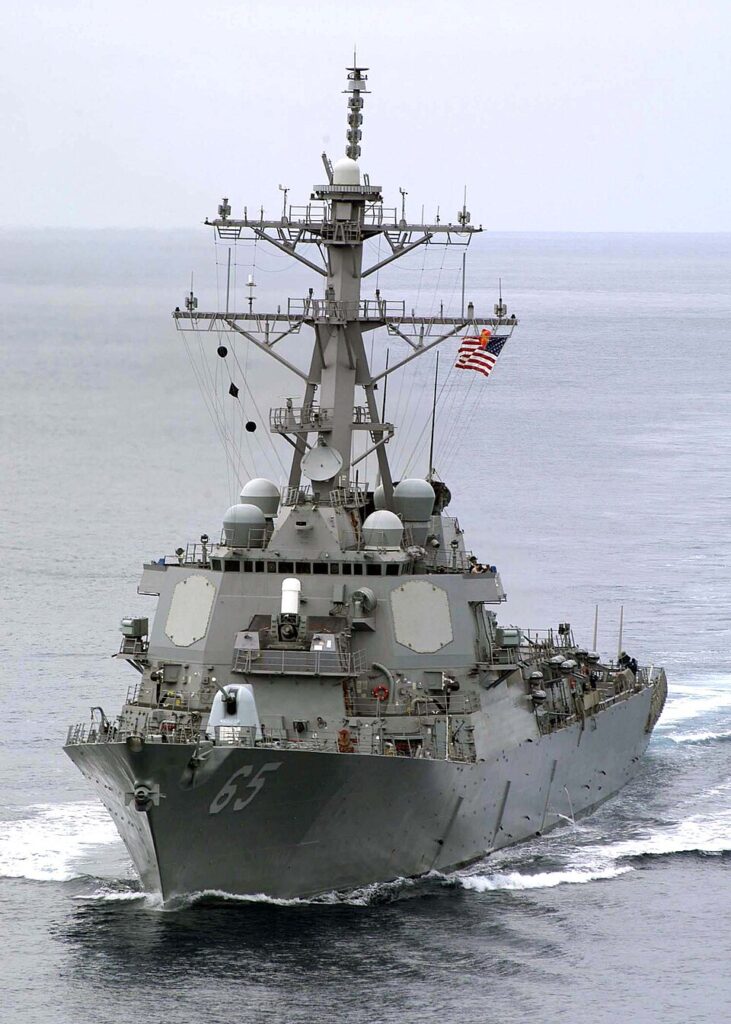
Image: USS Benfold (DDG 65) (Wikipedia)
By Open Chronicle Defence with agencies
A US Navy guided-missile destroyer suffered a complete loss of electrical power while operating in the South China Sea, leaving roughly 300 sailors aboard the warship without normal access to drinking water, hot meals, functioning toilets, or air conditioning for several days.
The USS Benfold, an Arleigh Burke-class destroyer assigned to the USS George Washington carrier strike group, experienced what the US Navy described as an “engineering casualty involving its generators” on July 24.
The failure resulted in a total loss of power aboard the approximately three-decade-old destroyer, forcing other vessels in the strike group to provide assistance while the ship remained disabled at sea.
After several days, the Benfold was towed to Subic Bay in the Philippines, arriving on July 28. Electrical power was restored two days later, and the destroyer eventually returned to operational service on August 8.
No crew members were injured, according to the US Seventh Fleet.
🇺🇸 A US WARSHIP LOST ALL POWER FOR FOUR DAYS IN THE SOUTH CHINA SEA!
USS Benfold reportedly lost all power for four days in the South China Sea after a generator failure on July 24.
Around 300 sailors were left without working toilets, AC, kitchen or water systems in extreme… pic.twitter.com/0hpiaeNvWd
— Defense Intelligence (@DI313_) August 17, 2026
Complete power loss at sea
A complete electrical failure represents a serious challenge aboard a modern warship.
Although a destroyer is designed primarily around weapons, sensors and propulsion, electrical power supports almost every aspect of life and operations aboard the vessel.
Seventh Fleet spokesman Matthew Comer said the failure affected potable water, galley services, toilets and air conditioning.
That meant the approximately 300 sailors aboard the Benfold had to operate under significantly degraded living conditions while efforts were made to stabilise the situation.
Other ships within the George Washington strike group assisted. The cruiser USS Robert Smalls, for example, supplied meals to the destroyer’s crew.
The incident demonstrates one of the advantages of operating warships as part of a carrier strike group. Individual vessels can provide logistical and operational support when another ship suffers a major casualty.
Four difficult days for the crew
The Benfold remained without normal power from July 24 until reaching Subic Bay on July 28.
Once in the Philippines, sailors were provided with accommodation ashore while maintenance teams worked on the ship.
Power was restored on July 30.
Comer praised the crew for its response, saying there were no injuries and that sailors demonstrated “resilience, grit, professionalism, and unwavering steadiness”.
The ship subsequently underwent repairs and checks before returning to operations on August 8 with its systems fully operational.
According to the Navy, the cause of the generator casualty remains under investigation.
Why losing electricity is so serious aboard a destroyer
Modern naval vessels depend enormously on electrical power.
The Arleigh Burke class was designed around an integrated network of sensors, weapons, communications equipment and combat management systems.
Electrical generation supports radar systems, communications, computers, pumps, ventilation, water production and numerous auxiliary systems.
Even basic living conditions depend on reliable power.
Warships produce fresh water through onboard systems rather than carrying enough drinking water for an entire deployment. Food preparation requires galley equipment. Ventilation and air conditioning are particularly important when operating in hot and humid environments such as the South China Sea.
A prolonged blackout can therefore rapidly become both an operational and habitability problem.
The fact that the Benfold suffered no reported injuries and eventually returned to service suggests the crew successfully prevented the initial engineering casualty from developing into a more serious emergency.
An ageing but heavily used warship
The incident also draws attention to the age and operational demands placed on parts of the US surface fleet.
Commissioned in 1996, USS Benfold is one of the earlier Arleigh Burke-class destroyers still operating with the Navy.
The class has nevertheless proved extraordinarily important to American naval power.
Arleigh Burke destroyers perform air defence, ballistic missile defence, anti-submarine warfare, surface warfare, and long-range strike missions.
Their Aegis combat systems also make them essential escorts for American aircraft carriers.
The US Navy continues constructing newer variants of the design, even as older vessels remain heavily involved in operations across the Indo-Pacific and other regions.
That creates an increasingly complicated maintenance challenge.
South China Sea operations add strategic importance
The location of the breakdown is significant.
The South China Sea is one of the world’s most strategically contested maritime regions.
China claims sovereignty over large areas of the sea, overlapping with claims by several Southeast Asian states. Beijing has constructed and militarised artificial islands while expanding the capabilities of the People’s Liberation Army Navy and China Coast Guard.
The United States does not accept China’s expansive maritime claims and regularly conducts military operations throughout the region.
American carrier strike groups, destroyers, submarines and surveillance aircraft therefore operate in an environment where readiness can have immediate strategic consequences.
An engineering failure during routine operations is very different from a breakdown during an actual confrontation, but the incident demonstrates why mechanical reliability remains as important as weapons capability.
A destroyer with sophisticated missiles and radar becomes dramatically less useful if its electrical systems fail.
Reliability matters in a potential Pacific conflict
The strategic implications extend beyond a single ship.
US military planning increasingly focuses on the possibility of operating across enormous distances in the western Pacific during a high intensity conflict.
In such an environment, damaged or disabled vessels might not have immediate access to major American naval bases.
Maintenance facilities could themselves be threatened.
Supply chains could be disrupted.
Towing a disabled vessel might also become considerably more dangerous during wartime.
The Benfold incident therefore highlights the importance of redundancy, damage control, and forward repair capabilities.
The Navy’s ability to restore the destroyer and return it to operations relatively quickly demonstrates the value of maintenance infrastructure in the region, including the Ship Repair Facility and Japan Regional Maintenance Center referenced by Seventh Fleet.
Another US carrier group faces prolonged deployment pressures
The incident also comes amid wider scrutiny of conditions aboard US naval vessels operating on extended deployments.
Reports have focused particularly on the aircraft carrier USS Abraham Lincoln, which has spent more than eight months deployed amid American military operations and heightened tensions involving Iran and the Strait of Hormuz.
Some family members have alleged shortages of food and water, equipment problems and deteriorating conditions aboard the carrier.
The Trump administration has disputed characterisations portraying conditions aboard the Lincoln as dire.
The controversy nevertheless highlights a larger problem facing any navy attempting to sustain a high global operational tempo.
Ships require maintenance.
Equipment wears out.
Sailors need rest.
Long deployments increase pressure on both personnel and machinery.
George Washington group could head toward Middle East
That pressure could become particularly relevant for the George Washington carrier strike group.
The formation, which included the Benfold when the destroyer suffered its engineering failure, is expected to move toward the Middle East to relieve the Abraham Lincoln.
Such a deployment would underline the global demands currently being placed on the US Navy.
American naval forces must simultaneously maintain a major presence in the Indo-Pacific, protect maritime routes, deter potential adversaries and respond to crises in the Middle East.
Moving a carrier strike group from the western Pacific toward the Middle East inevitably affects force availability elsewhere.
That is one reason readiness problems aboard individual vessels can acquire strategic significance.
Carrier strike groups depend on their escorts
An aircraft carrier may be the most visible component of a carrier strike group, but it does not operate independently.
Destroyers such as the Benfold provide essential protection.
They can defend against aircraft and missiles, hunt submarines, attack surface vessels and launch Tomahawk cruise missiles against land targets.
They also contribute sensors and communications capabilities to the wider formation.
Losing an escort temporarily therefore affects more than one ship.
It changes the capabilities available to the entire strike group.
In peacetime, commanders can adjust formations and rely on other vessels.
During combat, particularly against a technologically sophisticated adversary, every functioning escort could matter.
The human factor
The experience of the approximately 300 sailors aboard Benfold is equally important.
Modern naval warfare is often discussed through missile ranges, radar capabilities, and fleet numbers.
But warships remain inhabited machines.
Hundreds or thousands of people must live inside them for months at a time.
When power disappears, the consequences are immediate.
Food preparation becomes difficult.
Water availability can be affected.
Sanitation deteriorates.
Temperatures inside compartments can rise rapidly.
Sleep becomes more difficult.
Crews must simultaneously manage those conditions while repairing the vessel and maintaining safety.
The Navy’s emphasis on the crew’s response reflects the central role of damage control training in American naval doctrine.
A reminder that sophisticated fleets remain vulnerable to basic failures
The USS Benfold incident did not involve enemy missiles, drones, or submarines.
It involved generators.
Yet the result temporarily removed a multimillion-dollar guided-missile destroyer from normal operations.
That offers a useful reminder about modern military power.
Advanced weapons are only effective when the infrastructure supporting them works.
Electricity, fuel, maintenance, spare parts, trained technicians, and logistics are not secondary concerns. They are what allow sophisticated combat systems to function.
As the United States prepares its fleet for increasingly demanding operations across the Indo-Pacific and Middle East, those fundamentals become even more important.
The Benfold is now back at sea.
The investigation into why its generators failed will matter far beyond the engineering spaces of one destroyer.
For a Navy expected to operate across two enormous strategic theatres, keeping ships operational may ultimately prove just as important as building new ones.