
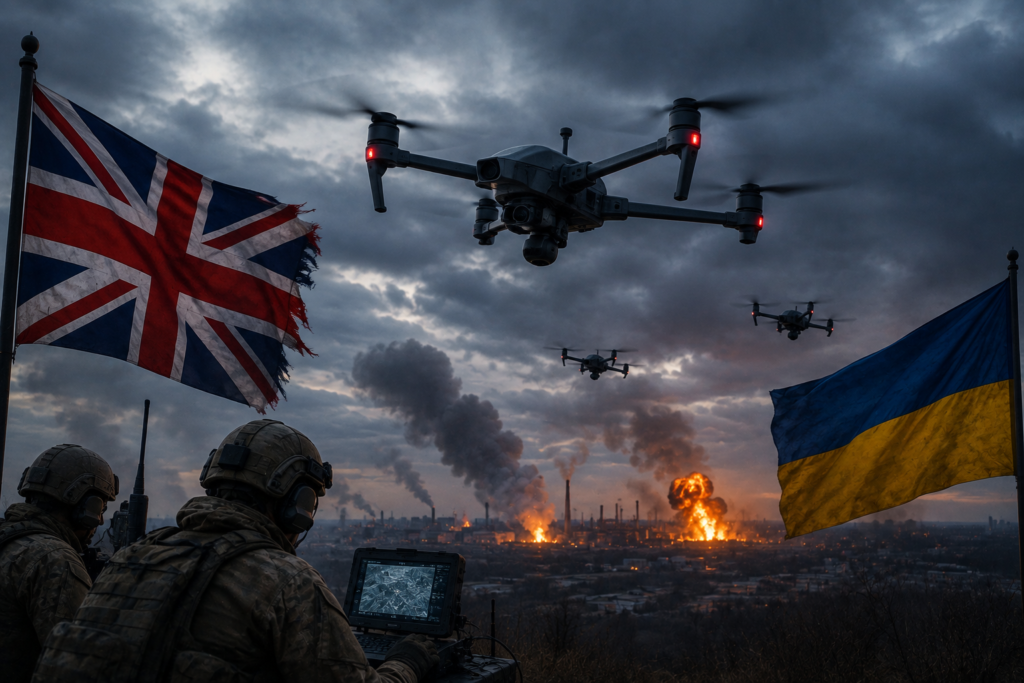
Image Credits: Russia Threatens UK With ‘Consequences’ Over Ukraine’s Use of British Drones in Deep Strikes. AI-generated illustration created by Open Chronicle using ChatGPT (OpenAI). August 2026. This image is illustrative and does not depict a real-world scene.
By Open Chronicle Defence with agencies
Russia has threatened the United Kingdom with unspecified “consequences” following reports that Ukrainian forces used British-made drones to strike targets inside Russian territory, opening another dispute over the expanding role of Western-supplied weapons in Kyiv’s long-range campaign.
The Russian Embassy in London accused Britain of deliberately escalating the conflict by supporting Ukrainian attacks deep inside Russia. Moscow argued that the use of British technology demonstrated that London was becoming increasingly involved in military operations beyond Ukraine’s internationally recognised borders.
“London’s actions will inevitably have consequences for which it will have to answer,” the Russian diplomatic mission said.
The British government rejected Moscow’s criticism and reiterated that the United Kingdom intends to continue providing military equipment to Ukraine.
The confrontation comes as Kyiv dramatically expands its long-range strike capability, increasingly targeting military production facilities, energy infrastructure and logistics networks hundreds of kilometres from the frontline.
Moscow accuses Britain of escalation
Russia’s criticism followed reports that Ukrainian forces had deployed unmanned aerial vehicles produced by two British companies during operations against targets on Russian territory.
The Russian Embassy accused London of “deliberately choosing escalation” and seeking to inflict maximum damage on Russia through Ukrainian forces.
Moscow has repeatedly argued that Western governments providing weapons, intelligence and military technology to Kyiv are becoming direct participants in the conflict.
Britain and other NATO countries reject that interpretation.
They maintain that Ukraine has the right to defend itself against Russia’s invasion and that supplying military assistance does not make NATO a party to the war.
The disagreement has persisted since the early stages of the conflict, but the growing ability of Ukrainian weapons to reach deep inside Russia has made the issue increasingly sensitive.
Britain says support for Ukraine will continue
The UK Ministry of Defence responded firmly to Russia’s warning.
“Russia should have no doubt about this government’s resolve to stand up to Russian aggression against Ukraine, as well as the United Kingdom and our allies,” a ministry spokesperson said.
The government indicated that Britain would continue supplying equipment intended to help Ukraine resist Russian military operations.
London has been among Kyiv’s most significant European military supporters, providing weapons, training and other forms of assistance throughout the war.
British support has also increasingly focused on the technologies transforming the battlefield, including drones and other unmanned systems.
The latest dispute demonstrates how those systems are becoming strategically important far beyond frontline combat.
Ukraine dramatically expands deep strikes
Ukraine has significantly increased the frequency of attacks against targets inside Russia during 2026.
According to figures cited from conflict monitoring organisation ACLED, Kyiv conducted approximately three times as many long-range attacks in July as it had in January.
The targets have included military factories, ammunition facilities, energy installations and logistics infrastructure.
Rather than simply attempting to cause economic damage, many of these attacks appear designed to weaken Russia’s ability to sustain military operations against Ukraine.
A factory producing components for missiles or explosives hundreds of kilometres from the border may ultimately influence combat operations just as much as a weapons depot positioned close to the frontline.
Ukraine’s increasingly sophisticated long-range strike campaign therefore attempts to extend the battlefield deep into Russia’s military-industrial system.
Kamensky Plant struck in Rostov region
One of the latest operations occurred during the night of August 16.
Ukrainian forces struck the Kamensky Plant in Russia’s Rostov region, a facility associated with the production of solid rocket fuel.
Such facilities represent particularly significant targets because solid propellants are critical components of numerous missile and rocket systems.
Attacking production infrastructure can potentially have consequences extending well beyond the immediate physical damage.
Industrial equipment may be difficult to replace.
Specialised machinery can take months to repair.
Production interruptions can create bottlenecks elsewhere in the defence supply chain.
Ukraine’s strategy increasingly appears designed around exploiting these vulnerabilities.
Drones are changing strategic warfare
Long-range drones have given Ukraine an option that would have been extraordinarily expensive to develop using traditional military aviation.
Conducting comparable operations with crewed aircraft would require penetrating Russian air defences and exposing pilots and valuable combat aircraft to considerable danger.
Drones fundamentally change that calculation.
They can be produced relatively cheaply compared with cruise missiles or combat aircraft.
They can fly complex routes.
They can approach targets from unexpected directions.
And losing one does not mean losing a pilot.
This makes it possible to conduct repeated attacks designed not only to destroy targets, but also to impose persistent defensive costs on Russia.
Russia must defend an enormous territory
Ukraine’s expanding strike range creates a fundamental problem for Russian air defence planners.
Russia is geographically enormous.
Important military and industrial facilities are distributed across thousands of kilometres.
Every additional region potentially exposed to Ukrainian drones creates another defensive requirement.
Russia must decide which facilities receive advanced surface-to-air missile systems, electronic warfare equipment and other counter-drone capabilities.
Protecting Moscow may require one concentration of systems.
Defending military airfields requires another.
Oil refineries, ammunition plants, command centres and defence factories create additional requirements.
No air defence network can provide identical protection everywhere.
Ukraine can therefore use relatively inexpensive drones to force Russia to disperse comparatively scarce defensive assets.
Deep strikes create an air defence dilemma
This produces an important strategic effect even when Ukrainian drones fail to reach their targets.
Every interceptor deployed around an industrial facility is an interceptor unavailable elsewhere.
No single radar can simultaneously protect both a refinery and a frontline logistics hub.
Every electronic warfare system positioned around a factory represents equipment that could otherwise support Russian forces in occupied Ukraine.
Long-range attacks consequently impose what military planners describe as an opportunity cost.
Russia must defend its rear areas while continuing to protect frontline forces.
The wider Ukraine’s strike capability becomes, the larger that defensive burden grows.
British technology adds a political dimension
The involvement of British-manufactured drones makes the issue considerably more sensitive.
Weapons manufactured domestically in Ukraine are politically different from systems supplied or developed by NATO countries.
Moscow can portray attacks involving Western equipment as evidence that the conflict is expanding beyond a bilateral Russia-Ukraine war.
London, meanwhile, can argue that a manufacturer’s nationality does not alter Ukraine’s right to defend itself.
This disagreement becomes especially important when Western-supplied weapons strike targets far inside Russia.
The physical target may be Russian.
The operator may be Ukrainian.
The technology may be British.
Intelligence supporting the mission could potentially come from several sources.
Modern warfare therefore makes traditional definitions of participation increasingly complicated.
Moscow has issued similar warnings before
Russia has repeatedly warned NATO governments against expanding the capabilities supplied to Ukraine.
Similar threats accompanied debates over tanks, long-range missiles and combat aircraft.
Moscow has frequently argued that each new category of Western weapon risks escalating the conflict.
Western governments have generally responded incrementally.
Weapons initially considered politically sensitive have sometimes later become routine components of Ukrainian military assistance.
That pattern has produced a gradual expansion of Kyiv’s capabilities without triggering a direct military confrontation between Russia and NATO.
But each new step continues to carry escalation risks.
The unanswered question is what ‘consequences’ means
Russia’s warning deliberately leaves its potential response undefined.
Moscow has numerous options below the threshold of direct military confrontation with Britain.
These could include diplomatic measures, cyber operations, information campaigns or other forms of pressure.
Russia could also intensify military operations against Ukrainian infrastructure associated with long-range strikes.
A direct Russian attack against British territory would represent a fundamentally different level of escalation because the United Kingdom is a NATO member.
Such an attack could raise questions concerning the alliance’s collective defence obligations.
For that reason, both Moscow and London have strong incentives to maintain confrontation below the threshold of direct Russia-NATO warfare.
Ukraine is building its own long-range strike ecosystem
One of the most important developments of the war has been Ukraine’s determination to reduce its dependence on foreign long-range weapons.
Domestic manufacturers have developed increasingly capable drones capable of reaching targets deep inside Russian territory.
Some systems are relatively simple.
Others increasingly resemble small cruise missiles in their range, navigation and payload capabilities.
International partnerships can accelerate that process by providing components, manufacturing expertise and investment.
British defence technology companies can therefore contribute to Ukrainian capabilities without necessarily supplying conventional missiles directly from UK military inventories.
This model could become increasingly important as Ukraine attempts to sustain a large-scale strike campaign over months or years.
Britain is also learning from Ukraine
The relationship is not one-directional.
The United Kingdom is examining lessons from Ukraine as it considers reforms to its own armed forces.
The war has demonstrated the importance of inexpensive drones, rapid technological development, electronic warfare and distributed manufacturing.
It has also challenged assumptions about how quickly conventional military equipment can be consumed during a major conflict.
Ukraine has frequently developed new drone designs and battlefield modifications in weeks rather than following the multiyear procurement cycles typical of traditional Western defence programmes.
British military planners are studying that experience as they consider how future forces should operate.
Ukraine is therefore simultaneously receiving Western military technology and providing Western militaries with extensive battlefield knowledge.
The drone war is moving far beyond the frontline
The latest confrontation between Moscow and London illustrates how drones are changing the geography of war.
The traditional frontline remains crucial.
Russian and Ukrainian troops continue fighting for territory.
But military competition now extends far behind those positions.
Factories are targets.
Refineries are targets.
Airbases are targets.
Railway infrastructure and logistics centres are targets.
Electronic warfare facilities and command centres are targets.
Long range unmanned systems allow Ukraine to threaten those locations without possessing a large strategic bomber force.
That capability forces Russia to think about national air defence rather than simply battlefield air defence.
A growing test for Russia and NATO
For Moscow, the strategic problem is straightforward but difficult to solve.
Ukraine’s strike capability is becoming longer-ranged and more numerous, while Western technological support helps sustain that development.
For Britain, the challenge is different.
London wants Ukraine to possess enough military capability to resist Russia while avoiding a confrontation between NATO and Moscow.
Those objectives are not necessarily incompatible, but the space between them becomes narrower as Ukrainian strikes reach deeper into Russian territory.
Russia’s latest warning is therefore part of a larger contest over where the boundaries of Western military support ultimately lie.
British assistance to Ukraine is unlikely to end because of Moscow’s threat.
Ukraine is equally unlikely to abandon deep strikes while they continue imposing costs on Russia’s military infrastructure.
That means the underlying source of tension will remain.
As drones become cheaper, longer-ranged, and increasingly integrated into conventional military operations, the distinction between the frontline and the strategic rear is disappearing.
The dispute between Russia and Britain is another consequence of that transformation.