The emergence of the Christian Church from the ministry of Jesus, the apostolic community and the first generation of Christianity
The origins of the Catholic Church lie within the religious world of first century Judaism and the movement that formed around Jesus of Nazareth.
What eventually became one of the largest and most influential religious institutions in human history did not begin with cathedrals, diocesan bureaucracies or an established hierarchy operating from Rome. It began with a relatively small community of disciples in Roman Judaea who believed that Jesus was the Messiah and, following his crucifixion, proclaimed that he had risen from the dead.
During the decades that followed, this movement expanded from Jerusalem into the cities of the eastern Mediterranean and eventually across much of the Roman world.
Within that first century appeared many of the elements that would become fundamental to Catholic Christianity: baptism, the Eucharist, apostolic teaching, organised local communities, missionary activity, ordained or appointed ministries, the authority of bishops and elders in developing forms, and an understanding of the Church as a community extending beyond individual cities and peoples.
The Catholic Church understands this apostolic community not simply as a predecessor but as the beginning of the same Church that continues today.
Historical scholarship approaches the question differently. Historians examine the development of early Christian communities, institutions and doctrines without necessarily accepting later theological claims about institutional continuity.
Understanding the origins of the Catholic Church therefore requires examining both perspectives.
Historical Profile
| Origins | 1st century AD |
| Geographical origin | Roman Judaea |
| Initial centre | Jerusalem |
| Founder according to Catholic teaching | Jesus Christ |
| Foundational community | Jesus and the Apostles |
| Principal apostolic figures | Peter, Paul, James, John and the Twelve |
| Original religious context | Second Temple Judaism |
| Early expansion centres | Jerusalem, Antioch, Ephesus, Corinth, Alexandria and Rome |
| Principal early rites | Baptism, Eucharist, prayer and laying on of hands |
| Principal surviving sources | New Testament writings, early Christian texts and later apostolic traditions |
| Traditional first Bishop of Rome | Saint Peter |
| Emergence of the term Catholic Church | Early 2nd century, explicitly attested in Ignatius of Antioch |
Jesus and the Beginning of the Christian Movement
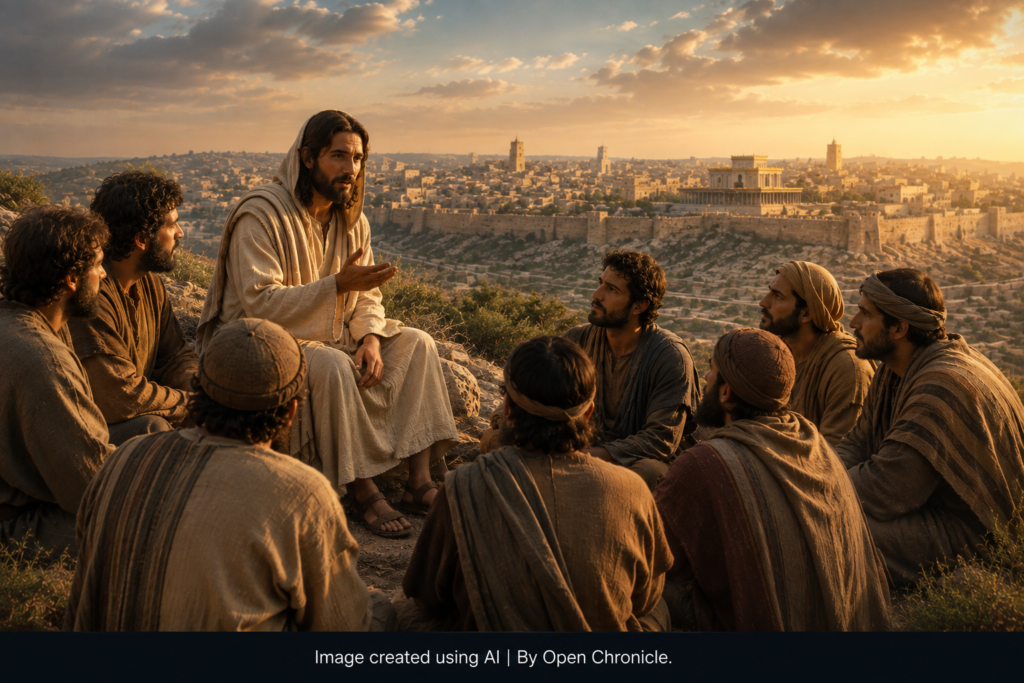
Christianity originated around the life and teachings of Jesus of Nazareth.
Jesus was a Jew living in Roman controlled Judaea and Galilee during the early first century.
His teaching developed within the religious traditions of Israel. He proclaimed the Kingdom of God, interpreted Jewish scripture, taught about repentance and forgiveness, gathered disciples and attracted followers through preaching and acts that his followers regarded as miraculous.
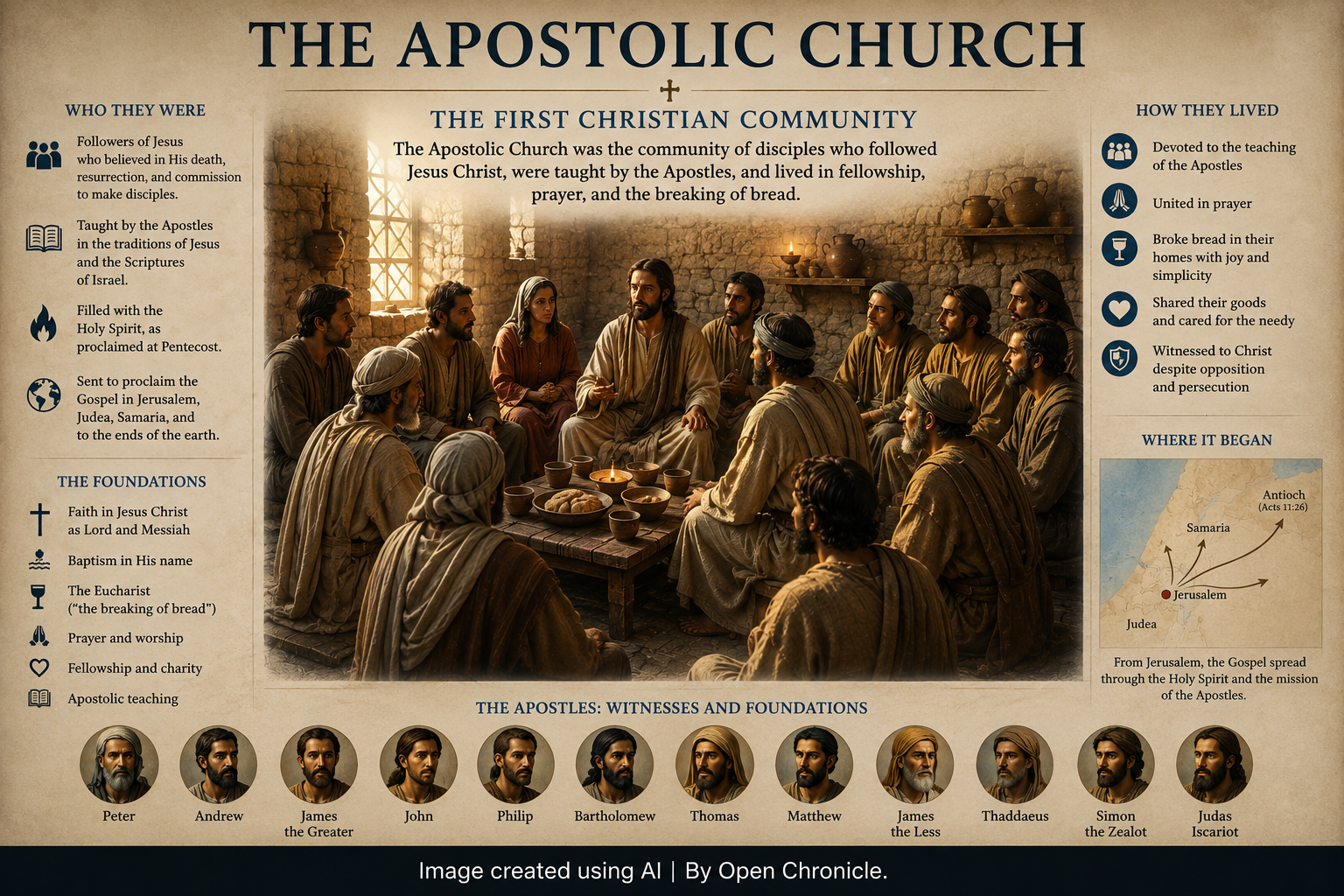
Among his disciples Jesus selected a group traditionally known as the Twelve Apostles.
The symbolic importance of twelve was substantial.
Ancient Israel had been composed of twelve tribes, and the selection of twelve disciples therefore carried implications concerning the restoration and renewal of the people of Israel.
Christian tradition subsequently understood the Apostles as the foundational witnesses and leaders of the Church.
The Twelve Apostles
The New Testament identifies a core group of disciples who accompanied Jesus during his ministry.
They became witnesses to his teaching and, according to Christian belief, to his Resurrection.
Following Jesus’ death, the Apostles became central figures in the expansion of the movement.
Catholic theology consequently regards the Church as apostolic.
This means not merely that the Church honours the Apostles historically, but that its teaching and ministry are understood as continuing the mission entrusted to them.
The Second Vatican Council later expressed this principle by teaching that the bishops continue the pastoral ministry of the Apostles.
Peter
Among the Apostles, Simon Peter occupies a particularly prominent position in the New Testament.
His name frequently appears first in lists of the Twelve, and several Gospel passages associate him with distinctive responsibilities.
The Gospel of Matthew records Jesus telling Peter:
“You are Peter, and on this rock I will build my church.”
Other passages depict Peter being instructed to strengthen the other disciples and to tend Christ’s flock.
Following the Resurrection narratives, the Acts of the Apostles portrays Peter as one of the principal leaders and public spokesmen of the Jerusalem community.
He addresses the crowd at Pentecost, participates in decisions affecting the community and plays an important role in the admission of Gentiles.
Catholic doctrine interprets these passages as establishing a distinctive Petrine ministry within the Church.
The later doctrine of papal primacy developed from the belief that this ministry continued through Peter’s successors as bishops of Rome.
Historical analysis is more cautious about projecting the fully developed medieval or modern papacy directly into the first century.
The administrative structures associated with later papal government did not yet exist.
Nevertheless, Peter’s exceptional prominence within early Christian tradition is clear.
Pentecost
The Acts of the Apostles presents Pentecost as a decisive moment in the formation of the Christian community.
According to Acts, the disciples were gathered in Jerusalem when the Holy Spirit descended upon them.
Peter then addressed the assembled population, proclaiming Jesus as the risen Messiah.
Acts reports that thousands accepted the message and were baptised.
For this reason Pentecost is often described in Christian tradition as the public birth of the Church.
The community that emerged is portrayed as devoted to apostolic teaching, fellowship, prayer and the breaking of bread.
These practices became fundamental characteristics of Christian communal life.
The Church of Jerusalem
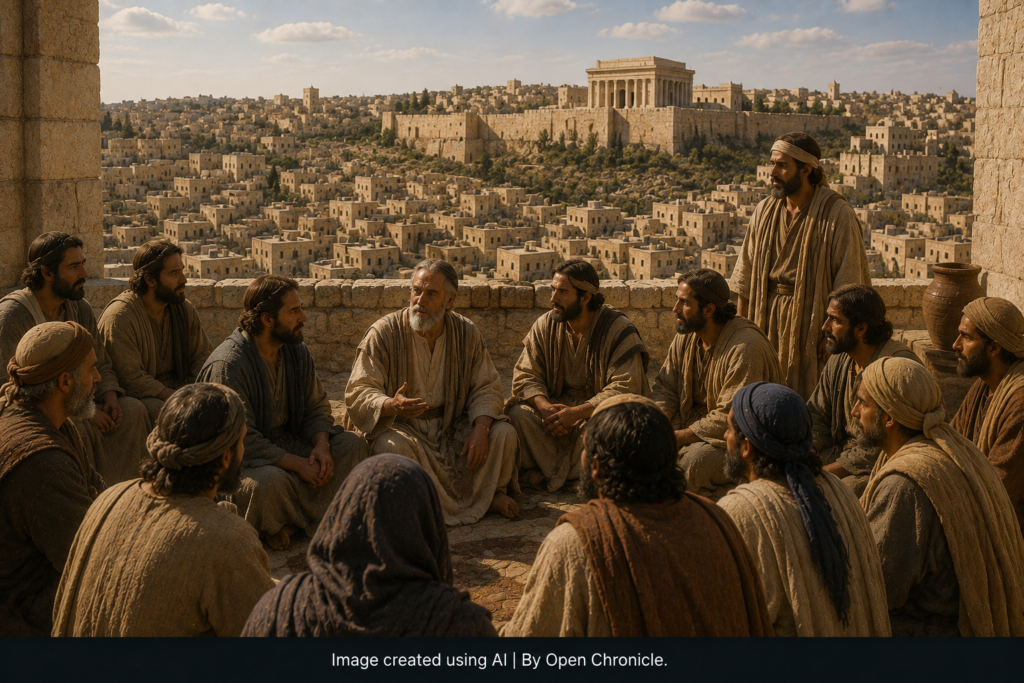
Jerusalem was the first major centre of Christianity.
The earliest followers of Jesus continued to operate within a Jewish religious environment.
They prayed, interpreted Jewish scripture and initially participated in aspects of Jewish religious life while simultaneously developing practices centred upon Jesus.
The Jerusalem community included the Apostles and other followers of Jesus.
James, traditionally identified as James the Just and described in the New Testament as the brother of Jesus, eventually became one of its most important leaders.
Peter, James and John were regarded by Paul as major figures within the early movement.
The Jerusalem Church therefore served as an important reference point when disputes emerged among expanding Christian communities.
Christianity Begins to Expand
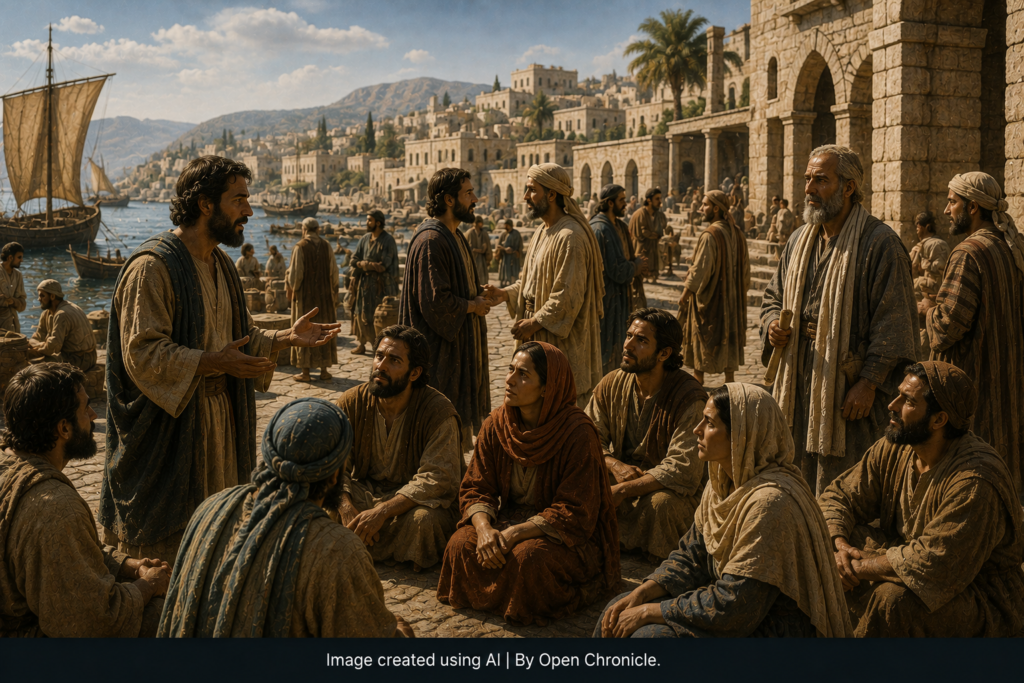
The movement soon spread beyond Jerusalem.
Persecution and migration contributed to the dispersal of believers, while missionaries deliberately carried the Christian message into new territories.
Communities appeared in Judaea, Samaria, Syria and elsewhere.
One of the most important centres emerged at Antioch.
Acts records that followers of Jesus were first called Christians there.
Antioch became an important bridge between the Jewish origins of Christianity and its expansion into the wider Greco Roman world.
Traditions concerning Peter also associate him with Antioch before his later connection with Rome.
Paul and the Gentile Mission
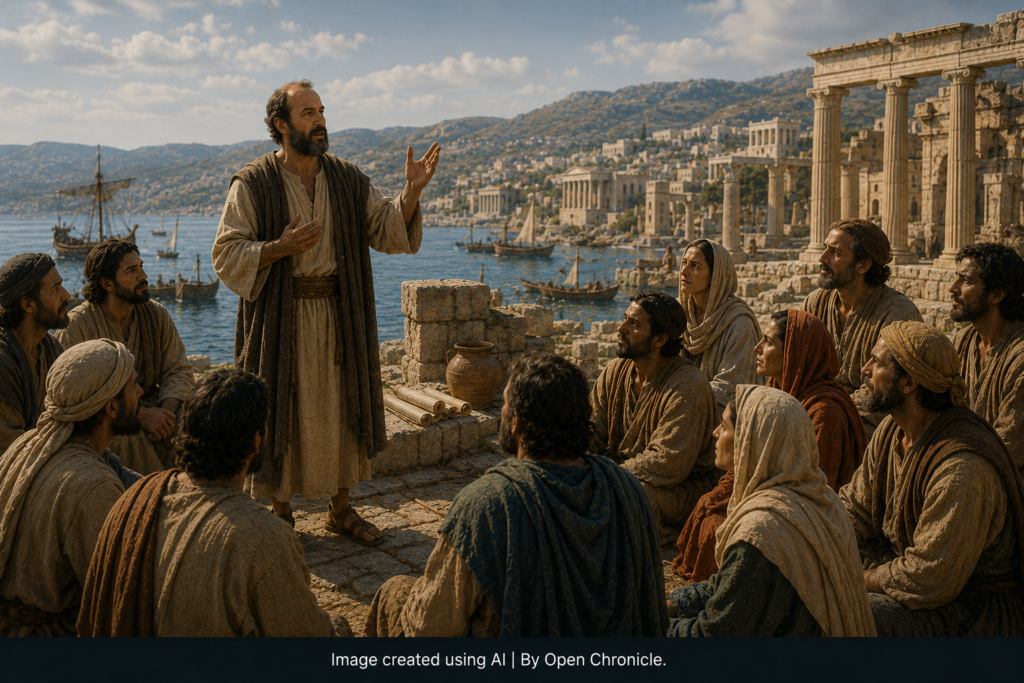
No individual was more important to the international expansion of first century Christianity than Paul of Tarsus.
Paul had not belonged to the original Twelve.
According to his own writings and Acts, he initially opposed the Christian movement before undergoing an experience that convinced him that the risen Jesus had called him to become an apostle.
Paul subsequently travelled throughout the eastern Mediterranean establishing and supporting Christian communities.
His missions reached areas of modern Türkiye, Greece and eventually Rome.
His surviving letters are among the earliest Christian writings known to exist.
They provide extraordinary evidence concerning the beliefs, disputes, worship and organisation of Christian communities only a few decades after the death of Jesus.
The Great Question: Must Christians Become Jews?
The expansion among non-Jewish populations created one of the first major theological controversies in Christian history.
Jesus and the original disciples were Jewish.
The question therefore arose whether Gentile converts had to adopt Jewish religious law, including circumcision and dietary requirements.
Paul strongly argued that Gentiles could become followers of Christ without first becoming Jews.
The dispute became important enough for representatives of the movement to meet in Jerusalem.
The Council of Jerusalem
The meeting traditionally known as the Council of Jerusalem, usually placed around AD 49 or 50, became a defining event in Christianity’s transformation into a universal religion.
According to Acts and Paul’s Letter to the Galatians, major figures including Peter, James, Paul, and Barnabas participated in discussions concerning Gentile converts.
The resulting decision allowed the Gentile mission to continue without requiring full observance of Mosaic Law.
The consequences were enormous.
Christianity could now expand across the Roman world without requiring converts to enter Judaism.
This decision helped transform a movement originating within Judaism into an increasingly multinational religious community.
Baptism
Baptism was fundamental to Christian initiation from the earliest period.
The practice had precedents within Jewish purification traditions and was prominently associated with John the Baptist.
Christian baptism, however, became connected specifically with entry into the community of believers and participation in the death and Resurrection of Christ.
The New Testament repeatedly associates baptism with conversion and admission into Christian life.
Later first century and early second century sources demonstrate that established procedures surrounding baptism were already developing.
The Didache, an exceptionally important early Christian text whose precise dating remains debated, provides instructions concerning baptism and indicates that different methods could be used depending upon circumstances.
The Eucharist
The Eucharist developed from the tradition of Jesus’ Last Supper with his disciples.
Paul’s First Letter to the Corinthians contains the earliest surviving written account of the tradition.
Christians gathered for meals in remembrance of Jesus, using bread and wine within a ritual associated with his body and blood.
The practice became one of the defining elements of Christian worship.
Different aspects of Eucharistic theology developed over subsequent centuries, but the central ritual itself belongs to Christianity’s earliest period.
For Catholicism, the Eucharist eventually became the centre of sacramental life.
Christian Worship
There were no great Christian cathedrals during the first century.
Communities commonly met in private homes.
Paul’s letters contain references to churches meeting in houses.
Christian gatherings included prayer, scripture, teaching, hymns, prophecy and communal meals.
Sunday gradually acquired particular significance because Christians associated the first day of the week with the Resurrection.
The transition from predominantly Jewish patterns of worship towards recognisably distinct Christian liturgical traditions occurred gradually rather than through a single institutional decision.
From Apostles to Local Leadership
The earliest Christian communities did not everywhere possess an identical administrative structure.
The New Testament refers to apostles, prophets, teachers, elders, overseers and deacons.
Terminology could overlap.
The Greek word episkopos, from which the English word bishop developed, originally described an overseer.
Presbyteros meant elder and eventually became associated with the priesthood.
Diakonos referred to a minister or servant and became the origin of the office of deacon.
During the first century these ministries were still developing.
Evidence from the late first and early second centuries indicates increasing institutional organisation.
The later structure consisting of a bishop assisted by presbyters and deacons became increasingly visible during the following generations.
Catholic theology understands this development within the principle of apostolic succession, by which the pastoral mission entrusted to the Apostles continues through bishops.
Apostolic Succession
The death of the original Apostles created an unavoidable problem.
Christianity expected to continue, but its original witnesses could not remain alive indefinitely.
Communities therefore required leaders capable of preserving teaching, administering worship and maintaining unity.
The late first century First Epistle of Clement contains important evidence concerning this transition.
Written from the Church of Rome to the Church of Corinth, traditionally around AD 96, the letter discusses ministers appointed by the Apostles and provisions for successors.
Catholic tradition sees such evidence as part of the historical foundation of apostolic succession.
Historians continue to debate precisely how uniform succession and episcopal structures were during the earliest period.
What is clear is that Christian communities were already confronting the problem of institutional continuity before the first century had ended.
Peter and Rome
The relationship between Peter and Rome became fundamental to the later history of Catholicism.
Ancient Christian tradition associates Peter’s final ministry and martyrdom with the imperial capital.
The New Testament does not provide a detailed narrative of Peter’s arrival or death in Rome.
However, early Christian literary traditions connect him strongly with the city.
Catholic tradition holds that Peter served as the first Bishop of Rome and was martyred there during the reign of Nero.
His burial place was traditionally associated with the Vatican Hill.
The later Basilica of Saint Peter was constructed over the area venerated as his tomb.
The connection between Peter, Rome and episcopal succession became one of the foundations of the Roman Church’s later claim to primacy.
Paul in Rome
Rome’s apostolic identity was strengthened further by its association with Paul.
Paul’s Letter to the Romans demonstrates that a Christian community already existed in the city before he arrived.
Acts describes Paul eventually reaching Rome as a prisoner.
Ancient Christian tradition holds that Paul was subsequently martyred there.
Rome therefore became associated with both Peter and Paul, two of the most important figures of apostolic Christianity.
This dual apostolic heritage contributed significantly to the prestige of the Roman Church.
The Neronian Persecution
Christianity’s presence in Rome is independently illuminated by Roman historical evidence concerning the reign of Nero.
After the Great Fire of Rome in AD 64, Nero blamed Christians for the disaster according to the Roman historian Tacitus.
Christians were subjected to brutal punishments.
Later Christian tradition placed the martyrdoms of Peter and Paul within the broader context of Neronian persecution.
These events became deeply embedded in Christian memory.
Martyrdom increasingly came to represent the ultimate testimony of faith.
The Destruction of Jerusalem
Another transformational event occurred in AD 70.
Following the Jewish revolt against Rome, Roman armies captured Jerusalem and destroyed the Second Temple.
The catastrophe changed both Judaism and Christianity.
For Christians, the destruction weakened Jerusalem’s position as the movement’s geographical centre.
Christian communities were already widely distributed throughout the Roman world, and cities such as Antioch, Ephesus, Alexandria and Rome became increasingly important.
Christianity’s institutional future would therefore develop through a network of urban churches rather than around Jerusalem alone.
Rome’s Growing Importance
Rome possessed obvious strategic importance.
It was the capital of the Roman Empire and one of the largest cities in the ancient world.
Christianity had reached the city relatively early, probably through ordinary migration and missionary networks rather than through a single founding mission.
By the late first century the Roman Christian community was sufficiently established to communicate with other churches.
The most significant surviving example is First Clement.
Around AD 96, the Church of Rome intervened through a letter in a serious dispute affecting the Church of Corinth.
The document does not demonstrate the fully developed papal jurisdiction of later centuries.
It does, however, provide important evidence that the Roman community already possessed considerable confidence, organisational maturity and concern for the affairs of another major Christian church.
Rome’s importance would expand dramatically during the following centuries.
The First Christian Scriptures
The first Christians inherited the Jewish scriptures.
At the same time, new Christian writings began circulating among communities.
Paul’s letters were written during the middle decades of the first century.
The Gospels emerged during the latter part of the century according to the predominant modern scholarly chronology.
Other letters, theological writings and apocalyptic texts circulated among churches.
There was not yet a universally defined New Testament canon identical to the modern one.
The process through which particular writings came to be recognised as authoritative scripture took generations.
Nevertheless, by the end of the first century a substantial body of Christian literature already existed.
Oral Tradition
Christian teaching was not transmitted only through written texts.
For much of the first century oral teaching remained essential.
The Apostles and missionaries taught communities directly.
Stories about Jesus, accounts of his teachings, liturgical formulas, prayers and interpretations of scripture circulated orally before and alongside written documents.
Catholic Christianity later developed the concept that apostolic faith was transmitted through both Scripture and Tradition.
The relationship between written scripture and inherited apostolic tradition eventually became one of the major theological questions dividing Christian traditions.
Persecution and Survival
There was no continuous empire wide persecution of Christians throughout the entire first century.
Hostility was often local and depended upon particular circumstances.
Christians could encounter opposition from local authorities, communities or imperial officials.
The Neronian persecution in Rome remains the most famous first century example.
By the end of the century, Christian texts reflect increasing awareness that allegiance to Christ could conflict with political and social expectations.
The Book of Revelation is one of the most powerful surviving expressions of Christian resistance to imperial religious culture.
Persecution ultimately strengthened the importance of martyrdom within Christian identity.
Christianity at the End of the First Century
By approximately AD 100, Christianity had changed enormously from the small Galilean and Judaean movement that had existed several generations earlier.
Christian communities could be found across substantial parts of the Roman Empire.
They existed in Palestine, Syria, Asia Minor, Greece, Italy and probably beyond.
Christianity had become increasingly Gentile.
Its communities possessed recognised leaders.
Baptism and Eucharistic worship were established.
Christian writings circulated between churches.
Missionary networks connected communities separated by enormous distances.
The memory and teaching of the Apostles had become a fundamental measure of religious authority.
Rome was emerging as an increasingly important Christian centre.
Yet many features associated with later Catholicism were still developing.
There was no medieval papal administration.
The precise relationship between bishops, presbyters and local churches continued to evolve.
The New Testament canon had not been formally fixed.
Theological vocabulary concerning the Trinity and Christ would receive more precise definitions only centuries later.
The Church of the first century must therefore be understood on its own terms rather than simply imagined as a smaller version of the later medieval Church.
When Did It Become the “Catholic Church”?
The word catholic derives from the Greek katholikos, meaning universal or according to the whole.
The earliest surviving explicit use of the expression Catholic Church is generally associated with Ignatius of Antioch, writing to the Christians of Smyrna around the beginning of the second century.
Ignatius used the expression to describe the universal Christian Church.
This means that Peter, Paul and the earliest Jerusalem Christians would not normally have described their institution using the later formal name “Roman Catholic Church”.
The absence of the terminology does not settle the question of institutional identity.
Catholic teaching maintains that the Church founded by Christ and entrusted to the Apostles is historically continuous with the Catholic Church.
Other Christian traditions interpret that history differently.
Historical scholarship, meanwhile, generally describes the first century movement using terms such as early Christianity, apostolic Christianity or the early Church, avoiding later denominational labels where they could imply institutions that had not yet fully developed.
Catholic Understanding of the Origins
According to Catholic teaching, the Church was not created gradually as an entirely human institution after the death of Jesus.
Christ founded the Church through his ministry, the calling of the Apostles, the mission entrusted to them and the events culminating in his death and Resurrection.
Pentecost marks the Church’s manifestation through the action of the Holy Spirit.
Peter received a particular responsibility for maintaining unity.
The Apostles transmitted their ministry to successors.
The bishops continue that apostolic ministry, while the Bishop of Rome continues the Petrine ministry.
From this perspective, the Catholic Church of the twenty first century and the apostolic community of the first century belong to the same historical and sacramental continuity.
Historical Perspective
Historical scholarship can establish many aspects of this development independently of theological belief.
Jesus existed within first century Judaism.
A movement of his followers survived his crucifixion.
Those followers proclaimed his Resurrection.
Jerusalem became the earliest centre.
Missionaries spread the movement rapidly.
Paul was crucial to Gentile expansion.
Christian communities appeared throughout the eastern Mediterranean and at Rome.
Leadership structures developed.
Ritual practices including baptism and communal Eucharistic worship became established.
Peter and Paul became associated with Rome in very early Christian tradition.
By the end of the century, the Roman Church was sufficiently organised and influential to address problems in another Christian community.
The theological interpretation of those facts, particularly whether they establish direct continuity with later Catholic institutions and papal authority, remains a subject of disagreement among Catholic, Orthodox, Protestant and secular historians.
Recognising that distinction allows the history to be presented without confusing historical evidence with confessional claims.
Legacy
The first century established the foundations upon which almost every subsequent phase of Catholic history would develop.
Jesus and the Apostles provided its foundational narrative.
Peter became central to the Catholic understanding of ecclesiastical unity.
Paul helped transform Christianity into a religion capable of crossing ethnic and geographical boundaries.
Jerusalem provided the first Christian community.
Antioch became a major missionary centre.
Rome acquired the apostolic memory of Peter and Paul and gradually emerged as the principal centre of Western Christianity.
Baptism established initiation into Christian life.
The Eucharist became the central act of Christian worship.
Apostolic teaching provided the basis from which Christian scripture and tradition developed.
Emerging ministries created the foundations of ecclesiastical government.
The first century therefore did not produce the Catholic Church in every institutional form familiar today.
It produced something more fundamental: the apostolic Christian communities, beliefs, practices, scriptures, memories and structures from which the Catholic Church understands itself to have developed in continuous succession.
What began as a small movement within Roman Judaea had, before the century ended, become a network of communities extending across the Mediterranean world.
The transformation had begun.
Two thousand years of Church history would follow.
Timeline
| Date | Development |
| c. AD 27–30 | Public ministry of Jesus of Nazareth |
| c. AD 30–33 | Crucifixion of Jesus; Christian proclamation of the Resurrection |
| c. AD 30s | Formation of the Jerusalem Christian community |
| c. AD 30s | Pentecost according to Acts |
| c. AD 30s–40s | Christianity spreads beyond Jerusalem |
| c. AD 40s | Antioch becomes an important Christian centre |
| c. AD 40s–60s | Major missionary activity of Paul |
| c. AD 49–50 | Council of Jerusalem, approximate traditional chronology |
| AD 50s–60s | Pauline letters provide the earliest surviving substantial Christian writings |
| AD 64 | Great Fire of Rome and Neronian persecution |
| c. AD 60s | Traditional period associated with the martyrdoms of Peter and Paul in Rome |
| AD 70 | Roman destruction of Jerusalem and the Second Temple |
| c. AD 70–100 | Composition and circulation of major New Testament writings |
| c. AD 96 | Church of Rome sends the letter known as First Clement to Corinth |
| c. AD 100 | Christian communities established throughout significant areas of the Roman world |
| c. AD 107 | Ignatius of Antioch provides the earliest surviving explicit use of the expression “Catholic Church” |
Sources and Further Reading
Primary and ancient sources
The New Testament, particularly the Gospels, Acts of the Apostles, Pauline Epistles, Catholic Epistles and Revelation.
Clement of Rome, First Epistle to the Corinthians.
Didache, or Teaching of the Twelve Apostles.
Ignatius of Antioch, Letters.
Tacitus, Annals.
Josephus, works concerning first century Judaea and the Jewish War.
Church sources
Second Vatican Council, Lumen Gentium.
Catechism of the Catholic Church.
Holy See, documents concerning Saint Peter, apostolic succession and the primacy of the Bishop of Rome.
Modern historical study
Modern scholarship on the historical Jesus, Second Temple Judaism, apostolic Christianity, Pauline Christianity, early Christian ministry, Roman Christianity and the formation of Christian institutions should be consulted alongside confessional sources when examining the historical development of the Church.
Open Chronicle Encyclopedia
This article distinguishes between historical reconstruction, early Christian testimony and Catholic theological interpretation. Dates from the apostolic period are frequently approximate and remain subjects of scholarly discussion.
Explore this subject
Continue exploring related Open Chronicle Encyclopedia entries through the categories associated with this article.

Staff Writers at Open Chronicle produce trusted journalism, strategic analysis and authoritative reference content across global affairs, geopolitics, defense, science, history, technology, business, culture and sport. Their work combines accurate reporting with historical perspective and analytical depth, helping readers understand not only what is happening, but why it matters. Beyond daily news coverage, Staff Writers contribute to the Open Chronicle Encyclopedia, investigative features, original research projects and long-form reports, building a comprehensive knowledge platform designed to inform, educate and preserve reliable information for a global audience.