
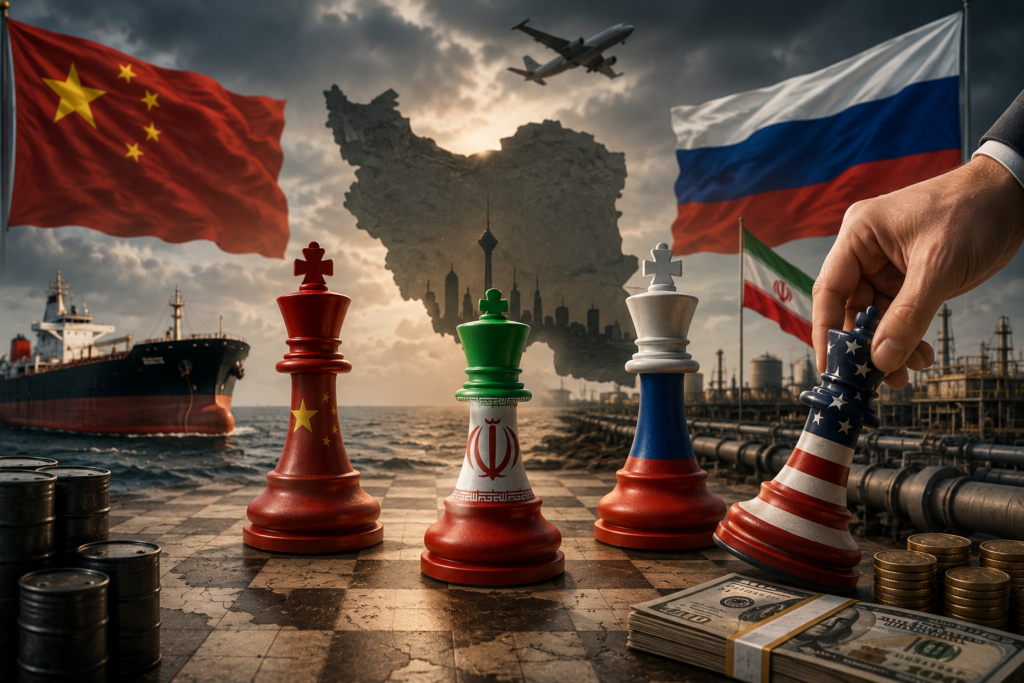
Image Credits: China and Russia Could Undermine Trump’s Bid to Economically Isolate Iran. AI-generated illustration created by Open Chronicle using ChatGPT (OpenAI). August 2026. This image is illustrative and does not depict a real-world scene.
By Open Chronicle with agencies
US President Donald Trump is attempting to intensify Iran’s economic isolation with threats of severe penalties against countries and companies that continue helping Tehran circumvent sanctions. But two of Iran’s most important strategic partners, China and Russia, could make that strategy considerably harder to enforce.
Six months into the US conflict with Iran, Trump has announced what he describes as an “economic D-Day” against Tehran, threatening consequences for countries providing Iran with an economic lifeline.
The strategy targets not only Iranian companies and institutions but also the international networks that allow Tehran to trade despite sanctions.
Yet analysts argue that Washington faces a fundamental problem. China remains the dominant customer for Iranian oil, while Russia has spent years developing economic, military and financial relationships with Tehran outside the Western-dominated system. Both countries also possess significant incentives to resist additional American pressure.
Trump promises a new economic offensive
Trump has described the planned campaign as an extraordinarily aggressive attempt to restrict Iran’s remaining access to international markets.
The White House is focusing on mechanisms that Tehran allegedly uses to circumvent sanctions, including oil trading networks, currency arrangements, financial intermediaries, ship registries and front companies.
The strategy effectively expands the pressure campaign beyond Iran itself.
Countries, banks, shipping companies and businesses facilitating Iranian commerce could potentially face American secondary sanctions.
That approach relies heavily on the enormous influence of the US financial system. Companies with significant exposure to American markets frequently have much more to lose from US sanctions than they gain through commerce with Iran.
But that leverage is not equally effective everywhere.
China and Russia represent particularly difficult targets.
China remains Iran’s critical economic partner
China is arguably the most important country for the survival of Iran’s sanctions-constrained economy.
According to Kpler data cited by Al Jazeera, China purchased approximately 80 percent of Iran’s shipped oil in 2025.
That relationship provides Tehran with a crucial source of export revenue.
Washington could attempt to target Chinese companies involved in the trade, but enforcing such restrictions presents significant challenges.
Much of the Iranian crude reaching China is purchased by independent refiners with relatively limited exposure to the American financial system.
These companies may therefore be more willing to accept the risk of US sanctions than major multinational corporations would be.
The result is a trading ecosystem considerably more resistant to traditional American financial pressure.
Targeting Chinese banks would be much more consequential
Washington possesses more powerful options.
The United States could impose penalties against major Chinese financial institutions processing Iranian transactions.
Such measures would dramatically increase the potential economic consequences for Beijing because major Chinese banks remain deeply connected to international financial markets.
But taking that step could produce retaliation.
Washington and Beijing are already engaged in an intense economic and technological competition, while both governments have recently sought to stabilise their relationship.
Analysts therefore question whether Trump would be willing to jeopardise broader negotiations with China simply to increase pressure on Iran.
Yu Jie of Chatham House told Al Jazeera that Trump’s threats were unlikely to fundamentally alter China’s existing economic relationship with Tehran.
Washington faces a strategic contradiction with Beijing
The problem demonstrates the limits of secondary sanctions when applied against another major economic power.
The United States can threaten a smaller economy with exclusion from American financial markets and expect substantial compliance.
China is different.
It is the world’s second-largest economy and an essential component of international manufacturing, trade and supply chains.
Escalating sanctions against major Chinese institutions could therefore impose costs on the United States as well.
Trump is simultaneously attempting to pressure Beijing over Iran while preparing for further diplomacy with Chinese President Xi Jinping.
Xi is expected to visit Washington next month, and additional meetings between the two leaders could follow later in the year.
That creates competing strategic priorities.
Washington wants China to stop supporting Iran economically.
It also wants to avoid another uncontrolled escalation in US-China economic relations.
Beijing understands that tension.
China calls for diplomacy instead
China has rejected the idea that additional sanctions will resolve the crisis.
Foreign Ministry spokesperson Lin Jian said Beijing believed further economic restrictions would not solve the problem and called for political and diplomatic measures.
China’s position reflects both economic and strategic interests.
Iran provides Beijing with energy supplies and occupies an important geographical position connecting the Middle East, Central Asia and the wider Eurasian trading system.
Maintaining relations with Tehran also gives China influence in a region traditionally dominated by American military and diplomatic power.
Beijing therefore has little strategic incentive to help Washington completely isolate Iran.
Russia presents an entirely different problem
If China is difficult to pressure because of its economic power, Russia is difficult to pressure for another reason.
Much of Washington’s traditional economic leverage against Moscow has already been used.
Russia has been subjected to extensive Western sanctions following its war against Ukraine.
Its major financial institutions, companies, political figures, and industries already operate under significant restrictions.
That means threatening Moscow with additional exclusion from Western markets may produce diminishing returns.
Russia has also spent years building alternative economic relationships intended to reduce its dependence on Western financial systems.
Iran has been pursuing many of the same strategies.
The two sanctioned economies consequently have strong incentives to cooperate.
Moscow and Tehran have built a sanctions-resistant relationship
Russia and Iran signed a 20-year strategic partnership treaty in January 2025, formalising a relationship that had already expanded significantly.
Trade between the two countries reached approximately $4.8 billion during the first 11 months of 2025, according to figures cited by Russian Energy Minister Sergey Tsivilev.
Their relationship extends beyond conventional commerce.
Russia and Iran have developed extensive military connections while seeking trading and financial mechanisms capable of operating outside Western sanctions.
The Caspian Sea provides a particularly important geographical connection between them.
Cargo can move directly between Russian and Iranian ports without passing through territory controlled by Western governments.
That makes the relationship difficult for Washington to completely disrupt.
Military cooperation adds another dimension
The Moscow-Tehran relationship has also become increasingly important militarily.
A European government document cited by NBC News reportedly indicated that Russia recently transported drone components, ammunition and TNT to Iran by sea.
If accurate, such transfers demonstrate how the partnership can operate as more than an economic lifeline.
Russia and Iran can potentially exchange military technology, components, raw materials and expertise while both remain heavily sanctioned by Western governments.
That creates a strategic network rather than simply a commercial relationship.
For Washington, disrupting such exchanges becomes substantially more difficult because both governments already expect confrontation with the United States.
The UAE embargo shows where US pressure can work
Trump’s strategy may nevertheless produce significant results among countries more closely integrated with Western markets.
The United Arab Emirates announced an indefinite trade embargo against Iran after accusing Tehran’s military of firing two ballistic missiles toward Emirati territory.
The UAE has historically been extremely important to Iranian commerce.
Dubai in particular has functioned as a commercial gateway through which Iranian companies could access international goods, financial services and trading networks.
Nader Habibi of Brandeis University suggested Washington likely played an important role in encouraging the UAE decision.
Losing access to Emirati markets could therefore impose high additional costs on Iran.
But isolating Tehran from the UAE is fundamentally different from isolating it from China.
BRICS provides Iran with another escape route
Iran is also attempting to use its membership of BRICS to reduce its dependence on Western financial institutions.
The organisation includes China, Russia, India, Brazil and several other major emerging economies.
Iranian Central Bank Governor Abdolnaser Hemmati said Tehran intends to pursue membership in the BRICS New Development Bank.
Membership could potentially expand Iran’s access to financing outside Western-controlled institutions, although any accession would require a formal process and the bank has not confirmed Iranian membership.
Tehran is also promoting greater use of national currencies in trade between BRICS members.
Such arrangements are particularly attractive to sanctioned states because they can reduce reliance on the US dollar and Western financial intermediaries.
The dollar remains Washington’s greatest economic weapon
American sanctions are extraordinarily powerful partly because of the central role of the dollar.
International companies routinely require access to US banks and dollar-denominated transactions.
Washington can therefore make companies choose between doing business with sanctioned countries or maintaining access to the much larger American financial system.
For decades, that has given the United States a form of economic power unmatched by most countries.
But extensive use of sanctions also creates incentives for targeted governments to develop alternatives.
China, Russia and Iran increasingly share an interest in creating financial mechanisms that cannot easily be controlled from Washington.
These alternatives remain far smaller and less efficient than the dollar-based system.
But sanctions themselves provide an incentive to expand them.
Iran has decades of experience surviving sanctions
Iran is not entering this confrontation without experience.
The country has lived under various forms of American sanctions for decades.
Over time, Iranian companies and institutions have developed increasingly sophisticated methods for maintaining international commerce.
Oil can be sold through intermediaries.
Ships can change registrations.
Cargoes can be transferred between vessels.
Companies can operate through complex ownership structures.
Payments can move through exchange houses or alternative currencies.
These methods increase transaction costs and reduce Iran’s economic efficiency.
They do not necessarily eliminate trade.
The question facing Washington is therefore not simply whether sanctions hurt Iran.
They clearly can.
The more difficult question is whether economic pressure can become strong enough to force Tehran to change its strategic behaviour.
Secondary sanctions could test America’s economic power
Trump’s new campaign could become one of the most significant tests of secondary sanctions in years.
Applying them aggressively against smaller companies and countries would be relatively straightforward.
Applying them against major Chinese banks or strategically important Russian entities would be far more consequential.
Washington would effectively be asking Beijing and Moscow to subordinate their relationships with Iran to American foreign policy objectives.
Neither has much incentive to do so.
China wants Iranian energy and influence in the Middle East.
Russia values Iran as a strategic and military partner.
Both governments also have broader reasons to challenge American economic dominance.
That makes the current confrontation about considerably more than Iran.
The campaign could accelerate economic fragmentation
There is also a longer-term risk for Washington.
The more frequently the United States uses access to its financial system as a geopolitical weapon, the stronger the incentive becomes for rivals to develop alternatives.
That does not mean the dollar is about to lose its dominant international role.
Replacing the infrastructure surrounding the American currency would be extraordinarily difficult.
But incremental changes matter.
More bilateral trade in national currencies reduces dollar dependence.
Alternative payment systems reduce exposure to Western financial networks.
New lending institutions create additional sources of capital.
Over time, these mechanisms could make sanctions less effective against countries operating within parallel economic networks.
Iran, Russia and China have powerful reasons to accelerate that process.
Economic pressure becomes another front in the Iran conflict
Trump’s declaration of an economic offensive demonstrates that the confrontation with Iran is increasingly being fought simultaneously across military, diplomatic and financial domains.
Washington is attempting to restrict Tehran’s ability to finance military operations and sustain its economy.
Iran is seeking alternative markets and financial mechanisms.
China continues purchasing Iranian energy.
Russia provides an increasingly important strategic connection.
BRICS offers additional possibilities for financial cooperation.
The outcome will help determine whether American economic power can still isolate a major regional state when other great powers refuse to cooperate.
That is the central weakness in Trump’s strategy.
Sanctions are most effective when the world’s major economies enforce them together.
Without Chinese and Russian participation, Iran retains important routes to trade, financing and military cooperation.
Washington can make those relationships more expensive.
It can punish individual companies.
It can pressure countries such as the UAE that remain deeply integrated with Western markets.
But completely isolating Iran would require something much harder: persuading or coercing China and Russia into helping enforce an American strategy they have little strategic reason to support.
That may prove far more difficult than imposing the sanctions themselves.
The Grand Strategy Institute
Continue Exploring Strategic Analysis
Return to The Grand Strategy Institute for strategic assessments, long-form analysis and research examining geopolitics, military affairs, international security, emerging technologies and the changing international order.
← Back to The Grand Strategy Institute