
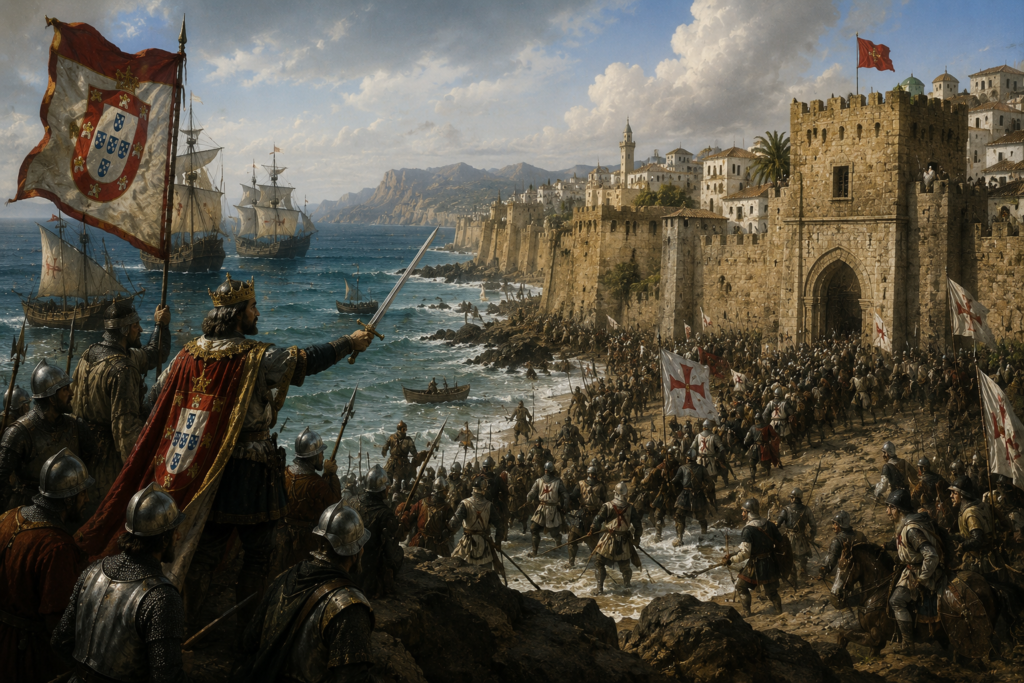
Image Credits: August 21, 1415: The Conquest of Ceuta and the Beginning of Portugal’s Overseas Expansion. AI-generated illustration created by Open Chronicle using ChatGPT (OpenAI). August 2026. This image is illustrative and does not depict a real-world scene.
By Open Chronicle
21 August 1415
On 21 August 1415, a Portuguese army led by King John I of Portugal captured the North African city of Ceuta, on the southern side of the Strait of Gibraltar. The operation was one of the most ambitious Portuguese military expeditions of the late Middle Ages and would later acquire a significance extending far beyond the immediate conquest.
Ceuta gave Portugal its first permanent possession outside the European mainland and placed the kingdom directly on the North African shore. For that reason, the conquest of 1415 is traditionally regarded as one of the opening events of the Portuguese overseas expansion.
Yet Ceuta did not immediately produce the maritime empire that would eventually stretch from the Atlantic islands and West Africa to India, Southeast Asia and Brazil. Rather, it represented an important transition. Portugal was beginning to look beyond the Iberian Peninsula at precisely the moment when new political ambitions, commercial interests, religious motivations and advances in navigation were creating the conditions for a much wider expansion.
Portugal After the Crisis of 1383–1385
The expedition cannot be understood without the political transformation Portugal had experienced only a generation earlier.
Following the death of King Ferdinand I in 1383 without a male heir, Portugal entered a dynastic crisis. The possibility that the Portuguese crown might fall under the influence of Castile produced political division and eventually war.
The crisis ended with the triumph of John, Master of Aviz, whose forces defeated the Castilians at the Battle of Aljubarrota on 14 August 1385.
John became King John I, establishing the House of Aviz.
His reign consolidated Portuguese independence and produced a new political order supported by important sections of the nobility, urban elites and merchant communities.
By the early fifteenth century, the dynasty was secure.
Portugal could increasingly direct its ambitions beyond the struggle for survival on the Iberian Peninsula.
North Africa offered an obvious possibility.
Why Ceuta?
Ceuta occupied an exceptional geographical position.
Situated on the North African coast near the entrance to the Mediterranean, the city stood close to the maritime routes passing through the Strait of Gibraltar.
It also had connections with commercial networks extending into Morocco and across North Africa.
For Portuguese leaders, possession of Ceuta offered several possible advantages.
The city could provide a strategic base overlooking one of the world’s most important maritime passages. It might give Portuguese merchants greater access to North African commerce. It could also serve as a military position from which further operations might be conducted.
Religion was equally important.
The ideological traditions of the Reconquista, the centuries-long struggle between Christian and Muslim states on the Iberian Peninsula, remained powerful within Portuguese aristocratic culture.
An expedition against a Muslim city in North Africa could therefore be presented as a continuation of Christian warfare beyond Iberia.
For members of the Portuguese nobility, the campaign also offered opportunities for military distinction, honour and advancement.
Ceuta combined strategic, commercial, dynastic and religious ambitions in a single objective.
The Princes of the House of Aviz
The expedition also became closely associated with the sons of John I and Queen Philippa of Lancaster.
Among them were Duarte, the future King Edward of Portugal, Pedro, Duke of Coimbra, and Henry, later remembered as Prince Henry the Navigator.
The three princes were young men seeking the military distinction expected of aristocratic rulers.
Participation in the campaign offered an opportunity to demonstrate courage and earn knighthood through battle.
Henry’s involvement would later become particularly significant because of his association with Portuguese exploration along the African coast.
It is tempting to interpret the entire Ceuta expedition through the later history of Henry and the voyages of discovery.
The reality was more complicated.
In 1415, the campaign remained fundamentally a military expedition against a strategically important North African city. Its relationship with the systematic Atlantic exploration that followed developed gradually rather than according to a fully formed imperial plan.
Preparing the Expedition
Preparations for the attack were conducted on an extraordinary scale.
Ships, soldiers, weapons, horses and provisions had to be assembled while the intended target remained as secret as possible.
The Portuguese fleet gathered during the summer of 1415.
Contemporary and later chronicles differ over the precise number of ships and troops involved, but the expedition was clearly one of the largest maritime forces Portugal had assembled.
The operation required substantial logistical coordination.
For a relatively small European kingdom, transporting a major army across the sea represented an impressive demonstration of organisational capacity.
The expedition departed from Portugal and moved toward the Strait of Gibraltar.
Across the water lay Ceuta.
Crossing to North Africa
The Portuguese fleet reached the North African coast in August.
Weather and maritime conditions complicated the approach, but the force eventually prepared for the assault.
On 21 August 1415, Portuguese troops landed near Ceuta.
The defenders attempted to resist the invasion, but the Portuguese forces succeeded in establishing themselves ashore and advancing toward the city.
Fighting spread through Ceuta.
The Portuguese attackers eventually overwhelmed the resistance and occupied the urban centre.
By the end of the operation, the city was in Portuguese hands.
King John I had achieved an extraordinary military victory.
Portugal now possessed territory in North Africa.
The Princes Become Knights
Following the conquest, the campaign acquired an important dynastic dimension.
John I knighted his sons Duarte, Pedro and Henry.
The ceremony associated the young princes with one of the greatest military achievements of their father’s reign.
For the House of Aviz, Ceuta became a demonstration of royal strength and Christian military prestige.
The victory also reinforced Portugal’s position as an independent kingdom capable of projecting military power beyond the Iberian Peninsula.
Yet holding Ceuta would prove far more difficult than capturing it.
The Commercial Expectations
Portuguese leaders had hoped that possession of Ceuta might provide access to valuable commercial networks.
North African trade connected Mediterranean ports with routes extending toward the interior of Africa.
Gold, textiles, spices and other commodities circulated through these networks.
But conquest disrupted many of the commercial relationships that had made Ceuta valuable.
Merchants could redirect trade elsewhere, while maintaining the city required soldiers, supplies and money from Portugal.
Ceuta therefore failed to become the straightforward commercial prize some supporters of the expedition may have imagined.
Instead, it became an expensive strategic possession that Portugal was determined to defend.
That experience helped demonstrate an important reality.
Capturing territory was not necessarily the most effective way to gain access to African commerce.
Finding maritime routes to the sources of trade could offer another solution.
Prince Henry and the Atlantic
In the decades following Ceuta, Prince Henry became an important patron of Portuguese maritime activity.
Portuguese navigators increasingly explored the Atlantic and the western coast of Africa.
The settlement of Madeira began during the early fifteenth century. The Azores were subsequently explored and settled.
Portuguese voyages then pushed progressively farther south along the African coastline.
Cape Bojador, long regarded by European sailors as a formidable psychological and navigational barrier, was passed by Gil Eanes in 1434.
Exploration continued.
Portuguese mariners developed greater knowledge of Atlantic winds and currents, while ship design, cartography and navigation evolved through practical experience.
The objective was increasingly commercial as well as exploratory.
Portugal sought direct access to African gold and other valuable goods without depending entirely upon established North African trading networks.
Was Ceuta the Beginning of the Portuguese Empire?
Historians often describe the conquest of Ceuta as the beginning of the Portuguese Empire.
There is good reason for doing so.
Ceuta was Portugal’s first lasting overseas conquest, and the expedition represented a deliberate projection of Portuguese military power beyond Europe.
But the description requires qualification.
The global Portuguese maritime network of the sixteenth century did not emerge fully formed from the events of 1415.
The expansion unfolded gradually.
Atlantic island colonisation, exploration of the African coast, participation in African trade and attempts to reach the Indian Ocean developed over many decades.
The conquest of Ceuta therefore represented a starting point in a longer historical transformation rather than the execution of an already established global strategy.
Its significance becomes clearest when viewed from the perspective of what followed.
Around the Cape of Good Hope
By the late fifteenth century, Portuguese exploration had reached a new stage.
In 1488, Bartolomeu Dias rounded the southern tip of Africa, demonstrating that the Atlantic and Indian oceans were connected by a navigable maritime route.
Ten years later, Vasco da Gama reached India.
His arrival at Calicut in 1498 transformed the commercial geography of Europe and the Indian Ocean.
Portugal began constructing a network of fortified ports, trading posts and naval bases extending along the coasts of Africa and Asia.
Goa became the principal centre of Portuguese power in India.
Portuguese forces established themselves at Malacca, while commercial networks extended toward China and Japan.
In the Atlantic, Portuguese colonisation also transformed Madeira, the Azores and eventually Brazil, reached by the fleet of Pedro Álvares Cabral in 1500.
Within less than a century of the attack on Ceuta, Portuguese ships were operating across several oceans.
A Transformation with Global Consequences
Portuguese maritime expansion helped create sustained connections between regions of the world that had previously interacted through more indirect networks.
Europe, Africa, Asia and the Americas became increasingly connected through oceanic routes.
Goods, technologies, religions, languages, plants, animals and people moved across enormous distances.
The consequences were profound and frequently violent.
Portuguese expansion included warfare, conquest and coercive commercial systems. Portugal also became deeply involved in the Atlantic slave trade, which forcibly transported millions of Africans across the Atlantic over the following centuries as part of a much larger European system of enslavement and colonial exploitation.
The history that followed Ceuta therefore cannot be understood solely as a story of exploration and navigation.
It was also a history of empire, cultural encounter, economic transformation, forced migration and conflict.
Ceuta and Portugal
Portugal retained Ceuta for more than two centuries.
When Portugal and Spain came under the same monarch during the Iberian Union beginning in 1580, Ceuta remained connected to the wider Iberian monarchy.
After Portugal restored its independence in 1640, Ceuta did not return to Portuguese allegiance.
Its incorporation into Spain was subsequently recognised through diplomatic settlement.
Today, Ceuta is a Spanish autonomous city on the North African coast.
Its history continues to reflect the extraordinary strategic importance of the Strait of Gibraltar and the long interaction between Europe and North Africa.
August 21, 1415
The capture of Ceuta was conceived as a military expedition rooted in the political, religious and strategic world of late medieval Portugal.
Its participants could not have known the full consequences of the transformation that would follow.
Yet the operation demonstrated that the Portuguese monarchy possessed the ships, organisational capacity and political ambition required to project power beyond the Iberian Peninsula.
During the following century, that outward movement expanded dramatically.
Portuguese navigators explored Atlantic islands, travelled down the African coast, rounded the Cape of Good Hope and entered the Indian Ocean. Eventually, Portuguese maritime networks stretched across much of the globe.
For that reason, 21 August 1415 occupies a symbolic place in world history.
The conquest of Ceuta was not yet the global Portuguese maritime empire.
But it was one of the first decisive steps in the process that created it.