
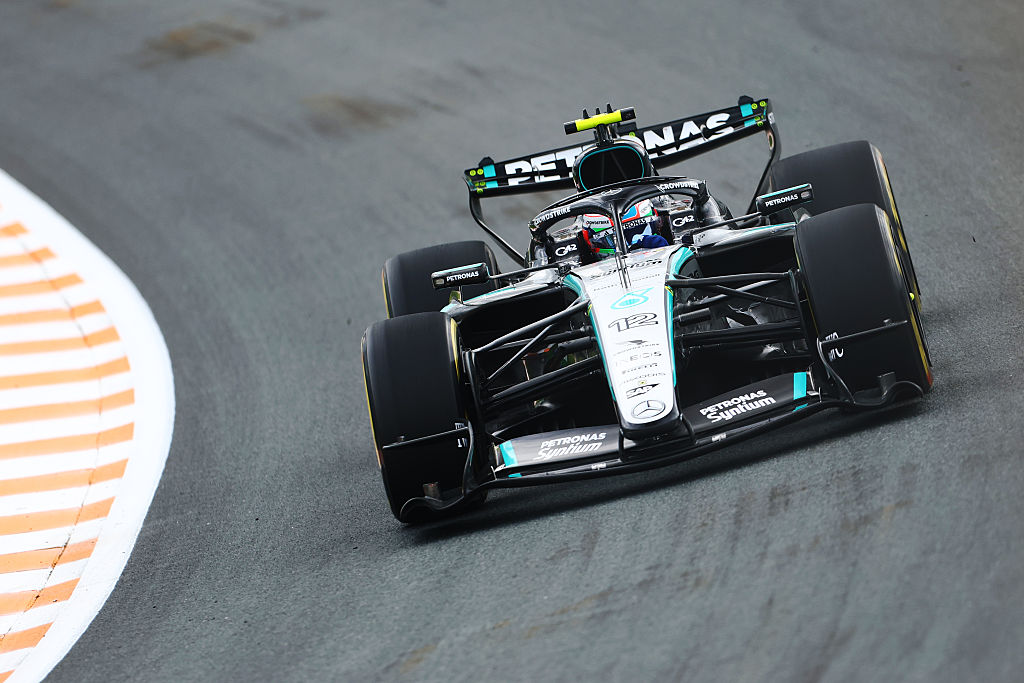
Image: from Formule1.nl X @Formule1
Mercedes championship leader tops the Dutch Grand Prix’s only practice session ahead of Norris and Russell, while Ferrari shows competitive pace, Audi breaks into the top ten and changing weather conditions add another layer of uncertainty to the Sprint weekend.
By Open Chronicle News Desk with Agencies
Formula One returned from its European summer break with an immediate reminder of how unpredictable Zandvoort can be.
Kimi Antonelli set the fastest time in the only free practice session for the 2026 Dutch Grand Prix, leading Lando Norris and Mercedes teammate George Russell after a rapidly evolving hour that began on a wet circuit and ended with drivers pushing on slick tyres in conditions approaching normal.
The championship leader produced a late lap of 1:12.949 to take first place, beating Norris by just 0.121 seconds. Russell was only four thousandths further behind, completing a remarkably tight top three.
Lewis Hamilton placed Ferrari fourth with a 1:13.139, while Charles Leclerc followed in fifth, leaving Mercedes, McLaren and Ferrari separated by less than three tenths at the end of Formula One’s first competitive session since the summer break.
Further down the order, Audi enjoyed an encouraging start as Nico Hülkenberg finished seventh and Gabriel Bortoleto ninth.
With Zandvoort hosting a Sprint weekend, however, practice represented much more than another Friday session. It was the teams’ only opportunity to understand their cars before competitive running begins.
And with rain still threatening the remainder of the weekend, the information collected during this single hour could prove crucial.
Formula One Returns From the Summer Break
The Dutch Grand Prix marks the beginning of the second half of the 2026 Formula One season following almost a month without racing.
There is additional significance surrounding this year’s event, with Zandvoort preparing for its farewell from the Formula One calendar.
The compact, fast and heavily banked Dutch circuit has produced some memorable races since returning to Formula One, but its final weekend presents teams with an unusual challenge because of the Sprint format.
Only one practice session was available before the Sprint Shootout.
That meant every minute mattered.
Teams needed to evaluate tyre compounds, understand the balance of their cars, collect long run information and, in several cases, assess significant technical upgrades, all within a single hour.
The weather immediately complicated those plans.
Heavy rain had fallen throughout the night in the Netherlands. Although the rain had stopped by the beginning of practice, the circuit remained wet and grip levels were considerably lower than normal.
The surface would not remain that way for long.
Intermediate Tyres Open the Session
Nico Hülkenberg became the first driver to leave the pit lane, with Audi sending the German onto the circuit using intermediate tyres.
It quickly became apparent that conditions were already moving towards the crossover point.
Hülkenberg reported that the circuit was too dry for intermediates, although it remained too damp in several areas to make slick tyres an obvious choice.
Nevertheless, the first representative times were recorded on the green marked compound.
Hülkenberg established the early benchmark at 1:26.555, before Hamilton moved Ferrari to the top with a 1:25.562.
Franco Colapinto also featured prominently during the opening phase as more cars gradually emerged from their garages.
The circuit was changing with almost every lap.
Then McLaren made the move that transformed the session.
Piastri Triggers the Switch to Slicks
Oscar Piastri became the first driver to commit to slick tyres.
It proved to be the correct decision.
The Australian immediately produced a 1:23.311, more than two seconds quicker than the previous benchmark and clear evidence that the crossover point had arrived.
Within minutes, teams throughout the pit lane began abandoning intermediates.
Race control subsequently confirmed that grip conditions could effectively be considered normal, even though small areas of moisture remained around the circuit.
Antonelli then demonstrated just how dramatic the improvement had become.
The Mercedes driver switched to slicks and produced a 1:18.264, improving on Piastri’s benchmark by more than five seconds.
From that moment, the session became an increasingly intense search for lap time.
Zandvoort Comes Alive
As the remaining damp patches disappeared and a dry racing line developed, lap times began falling dramatically.
Russell was among the first drivers to break into the 1:16 range, while Hamilton and Leclerc steadily moved Ferrari towards the front.
The Italian team arrived in the Netherlands with another technical development package as its battle with McLaren continued into the second half of the season.
The initial signs were encouraging.
Leclerc briefly climbed into second position, while Hamilton remained close behind. Mercedes and McLaren responded almost immediately, creating a constantly changing order at the top.
Russell, Leclerc, Hamilton, Norris and Max Verstappen all featured in the battle for the fastest time as grip improved.
Antonelli remained firmly involved despite one unusual moment.
The championship leader suddenly spun through a complete 360 degree rotation during one of his attempts. He recovered without hitting anything and admitted over the radio that he was unsure what had caused the car to rotate.
There was no damage.
More importantly, there appeared to be no damage to Antonelli’s confidence either.
Antonelli Responds
The Italian quickly returned to competitive pace.
As the session entered its final phase, teams began fitting fresher tyres and preparing for the closest thing they would have to a qualifying simulation before the Sprint Shootout.
Norris briefly moved to the top.
Russell responded for Mercedes.
Antonelli’s first serious attempt did not come together, leaving the championship leader temporarily outside the leading positions.
His next lap was very different.
Antonelli put together all three sectors and stopped the clock at 1:12.949.
Nobody could beat it.
Norris finished just 0.121 seconds behind with a 1:13.070, while Russell’s 1:13.074 left him only 0.125 seconds away from his teammate.
After a month away from competitive Formula One action, the three leading drivers were separated by little more than a tenth of a second.
Ferrari Remains in the Fight
Ferrari’s opening session provided further encouragement after a competitive first half of the season.
Hamilton’s 1:13.139 placed him fourth, only 0.190 seconds behind Antonelli.
Leclerc followed with a 1:13.238, 0.289 seconds away from the benchmark.
More important than the outright positions was Ferrari’s apparent ability to remain close to Mercedes and McLaren as conditions improved.
Both Ferrari and McLaren brought upgrades to Zandvoort, continuing a development contest that could become increasingly significant as the championship enters its decisive phase.
Piastri eventually finished sixth with a 1:13.608, meaning the leading six positions were occupied exclusively by Mercedes, McLaren and Ferrari.
Audi Makes an Encouraging Start
Audi emerged as one of the most interesting teams behind the leading group.
Hülkenberg remained competitive throughout the session and eventually recorded a 1:13.784, good enough for seventh.
Bortoleto also became increasingly competitive as grip improved.
After a relatively quiet opening phase, the Brazilian began producing increasingly strong laps and moved into the top ten. At one stage he climbed as high as seventh, placing himself between some of the established frontrunners.
During the final runs, Bortoleto used the medium compound to record a 1:13.992, securing ninth position.
He finished just 0.208 seconds behind Hülkenberg.
With both cars inside the top nine, Audi leaves the only practice session of the weekend with encouraging evidence that its package could be competitive around Zandvoort.
Red Bull Forced Into a Driver Change
One of the biggest stories before practice concerned Red Bull’s driver line up.
Isack Hadjar was ruled out of the Dutch Grand Prix after suffering a fractured wrist.
Red Bull responded by temporarily promoting Liam Lawson to the senior team, while Yuki Tsunoda returned to the Formula One grid to occupy Lawson’s Racing Bulls seat.
The arrangement immediately created an intriguing comparison.
Tsunoda initially appeared slightly faster while Lawson adapted to the Red Bull, but the New Zealander quickly improved and briefly climbed as high as third during the evolving session.
His final position, however, was less representative.
Lawson finished 14th with a 1:14.861, while Tsunoda recorded a 1:15.110 for 17th.
Verstappen also ended the session outside the leading positions.
The Dutchman, racing at home, finished 11th with a 1:14.325, more than 1.3 seconds behind Antonelli.
With different programmes being conducted throughout the field, the final positions should not necessarily be interpreted as the definitive competitive order.
Aston Martin Evaluates Honda Upgrade
Aston Martin also brought significant technical changes to the Netherlands.
The team introduced a revised front wing and, more importantly, an updated Honda power unit.
Fernando Alonso provided the first indications that the package could represent progress, running close to the top ten during parts of the session.
The Spaniard eventually finished 12th with a 1:14.511, while Lance Stroll was 18th on 1:15.199.
With only one practice session available, Aston Martin now faces the difficult task of extracting further performance without another conventional practice opportunity.
Difficult Morning for Sainz
While several teams left practice encouraged, Carlos Sainz endured a particularly complicated session.
The Williams driver repeatedly ran off the circuit, bringing gravel onto the track on several occasions.
Williams subsequently informed Sainz that his car had sustained floor damage.
He finished at the bottom of the timesheets with a 1:16.345, almost three and a half seconds behind Antonelli.
Alexander Albon was 19th in the other Williams, recording a 1:15.357.
Different Programmes Complicate the Picture
The final classification provides only part of the story.
Sprint weekends force teams to compress programmes that would normally span three practice sessions into a single hour.
Some drivers concentrated on qualifying simulations. Others completed longer runs or evaluated tyre behaviour. Several compounds appeared throughout the session.
The rapidly changing circuit made direct comparisons even more difficult.
Times set early in the hour quickly became irrelevant as the track dried, while drivers completing their fastest laps later benefited from significantly improved grip.
What can be said with confidence is that Mercedes began the second half of the season strongly.
Antonelli topped the session.
Russell finished third.
Between them was Norris, ensuring McLaren remained firmly in the conversation.
Ferrari was close behind, while Audi produced one of the strongest midfield performances of the session.
The margins suggest that the Sprint Shootout could be considerably more revealing.
Full Free Practice Classification
| Pos. | Driver | Team | Time |
|---|---|---|---|
| 1 | Kimi Antonelli | Mercedes | 1:12.949 |
| 2 | Lando Norris | McLaren Mercedes | 1:13.070 |
| 3 | George Russell | Mercedes | 1:13.074 |
| 4 | Lewis Hamilton | Ferrari | 1:13.139 |
| 5 | Charles Leclerc | Ferrari | 1:13.238 |
| 6 | Oscar Piastri | McLaren Mercedes | 1:13.608 |
| 7 | Nico Hülkenberg | Audi | 1:13.784 |
| 8 | Pierre Gasly | Alpine Mercedes | 1:13.911 |
| 9 | Gabriel Bortoleto | Audi | 1:13.992 |
| 10 | Arvid Lindblad | Racing Bulls Red Bull Ford | 1:14.285 |
| 11 | Max Verstappen | Red Bull Racing Red Bull Ford | 1:14.325 |
| 12 | Fernando Alonso | Aston Martin Honda | 1:14.511 |
| 13 | Franco Colapinto | Alpine Mercedes | 1:14.826 |
| 14 | Liam Lawson | Red Bull Racing Red Bull Ford | 1:14.861 |
| 15 | Oliver Bearman | Haas Ferrari | 1:14.874 |
| 16 | Esteban Ocon | Haas Ferrari | 1:14.897 |
| 17 | Yuki Tsunoda | Racing Bulls Red Bull Ford | 1:15.110 |
| 18 | Lance Stroll | Aston Martin Honda | 1:15.199 |
| 19 | Alexander Albon | Williams Mercedes | 1:15.357 |
| 20 | Valtteri Bottas | Cadillac Ferrari | 1:15.580 |
| 21 | Sergio Pérez | Cadillac Ferrari | 1:15.700 |
| 22 | Carlos Sainz | Williams Mercedes | 1:16.345 |
What Comes Next at Zandvoort
There is no conventional second practice session.
The Dutch Grand Prix weekend now moves directly into competitive action with the Sprint Shootout, which will determine the starting grid for the Sprint.
That will provide the first genuine indication of whether Antonelli’s pace represents Mercedes’ true advantage or whether Norris, Russell, Ferrari and perhaps some of the unexpected midfield contenders have more performance available.
The Sprint follows before attention turns to qualifying for Sunday’s Grand Prix and ultimately the final Formula One race at Zandvoort.
Weather could still become one of the weekend’s defining factors. Rain remains a possibility, and at a circuit where wind, sand and rapidly changing grip conditions already make car control difficult, another wet session could completely reshape the competitive order.
For now, though, Formula One’s championship leader has delivered the opening statement.
After the summer break, Kimi Antonelli and Mercedes are immediately back on top.