
By Open Chronicle Defence
Few military aircraft have demonstrated the combination of longevity, adaptability and operational relevance associated with the Hercules family.
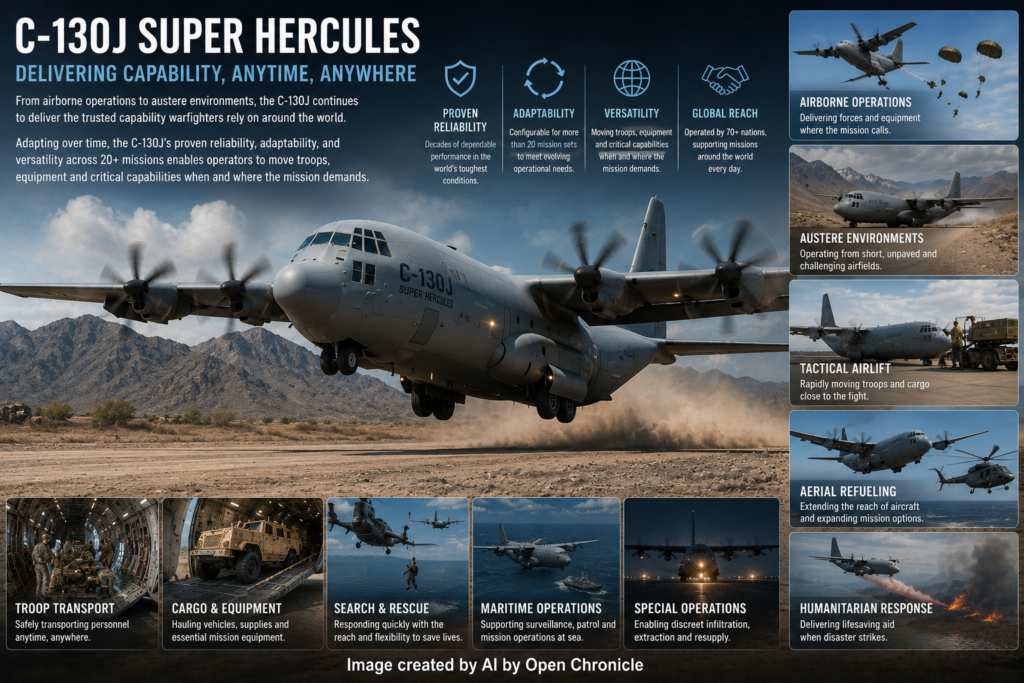
From transporting soldiers and equipment to supporting airborne operations and missions from austere airfields, the C-130 has become one of the most recognisable tactical transport aircraft in military aviation. Its modern incarnation, the C-130J Super Hercules, continues that tradition while incorporating new engines, avionics and systems designed for contemporary operations.
Its enduring value comes from a relatively simple principle: military forces rarely know exactly where the next mission will take them.
They therefore need an aircraft capable of adapting.
The C 130J was designed around precisely that requirement.
A tactical airlifter for the unpredictable
Strategic transport aircraft are extraordinarily effective at moving large quantities of equipment between major airbases.
But military operations do not always happen near major airports.
Troops may need supplies at remote bases. Special operations forces may require insertion into isolated territory. Humanitarian assistance may need to reach communities where conventional airport infrastructure has been damaged or does not exist.
This is where tactical airlift becomes critical.
The C-130J combines useful payload capacity with the ability to operate from comparatively short and austere airfields.
That allows commanders to move personnel and equipment considerably closer to where they are actually required.
Instead of simply connecting major logistics hubs, the aircraft can become part of the final tactical stage of the transportation network.
The Super Hercules represents decades of evolution
The original C-130 Hercules first flew in the 1950s.
The basic configuration proved remarkably successful: four turboprop engines, a high-mounted wing, a large cargo compartment, and a rear loading ramp.
But the aircraft operating today is not simply a 1950s transport kept alive indefinitely.
The C 130J introduced a substantial technological evolution.
Its Rolls-Royce AE 2100D3 turboprop engines drive six-bladed composite propellers, providing improved performance and efficiency compared with earlier generations.
The cockpit was also extensively modernised.
Digital avionics, multifunction displays and more automated systems reduced crew workload while improving situational awareness.
These changes allowed the Hercules concept to survive into an era dramatically different from the one in which the original aircraft was conceived.
More than twenty mission types
One of the defining characteristics of the C-130J family is its versatility.
The aircraft and its specialised derivatives can support more than twenty mission sets across military and government operations.
Transport remains fundamental.
But the wider Hercules ecosystem has been adapted for missions involving special operations, aerial refuelling, search and rescue, firefighting, weather reconnaissance, maritime operations and other specialised requirements.
This flexibility explains why the aircraft has remained relevant.
A highly specialised platform may be exceptionally effective at one task but of limited value when operational requirements change.
The Hercules philosophy is different.
Its airframe provides a foundation that can be adapted around the mission.
Moving troops into the fight
Personnel transport remains one of its most important roles.
Military forces frequently need to reposition large numbers of soldiers rapidly across theatres where ground transportation would take considerably longer.
The C 130J can move troops directly between forward locations, reducing dependence on major transportation hubs.
That becomes especially valuable during rapidly developing crises.
A unit located hundreds of kilometres away can potentially be repositioned within hours rather than days.
The aircraft can also support evacuation and redeployment when conditions change.
Mobility therefore becomes a combat capability in its own right.
Airborne operations remain central to the Hercules identity
The C 130 has long been associated with paratroopers and airborne forces.
When conventional landing is impossible or tactically undesirable, personnel and equipment can be delivered by parachute.
This allows forces to operate beyond established airfields.
Airborne troops can be inserted into strategically important areas, while supplies can be dropped to units operating in isolated locations.
Cargo delivery can be equally important.
Food, ammunition, medical supplies, and equipment can reach forces without requiring the aircraft to land.
In contested environments, the ability to deliver cargo quickly and leave the area can provide commanders with an important logistical option.
The rear ramp is one of its greatest strengths
The aircraft’s large rear cargo ramp gives it tremendous flexibility.
Vehicles can be driven aboard.
Palletised cargo can be loaded rapidly.
Troops can embark efficiently.
Specialised equipment can be transported without requiring the extensive ground infrastructure associated with many civilian cargo aircraft.
That simplicity matters during military operations.
Aircraft may need to land, unload and depart rapidly.
The less equipment required on the ground, the easier it becomes to operate from forward locations.
Built for austere environments
Perhaps the most important characteristic of the Hercules is its ability to operate where infrastructure is limited.
Modern military operations increasingly emphasise distributed basing.
Instead of concentrating aircraft and personnel at a small number of enormous bases, forces may disperse across multiple locations to complicate enemy targeting.
This approach places new demands on transport aircraft.
Forward airfields may have shorter runways.
Ground support equipment may be limited.
Maintenance facilities may be basic.
Environmental conditions may be difficult.
The C 130J’s tactical design makes it particularly useful in these circumstances.
It does not eliminate the logistical challenges of dispersed operations, but it provides commanders with considerably more flexibility in addressing them.
Logistics decides whether forces can keep fighting
Modern weapons attract much of the attention surrounding military power.
But combat forces cannot operate without logistics.
Aircraft require parts and fuel.
Ground units require ammunition.
Soldiers require food and medical supplies.
Advanced weapons systems require specialised components.
A force separated from its supply network gradually loses combat effectiveness regardless of how sophisticated its equipment may be.
Aircraft such as the C-130J exist to maintain that connection.
Their contribution may appear less dramatic than that of fighters or bombers, but sustained military operations would become impossible without them.
Special operations demand flexibility
The Hercules family has also become closely associated with special operations.
Special operations missions frequently occur at long distances from established bases and under conditions where conventional transportation is unsuitable.
Specialised Hercules variants can support infiltration, extraction, resupply and aerial refuelling.
The aircraft’s range, cargo capacity and ability to operate from relatively austere locations make it a natural platform for such missions.
Special operations also demonstrate one of the fundamental advantages of a mature aircraft family.
Instead of developing an entirely new aircraft for every requirement, the existing platform can be modified around specialised equipment and mission systems.
Aerial refuelling expands the family further
Certain Hercules variants serve as aerial refuelling aircraft.
This is particularly important for helicopters and other aircraft operating far from established bases.
Refuelling in flight extends their operational radius and allows missions to continue without returning to a fixed location.
For expeditionary forces, that creates another layer of flexibility.
The same basic aircraft family that transports troops can therefore also help sustain aircraft supporting them.
Humanitarian missions demonstrate another side of the aircraft
The qualities that make the C-130J useful during war also make it valuable during natural disasters.
Earthquakes, floods, hurricanes, and other emergencies frequently damage roads, ports, and airports.
Yet those are precisely the moments when large quantities of food, medicine, rescue equipment and personnel need to move quickly.
Tactical transport aircraft can reach areas where normal commercial logistics have broken down.
The ability to operate with limited infrastructure becomes humanitarian rather than military, but the underlying capability is essentially the same.
Reliability matters more than glamour
Transport aircraft rarely attract the same public attention as stealth fighters.
Their effectiveness is measured differently.
A tactical airlifter must start when required.
It must carry its cargo.
It must operate repeatedly.
It must tolerate difficult environments.
It must remain maintainable across decades of service.
Reliability therefore becomes one of its most important characteristics.
An aircraft capable of spectacular performance but unavailable when required has limited operational value.
The Hercules earned its reputation through repeated use rather than technological novelty alone.
A global logistics network
The widespread international adoption of the Hercules creates another advantage.
Operators around the world have accumulated decades of experience with the aircraft family.
Maintenance expertise, training practices, logistics knowledge and operational procedures have developed across numerous air forces.
For allied countries, common aircraft can also improve interoperability.
Crews understand similar procedures.
Support organisations have experience with comparable systems.
During multinational operations, that familiarity can simplify cooperation.
The C-130J therefore functions not merely as an aircraft but as part of a much larger international logistics ecosystem.
Modern warfare may increase its importance
Recent conflicts have reinforced the vulnerability of large permanent military installations.
Long-range missiles, cruise missiles and drones can threaten bases hundreds or even thousands of kilometres from a frontline.
Future forces may consequently need to disperse more frequently.
Aircraft could move between smaller operating locations.
Air defence systems may need rapid repositioning.
Specialised equipment could require constant resupply.
Personnel might move between temporary bases as threats change.
That environment places enormous importance on tactical mobility.
The C 130J is particularly well suited to supporting such distributed operations.
Connecting strategic airlift with the battlefield
Large strategic transport aircraft can move enormous payloads across continents.
But those aircraft generally perform best when operating between substantial airbases.
The C 130J occupies a different position.
Strategic transports can bring equipment into a theatre.
The Hercules can then distribute personnel and cargo toward smaller forward locations.
This creates a logistics chain extending from factories and major bases all the way toward operational units.
Without the tactical portion of that chain, enormous strategic airlift capacity can become concentrated far from the forces that actually need the supplies.
Adaptability is the real capability
The most remarkable aspect of the C-130 story may not be any individual performance statistic.
It is adaptability.
The geopolitical environment surrounding the aircraft has changed repeatedly.
The Cold War ended.
Counterinsurgency operations expanded.
Humanitarian missions increased.
Special operations became more important.
Precision weapons transformed warfare.
Drones proliferated.
Military forces began exploring distributed operations.
Yet the basic requirement for moving people and equipment into difficult places never disappeared.
The Hercules evolved around that enduring requirement.
The mission determines the aircraft’s value
A C-130J may carry paratroopers on one mission.
Another aircraft may transport vehicles.
Another could move humanitarian supplies after a disaster.
A specialised variant might support special operations or aerial refuelling.
Different missions, different environments, same underlying philosophy.
Deliver what is required, where it is required, when it is required.
That explains why an aircraft lineage originating more than seven decades ago remains relevant to twenty-first-century warfare.
The C-130J Super Hercules does not depend on one spectacular capability for its reputation.
Its strength comes from being useful across an extraordinary range of circumstances.
From airborne operations to remote airfields, from combat logistics to humanitarian response, the aircraft continues performing the fundamental task upon which every military ultimately depends.
Getting people, equipment, and critical capabilities to the place where they are needed most.