
By Open Chronicle Defence
The rapid spread of small drones has created one of the most difficult detection problems facing modern militaries, governments and security services.
Unmanned aircraft can be inexpensive, commercially available and extremely small. They can approach targets at low altitude, operate among buildings and exploit terrain that complicates conventional radar coverage. Recent conflicts have demonstrated that even relatively simple drones can conduct reconnaissance, direct artillery, attack vehicles and infrastructure or carry explosives.
Now researchers are exploring a different approach to finding them.
Instead of relying exclusively on dedicated military sensors, existing communications infrastructure could itself become part of the detection network.
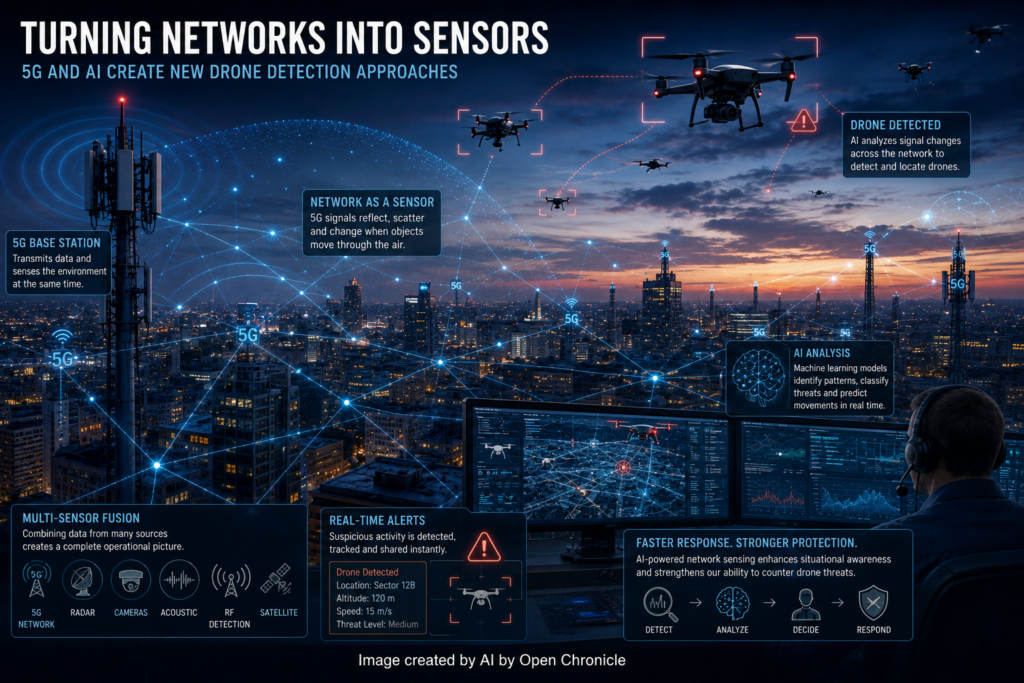
The combination of 5G telecommunications and artificial intelligence creates the possibility of turning ordinary wireless networks into distributed sensing systems capable of detecting and potentially tracking drones moving through their coverage areas.
The concept could fundamentally change how countries think about counter-drone surveillance.
The drone detection problem
Traditional air defence was designed primarily to detect comparatively large targets.
Fighter aircraft, bombers and missiles generally produce signatures that sophisticated radar systems can identify at useful distances.
Small drones present a different challenge.
Some weigh only a few kilograms. Others are even smaller.
They often contain substantial amounts of plastic and composite materials, reducing their radar signature. They can fly slowly and extremely close to the ground, sometimes resembling birds or other background objects to conventional sensors.
Urban environments make the problem even more difficult.
Buildings create reflections and blind spots. Civilian communications generate enormous quantities of electromagnetic activity. Roads, aircraft, machinery and people create additional clutter.
A drone can disappear into this complicated environment.
Yet the wireless infrastructure surrounding it may still detect that something has changed.
Turning communications networks into sensors
5G networks were designed to move information rapidly between large numbers of connected devices.
But wireless communication depends on electromagnetic signals travelling through the physical environment.
Objects affect those signals.
Buildings reflect them.
Vehicles obstruct them.
People alter propagation patterns.
Aircraft and drones can do the same.
That creates an intriguing possibility.
If a communications network continuously understands what its normal radio environment looks like, unusual disturbances could reveal that an object is moving through it.
In effect, the network begins performing two jobs simultaneously.
It communicates.
And it senses.
Why 5G is particularly interesting
Several characteristics of 5G make the technology attractive for this purpose.
Modern networks contain large numbers of antennas distributed across populated areas.
They use sophisticated beamforming techniques to direct radio energy.
Higher frequency signals can also interact strongly with objects in the surrounding environment.
Together, these characteristics create an increasingly detailed electromagnetic picture of the area covered by the network.
A drone crossing that environment may produce subtle changes in signal strength, reflections, interference patterns and propagation.
Individually, those changes may appear meaningless.
Collectively, they can form a pattern.
This is where artificial intelligence becomes important.
AI searches for the pattern
A human operator could never continuously analyse every variation occurring across a large telecommunications network.
Machine learning can.
AI models can be trained to distinguish between ordinary environmental changes and signatures associated with moving objects.
The system might learn how signals behave when a truck passes.
It can learn the effects created by pedestrians.
It can recognise weather-related changes.
Eventually, it may learn the characteristic disturbances produced by drones.
The objective is not necessarily to create a perfect image of the aircraft.
It is to recognise that something unusual is present and determine whether that object behaves like a drone.
Detection without relying on the drone’s own transmissions
Many existing counter-drone systems search for radio signals exchanged between a drone and its operator.
That approach can be extremely effective against commercial aircraft using conventional command links.
But increasingly sophisticated drones can operate differently.
Some follow preprogrammed routes.
Others use autonomous navigation.
Military systems may employ encrypted communications or frequency hopping.
A drone could theoretically operate without transmitting anything at all.
Passive detection based on changes to existing network signals offers a different approach.
The system does not necessarily need the drone to communicate.
It needs the drone to physically interact with electromagnetic energy already present in the environment.
That distinction could become increasingly important as autonomous drones proliferate.
Existing infrastructure creates a major advantage
Building nationwide networks of dedicated military radars would be enormously expensive.
5G infrastructure already exists across many cities, industrial areas, airports, and transport corridors.
If some of that infrastructure could provide useful sensing information, governments might gain an additional surveillance layer without constructing an entirely separate network from the ground up.
The telecommunications system effectively becomes dual-purpose infrastructure.
A base station continues connecting smartphones and other devices.
At the same time, software analyses environmental changes around the network.
Multiple base stations could contribute observations.
AI could combine them.
The result might be a distributed detection architecture covering areas where traditional military sensors are limited or uneconomical.
Cities could become enormous sensor fields
Urban environments are among the most challenging places to detect drones.
They could also be where network sensing becomes most valuable.
Cities contain extremely dense telecommunications infrastructure.
A drone moving between buildings may be hidden from a distant radar.
But it could pass through the coverage of multiple communications antennas.
Each interaction provides another fragment of information.
One antenna detects an anomaly.
Another observes a related disturbance moments later.
A third detects movement along the projected route.
AI correlates the observations and estimates the object’s position.
Instead of one radar attempting to maintain continuous contact, the city itself becomes part of the sensing architecture.
Airports are an obvious application
Drone incursions near airports have repeatedly demonstrated the disruptive potential of relatively simple unmanned aircraft.
Even an unconfirmed drone sighting can force authorities to suspend operations because the consequences of a collision with a passenger aircraft could be severe.
Traditional airport counter-drone systems commonly combine radar, cameras, and radio frequency detection.
Network-based sensing could provide another layer.
Telecommunications infrastructure surrounding an airport could potentially help identify movement before a drone approaches sensitive airspace.
The information could then cue conventional sensors.
A camera could turn toward the suspected position.
A dedicated radar could concentrate its search.
Security personnel could receive an alert.
This illustrates one of the most realistic near-term roles for the technology.
5G sensing may not replace dedicated systems.
It could help them find where to look.
Military bases face the same challenge
Military installations increasingly need protection from small unmanned aircraft.
The war in Ukraine has demonstrated how inexpensive drones can observe bases, attack equipment and identify valuable targets.
Long-range systems have also attacked airfields, fuel facilities and military infrastructure hundreds of kilometres from the frontline.
Traditional perimeter security is no longer enough.
A hostile aircraft may approach from almost any direction.
Military 5G networks could potentially contribute to base defence by creating a persistent electromagnetic surveillance layer around sensitive facilities.
Combined with cameras, acoustic arrays and conventional radar, this could provide much stronger situational awareness.
The real power comes from sensor fusion
No single technology is likely to solve the drone problem.
Radar has strengths.
Cameras have strengths.
Acoustic sensors have strengths.
Radio frequency detectors have strengths.
5G-based sensing would have its own strengths and limitations.
Artificial intelligence allows those systems to work together.
Suppose the network detects an unusual moving object.
AI assigns a moderate probability that it is a drone.
An acoustic sensor then detects a rotor signature.
The probability rises.
A camera automatically searches the predicted location and identifies a small quadcopter.
Now the system has confirmation.
This process is known as sensor fusion.
The important innovation is not necessarily any individual sensor.
It is the ability to combine weak signals into a strong conclusion.
AI can continuously learn
Drone technology changes rapidly.
Commercial manufacturers introduce new aircraft.
Military organisations modify civilian platforms.
Propulsion systems change.
Flight patterns evolve.
A static detection system can gradually become less effective.
Machine learning offers the possibility of continuous adaptation.
When operators confirm that a new type of drone has been detected, the system can incorporate that information into future classification.
Over time, the network develops a richer understanding of its environment.
This creates an important advantage in a technological competition where threats can evolve within months rather than decades.
But AI introduces its own problems
An automated system capable of detecting drones across a city must distinguish hostile or suspicious aircraft from enormous amounts of legitimate activity.
Birds fly through the same airspace.
Civilian drones conduct photography, inspections and deliveries.
Emergency services may operate unmanned aircraft.
Helicopters and light aircraft create additional signatures.
False alarms could rapidly overwhelm operators.
The AI therefore needs to answer more than:
Is something flying?
It must eventually help answer:
What is it?
Where is it going?
Is it authorised?
Does its behaviour indicate a threat?
Those are considerably more difficult questions.
From detection to intent
The next stage could involve behavioural analysis.
Imagine a drone flying through a city.
Flying alone does not make it hostile.
But behaviour provides context.
Is it repeatedly circling an electrical substation?
Is it approaching an airport runway?
Is it hovering above a military installation?
Is it travelling toward a large public gathering?
AI systems could combine location, movement, and historical patterns to assign different levels of concern.
This would move counter-drone technology from simple detection toward automated threat assessment.
Human operators would still make critical decisions, but they would receive a much richer picture.
Privacy will become a major issue
Turning civilian telecommunications infrastructure into a sensing network raises obvious questions.
Who owns the resulting data?
What exactly can the network detect?
Can it distinguish drones from people or vehicles?
How long is information retained?
Can law enforcement access it?
Could the same technology used to protect an airport also become a powerful surveillance system?
These questions will become increasingly important if network sensing moves from military experiments into civilian infrastructure.
Technical capability does not automatically establish acceptable use.
Governments will need legal frameworks defining when sensing can occur, what information can be collected and who can access it.
Adversaries will attempt to defeat the network
As with every detection technology, countermeasures will follow.
Drone designers may attempt to reduce electromagnetic signatures.
Flight paths could exploit network coverage gaps.
Attackers might attempt to overwhelm sensing systems with multiple simultaneous drones.
Cyberattacks could target the network itself.
More sophisticated adversaries might deliberately create false signatures intended to confuse machine learning models.
This creates another emerging battlefield.
The contest will not simply be between drone and radar.
It could become a competition between algorithms.
One AI attempts to identify the drone.
Another helps the drone avoid identification.
Swarms make distributed sensing even more important
The challenge becomes much greater when dozens or hundreds of drones appear simultaneously.
Traditional air defence systems were not designed economically to destroy large numbers of extremely inexpensive targets.
Detection itself becomes difficult when the sky contains many objects moving independently.
Distributed sensing could help maintain a wider picture.
Rather than relying on one radar to track everything, multiple network nodes contribute observations.
AI correlates them into individual tracks.
Other systems determine which aircraft represent the greatest threat.
The architecture becomes increasingly similar to a digital nervous system.
Sensors detect.
Networks transmit.
AI interprets.
Command systems decide.
Defensive systems respond.
5G could become part of future air defence
This does not mean telecommunications towers will replace military radar.
Dedicated air defence sensors remain vastly more capable for many missions.
The significance lies in creating additional layers.
Future air defence could involve satellites watching large areas, long-range radar identifying conventional aircraft and missiles, specialised systems detecting low flying threats, 5G infrastructure sensing local anomalies, acoustic systems listening for drones, and cameras providing visual confirmation.
Artificial intelligence connects everything.
That layered architecture is increasingly necessary because the aerial threat environment itself has become layered.
A country may simultaneously face ballistic missiles, cruise missiles, conventional aircraft, and drones costing only a few thousand dollars.
No single sensor can efficiently handle all of them.
From communications infrastructure to strategic infrastructure
The development also demonstrates how the boundary between civilian and military technology is becoming increasingly blurred.
5G was built primarily to connect people, businesses, vehicles and machines.
Yet the same infrastructure could contribute to national security.
This creates both opportunity and vulnerability.
A telecommunications network capable of supporting military sensing becomes strategically important infrastructure.
Protecting it from cyberattack, sabotage, and physical destruction becomes even more important.
Future conflicts may therefore target communications networks not simply to interrupt connectivity, but to blind sensing systems dependent upon them.
The network becomes the sensor
For decades, military detection systems followed a familiar model.
Build a radar.
Point it toward the threat.
Analyse what it sees.
The emerging model is fundamentally different.
The sensor may no longer be a single machine.
It may be the network itself.
Thousands of antennas, cameras, acoustic detectors, radars and connected devices could collectively observe the environment.
Artificial intelligence then transforms those fragments into situational awareness.
That concept extends far beyond drones.
Future communications networks might potentially help monitor aircraft, vehicles, ships and other moving objects.
The distinction between communications network and sensor network could gradually disappear.
A new layer in the fight against drones
Small drones have created an uncomfortable military reality.
Weapons costing relatively little can threaten equipment and infrastructure worth millions or even billions.
The solution cannot always be an even more expensive interceptor.
Detection must become cheaper, more persistent, and more widely distributed.
5G and artificial intelligence offer one possible path.
Neither technology was created primarily to hunt drones.
Together, however, they could transform infrastructure already surrounding us into an additional layer of awareness.
The mobile network connecting a city today may therefore have another function tomorrow.
It will still carry calls, messages and data.
But somewhere inside the network, an AI system may also be watching subtle changes in the electromagnetic environment.
A small aircraft crosses between buildings.
The signals change.
The algorithms notice.
And suddenly the network is no longer simply carrying information.
The network has become the sensor.