
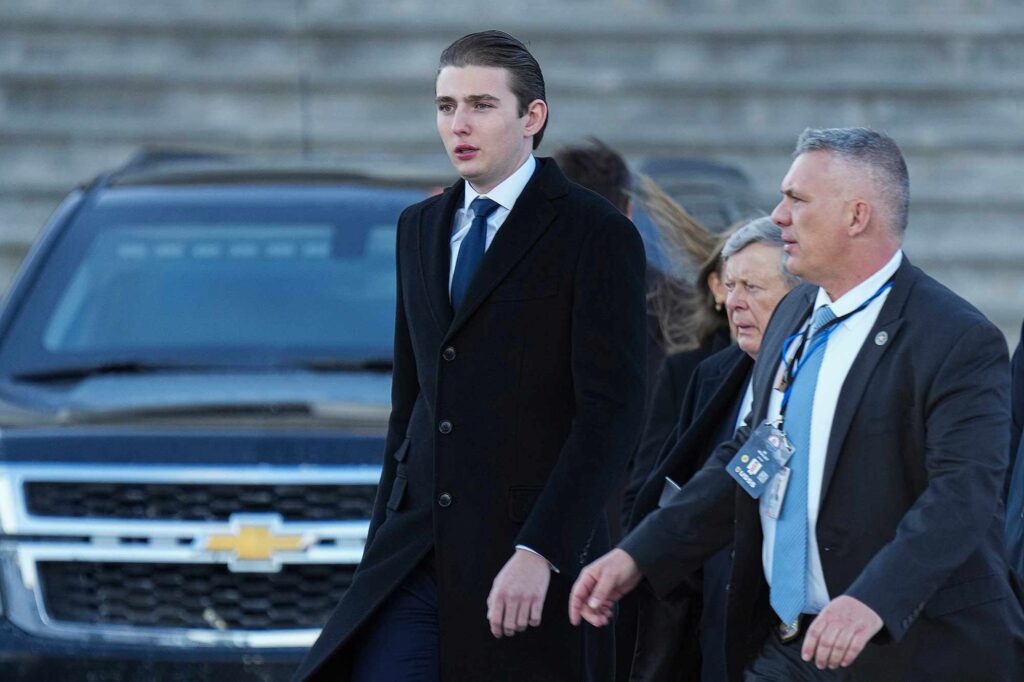
Image: from Mario Nawfal X @MarioNawfal
By Open Chronicle with agencies
The US Secret Service says it is aware of an Iranian state television video appearing to threaten Barron Trump, the youngest son of US President Donald Trump, and is assessing material that could constitute a threat against one of its protectees.
The nearly three-minute video, broadcast by Iran’s state-run Islamic Republic of Iran Broadcasting, reportedly showed locations associated with the 20-year-old Barron Trump and included explicit language suggesting he could be targeted.
According to CNN, Secret Service spokesperson Nate Herring confirmed that the agency was aware of the broadcast.
“The US Secret Service is aware of the video and investigates anything that can be perceived as a threat toward our protectees,” Herring said.
The agency declined to discuss how it might respond, citing the need to protect sensitive information concerning security operations.
The episode comes amid heightened hostility between Washington and Tehran following the US-Israeli war with Iran and the February 28 killing of Iran’s former Supreme Leader Ayatollah Ali Khamenei and members of his family.
The US Secret Service says it's aware of a video aired by Iran's state broadcaster appearing to threaten the life of Barron Trump, the youngest son of President Donald Trump. https://t.co/iTRHsxjri8 pic.twitter.com/XBhGCWq6yI
— CNN International (@cnni) August 25, 2026
Iranian broadcast targets president’s youngest son
The IRIB video reportedly included images of places Barron Trump is known to frequent, including Trump Tower in New York.
More seriously, the programme reportedly displayed an explicit question about killing the president’s son and referred to a $10 million reward.
The material represents an unusually direct public reference to a member of the US president’s immediate family.
Barron, the only child of Donald and Melania Trump, turned 20 in March. Although the president’s other children have long occupied highly visible positions in American public life, Barron has generally maintained a substantially lower public profile.
The reported Iranian broadcast therefore raises particular security concerns because it combined threatening language with information about locations associated with him.
Secret Service assessing potential threat
The Secret Service is responsible for protecting the US president and members of the presidential family, along with other designated officials and former officeholders.
The agency routinely evaluates potential threats using information from its own protective intelligence operations as well as intelligence agencies, law enforcement organisations and foreign governments.
Herring said the Secret Service investigates material that could be interpreted as threatening its protectees but would not disclose details about the agency’s response.
That restriction is significant because presidential protection depends partly on preventing potential attackers from understanding security procedures, movements or vulnerabilities.
Protective arrangements can be modified as threat assessments change.
A publicly circulated video identifying locations associated with a protectee would therefore be considered within a much broader intelligence picture rather than assessed solely as a media broadcast.
Threats emerge after war with Iran
The video comes against the background of a dramatically deteriorated relationship between the United States and Iran.
Iranian media have issued threats against Donald Trump and members of his family following the February 28 assassination of Ayatollah Ali Khamenei and relatives during the US Israeli war against Iran.
According to the information reported by CNN, Melania Trump has previously been referenced in threatening material. The latest broadcast, however, appears to represent the first public threat specifically directed at Barron Trump.
Iranian anger toward the US president has consequently expanded beyond threats against Trump himself and into material involving members of his family.
That development is particularly sensitive for American security agencies because threats involving relatives of political leaders can create additional vulnerabilities outside heavily protected government environments.
A broader campaign against Trump and his family
According to CNN, the IRIB broadcast forms part of a wider Iranian media campaign directed at Trump and his relatives.
Other material has reportedly included information concerning movements associated with members of the Trump family and suggestions that relatives could be targeted.
There is an important distinction between hostile propaganda and evidence of an operational assassination plot.
The information currently available does not establish that the broadcast corresponds to an active Iranian operation against Barron Trump.
Nevertheless, security agencies cannot simply dismiss explicit public threats, particularly when they include identifiable locations or information concerning a protected person’s movements.
For the Secret Service, even propaganda can become relevant protective intelligence if it encourages individuals or organisations to act.
The challenge of protecting presidential families
Protecting members of a president’s family creates different challenges from protecting the president himself.
The president operates within an extraordinary security architecture involving the Secret Service, military personnel, secure transportation and tightly controlled venues.
Adult relatives may have substantially more varied routines.
They attend universities, businesses, social events and private locations. They may travel independently and interact with environments that cannot always be controlled to the same degree as the White House or presidential motorcade.
Barron’s relatively private lifestyle does not eliminate those challenges.
Once information about locations associated with him becomes internationally publicised, security officials must consider whether routines, travel or protective measures require adjustment.
Trump Tower featured in the broadcast
The reported inclusion of Trump Tower is especially notable.
The Manhattan skyscraper has been associated with the Trump family for decades and remains one of the most internationally recognisable properties connected to Donald Trump.
Its prominence also makes it fundamentally different from a private residence whose location is not widely known.
The building already operates within an unusually sensitive security environment whenever members of the Trump family are present.
Showing such a location in threatening propaganda may provide little genuinely secret information, but its inclusion can still carry symbolic significance.
The message communicates that the people producing the broadcast are thinking not simply about the president but about the physical environments occupied by his family.
Iran and the politics of retaliation
The reported threat also illustrates how the consequences of the Iran conflict have moved beyond conventional military confrontation.
Wars involving major powers frequently generate retaliatory activity across multiple domains.
Military operations can be followed by cyberattacks, intelligence activity, economic retaliation, information warfare and threats against political leaders.
Iran has historically demonstrated an ability to operate through intelligence networks and allied organisations beyond its borders.
For Washington, that means security concerns generated by the conflict do not necessarily disappear when major military operations subside.
Protective intelligence becomes part of the wider confrontation.
A serious escalation in rhetoric
Threats against political leaders are not new to the confrontation between Washington and Tehran.
Threatening members of their families, however, crosses another psychological and political boundary.
Barron Trump does not hold elected office and does not determine American policy toward Iran.
His inclusion in threatening state media content therefore shifts the focus from retaliation against political decision makers toward intimidation of their relatives.
That distinction is likely to increase scrutiny of the broadcast in Washington.
It could also further complicate any future attempt to reduce tensions between the United States and Iran.
Security agencies will focus on intent and capability
The central question for American authorities will not simply be what Iranian television broadcast.
They will need to determine whether the rhetoric corresponds to any credible capability or operational intent.
Protective intelligence traditionally evaluates multiple factors, including the source of a threat, specificity, access to the potential target, known networks, previous behaviour and indications that someone is moving from rhetoric toward action.
Those assessments are rarely made public.
That explains the Secret Service’s limited response.
Confirming awareness reassures the public that the material is being examined.
Revealing how the agency intends to respond could undermine the protection itself.
Propaganda with real security consequences
The Iranian video may ultimately prove to be propaganda designed to intimidate the Trump administration and appeal to domestic anger following the death of Iran’s former supreme leader.
But explicit threats can have consequences even without an organised plot behind them.
They can inspire individuals.
They can reveal areas requiring additional protection.
They can force changes to routines.
And they can intensify an already hostile relationship between governments.
For the Trump family, the consequences of the conflict with Iran have therefore become increasingly personal.
For the Secret Service, the responsibility remains more straightforward: determine whether rhetoric represents a credible danger and ensure that the people under its protection remain secure.
The agency is now examining a threat environment in which the president himself is no longer the only member of the Trump family being publicly targeted.