
By Open Chronicle with agencies
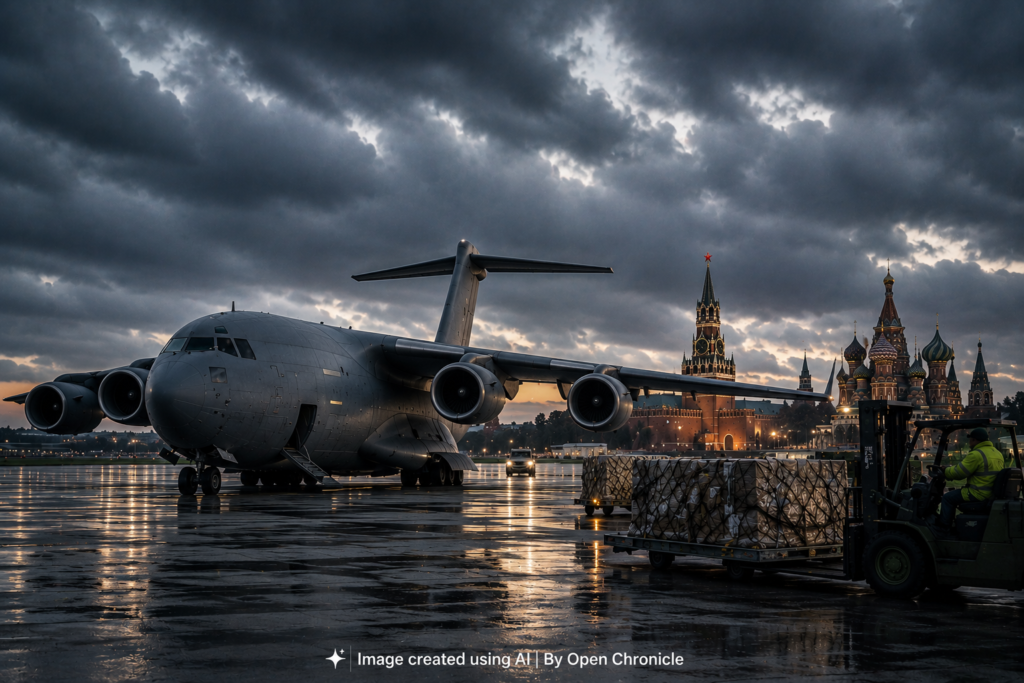
A rare US military transport flight into Moscow has attracted attention after a US Air Force C 17A Globemaster III landed at Vnukovo International Airport following a direct flight from Riga, raising questions about whether Washington and Moscow may be maintaining another discreet channel of communication.
The aircraft, identified as 07 7181 and operating under the callsign RCH4555, or REACH4555, arrived in the Russian capital after a journey that had previously taken it through the Washington area.
Such US military flights into Russia have been extremely unusual since relations between the two countries deteriorated sharply following Russia’s full-scale invasion of Ukraine in 2022.
Neither Washington nor Moscow has publicly explained the purpose of the mission.
That absence of information, combined with the aircraft’s route and the wider diplomatic environment surrounding negotiations over Ukraine, has inevitably generated speculation.
There is, however, currently no evidence that the C 17 was carrying American negotiators or that secret political talks took place in Moscow.
In a rare and unusual visit, U.S. Air Force Boeing C-17A Globemaster III strategic airlifter arrived at the Vnukovo International Airport in Moscow on Tuesday morning.
The plane took from Riga, Latvia. Before its trip across the pond on August 23, the same airframe visited the… pic.twitter.com/8yn1mpSgys
— Status-6 (War & Military News) (@Archer83Able) August 25, 2026
A highly unusual destination
The C-17 involved belongs to the US Air Mobility Command, which operates the aircraft for strategic and tactical transport missions around the world.
Its REACH callsign is routinely used by Air Mobility Command flights and does not, by itself, indicate a classified operation, diplomatic mission or VIP movement.
The unusual element is Moscow.
The aircraft reportedly flew from Riga directly to Vnukovo after previously travelling through Joint Base Andrews, close to Washington. Its earlier movements also included Joint Base McGuire Dix Lakehurst and Charleston.
That route does not establish what was aboard.
C 17 aircraft can transport personnel, military equipment, vehicles, communications systems, and substantial quantities of cargo. They can also support diplomatic, logistical and technical missions.
What makes the flight noteworthy is that an American military aircraft travelled directly from a NATO country into Russian airspace during one of the most difficult periods in US Russian relations in decades.
The flight required Russian coordination
A US military transport cannot simply enter Russian airspace and land at a Moscow airport without appropriate authorisation.
The mission would therefore have required prior clearances and coordination with Russian authorities.
That establishes something important, even if it reveals little about the aircraft’s cargo or passengers.
The Russian side knew the American aircraft was coming.
It does not establish why it was coming.
The necessary coordination could have involved routine aviation authorities and military channels rather than senior political officials.
Nevertheless, the fact that the flight was authorised demonstrates that functional communication between the two countries remains possible despite their broader confrontation.
Kremlin says it knows nothing about the mission
The Kremlin has said it has no information concerning the aircraft’s arrival and indicated that no meetings involving representatives of the US administration were scheduled at the Kremlin during the week.
That makes claims of a direct American negotiating mission to meet Russian President Vladimir Putin premature.
It does not necessarily rule out other forms of contact.
Sensitive communications between rival governments can take place through diplomatic officials, intelligence services, military representatives or specialised technical delegations without involving the presidential administration directly.
There are therefore several plausible explanations for the flight, and currently insufficient evidence to determine which is correct.
Timing fuels speculation over Ukraine diplomacy
The timing is nevertheless significant.
The flight took place as the United States, Ukraine and European partners were preparing another set of proposals intended for Moscow.
Previous attempts to explore possible diplomatic movement surrounding the war in Ukraine have involved discreet communications and, at times, deliberately limited public disclosure.
A C 17 could support such activity by transporting personnel and equipment required for a delegation.
But circumstantial compatibility is not confirmation.
The aircraft could equally have been performing a military, logistical, diplomatic or technical mission unrelated to negotiations over Ukraine.
Until either government provides additional information, claims of secret peace negotiations remain speculation.
Why use a C 17?
The C 17 Globemaster III is one of the principal heavy transport aircraft operated by the United States Air Force.
It is capable of carrying large cargoes, military vehicles and personnel over intercontinental distances while operating from a wide variety of airfields.
Its presence therefore does not provide an obvious clue about the nature of the mission.
If Washington were supporting a substantial official delegation, the aircraft could carry secure communications equipment, vehicles and other logistical support.
But exactly the same transport capability makes the C 17 suitable for numerous nonpolitical missions.
The aircraft itself is consequently less revealing than its destination and the diplomatic circumstances surrounding its arrival.
Military communication has survived political confrontation
Even during periods of intense confrontation, Washington and Moscow have reasons to preserve certain communication channels.
The United States and Russia remain the world’s two largest nuclear powers.
Their military forces operate in environments where misunderstanding could have serious consequences.
Communication can therefore continue even when formal political relations are severely strained.
During the Ukraine war, military deconfliction and other limited contacts have periodically remained necessary precisely because the risks created by accidental escalation are so high.
A coordinated US military flight into Moscow demonstrates that at least some practical mechanisms remain functional.
Whether those mechanisms were being used for something more significant in this case remains unknown.
The possibility of backchannel diplomacy
Governments frequently use discreet channels during conflicts because public diplomacy can make compromise more difficult.
Private discussions allow officials to explore proposals without immediately committing political leaders to them.
They can test whether the opposing side is willing to negotiate.
They can clarify positions.
They can also prevent misunderstandings from escalating.
For that reason, the possibility that the Moscow flight was connected to some form of US-Russian communication cannot be dismissed.
But neither should it be presented as fact.
The distinction is particularly important when analysing unusual military movements.
A flight can be verified.
Its diplomatic meaning cannot automatically be inferred from its route.
Washington, Moscow and the search for leverage
Any genuine US-Russian talks would occur against an extraordinarily complicated political background.
Washington continues to coordinate closely with Ukraine and European allies, while Moscow has shown little willingness to abandon its fundamental demands concerning the conflict.
Ukraine, meanwhile, remains deeply concerned that negotiations between major powers could produce pressure for concessions affecting its territory or security.
European governments have similarly insisted that decisions concerning Ukraine cannot be made without Ukrainian participation.
That means even exploratory American contacts with Russia would carry considerable political significance.
Any indication of a separate Washington-Moscow channel would therefore receive intense scrutiny in Kyiv and European capitals.
A logistical mission remains entirely possible
There are less dramatic explanations.
Military aircraft routinely perform missions that attract little attention until their flight paths become visible through public tracking services.
The C 17 may have transported equipment.
It may have carried personnel involved in military or diplomatic liaison.
It could have supported a technical operation requiring American personnel or material in Russia.
Some missions may also involve issues that governments deliberately avoid discussing publicly even when they have little connection to high level political negotiations.
Without information concerning the aircraft’s manifest or passengers, narrowing those possibilities becomes difficult.
What we know, and what we do not
Several elements of the episode can be separated from the speculation surrounding it.
A US Air Force C-17 made an unusual flight into Moscow.
The aircraft had previously operated through locations including the Washington area and Riga.
Its entry into Russian airspace necessarily required prior authorisation.
The Russian government therefore had advance knowledge of the flight at an operational level.
What remains unknown is considerably more important.
There is no public confirmation of who travelled aboard the aircraft.
There is no confirmed information about its cargo.
There is no evidence establishing that an American negotiating delegation arrived in Moscow.
And there is currently no confirmation that the flight was connected to negotiations over Ukraine.
A rare flight worth watching
The C 17’s arrival is therefore significant without requiring a more dramatic interpretation.
At a time when Washington and Moscow remain geopolitical adversaries and the war in Ukraine continues to dominate European security, a coordinated US military flight directly into the Russian capital is unusual enough to merit attention.
The diplomatic timing makes it more intriguing.
But unusual does not necessarily mean secret diplomacy.
For now, the most defensible conclusion is also the simplest.
An American military transport carried out a rare and previously uncoordinated mission to Moscow after operating through the Washington area and Riga.
Russia authorised its arrival.
Neither government has explained its purpose.
And until more information emerges, the question of whether REACH4555 carried cargo, officials or something connected to a new US Russian diplomatic channel remains unanswered.