
By Open Chronicle History Desk
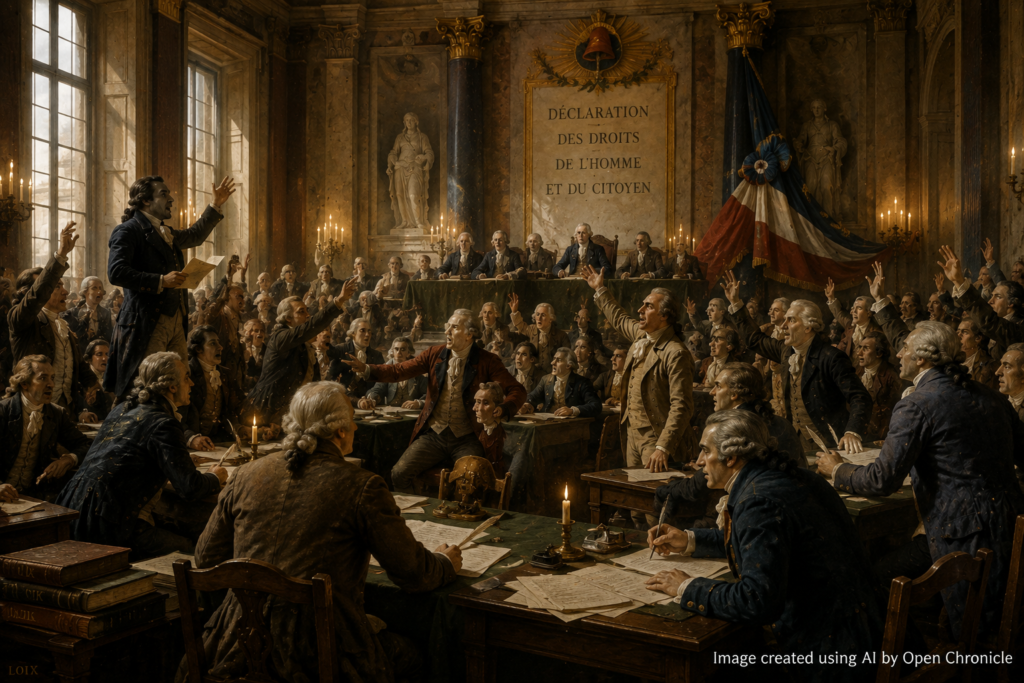
On August 26, 1789, in the opening months of the French Revolution, France’s National Constituent Assembly adopted one of the most influential political documents of the modern age: the Declaration of the Rights of Man and of the Citizen.
Its seventeen articles were remarkably concise.
Yet the principles they proclaimed challenged centuries of political and social order.
“Men are born and remain free and equal in rights.”
Sovereignty belonged fundamentally to the nation.
Liberty was a natural right.
Citizens were equal before the law.
No person could be arrested arbitrarily.
Taxation should be distributed according to ability to pay.
Freedom of opinion and religion was protected within limits established by law.
Public officials were accountable to society.
Property was declared an inviolable and sacred right.
These ideas did not appear from nowhere. They emerged from Enlightenment philosophy, natural rights theory, debates over constitutional government and the revolutionary experience of America.
But in France they acquired explosive significance.
The declaration was adopted while one of Europe’s oldest monarchies was being transformed from within.
The ancien régime had rested upon legal privilege, hereditary status, corporate rights and a society formally divided into estates.
The declaration proposed a radically different principle.
Political legitimacy should begin not with dynasty, privilege or inherited rank, but with human beings possessing rights.
The French Revolution would soon become far more violent and contradictory than the language of August 1789 suggested.
Women remained excluded from full political citizenship. Slavery continued in French colonies. Religious conflict intensified. Revolutionary governments would themselves violate many of the liberties proclaimed in the declaration.
Yet the document survived those contradictions.
More than two centuries later, its language remains embedded in French constitutional law and in the broader history of human rights.
August 26, 1789, therefore marks something larger than the adoption of a revolutionary text.
It marks one of history’s great attempts to answer a fundamental political question:
What rights belong to people simply because they are human?
France Before the Revolution
Eighteenth century France was one of the most powerful states in Europe.
It was also a society structured around profound legal and social inequalities.
The traditional political order, later known as the ancien régime, divided society into three estates.
The First Estate consisted of the clergy.
The Second Estate consisted of the nobility.
The Third Estate encompassed the overwhelming majority of the population, from wealthy merchants and lawyers to artisans, urban labourers and peasants.
These categories were not simply social descriptions.
They carried legal consequences.
Privilege was embedded within the structure of society.
Different groups could possess different rights, obligations and exemptions.
Many nobles enjoyed important fiscal privileges.
The Church possessed enormous property and collected the tithe.
Peasants could face royal taxation, seigneurial dues and other obligations.
The monarchy itself claimed authority rooted in tradition and dynastic legitimacy.
France was not a modern constitutional democracy.
But by the late eighteenth century, the intellectual foundations of the old order were increasingly under attack.
The Enlightenment
Across Europe, Enlightenment thinkers had spent decades questioning traditional assumptions about government, religion, law and society.
John Locke, writing in England in the previous century, had argued that individuals possessed natural rights and that legitimate government rested upon consent.
His political philosophy profoundly influenced later debates about liberty and constitutional government.
French thinkers pushed these arguments in different directions.
Montesquieu examined political institutions and famously explored the division of governmental powers.
Voltaire attacked intolerance and arbitrary authority.
Jean Jacques Rousseau developed the concept of popular sovereignty and argued that legitimate political authority ultimately derived from the people.
The Enlightenment was not a single coherent ideology.
Its thinkers disagreed profoundly.
But together they helped create an intellectual environment in which inherited institutions could be judged according to reason rather than merely accepted because they were ancient.
If political institutions existed for human beings, then human beings could ask whether those institutions were just.
That question was revolutionary.
Natural Rights
Central to the declaration was the concept of natural rights.
This idea held that certain rights did not originate as gifts from kings or governments.
They belonged to individuals by nature.
Government might protect those rights.
Government might violate them.
But government did not create them.
The distinction was fundamental.
If a monarch granted a privilege, the monarch could theoretically withdraw it.
A natural right was different.
It existed before political authority.
The declaration would identify liberty, property, security and resistance to oppression as natural and imprescriptible rights.
This transformed the theoretical relationship between ruler and ruled.
The citizen was no longer merely a subject receiving protection from a sovereign.
Political authority itself had to justify its existence in relation to rights.
The American Revolution
Events across the Atlantic provided another powerful influence.
In 1776, thirteen British colonies in North America declared independence.
The American Declaration of Independence proclaimed that all men were created equal and possessed unalienable rights.
Individual American states adopted declarations of rights.
The Virginia Declaration of Rights, drafted primarily by George Mason in 1776, was particularly influential.
France had supported the American revolutionaries against Britain.
French soldiers and officers returned home having witnessed republican ideas in practice.
Among them was Gilbert du Motier, Marquis de Lafayette.
Lafayette had served in the American Revolution and developed a close relationship with George Washington.
He returned to France as both an aristocrat and an advocate of political reform.
When revolution began in France, Lafayette would play an important role in drafting a declaration of rights.
France’s Financial Crisis
Ideas alone did not cause the French Revolution.
The monarchy faced an increasingly severe financial crisis.
France had accumulated enormous debts through warfare, including participation in the American War of Independence.
Attempts at fiscal reform repeatedly encountered resistance.
The state needed revenue.
Meaningful reform threatened privileged interests.
King Louis XVI and his ministers struggled to resolve the crisis.
Eventually, the monarchy took a step that would transform French history.
The king summoned the Estates General.
It had not met since 1614.
Representatives of the clergy, nobility and Third Estate were called to Versailles in 1789.
The monarchy hoped the assembly would help solve the financial crisis.
Instead, it created a political revolution.
The Third Estate
A fundamental dispute emerged immediately.
Should the Estates General vote by estate, giving each of the three estates one vote?
Or should representatives vote individually?
Voting by estate could allow the clergy and nobility to outvote the Third Estate despite representing only a small portion of the population.
The Third Estate increasingly rejected this system.
Its representatives argued that they represented the nation.
In June 1789, they declared themselves the National Assembly.
The meaning was revolutionary.
Political authority was shifting conceptually away from the king and traditional estates toward the nation.
When deputies found their usual meeting hall closed, they gathered in an indoor tennis court at Versailles.
There, on June 20, they swore the famous Tennis Court Oath.
They would not separate until France possessed a constitution.
The old political order was beginning to disintegrate.
The Fall of the Bastille
Tension spread beyond Versailles.
Paris was filled with rumours, political agitation and fears that royal forces might suppress the emerging revolution.
On July 14, 1789, crowds attacked the Bastille.
The medieval fortress contained relatively few prisoners.
Its political importance was far greater than its military significance.
The Bastille symbolised arbitrary royal authority.
Its fall demonstrated that the revolution would not be confined to speeches and parliamentary debates.
Popular mobilisation had entered the political arena.
The king could no longer assume that the army would simply restore the old order.
Across France, the crisis deepened.
The Great Fear
During the summer of 1789, panic spread through the countryside in an episode known as the Great Fear.
Rumours circulated that aristocrats had organised brigands to attack peasants or destroy crops.
Peasant communities armed themselves.
Manor houses were attacked.
Documents recording feudal obligations were burned.
The countryside was becoming revolutionary.
Members of the National Assembly recognised that the feudal and seigneurial order itself had become politically unsustainable.
The response came during one of the most dramatic nights of the Revolution.
The Night of August 4
On the night of August 4, 1789, deputies in the National Assembly renounced a wide range of privileges associated with the old regime.
Feudal rights, tax privileges and corporate distinctions came under attack.
The precise implementation of these reforms would prove complicated.
Some dues were initially supposed to be redeemed rather than simply abolished.
But symbolically the significance was enormous.
The society of orders and privileges was being dismantled.
If privilege was abolished, however, what would replace it?
France needed new principles upon which law and political authority could rest.
A declaration of rights offered an answer.
Writing a New Political Order
The deputies were preparing a constitution.
Before designing the machinery of government, many believed they should establish the fundamental principles upon which government itself would rest.
Several proposed declarations circulated.
Lafayette presented a draft.
The Abbé Emmanuel Joseph Sieyès, whose famous pamphlet What Is the Third Estate? had helped shape revolutionary political thought, also contributed to the intellectual debate.
Other deputies proposed different formulations.
The assembly discussed wording article by article.
The result was not the work of one individual.
It was a collective revolutionary document shaped by multiple intellectual traditions.
On August 26, the assembly completed its declaration.
Seventeen articles had transformed political theory into revolutionary law.
“Men Are Born and Remain Free and Equal in Rights”
The opening article contains the declaration’s most famous principle:
“Men are born and remain free and equal in rights.”
In the context of ancien régime France, the statement was extraordinary.
French society had been structured around legally recognised distinctions.
Birth could determine privilege.
Noble status carried advantages unavailable to ordinary subjects.
The declaration did not claim that everyone possessed identical wealth, occupation or social circumstances.
It recognised that social distinctions could exist.
But those distinctions could only be justified by common utility.
Hereditary privilege no longer possessed automatic legitimacy.
The principle of equality before the law had entered the foundation of the new political order.
Liberty, Property, Security and Resistance to Oppression
Article 2 identified four natural and imprescriptible rights:
liberty, property, security and resistance to oppression.
The inclusion of resistance to oppression was particularly striking.
Government was not automatically legitimate merely because it possessed power.
If political authority became oppressive, the language of natural rights implied that resistance could itself possess legitimacy.
The revolutionaries were transforming rebellion from a crime against sovereign authority into something that might be justified when authority violated fundamental rights.
It was a principle born directly from revolution.
Sovereignty Belongs to the Nation
Article 3 addressed the source of political authority.
The principle of sovereignty, it declared, resided essentially in the nation.
No individual or body could exercise authority that did not proceed from it.
This was a direct challenge to traditional monarchy.
The king might continue to exist.
Indeed, in 1789 most deputies were not yet demanding a republic.
But kingship would have to be redefined.
Authority could no longer be understood simply as a hereditary possession of the monarch.
The nation was sovereign.
The king would have to govern within a constitutional system deriving legitimacy from that nation.
The conceptual transformation was enormous.
France was moving from subjects of a king toward citizens of a nation.
What Is Liberty?
The declaration attempted to define liberty carefully.
Liberty consisted of being able to do anything that did not harm another person.
Rights therefore existed alongside the equal rights of others.
Law would establish the boundaries.
This conception rejected both arbitrary government and unlimited individual licence.
Freedom existed within a civic order in which every citizen possessed equivalent rights.
The principle would become fundamental to modern liberal constitutional thought.
Law as the Expression of the General Will
Article 6 declared that law was the expression of the general will.
The influence of Rousseau is unmistakable.
Every citizen had the right to participate personally or through representatives in its formation.
Law should be the same for everyone.
All citizens were equally eligible for public offices according to their abilities and without distinctions other than virtues and talents.
This attacked the hereditary structure of public privilege.
Office should not belong to someone simply because of birth.
Citizenship, law and merit would replace estate and hereditary status as the theoretical foundations of public life.
Protection Against Arbitrary Arrest
The ancien régime had become associated in revolutionary memory with arbitrary imprisonment.
Royal orders known as lettres de cachet could be used to detain individuals without ordinary judicial procedures.
The Bastille had become the most famous symbol of this power.
The declaration directly challenged such practices.
No person could be accused, arrested or imprisoned except in cases determined by law and according to legal procedures.
Those who issued or carried out arbitrary orders should be punished.
But citizens legally summoned or arrested were required to obey.
The principle was not an attack on law enforcement.
It was an attempt to place coercive state power under law.
No Punishment Without Law
The declaration also addressed criminal justice.
Penalties should be strictly and evidently necessary.
No person could be punished except under a law established and promulgated before the offence and legally applied.
This principle attacked retroactive and arbitrary punishment.
It belongs to a broader legal tradition expressed through the concept that there can be no crime or punishment without law.
The state could punish.
But it could not invent offences after the fact simply to destroy its enemies.
At least, that was the principle.
The Revolution itself would later test it severely.
Presumption of Innocence
Article 9 proclaimed another principle now fundamental to modern legal systems:
A person was presumed innocent until declared guilty.
If arrest was necessary, unnecessary harshness in securing the prisoner should be prohibited.
The importance of the principle is difficult to exaggerate.
The accused individual retained rights.
The power of the state did not automatically establish guilt.
Justice required procedure.
Again, revolutionary practice would not always respect revolutionary principle.
But the principle survived.
Freedom of Opinion and Religion
The declaration stated that no one should be disturbed because of opinions, including religious opinions, provided their expression did not disturb the public order established by law.
France had a long history of religious conflict.
The Wars of Religion had devastated the country during the sixteenth century.
Louis XIV had revoked the Edict of Nantes in 1685, intensifying persecution of Protestants.
Religious uniformity had long been associated with political authority.
The declaration moved toward a different principle.
Private belief should not itself make someone a target of the state.
This did not yet create the later French system of laïcité.
But it marked an important movement toward freedom of conscience.
Freedom of Expression
Article 11 proclaimed the free communication of ideas and opinions as one of the most precious rights of man.
Citizens could speak, write and print freely, while remaining responsible for abuses defined by law.
This was a direct challenge to censorship.
Under the ancien régime, publication had been regulated and politically dangerous texts could be suppressed.
The Revolution unleashed an extraordinary explosion of newspapers, pamphlets, political clubs and public debate.
Freedom of expression became one of the Revolution’s great promises.
It would also become one of its great contradictions when later revolutionary governments suppressed opponents.
Taxation and Equality
The declaration addressed taxation directly.
Public forces and administration required financial contributions.
But those contributions should be distributed among citizens according to their ability to pay.
This principle attacked one of the deepest grievances against the ancien régime.
Taxation had not fallen equally across French society.
Privilege could mean exemption.
The new system proclaimed that public burdens should be shared according to general principles rather than inherited status.
Citizens also possessed the right to determine, personally or through representatives, the necessity of taxation and to know how public money was used.
Taxation was being transformed from a royal demand into an element of accountable government.
Government Must Be Accountable
Article 15 declared that society had the right to demand an account from every public agent concerning his administration.
The statement sounds almost ordinary today.
In 1789, it represented a profound political principle.
Government officials were not simply servants of a monarch operating beyond public scrutiny.
They exercised authority on behalf of society.
Society therefore had the right to hold them accountable.
Public office was becoming a public trust.
Rights and the Constitution
Article 16 offered one of the declaration’s most powerful constitutional statements.
A society in which rights were not guaranteed and the separation of powers was not established had no constitution.
A constitution was therefore more than a document describing institutions.
It required limits on power.
It required guaranteed rights.
Without them, formal government structures alone were insufficient.
This principle would influence constitutional thought far beyond revolutionary France.
Property as a Sacred Right
The final article declared property an inviolable and sacred right.
No one could be deprived of it except when public necessity, legally established, clearly required it and provided that just compensation was paid.
This reflected the social world of many revolutionary deputies.
The Revolution attacked aristocratic privilege.
It did not reject private property.
Indeed, property was considered a fundamental guarantee of individual independence.
This distinction helps explain both the radicalism and limitations of the declaration.
It proclaimed legal equality.
It did not proclaim economic equality.
The King Accepts Reluctantly
Louis XVI did not enthusiastically embrace the revolutionary transformation.
Relations between the monarchy and National Assembly remained tense.
Economic hardship continued.
Bread prices remained politically explosive.
In October 1789, crowds, including large numbers of Parisian women, marched to Versailles.
The Women’s March on Versailles became another decisive revolutionary moment.
The royal family was brought from Versailles to Paris.
The king eventually accepted the revolutionary decrees and declaration.
The monarchy remained.
But it was increasingly trapped inside a political order it could no longer control.
Who Was “Man”?
The declaration spoke of the rights of “man” and “citizen.”
But revolutionary universalism contained major exclusions.
Women did not receive equal political citizenship.
They participated enormously in the Revolution.
Women marched.
They organised.
They wrote political texts.
They attended political meetings.
They demanded bread and political change.
Yet political rights remained overwhelmingly male.
This contradiction quickly attracted criticism.
Olympe de Gouges
In 1791, playwright and political activist Olympe de Gouges responded with the Declaration of the Rights of Woman and of the Female Citizen.
Its opening challenge was unmistakable:
Woman is born free and remains equal to man in rights.
De Gouges deliberately mirrored the language of the 1789 declaration to expose its limitations.
If rights were natural and universal, why should sex determine political citizenship?
Her intervention made explicit a contradiction at the heart of revolutionary universalism.
De Gouges would later be executed during the Reign of Terror in 1793.
Her declaration survived as an important landmark in the history of women’s rights.
Slavery and the Colonial Contradiction
An even more dramatic contradiction existed in France’s colonies.
The declaration proclaimed universal natural rights.
Yet slavery remained central to the economy of French Caribbean colonies, particularly Saint Domingue, modern Haiti.
Enslaved Africans produced enormous quantities of sugar and coffee under brutal conditions.
Could a nation proclaim that men were born free and equal while maintaining slavery?
The contradiction was impossible to contain indefinitely.
Free people of colour demanded rights.
Enslaved people interpreted revolutionary language according to its universal meaning.
In 1791, a massive slave uprising began in Saint Domingue.
The Haitian Revolution had begun.
The Haitian Revolution
The revolution in Saint Domingue would become one of the most radical consequences of the age of rights.
Enslaved people fought for freedom.
France abolished slavery in its colonies in 1794, although Napoleon Bonaparte later restored it in much of the French colonial empire in 1802.
Saint Domingue resisted.
Under leaders including Toussaint Louverture and later Jean Jacques Dessalines, the revolutionary struggle ultimately defeated French attempts to restore control.
In 1804, Haiti declared independence.
It became the first independent Black republic of the modern era and the only state created through a successful large scale revolt of enslaved people.
The events exposed the most fundamental question within the declaration.
If rights were universal, how universal were they really?
The Revolution Radicalises
The optimistic constitutional language of 1789 did not prevent France from descending into increasingly severe political conflict.
The monarchy attempted to flee in 1791.
War began against Austria and Prussia in 1792.
The monarchy collapsed.
France became a republic.
Louis XVI was executed in January 1793.
Marie Antoinette followed later that year.
Internal rebellion and foreign invasion threatened the revolutionary government.
The Revolution radicalised.
The Reign of Terror followed.
Thousands were executed.
Political dissent could become fatal.
Revolutionary tribunals operated under extraordinary conditions.
The government that claimed to defend liberty increasingly relied upon coercion.
The contradiction was stark.
A revolution that had proclaimed freedom from arbitrary authority created new forms of revolutionary repression.
Rights in an Age of Terror
The Terror did not erase the declaration’s significance.
It revealed the difficulty of translating abstract principles into political reality.
Rights exist within institutions.
When institutions collapse or governments claim emergency powers, declarations alone cannot guarantee liberty.
The French Revolution therefore became both a source of modern human rights language and a warning about the vulnerability of those rights during political crisis.
That tension remains relevant far beyond eighteenth century France.
Napoleon and the Revolutionary Legacy
Napoleon Bonaparte eventually emerged from the instability of revolutionary France.
He seized power in 1799.
In 1804, he crowned himself Emperor.
At first glance, the rise of an emperor might appear to represent the destruction of the Revolution.
The reality was more complicated.
Napoleon restricted political liberty and established authoritarian rule.
Yet his government preserved and institutionalised many revolutionary transformations.
Legal equality for men.
The destruction of feudal privilege.
Careers increasingly open to talent.
Administrative centralisation.
Secular civil law.
The Napoleonic Code carried some of these principles across Europe.
French armies conquered much of the continent.
They brought domination and exploitation.
They also helped dismantle older structures of privilege.
The revolutionary legacy spread through conquest as well as ideas.
The Declaration Beyond France
The Declaration of the Rights of Man and of the Citizen became part of an international political vocabulary.
Movements demanding constitutional government invoked similar principles.
Liberals challenged absolutist monarchies.
National movements connected sovereignty with peoples rather than dynasties.
Revolutionaries demanded equality before the law.
Abolitionists questioned slavery.
Campaigners for women’s rights challenged the exclusion of half the population from citizenship.
Socialists later criticised the declaration for emphasising formal legal equality while leaving economic inequality largely untouched.
Its principles became both inspiration and target.
That is one measure of the document’s historical importance.
People continued arguing with it.
Liberty, Equality, Fraternity
The famous revolutionary formula Liberty, Equality, Fraternity did not originate as the declaration’s official slogan.
But the declaration helped establish the political language from which that ideal developed.
Liberty without equality could preserve privilege.
Equality without liberty could become oppression.
Fraternity attempted to imagine citizenship as a shared political community.
France would spend the next two centuries repeatedly redefining the relationship among these ideals.
Monarchy returned.
Republics collapsed.
Empires rose.
Revolutions erupted.
Yet the language of 1789 survived.
The Universal Declaration of Human Rights
Nearly 160 years later, after the destruction of the Second World War and the Holocaust, the international community attempted another great declaration of rights.
On December 10, 1948, the United Nations General Assembly adopted the Universal Declaration of Human Rights.
Its first article begins:
“All human beings are born free and equal in dignity and rights.”
The intellectual and linguistic echoes of earlier rights traditions are unmistakable.
The 1948 declaration emerged from a very different world and represented a broader international project.
But the continuing idea that human beings possess rights by virtue of being human belongs to a historical tradition in which 1789 occupies a central position.
The Declaration in Modern France
The Declaration of the Rights of Man and of the Citizen is not merely a museum document.
Its principles remain part of France’s constitutional order.
The preamble to the Constitution of the Fifth Republic of 1958 refers to the rights defined by the declaration.
France’s Constitutional Council has recognised its provisions as possessing constitutional significance.
A document written while crowds filled revolutionary Paris therefore continues to influence legal decisions in modern France.
Few political texts from the eighteenth century possess such direct institutional continuity.
The Limits of Universalism
Modern readers should neither dismiss the declaration because it failed to include everyone nor treat its universal language as though those exclusions never existed.
Both realities matter.
The declaration articulated extraordinary principles.
It also emerged from a society in which women lacked political equality, slavery existed and wealth strongly influenced political participation.
Its history is therefore partly the history of people demanding that universal language be taken more seriously than its original authors sometimes intended.
Women could ask:
If human beings are equal in rights, why are women excluded?
Enslaved people could ask:
If liberty is natural, how can slavery exist?
Colonised peoples could ask:
If sovereignty belongs to nations, why are they ruled by foreign empires?
Workers could ask:
What does equality mean when economic power is profoundly unequal?
The declaration did not answer all these questions.
It helped provide the language in which they could be asked.
Rights Against Power
Perhaps the most enduring transformation of 1789 was conceptual.
Before the modern rights tradition, political discussion often began with the powers and duties of rulers.
The declaration reversed the direction of the question.
What rights does the individual possess?
What limits should exist on government?
Where does sovereignty originate?
When can authority legitimately restrict liberty?
What makes taxation lawful?
What protections should exist for an accused person?
Who may participate in making laws?
These questions became central to modern constitutional politics.
Governments would continue violating rights.
But increasingly, they would be judged according to principles claiming authority above ordinary political power.
Why August 26 Matters
August 26, 1789, represents one of the decisive intellectual and political moments of the French Revolution.
The Bastille had fallen only six weeks earlier.
Feudal privilege had been attacked during the extraordinary night of August 4.
The monarchy still existed.
The Republic had not yet been imagined as an immediate political reality by most revolutionary deputies.
Louis XVI was still king.
Robespierre had not yet become synonymous with the Terror.
Napoleon was still an obscure young artillery officer.
The Revolution’s future remained unknown.
Yet inside the National Assembly, seventeen articles attempted to define the principles upon which a new society should rest.
Human beings were born free and equal in rights.
Sovereignty belonged to the nation.
Law should apply equally.
Arbitrary arrest was illegitimate.
The accused were presumed innocent.
Opinion could not simply be criminalised.
Ideas could be communicated freely.
Taxation required accountability.
Government officials answered to society.
Property possessed legal protection.
A society without guaranteed rights and separated powers could not truly claim to possess a constitution.
The words were simple.
Their implications were revolutionary.
France would repeatedly fail to live according to them.
The Revolution itself would violate them.
Women would demand their extension.
Enslaved people would expose their contradictions.
Later generations would reinterpret them.
Other revolutions would echo them.
Constitutions would incorporate their principles.
Human rights movements would expand their meaning.
That is why the Declaration of the Rights of Man and of the Citizen matters.
Its importance does not depend upon believing that the revolutionaries of 1789 created a complete or perfectly universal theory of human freedom.
They did not.
Its importance lies in the political standard they helped establish.
Power required justification.
Law required equality.
Government required accountability.
And rights could be claimed not simply because a ruler granted them, but because human beings possessed them.
On August 26, 1789, revolutionary France placed that argument at the centre of a new political order.
More than two centuries later, the argument continues.