
Image: from NOELREPORTS X @NOELreports
Defence & Security | Russia-Ukraine War
By Open Chronicle with agencies
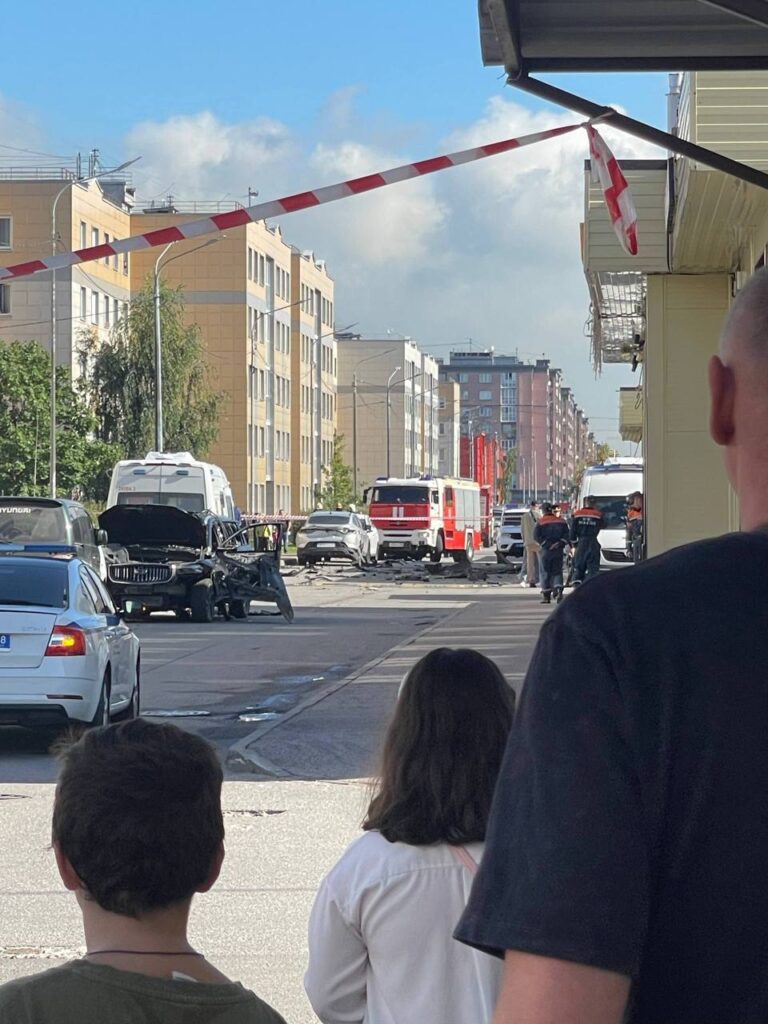
A Russian serviceman has been killed and his wife injured after their car exploded on the outskirts of St Petersburg, adding to a series of bombings and targeted attacks involving military personnel and other figures connected to Russia’s war in Ukraine.
The explosion occurred on Thursday in the Pushkinsky district, south of central St Petersburg, according to the city’s branch of Russia’s Investigative Committee.
Authorities confirmed that the serviceman died in the blast while his wife was injured. Officials did not immediately disclose the man’s identity, military rank or details about the unit in which he served.
Investigators have also not publicly identified those responsible for the attack.
The bombing comes amid heightened Russian concern over attacks against military personnel, defence industry figures and other individuals associated with the war.
Car bomb in St. Petersburg, Russia. A colonel reportedly killed, a woman critically injured. pic.twitter.com/UY7EOWRY4c
— Open Source Intel (@Osint613) August 27, 2026
Another Attack on Russian Soil
The St Petersburg explosion follows another car bombing earlier this month involving a senior figure in Russia’s defence industry.
On August 5, the director of a factory supplying drones to the Russian military was seriously wounded when a vehicle exploded outside Yekaterinburg, around 1,400 kilometres east of Moscow. His driver was killed.
Investigators did not publicly identify those responsible, and no organisation claimed responsibility for the attack.
The incidents have reinforced concerns within Russia that individuals connected to the country’s military and defence industrial infrastructure are increasingly vulnerable far from the Ukrainian battlefield.
An officer from the Russian military was killed in a car bomb in St. Petersburg on Thursday morning, according to local media outlets. pic.twitter.com/aETwRiVlKm
— TVP World (@TVPWorld_com) August 27, 2026
Moscow Restaurant Bombing Adds to Security Concerns
Days before the St Petersburg attack, another explosion struck an upscale Italian restaurant in Moscow.
At least five people, including the suspected bomber, were killed, according to Russian state media citing local authorities.
Russia’s embassy in Rome accused Ukraine of responsibility and described the attack as an attempt to intimidate the Italian community in Russia. The Russian Foreign Ministry subsequently reposted the embassy’s statement.
However, Russian security agencies had not publicly identified suspects or presented evidence establishing responsibility for the bombing.
Moscow Mayor Sergei Sobyanin described the explosion as a terrorist attack but did not attribute responsibility.
The uncertainty surrounding several recent incidents illustrates one of the central difficulties in assessing the growing pattern of attacks inside Russia. Responsibility has frequently been disputed, unclaimed or established only through allegations from one of the belligerents.
Russia Tightens Protection Around Senior Officials
Russia’s Federal Security Service had already announced tighter security around senior military officers and government officials following a succession of assassination attempts and bomb attacks since Russia launched its full scale invasion of Ukraine in February 2022.
Some attacks have taken place hundreds of kilometres from the Ukrainian border, demonstrating the vulnerability of individuals connected to the war even within major Russian cities.
Targets have included military commanders, nationalist figures and people associated with Russia’s defence sector.
The Russian authorities have frequently accused Ukrainian intelligence services of organising sabotage and assassination operations on Russian territory.
Kyiv has acknowledged responsibility in some cases but rejected Russian accusations in others.
Ukraine Claimed Killing of General Igor Kirillov
One of the most significant attacks occurred in Moscow in December 2024.
Lieutenant General Igor Kirillov, head of the Russian military’s nuclear, biological and chemical protection forces, was killed by an explosive device concealed in a scooter outside his apartment building.
Ukraine’s SBU security service said it had organised the operation.
Kirillov was killed one day after the Ukrainian security service announced criminal charges against him.
The assassination demonstrated that Ukrainian intelligence services were capable of conducting, or supporting, highly targeted operations deep inside the Russian capital.
It also prompted renewed Russian efforts to strengthen protection around senior military officials.
Responsibility Remains Contested in Other Cases
Not every high profile killing inside Russia has been acknowledged by Ukraine.
One of the most prominent examples was the August 2022 assassination of Darya Dugina, a Russian nationalist commentator and the daughter of political philosopher Alexander Dugin.
Dugina was killed when an explosive device planted in an SUV detonated while she was driving outside Moscow.
Her father, an outspoken supporter of President Vladimir Putin and Russia’s invasion of Ukraine, was widely considered a possible intended target. Russian reports said the vehicle belonged to Dugin and that he had decided shortly before the journey to travel separately.
Ukraine denied involvement in Dugina’s killing.
The case became one of the earliest examples of the shadow conflict developing inside Russia alongside the conventional war in Ukraine.
A Growing Internal Security Challenge
Thursday’s St Petersburg bombing adds another incident to a pattern that has increasingly blurred the geographical boundaries of the Russia-Ukraine war.
While the principal fighting continues on Ukrainian territory and along the front lines, assassinations, sabotage operations, drone strikes and explosions have increasingly brought elements of the conflict into Russia itself.
Military personnel and defence industry officials represent particularly sensitive potential targets because attacks against them can have an effect extending beyond individual casualties.
Such operations can force governments to increase security around military installations, commanders, industrial facilities and transportation networks, potentially imposing significant costs even when the attacks themselves are relatively limited.
At the same time, attribution remains a central problem.
Some attacks have been openly claimed by Ukrainian agencies. Others have been attributed to Kyiv by Russian authorities without independent confirmation, while several remain unresolved.
That uncertainty forms part of the broader intelligence and covert dimension of the war.
War Increasingly Extends Beyond the Front Line
The killing near St Petersburg illustrates how the conflict has evolved far beyond conventional battlefield operations.
Russia continues conducting large-scale missile and drone attacks against Ukrainian cities and infrastructure, while Ukraine has developed increasingly sophisticated long range strike capabilities against targets inside Russia.
Alongside those operations exists a less visible confrontation involving intelligence agencies, sabotage networks, covert operatives and security services.
The cumulative effect is an increasingly complex internal security environment for Russia.
The investigation into Thursday’s bombing will therefore be watched closely for evidence concerning the explosive device, the identity of the serviceman and whether authorities can establish who organised the attack.
Until investigators produce evidence or responsibility is credibly claimed, the perpetrators and motive behind the St Petersburg explosion remain unclear.