
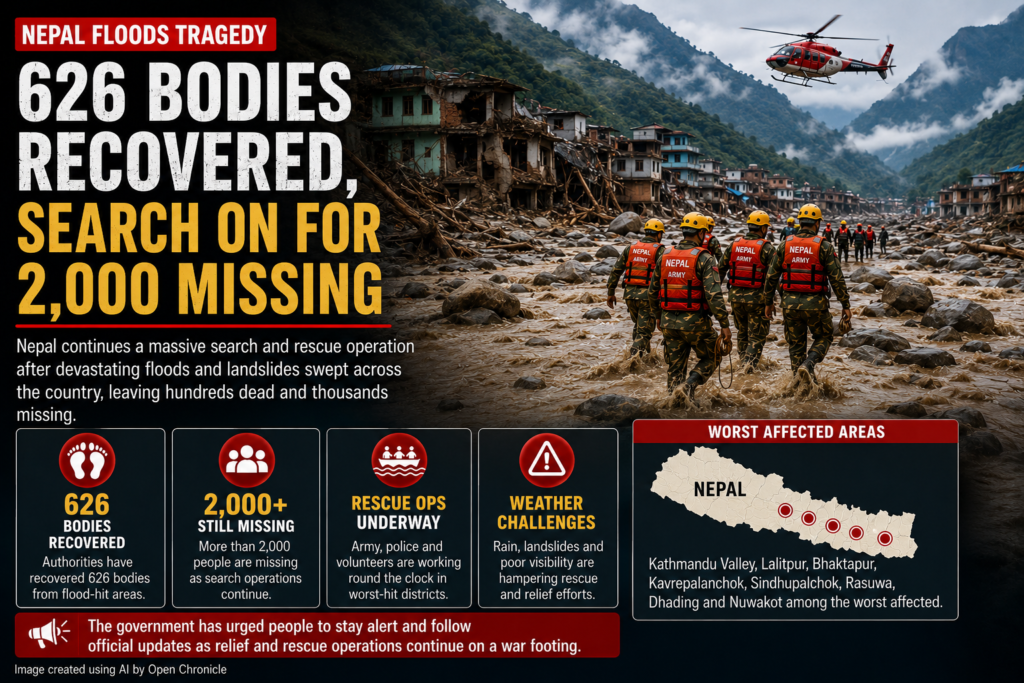
Department: World / Environment & Climate
By Open Chronicle with agencies
Nepal has appealed for international technical expertise and billions of dollars in financial support as the country struggles with the aftermath of the catastrophic Himalayan flood that devastated communities near the border with Tibet.
Search and rescue operations were temporarily suspended on Saturday because of deteriorating weather conditions, adding another obstacle to efforts to locate people still missing following one of the country’s most destructive natural disasters in recent years.
The disaster began after a massive collapse of ice, rock and debris high in the Himalayas triggered a destructive surge through mountain valleys and river systems. The resulting flood devastated settlements, roads, bridges and other infrastructure across parts of Nepal and neighbouring Tibet.
Nepal Calls for International Expertise
Nepalese authorities said the country’s most urgent international requirement is increasingly shifting from conventional search and rescue assistance toward specialised technical support.
The scale and unusual nature of the disaster have created major challenges for engineers, geologists, hydrologists and emergency planners attempting to understand how the landscape has changed and whether further hazards remain.
The flood altered river channels more than 100 kilometres downstream after descending more than 4,200 metres from the Himalayan region, demonstrating the extraordinary energy released by the collapse.
Authorities now face the difficult task of assessing damaged river systems, unstable mountain slopes, destroyed infrastructure and potential future flood risks.
Nepal is also seeking substantial international financial assistance for reconstruction. The damage to roads, bridges, settlements, energy infrastructure and other essential services is expected to require a long recovery effort.
Bad Weather Interrupts Search
Poor weather forced authorities to suspend search-and-rescue operations on Saturday.
The interruption comes at a particularly difficult moment, with families still awaiting information about people missing since the disaster.
Heavy cloud cover, rain, and unstable conditions can make helicopter operations dangerous in Nepal’s mountainous terrain, while damaged roads and bridges have complicated attempts to reach isolated communities by land.
Emergency teams have been working across areas covered by mud, rocks and debris left by the flood.
The scale of destruction means recovery operations are expected to continue well beyond the immediate emergency phase.
Threat From Barrier Lake Appears to Ease
There was some encouraging news from the border region on Saturday.
Chinese authorities said the danger posed by a barrier lake created following the glacier collapse had diminished after the lake appeared to shrink.
Such lakes can form when landslides, glaciers or debris temporarily block rivers. If the natural barrier suddenly fails, enormous volumes of accumulated water can be released downstream.
The possibility of another sudden release had therefore raised fears of a second destructive flood affecting already devastated communities in Nepal and Tibet.
The reduction in the lake’s size does not eliminate the broader geological risks created by the disaster, however. Authorities on both sides of the border continue to monitor unstable terrain and waterways.
A Disaster That Reshaped the Landscape
The Himalayan flood has demonstrated how events beginning in remote high mountain environments can rapidly become regional catastrophes.
The initial collapse sent ice, rock, mud and water down steep valleys before the flood entered larger river systems.
Entire sections of transport infrastructure were destroyed, while communities located along river corridors were overwhelmed by the rapidly moving surge.
The disaster also demonstrated the increasing importance of satellite monitoring, geological surveys and international scientific cooperation in assessing hazards across the Himalayan region.
Because major river systems cross international borders, disasters originating in Tibet or Nepal can quickly affect communities far downstream.
Climate and Himalayan Risks
The catastrophe has renewed attention on the vulnerability of the Himalayas to glacial instability and extreme geological events.
Scientists have increasingly warned that warming temperatures can destabilise glaciers, permafrost and high mountain rock formations.
The precise combination of factors responsible for individual disasters requires detailed scientific investigation. However, changing conditions in the world’s high mountain environments are becoming an increasingly important issue for countries across the Himalayan region.
Nepal is particularly exposed because millions of people live downstream from glaciers and steep mountain valleys.
The country also depends heavily on hydropower, mountain roads and river infrastructure that can be vulnerable to landslides and sudden floods.
🔥🚨 JUST IN — At least 633 people are confirmed dead in Nepal’s floods, with nearly 3,000 still missing.
Fox Weather reports rescuers are racing to survivors as helicopters lift stranded families. The earlier mudslides and flooding have turned into a mass-casualty disaster.…
— The Patriot Oasis™ (@ThePatriotOasis) August 29, 2026
Recovery Could Take Years
The immediate humanitarian emergency will eventually give way to an enormous reconstruction challenge.
Restoring roads and bridges will be essential for reconnecting isolated communities. Damaged energy and communications infrastructure will also have to be rebuilt, while authorities will need to determine whether some devastated settlements can safely be reconstructed in their previous locations.
Nepal’s request for technical assistance reflects the complexity of that task.
International specialists could help map unstable slopes, evaluate river channels, assess damaged infrastructure and develop new early warning systems.
Financial assistance will be equally important.
For Nepal, the disaster has become more than a search and rescue operation. It is developing into a long term national recovery effort involving humanitarian relief, reconstruction, geological assessment and potentially major changes in how the country prepares for future Himalayan disasters.