
By Open Chronicle
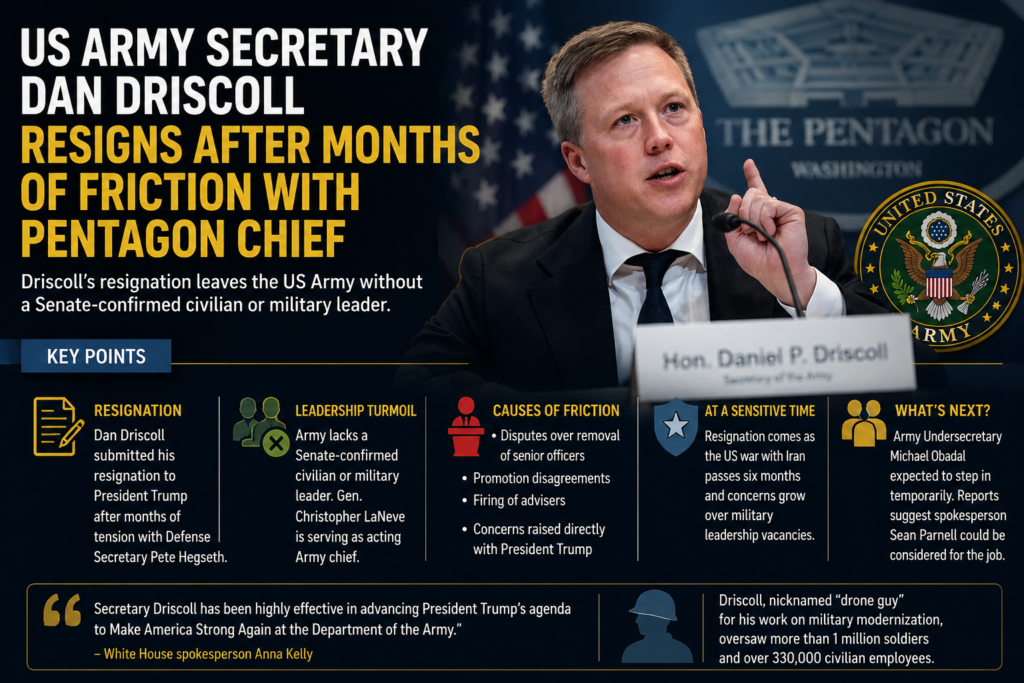
US Army Secretary Dan Driscoll has submitted his resignation to President Donald Trump following months of reported tensions with Defense Secretary Pete Hegseth over senior military leadership, personnel decisions and the future direction of the Army.
Driscoll is expected to leave the Pentagon within days, creating another major vacancy at the top of the service at a particularly sensitive moment for the US military.
His departure means the Army will temporarily operate without either a Senate confirmed civilian secretary or a Senate confirmed uniformed chief. Gen. Christopher LaNeve has been serving as acting Army chief since Hegseth removed Gen. Randy George from the position.
White House Praises Driscoll’s Record
Despite reports of serious disagreements inside the Pentagon, the White House praised Driscoll’s tenure.
White House spokesperson Anna Kelly said Driscoll had been highly effective in implementing Trump’s agenda within the Department of the Army, highlighting his role in improving readiness and lethality, overseeing military operations and assisting diplomatic efforts involving Russia and Ukraine.
The administration also credited Driscoll with helping strengthen the Army alongside Trump and Hegseth.
Behind those public comments, however, reports from several US media organizations describe an increasingly difficult relationship between Driscoll and the defense secretary.
Disagreement Over Army Leadership
According to The Atlantic, Driscoll eventually took his concerns directly to Trump.
The Army secretary reportedly warned the president about the number of experienced senior officers who had either been removed or passed over for promotion during Hegseth’s tenure.
Trump was reportedly surprised by the scale of the changes and expressed concern after hearing Driscoll’s assessment.
Driscoll argued that the departure of experienced commanders was making it increasingly difficult for the Army to carry out the transformation required to prepare for future conflicts.
The Army now has fewer general officers than at almost any point in its recent history, according to the report.
The dispute reportedly intensified after the removal of Gen. Randy George in April, followed shortly afterwards by Gen. Chris Donahue.
Promotion Disputes Deepened Rift
Personnel decisions appear to have been another major source of tension.
The New York Times reported that Hegseth sought to remove four officers, two Black men and two women, from a military promotions list. Driscoll reportedly refused to support the move.
Earlier in the year, Driscoll also resisted pressure surrounding Col. David Butler, one of his senior advisers.
Butler had previously served as a spokesperson for Gen. Mark Milley, the former chairman of the Joint Chiefs of Staff who became a prominent target of Trump’s criticism.
Reports in February said Hegseth ultimately forced Butler out despite Driscoll’s resistance.
The disputes contributed to a deteriorating relationship between the two senior Pentagon officials.
Driscoll’s friendship with Vice President JD Vance reportedly provided him with some political protection inside the administration, but it was ultimately insufficient to prevent the relationship with Hegseth from breaking down.
Questions Over Pentagon Chain of Command
Another sign of internal dysfunction emerged from reports involving acting Army chief Gen. Christopher LaNeve.
According to The Atlantic, LaNeve had at times bypassed Driscoll and approached Hegseth directly for operational decisions.
Such an arrangement would raise questions about the traditional relationship between the Army’s civilian leadership, its senior uniformed command and the Office of the Secretary of Defense.
The reports come amid broader concerns in Congress about vacancies across senior military leadership positions.
Those concerns have become more urgent as the United States remains involved in its conflict with Iran, which has now passed the six month mark.
Lawmakers have questioned whether prolonged vacancies and rapid turnover could affect military planning, continuity and institutional stability during an active conflict.
Who Could Replace Driscoll?
Army Undersecretary Michael Obadal is expected to assume leadership responsibilities in the immediate aftermath of Driscoll’s departure.
The longer term succession remains uncertain.
According to reports, some Pentagon officials believe current Pentagon spokesperson Sean Parnell could emerge as a candidate for permanent Army secretary.
Such a nomination could face significant scrutiny in Congress.
Critics cited in the reports have questioned whether Parnell possesses sufficient experience managing an organization on the scale of the US Army, while supporters could argue that his close alignment with the administration would provide clearer political direction.
Any permanent replacement would require Senate confirmation.
The debate is therefore likely to extend beyond the identity of the next secretary and into broader questions about how the Trump administration intends to reshape military leadership.
The Army’s “Drone Guy”
Driscoll emerged as an important advocate for military modernization during his relatively rapid rise through the Trump administration.
His focus on unmanned systems earned him the informal nickname “drone guy”, reflecting his efforts to accelerate the Army’s adoption of drones and other technologies shaped by lessons from recent conflicts.
As Army secretary, Driscoll was responsible for overseeing an institution encompassing more than one million active duty, National Guard and reserve personnel, alongside more than 330,000 civilian employees and a vast annual budget.
His modernization agenda came as the Army sought to adapt to a battlefield increasingly dominated by drones, electronic warfare, long range precision weapons, artificial intelligence and rapidly evolving battlefield communications.
That makes his departure particularly significant.
Leadership Turmoil Comes at Sensitive Moment
Driscoll’s resignation exposes a deeper debate inside the Pentagon over how rapidly the Army should change and how much institutional experience should be retained during that transformation.
The Trump administration and Hegseth have pursued significant changes across senior military leadership, arguing that the armed forces require renewed emphasis on combat effectiveness and accountability.
Critics, however, have warned that removing large numbers of experienced commanders could weaken institutional knowledge and undermine continuity.
Driscoll appears to have increasingly aligned himself with the latter concern, particularly regarding the Army’s ability to modernize while simultaneously losing experienced senior officers.
His resignation now leaves Washington facing two connected challenges: finding permanent leadership for the Army and determining whether the personnel changes that contributed to the dispute will continue.
With the United States engaged in major overseas military operations and the Army undergoing an ambitious technological transformation, the consequences of that leadership struggle could extend well beyond the Pentagon.