
By Open Chronicle
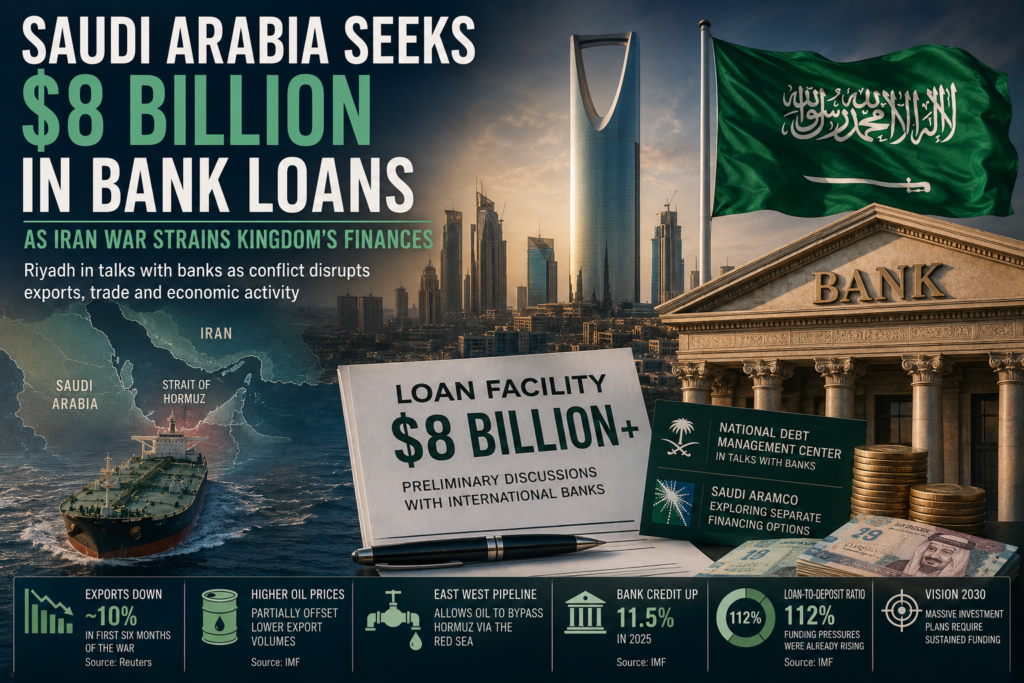
Saudi Arabia is sounding out banks for at least $8 billion in new loans as the economic consequences of the war with Iran put additional pressure on trade, energy exports and government financing.
The kingdom’s National Debt Management Center has begun preliminary discussions with lenders about a potential borrowing operation, according to reports based on Bloomberg information. Saudi Aramco, the state controlled energy giant, is also holding separate talks with banks about possible financing.
The discussions remain at an early stage, meaning the proposed transactions could still change or ultimately not proceed.
However, the move illustrates how the conflict is reshaping Saudi Arabia’s financial requirements at a time when Riyadh is simultaneously attempting to maintain ambitious investment programmes associated with Vision 2030.
Riyadh Looks to Diversify Its Financing
Saudi Arabia has increasingly turned to domestic and international debt markets to complement government revenues and finance major investment programmes.
The latest discussions would potentially add at least $8 billion in bank borrowing as the kingdom attempts to maintain financial flexibility during a period of heightened geopolitical uncertainty.
The decision does not necessarily indicate a liquidity or solvency crisis. Saudi Arabia continues to possess substantial financial reserves and remains one of the world’s most important oil exporters.
Instead, the discussions suggest that Riyadh is seeking to diversify its sources of funding while protecting its ability to finance government spending and strategic investment.
That requirement has become more important as the war disrupts economic activity across the Gulf.
War Disrupts Trade and Oil Exports
The conflict with Iran has created significant complications for Saudi Arabia and other Gulf economies.
Disruption around the Strait of Hormuz has affected shipping routes, imports and regional supply chains. According to a Reuters analysis of the first six months of the conflict, Saudi exports have fallen by around 10 percent.
The Strait of Hormuz is one of the world’s most important maritime energy corridors. Any sustained disruption therefore creates logistical and financial consequences even for major oil producers.
Saudi Arabia has an important advantage compared with several neighbouring exporters because part of its crude production can bypass Hormuz.
The kingdom’s East West Pipeline transports oil from producing regions in eastern Saudi Arabia to the Red Sea coast, allowing crude to reach international markets without passing through the strait.
That infrastructure has become increasingly strategically important during the conflict.
Higher Oil Prices Provide Some Protection
There is an apparent contradiction at the centre of Saudi Arabia’s current financial position.
War has disrupted oil exports, but it has also driven global crude prices higher.
According to the International Monetary Fund, higher prices have partially compensated Saudi Arabia for reduced export volumes. This provides the government with an important financial cushion and helps explain why the proposed borrowing should not automatically be interpreted as evidence of a broader Saudi financial crisis.
Nevertheless, higher oil prices cannot completely offset the wider economic consequences of prolonged regional instability.
The IMF has noted that the conflict has disrupted trade and petroleum exports while weakening confidence and affecting non oil economic activity.
That matters because one of the central objectives of Vision 2030 is precisely to reduce Saudi Arabia’s dependence on oil revenues.
Vision 2030 Creates Enormous Capital Requirements
Saudi Arabia is simultaneously undertaking one of the world’s largest economic transformation programmes.
Vision 2030 involves massive investment in infrastructure, tourism, technology, entertainment, renewable energy, manufacturing and entirely new urban developments.
These projects require enormous amounts of capital.
Riyadh has consequently developed a sophisticated financing strategy involving government borrowing, the Public Investment Fund, Saudi Aramco, domestic banks and international capital markets.
The war complicates that strategy because the government must balance long term development spending against the immediate economic consequences of regional instability.
Obtaining additional bank financing could therefore allow the kingdom to preserve liquidity while continuing strategically important investment programmes.
Saudi Banks Were Already Facing Funding Pressure
The Saudi banking system was experiencing rapidly growing demand for credit even before the full consequences of the conflict became apparent.
According to the IMF’s 2026 assessment of the Saudi economy, bank credit expanded by approximately 11.5 percent in 2025.
Saudi banks have increasingly relied on external financing as lending has grown faster than traditional deposit funding.
The IMF reported that the banking system’s loan to deposit ratio had reached approximately 112 percent, illustrating the growing funding requirements created by rapid domestic investment.
This underlying trend provides important context for the latest discussions with international banks.
The war did not create Saudi Arabia’s financing requirements, but it has increased the importance of maintaining access to multiple sources of capital.
Aramco Also Explores Financing
Saudi Aramco’s reported discussions with banks add another dimension to the situation.
As one of the world’s largest energy companies and the primary engine of Saudi government oil revenues, Aramco occupies a central position in the kingdom’s financial system.
Any major financing operation involving the company could provide additional flexibility for investment while allowing Saudi authorities to distribute borrowing requirements across different institutions.
The discussions also come as energy markets remain highly sensitive to developments in the Gulf.
Disruption around Hormuz has demonstrated how quickly geopolitical events can affect shipping, crude prices and energy infrastructure.
Not Yet a Saudi Financial Crisis
The proposed $8 billion borrowing programme should therefore be viewed within the broader transformation of Saudi government financing rather than as evidence that Riyadh is running out of money.
The IMF continues to describe Saudi Arabia as possessing significant financial buffers and relatively strong macroeconomic fundamentals.
But those strengths are being tested simultaneously by several pressures.
The kingdom must finance Vision 2030, support large infrastructure projects, manage rapidly expanding domestic credit and respond to the economic consequences of a major regional war.
The result is greater reliance on debt markets and external financing.
For investors, the crucial question will be how long the conflict continues and whether disruption to Saudi exports becomes structural rather than temporary.
War Tests Saudi Arabia’s Economic Strategy
Saudi Arabia’s ability to redirect crude through the Red Sea and benefit from higher global oil prices has helped cushion the immediate impact of the conflict.
But prolonged instability presents a more complicated challenge.
Higher energy prices can strengthen government revenues while simultaneously increasing global inflation, slowing international economic activity and disrupting the trade routes on which Saudi Arabia’s increasingly diversified economy depends.
That creates an unusual situation in which an oil price surge can simultaneously strengthen and weaken different parts of the Saudi economy.
The reported $8 billion financing discussions are therefore significant beyond their headline value.
They demonstrate how Riyadh is adapting its financial strategy to a geopolitical environment that has become substantially more uncertain.
Saudi Arabia remains financially powerful, but the war is forcing the kingdom to preserve cash, diversify funding and protect the enormous investment programme at the heart of Vision 2030.
The longer instability around the Gulf persists, the more important access to international capital is likely to become.