
By Open Chronicle
A majority of registered voters in the United States say their personal financial situation has deteriorated since President Donald Trump returned to the White House in January 2025, according to a new poll reported by the Financial Times.
The findings point to growing dissatisfaction with the administration’s handling of the economy and cost of living, potentially creating a significant political vulnerability for Republicans less than three months before the November midterm elections.
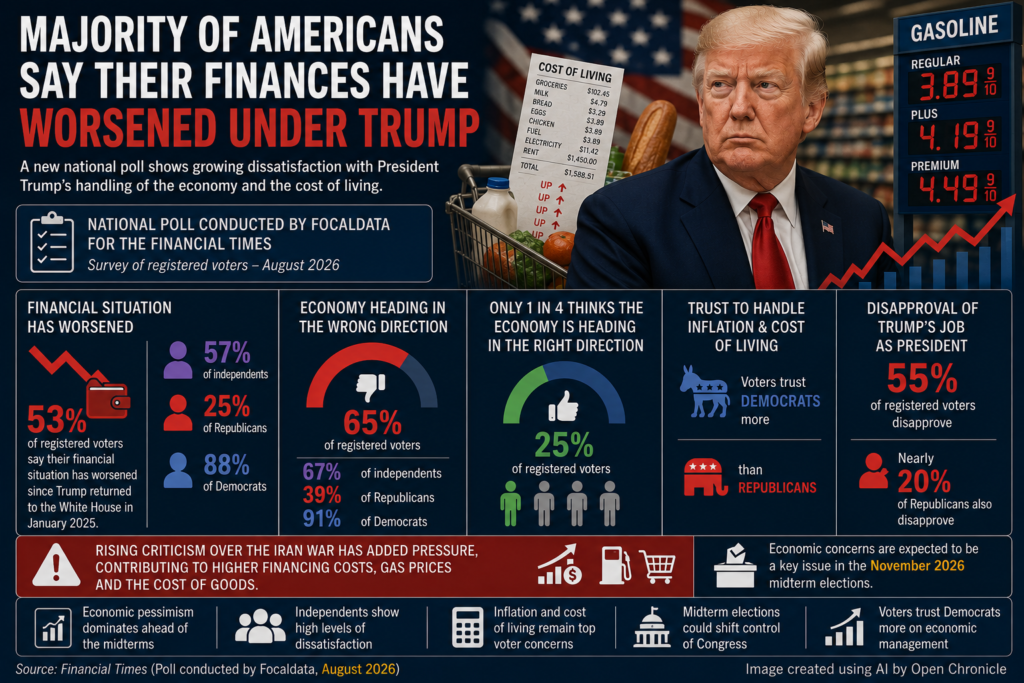
According to the national survey, conducted by Focaldata for the Financial Times, more than 53 percent of registered voters said their financial circumstances had worsened since Trump began his second term.
The dissatisfaction extends beyond Democratic voters. Nearly 57 percent of independents said their finances had deteriorated, while approximately one quarter of respondents identifying as Republicans expressed the same view.
Voters Pessimistic About the Economy
The survey paints a broader picture of economic anxiety among American voters.
Nearly two thirds of registered voters said they believed the US economy was heading in the wrong direction. That view was shared by more than two thirds of independents and more than one third of Republicans.
Only around one in four registered voters believed the economy was moving in the right direction.
The results suggest that perceptions of personal financial pressure are increasingly influencing assessments of the wider economy.
Inflation and the cost of living remain particularly important concerns. According to the poll, voters were more inclined to trust Democrats than Republicans to manage both issues.
That could prove significant in November, when control of Congress will be decided and economic conditions are expected to feature prominently in campaigns across the country.
Trump’s Approval Rating Under Pressure
The Financial Times poll also found significant dissatisfaction with Trump’s overall performance as president.
Around 55 percent of registered voters said they disapproved of the job he was doing. Notably, dissatisfaction was not confined to opposition voters, with almost 20 percent of Republicans also expressing disapproval.
The numbers indicate that the administration faces challenges both among independent voters and within parts of its own electoral coalition.
Economic perceptions have historically played an important role in US midterm elections, particularly when voters believe their household finances are deteriorating.
With the November elections approaching, Republicans will have to convince voters that the administration’s economic strategy is delivering improvements despite widespread concerns about prices and household budgets.
Iran War Adds Economic Pressure
The political challenge has been intensified by criticism surrounding the ongoing conflict with Iran.
The war has contributed to higher energy prices and increased financing costs, while consumers have faced pressure from gasoline prices and the broader cost of goods.
Those economic consequences are increasingly becoming part of the domestic political debate surrounding the conflict.
Recent US inflation figures have provided some relief. Prices increased at a slower pace in July, helped by lower fuel costs. However, inflation remains higher than it was when former President Joe Biden handed the presidency to Trump in January 2025.
That distinction could become increasingly important politically. The administration can point to signs that some inflationary pressures are moderating, while opponents can argue that households continue to face higher prices and worsening financial conditions.
Midterms Increasingly Focused on Cost of Living
The survey comes at a sensitive moment for both major parties.
Republicans will seek to defend Trump’s economic record and argue that the administration’s policies will produce stronger growth and improved household finances over time.
Democrats, meanwhile, are likely to focus heavily on inflation, consumer prices, borrowing costs and the percentage of Americans who say they are financially worse off.
Independent voters could prove particularly important. With nearly 57 percent of them reporting that their financial situation has deteriorated since Trump returned to office, their assessment of the economy could influence several competitive congressional races.
The Financial Times poll therefore provides an important snapshot of the political environment entering the final months before the midterms.
For Trump and the Republican Party, the central challenge may increasingly be straightforward: convincing Americans that an economy many currently perceive as moving in the wrong direction can still improve their personal financial circumstances before they cast their ballots in November.