
By Open Chronicle
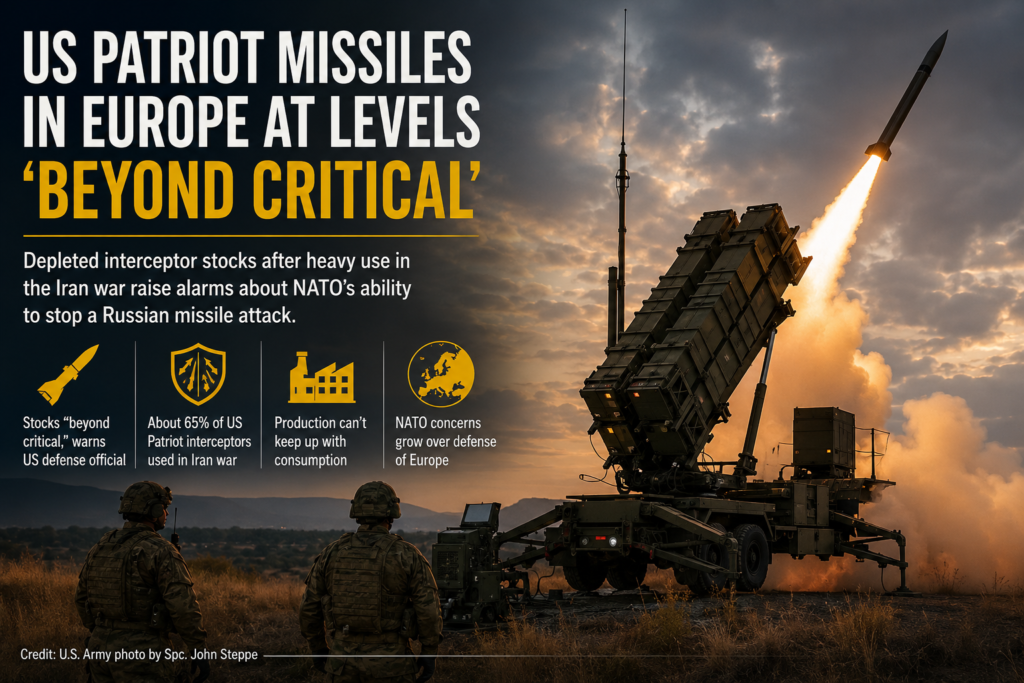
US military stocks of Patriot missile interceptors in Europe have fallen to what one American defense official described as “beyond critical” levels, raising concerns about NATO’s ability to withstand a sustained Russian ballistic missile attack while Washington directs significant air defense resources toward the Middle East.
According to military officials cited by the Associated Press, months of intensive missile defense operations connected to the war with Iran have placed extraordinary pressure on American interceptor inventories. The situation comes after years of supplying Patriot ammunition to Ukraine and attempting to expand an industrial base that cannot rapidly replace missiles at the rate they could be consumed in a major conflict.
The central problem is not necessarily the number of Patriot batteries available. It is the number of interceptor missiles ready to be fired.
Patriot Stocks Under Severe Pressure
A US defense official stationed in Europe described the available inventory as being at a level “beyond critical.”
According to the account, American forces in Europe could struggle to sustain defenses against a prolonged Russian ballistic missile campaign. Even a more limited attack could place substantial pressure on available interceptors.
That represents a serious challenge for NATO because the Patriot is one of the alliance’s most important defenses against sophisticated ballistic missile threats.
Ballistic missiles present particularly difficult targets. They can travel at several times the speed of sound and approach their targets along steep trajectories, leaving defenders only a short period to detect, track, and engage them.
Russia has demonstrated extensive use of ballistic and other long-range missile systems during the war in Ukraine, giving NATO planners a clear indication of the volume and diversity of weapons that could potentially be employed during a wider confrontation.
Iran War Changes the Calculation
The shortage has developed over several years, but the war with Iran appears to have accelerated the problem dramatically.
Since the conflict began, some American air defense resources previously allocated to Europe have reportedly been redirected toward the Middle East.
US forces and regional partners have relied heavily on missile defense systems to intercept Iranian ballistic missiles and other threats.
The intensity of that consumption appears to have exceeded previous planning assumptions.
Transfers of Patriot systems and interceptors to Ukraine after Russia’s full scale invasion in 2022 had already reduced American inventories. Those requirements, however, were relatively predictable and could be incorporated into longer term production and replenishment plans.
The sudden consumption associated with the Iran conflict created a substantially different challenge.
Missiles can be fired far more quickly than manufacturers can replace them.
Thousands of Interceptors Potentially Expended
An analysis from the Center for Strategic and International Studies cited alongside reporting on the shortage estimates that approximately 65 percent of the US Patriot interceptor inventory may have been consumed during the conflict with Iran.
That would represent roughly 1,500 interceptors from an estimated inventory of around 2,330.
If those estimates are accurate, the scale of expenditure demonstrates one of the fundamental problems facing modern air defense.
Advanced interceptors are technologically complex, expensive and slow to manufacture. An adversary, meanwhile, can attempt to overwhelm defenses by launching large numbers of missiles and drones simultaneously.
Increasing production is possible, but expanding the industrial base requires new manufacturing capacity, supply chains, skilled workers and long-term procurement commitments.
Significant increases in production capacity are not expected immediately, leaving a potentially dangerous gap between operational requirements and replenishment.
A Launcher Without Missiles Cannot Defend Europe
The distinction between Patriot batteries and Patriot interceptors is particularly important.
A country may possess functioning launchers, radars and command systems, but their military value declines rapidly once their available missiles are depleted.
A high-intensity conflict could require multiple interceptors against individual incoming ballistic missiles, depending on the threat and engagement doctrine.
This means inventories that appear substantial in peacetime could disappear rapidly during sustained combat.
The war in Ukraine has already demonstrated the enormous ammunition consumption associated with modern warfare.
The Iran conflict appears to be providing another lesson, this time regarding strategic air and missile defense.
Russia Could Combine Missiles and Drone Swarms
NATO planners must also consider that a potential Russian attack would probably not rely exclusively on ballistic missiles.
Russia has increasingly combined ballistic missiles, cruise missiles and large numbers of comparatively inexpensive drones during attacks against Ukraine.
Such combinations complicate defensive decisions.
Cheap drones can often be intercepted by shorter-range systems, guns, electronic warfare or specialized counter-drone weapons. Using an expensive Patriot interceptor against every low cost target would be economically and operationally unsustainable.
The challenge is therefore to create a layered defense architecture in which different weapons engage different categories of threats.
Patriot would ideally be preserved for the most dangerous targets, particularly ballistic missiles and high-value aerodynamic threats.
But a sufficiently large mixed attack could still force commanders to expend substantial numbers of sophisticated interceptors.
Europe Has Alternatives, but Not Direct Replacements
Europe possesses additional air defense systems that could reduce dependence on Patriot.
One of the most important is the Franco-Italian SAMP/T system.
Its next-generation development, SAMP/T NG, is intended to deliver substantially improved capabilities against ballistic and aerodynamic threats.
However, the newer configuration has not yet accumulated the operational combat experience of Patriot, while the currently deployed SAMP/T has different performance characteristics and cannot simply replace Patriot across every mission.
European countries are consequently attempting to expand a broader network of complementary air defense systems rather than relying on a single platform.
Naval air defense can also contribute.
Warships equipped with advanced radar and surface-to-air missiles can provide important defensive coverage, particularly around coastal regions.
Their usefulness nevertheless depends heavily on geography. A vessel positioned too far from the threatened target may be unable to provide effective protection.
Warships would also become high-value targets themselves during a major conflict.
NATO Faces an Industrial Problem
The shortage highlights a broader problem that has become increasingly visible since the beginning of the Ukraine war.
Western militaries were largely structured around relatively limited ammunition expenditure and conflicts in which they enjoyed substantial technological and air superiority.
Large scale conventional warfare creates very different requirements.
Thousands of artillery shells, drones, precision weapons and air defense missiles can be consumed within relatively short periods.
The United States and European NATO members are now attempting to expand defense production, but sophisticated missile manufacturing cannot be increased overnight.
Patriot interceptors contain advanced seekers, propulsion systems, guidance electronics and other specialized components supplied through complex industrial networks.
Building more missiles therefore requires more than simply increasing orders.
It requires expanding the industrial infrastructure capable of producing them.
ATACMS Stocks Also Running Low
The ammunition problem reportedly extends beyond defensive missiles.
American forces stationed in Europe are also facing reduced inventories of ATACMS, the Army Tactical Missile System used for long-range precision strikes.
ATACMS allows ground forces to attack command posts, logistics centers, air defenses, airfields and other valuable targets far behind the front line.
The shortage is considered less immediately dangerous than the Patriot situation because European NATO members possess other long-range strike weapons.
Germany’s Taurus cruise missile and the Franco-British Storm Shadow family provide European forces with alternative capabilities for attacking strategic targets at significant distances.
There is no equally simple solution to the shortage of ballistic missile defense interceptors.
Air Defense Becomes NATO’s Strategic Vulnerability
The situation illustrates an uncomfortable reality for NATO.
A modern air defense system is only as sustainable as the industrial system supplying its ammunition.
Europe may possess sophisticated radars, command networks and missile launchers, but those capabilities cannot provide prolonged protection without sufficiently deep interceptor reserves.
At the same time, Washington faces competing demands across several theaters.
Ukraine requires continued air defense against Russian attacks. American forces in the Middle East need protection against Iranian missiles and drones. US forces in Europe must maintain sufficient reserves to deter Russia, while the Indo-Pacific creates additional requirements for American missile defense inventories.
Those demands are increasingly competing for the same finite production capacity.
For NATO, the immediate challenge is therefore not simply deploying more Patriot batteries. It is creating enough interceptor production and sufficiently large reserves to sustain those batteries during the kind of prolonged, high-intensity missile campaign that a confrontation with Russia could produce.
The reported “beyond critical” condition of US Patriot stocks in Europe suggests that the alliance’s air defense problem has moved beyond theoretical planning.
It has become an industrial and strategic vulnerability that NATO will have to address urgently.