
By Open Chronicle Newsdesk with agencies
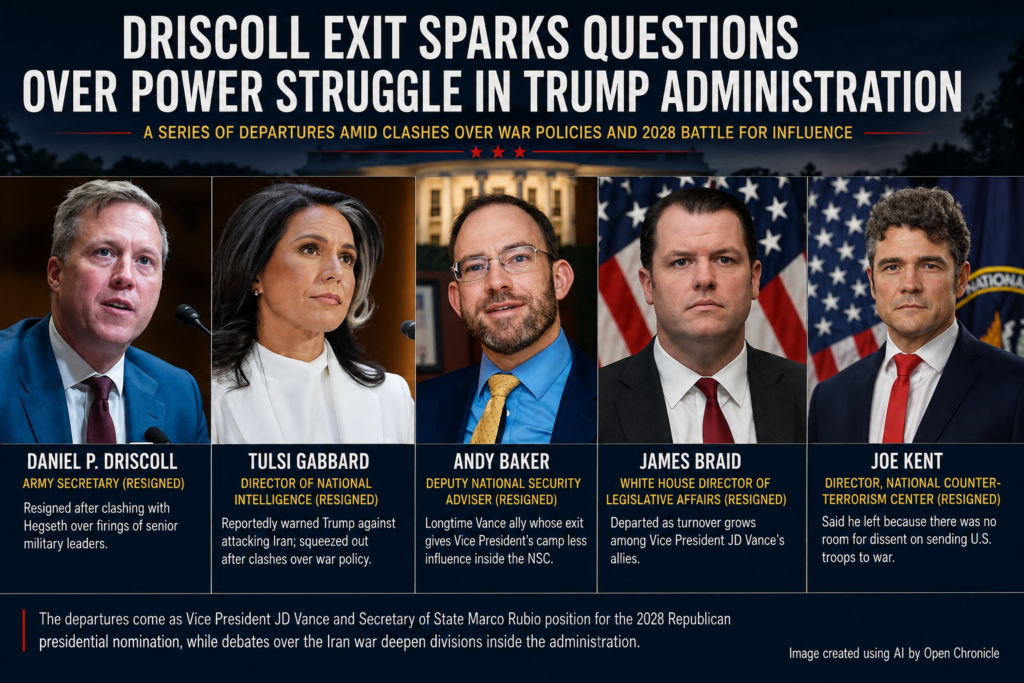
The resignation of US Army Secretary Dan Driscoll is fueling a wider debate over the direction of President Donald Trump’s second administration, as a series of departures by officials associated with Vice President JD Vance raises questions about an emerging struggle for influence over American foreign and defense policy.
Driscoll, a longtime friend of Vance who earned praise for his efforts to modernize the US Army, resigned this week after months of tensions with Defense Secretary Pete Hegseth. Their disagreements reportedly centered on the removal of senior military officers and broader questions about how the Army should prepare for future conflicts.
His departure might otherwise have been interpreted primarily as another Pentagon leadership dispute. But it comes amid a broader turnover involving figures considered close to Vance or sympathetic to the foreign policy restraint associated with parts of his political coalition.
Those departures are attracting particular attention as Washington looks beyond this year’s midterm elections toward an increasingly discussed contest for the 2028 Republican presidential nomination.
Driscoll and Hegseth Clashed Over Army Leadership
Driscoll’s relationship with Hegseth had reportedly deteriorated as the defense secretary removed a succession of senior military officials.
The outgoing Army secretary was particularly concerned about the loss of experienced officers at a time when the service is attempting to modernize for warfare increasingly shaped by drones, autonomous systems, electronic warfare and long range precision weapons.
According to reporting cited in the supplied material, Driscoll brought his concerns directly to Trump last week. The president was reportedly surprised by the scale of the removals when Driscoll described the situation.
The disagreement was significant because Driscoll had established himself as one of the administration’s most prominent advocates for Army modernization.
His resignation therefore removes not only a Vance ally but also an official closely associated with attempts to accelerate technological change inside the service.
A Wider Pattern of Departures
Driscoll is not the only figure associated with Vance’s political or foreign policy orbit to leave the administration.
Other recent departures have included Director of National Intelligence Tulsi Gabbard, Deputy National Security Adviser Andy Baker, White House Director of Legislative Affairs James Braid and National Counterterrorism Center Director Joe Kent.
The reasons behind those exits differ, and there is no evidence that they were all coordinated.
Nevertheless, taken together, the departures are generating speculation about whether the ideological balance inside the administration is changing.
One interpretation is largely political. Vance is widely regarded as a potential candidate for the Republican presidential nomination in 2028, and allies leaving government could begin constructing the fundraising, lobbying and political infrastructure required for a national campaign.
Several lower level Vance allies have already moved into Washington lobbying and consulting circles, potentially giving the vice president a network outside government capable of supporting a future presidential operation.
There is also a more straightforward explanation. Senior government positions impose considerable professional and personal demands, particularly during wartime, and some younger officials may simply be seeking better paid private sector positions or more time with their families.
But another interpretation is gaining attention in Washington.
Is the Administration Shifting Toward the Hawks?
Vance has generally been associated with a more restrained approach to American intervention abroad. Some figures within his broader political circle were skeptical of Trump’s decision to enter the war against Iran.
Secretary of State Marco Rubio, by contrast, has traditionally been identified with a more assertive approach to American foreign policy.
Sources cited in the supplied reporting argue that officials closer to Rubio’s worldview are increasingly occupying influential national security positions while restraint minded figures leave government.
The departure of Andy Baker could be particularly important.
As deputy national security adviser, Baker reportedly held an unusually broad portfolio and was considered ideologically close to Vance. His exit potentially reduces the number of officials inside the national security apparatus willing to challenge more interventionist policies.
Some critics of the changes describe them as an effort to marginalize foreign policy realists and restrainers and restore a more traditional Republican interventionist approach.
That interpretation remains contested, however, and personnel changes alone do not demonstrate the existence of a coordinated campaign.
Iran War Becomes the Central Divide
The war with Iran has magnified these disagreements.
Gabbard had built much of her political identity around criticism of US military interventions and reportedly warned Trump against attacking Iran before eventually resigning.
Kent was more explicit about his reasons for leaving. He said he could not support sending another generation of Americans to fight a war that, in his view, did not justify the cost in American lives.
Their departures have strengthened perceptions that officials skeptical of the conflict are losing influence.
The dispute is not confined to civilian officials.
Multiple four star generals have reportedly warned Hegseth that prolonged large scale military operations against Iran could become unsustainable.
Those concerns reflect the enormous demands imposed by the conflict on US forces, including air defense systems, naval assets, aircraft, precision weapons and personnel deployed throughout the Middle East.
There is little indication so far, however, that such warnings have fundamentally altered administration policy.
Hegseth Consolidates Pentagon Authority
Hegseth has simultaneously strengthened his control over military decision making.
The defense secretary has removed numerous senior officers during his tenure and increasingly centralized important decisions within his office.
Critics argue that the process risks weakening the institutional independence of senior military leadership. Supporters of the administration counter that civilian leaders have the authority to reshape military leadership and remove officers they believe are unsuitable for the president’s priorities.
Driscoll’s departure nevertheless adds another vacancy at a particularly sensitive moment for the Pentagon.
It also removes an official who had reportedly been willing to challenge Hegseth directly over the consequences of those personnel changes.
Vance and Rubio Look Toward 2028
Behind the national security debate lies another political question, the future leadership of the Republican Party.
Both Vance and Rubio are widely viewed as potential contenders for the Republican presidential nomination in 2028.
Their situations are very different.
Rubio spent 14 years in the Senate before joining the administration and already possesses an extensive network across Washington’s political, donor and foreign policy communities.
Vance spent only two years in the Senate before becoming vice president. Developing an outside political infrastructure could therefore be considerably more important for him.
That makes the movement of Vance aligned officials into lobbying, consulting and political organizations potentially significant.
Yet if the departures instead reflect declining influence inside the administration, the implications are very different.
Under that scenario, Rubio and officials favoring a more assertive foreign policy would be consolidating control while Vance’s restraint oriented faction loses access to key decisions.
Rubio’s Growing Influence Could Carry Political Risks
For the moment, the changing personnel landscape appears to favor Rubio.
Allies of the secretary of state reportedly hold influential positions within the State Department and national security apparatus, while Deputy National Security Adviser Mike Needham has emerged as another important figure within the National Security Council.
But greater influence also brings greater responsibility.
Rubio has managed to maintain some political distance from the most controversial aspects of the Iran war, while Trump, Vance and Hegseth have been more publicly associated with its conduct.
If restraint minded officials continue leaving and more interventionist figures gain influence, maintaining that distance could become increasingly difficult.
A prolonged or worsening conflict would inevitably produce questions about who shaped the strategy and who bears responsibility for its consequences.
A Pentagon Resignation With Wider Consequences
Driscoll’s resignation therefore matters beyond the leadership of the US Army.
It intersects with three larger developments taking place simultaneously inside Washington, the consolidation of Hegseth’s authority at the Pentagon, an ideological argument over America’s role in the Iran war, and the early positioning surrounding the Republican succession after Trump.
There are plausible explanations for the recent departures that do not involve an organized political purge. Some officials may be exhausted, seeking private sector opportunities or preparing for the next stage of their political careers.
But the cumulative effect is increasingly difficult to ignore.
Officials associated with foreign policy restraint appear to have less representation inside key national security institutions, while figures favoring a more assertive American role abroad are gaining influence.
As the Iran conflict continues and the Trump administration moves closer to the second half of its term, Dan Driscoll’s departure could ultimately be remembered as more than another Pentagon resignation.
It may become part of a much larger struggle over who defines Republican foreign policy after Trump.