
By Open Chronicle with agencies
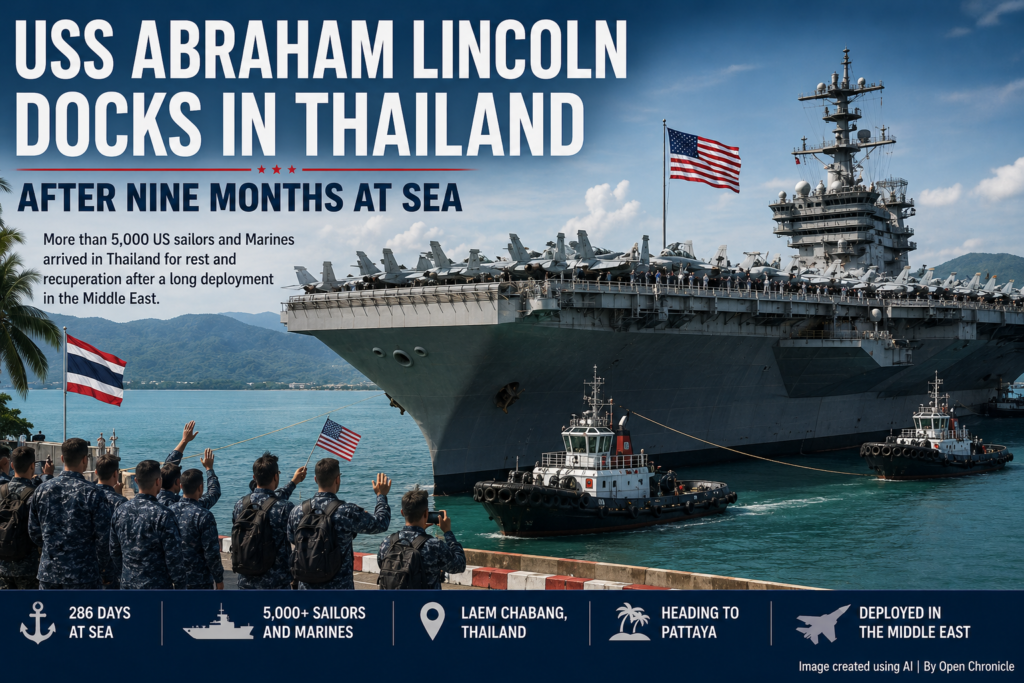
More than 5,000 US sailors and Marines have arrived in Thailand aboard the nuclear-powered aircraft carrier USS Abraham Lincoln, marking the ship’s first port visit after an extraordinary deployment that kept its crew at sea for 286 days.
The carrier entered Laem Chabang on Wednesday morning, guided into port by tugboats with dozens of aircraft visible across its flight deck. The visit gives the crew a long awaited period of rest after operations that took the carrier from the Indo-Pacific to the Middle East during the continuing US and Israeli conflict with Iran.
Most of the personnel aboard are expected to spend their shore leave in Pattaya, the Thai resort city that has served as a rest and recreation destination for American military personnel since the Vietnam War era.
First Port Visit After 286 Days
Rear Admiral Robert Loughran, commander of Carrier Strike Group 3, described the stop as an opportunity for personnel to recover after the unusually long period at sea.
“Our arrival in Laem Chabang provides a well deserved opportunity for our Sailors and Marines to rest and recharge,” Loughran said.
Captain Dan Keeler, commanding officer of the USS Abraham Lincoln, described the deployment as historic and said the visit would allow the crew to experience Thailand.
The carrier departed California in November 2025, initially deploying toward the South China Sea. Its mission changed dramatically when the ship was redirected to the Middle East ahead of the US and Israeli military campaign against Iran that began at the end of February.
That diversion ultimately transformed what had begun as an Indo-Pacific deployment into a prolonged combat mission.
Months of Middle East Operations
The USS Abraham Lincoln became an important component of the American military presence surrounding Iran.
Aircraft carriers have provided Washington with mobile air power during the conflict, allowing carrier-based aircraft to conduct operations without depending exclusively on land bases across the Gulf.
The United States has maintained a carrier presence in the Arabian Sea for operations associated with Iran and the enforcement of its maritime campaign against Tehran.
After months in the region, the Abraham Lincoln was replaced by the USS George Washington, previously based in Japan. The USS Theodore Roosevelt is subsequently expected to deploy from San Diego as Washington maintains its carrier rotation.
The prolonged commitment illustrates the strain that the Iran conflict is placing on the US Navy’s global force structure. Aircraft carriers must simultaneously support American commitments in the Middle East while preserving a significant naval presence in the Indo-Pacific.
Reports of Difficult Conditions Aboard
The length of the Abraham Lincoln deployment has also generated controversy inside the United States.
Reports emerged during the deployment alleging deteriorating living conditions aboard the carrier, including problems involving food supplies, plumbing and the mental health of crew members.
Particularly serious attention followed reports of mental health crises and attempted suicides among sailors.
Democratic lawmakers subsequently called for an investigation into conditions aboard the carrier and raised questions about whether the deployment had been allowed to continue for too long.
The Trump administration and senior Navy officials have disputed some of the criticism.
Acting Navy Secretary Hung Cao said in August that a small number of mental health cases had been treated and that there had been no loss of life. He also criticized reporting that portrayed personnel aboard the carrier as victims.
President Donald Trump similarly rejected suggestions that the carrier had remained deployed for an excessive period.
Nevertheless, the controversy has brought renewed attention to one of the less visible consequences of extended naval operations, the physical and psychological burden placed on thousands of sailors and Marines who may spend months away from port while maintaining continuous operational readiness.
Thailand Emphasizes Logistics and Rest
Bangkok has sought to separate the carrier’s arrival from the Middle East conflict.
Thai authorities say the visit is focused on logistics and crew rest under the longstanding defense relationship between Thailand and the United States, rather than representing Thai involvement in operations against Iran.
Thailand became a US treaty ally in 1954 and was designated a major non-NATO ally by Washington in 2003. The two countries maintain extensive military ties and regularly conduct joint exercises.
The arrival of one of America’s nuclear-powered aircraft carriers also provides a highly visible demonstration of those ties at a time when strategic competition across the Indo Pacific continues to intensify.
Pattaya Prepares for Thousands of Sailors
Local authorities have organized buses to transport sailors between Laem Chabang and Pattaya until the carrier’s scheduled departure on Sunday.
Pattaya Mayor Poramase Ngampiches said authorities were concentrating on security and ensuring visitors were charged fair prices.
Local officials have also imposed restrictions on some activities. Sailors have reportedly been prohibited from using jet skis and from taking advantage of Thailand’s comparatively permissive cannabis regulations.
Businesses across the resort, meanwhile, have prepared for the sudden arrival of thousands of potential customers.
For Pattaya’s tourism industry, the visit represents a significant economic opportunity, particularly because several thousand sailors and Marines will be taking shore leave simultaneously.
A Symbol of the Strain on the US Carrier Fleet
Beyond the port visit itself, the USS Abraham Lincoln deployment illustrates the growing demands being placed on America’s aircraft carrier force.
The carrier was originally deployed to the Asia-Pacific, where Washington faces increasing strategic competition with China. The outbreak of war with Iran then forced the Pentagon to redirect the ship toward another major theater.
Another carrier rotation must now follow its replacement to maintain the American naval presence around the Middle East.
That pattern demonstrates one of the central challenges facing US military planners. Aircraft carriers remain among Washington’s most powerful tools for responding rapidly to international crises, but the ships, their aircraft and, most importantly, their crews cannot remain deployed indefinitely.
For the more than 5,000 personnel now arriving in Thailand, those strategic calculations have a much more immediate meaning.
After 286 days at sea, the USS Abraham Lincoln has finally reached port.