
By Open Chronicle Newsdesk with agencies
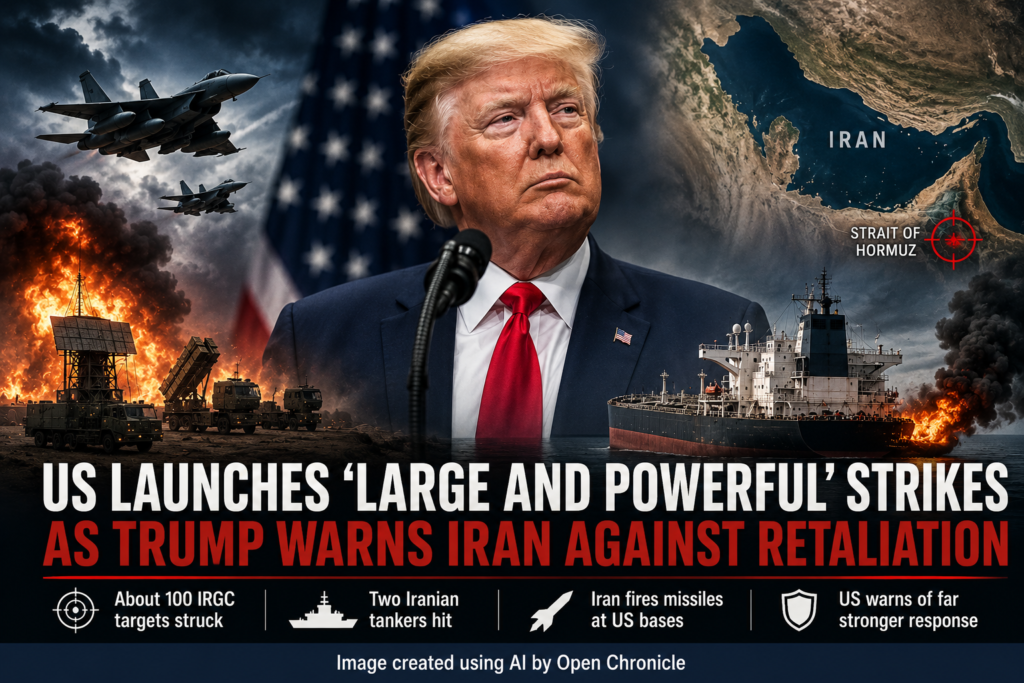
The United States has launched a major new wave of strikes against Iranian military targets around the Strait of Hormuz, hitting approximately 100 sites as President Donald Trump warned Tehran that any further retaliation would trigger an even larger American response.
The operation targeted facilities associated with Iran’s Islamic Revolutionary Guard Corps, including air defence positions, radar installations, mine laying capabilities and anti ship missile sites. Two Iranian government tankers were also attacked, according to US officials cited in the supplied reporting.
The strikes represent another significant escalation in the conflict and appear to introduce a more aggressive American deterrence strategy aimed at preventing Iran from rebuilding military capabilities around one of the world’s most strategically important waterways.
“The United States is, as we speak, striking Iranian Targets near the Strait of Hormuz,” Trump wrote on Truth Social, describing the operation as “large and powerful.”
Washington Says Operation Followed Iranian Actions
According to Trump, the strikes were ordered following what he described as a failed Iranian attempt to deploy sea mines in the Strait of Hormuz and an Iranian missile attack against an American military base in Jordan.
The president said eight missiles targeting the base had been intercepted.
Trump warned Tehran against responding to the new American operation, saying Iran would face attacks at a “much harder and higher level” if it retaliated.
He also claimed that an even larger military operation was prepared if necessary, using unusually severe language to describe the consequences Iran could face.
The comments underline an increasingly explicit US strategy of attempting to deter Iranian attacks through the threat of overwhelming retaliation.
Around 100 Iranian Targets Struck
US officials said approximately 100 targets were attacked during the operation.
The target set reportedly included IRGC air defence systems, radar installations, equipment associated with mine laying operations and anti ship missile positions capable of threatening vessels operating around the Strait of Hormuz.
US Central Command said the operation focused on IRGC forces considered a threat to commercial shipping.
Trump separately told Fox News that American forces had attacked Iranian radar facilities that Tehran had attempted to reconstruct following previous strikes.
According to the president, US forces deliberately waited until reconstruction had progressed before attacking the installations again.
The approach suggests Washington is attempting not only to destroy Iranian capabilities but also to prevent Tehran from restoring military infrastructure previously damaged during the conflict.
US Targets Iranian Tankers
One of the most significant elements of the operation was the reported attack on two Iranian government tankers.
US officials cited by Axios said American drones fired missiles into the engine rooms of the vessels while they were anchored off the Iranian coast.
The attacks reportedly represent the first implementation of what American officials have described as a new “tanker for tanker” deterrence policy.
Under the emerging strategy, Iranian actions against shipping could potentially trigger direct US retaliation against vessels connected to the Iranian government.
Such a policy would significantly expand the maritime dimension of the conflict.
Until now, much of Washington’s military activity around Hormuz has focused on protecting shipping, clearing mines, intercepting Iranian attacks and targeting military infrastructure threatening maritime traffic.
Directly attacking Iranian tankers introduces another level of escalation.
Strait of Hormuz Remains at Centre of Conflict
The Strait of Hormuz has become one of the principal fronts in the confrontation between Washington and Tehran.
The narrow waterway connects the Persian Gulf with the Gulf of Oman and the Arabian Sea and normally carries a substantial share of global oil and liquefied natural gas exports.
Repeated attacks, mining threats and military operations have severely disrupted maritime traffic since the conflict began.
Washington has increasingly focused its military strategy on preventing Iran from controlling or closing the waterway.
Trump said the United States now enjoys “almost total control of the Hormuz Strait” and argued that economic pressure on Tehran was intensifying.
The extent of American control remains contested, however, particularly as Iranian forces continue operating missile, drone and naval capabilities around the region.
Iran Launches Ballistic Missile Retaliation
Despite Trump’s warning, Iran responded with another series of attacks against American positions across the Middle East.
According to the supplied reports, Tehran launched approximately 25 ballistic missiles as well as multiple drones against US military installations.
Targets reportedly included American positions in Jordan, Bahrain, Kuwait and the Kurdish region of Iraq.
Iran also dispatched approximately two dozen drones toward US bases in Bahrain, while additional missiles and drones were directed toward facilities in Kuwait and Erbil.
US forces reportedly intercepted the majority of the incoming weapons.
The geographical spread of the Iranian response illustrates one of the central challenges facing Washington. American forces are distributed across a network of bases throughout the region, giving Tehran numerous potential targets if hostilities escalate.
A New American Deterrence Strategy
The latest operation appears to reflect a shift toward a more systematic US effort to prevent Iran from regenerating military capabilities after they are destroyed.
American officials reportedly believe the latest strikes have reduced the immediate threat to shipping around Hormuz for several weeks.
One US official cited in the reporting said the operation had “bought at least a month” of reduced threat levels.
Whether that assessment proves sustainable will depend heavily on Iran’s ability to replace radar systems, missile launchers, drones, mines and other equipment.
Iran has repeatedly demonstrated an ability to disperse military assets and rebuild damaged infrastructure during the conflict.
The American approach therefore risks creating a cycle in which Iranian capabilities are reconstructed and subsequently attacked again.
Diplomacy Moves Further Into the Background
Trump’s latest comments also suggest that Washington currently sees less value in negotiations with Tehran.
“I like our position now much better,” the president told Fox News, pointing to the situation around Hormuz and the pressure being placed on the Iranian economy.
The remarks contrast sharply with earlier periods of the conflict when diplomatic initiatives were presented as a possible route toward reducing hostilities.
The latest exchange instead suggests that military coercion and economic pressure are again becoming the dominant elements of American policy.
Risk of Regional Escalation Grows
The scale of the US strikes, the decision to target Iranian tankers and Tehran’s subsequent attacks across several countries significantly increase the danger of another broader escalation.
The confrontation is no longer confined to Iranian territory or the Strait of Hormuz.
US military installations throughout the Gulf and Iraq remain potential Iranian targets, while American forces possess the ability to strike Iranian military infrastructure across a much wider area.
The maritime confrontation is particularly dangerous because disruption around Hormuz can rapidly affect global energy markets, shipping routes and insurance costs.
For Washington, the latest operation is intended to demonstrate that attacks on American forces and international shipping will carry increasingly severe consequences.
For Tehran, however, retaliating against US military infrastructure remains an important means of demonstrating that American strikes will not go unanswered.
That dynamic leaves both countries facing the same fundamental danger. Each attempt to strengthen deterrence could instead create the conditions for the next round of escalation.