
By Open Chronicle Newsdesk with agencies
More than three decades after Britain consigned one of its most important Cold War emergency planning systems to the archives, the government is rebuilding it.
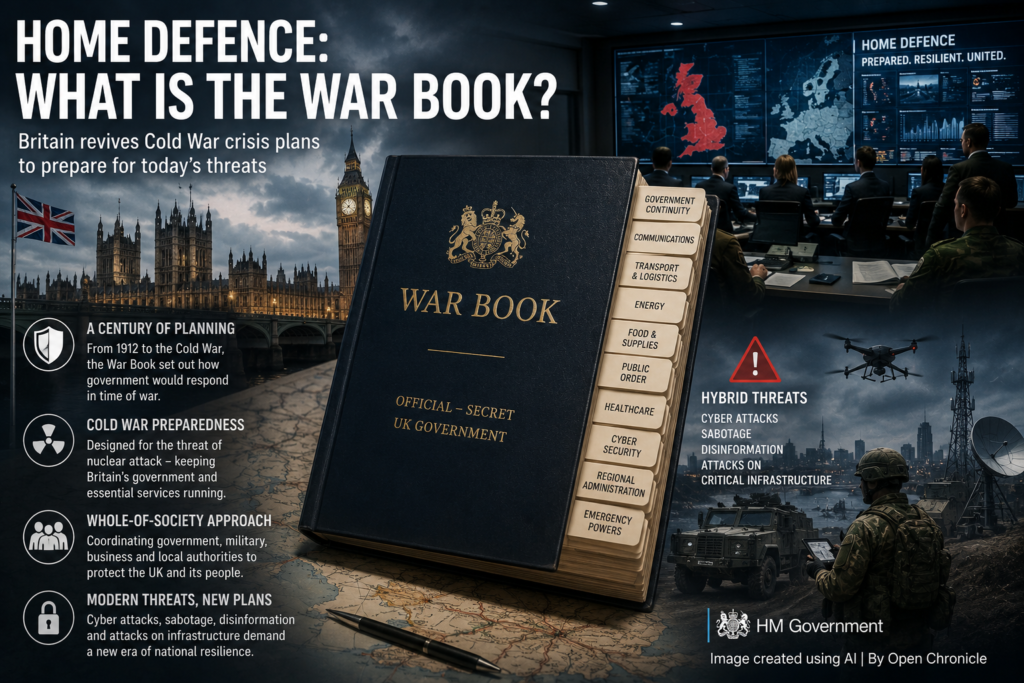
Known historically as the War Book, the system sets out how government departments, ministers, officials and other public authorities should respond if an international crisis escalates into conflict affecting the United Kingdom.
The concept dates back more than a century, but its modern revival reflects a dramatically different European security environment. Russia’s invasion of Ukraine, the growing threat of hybrid warfare, attacks on critical infrastructure and concern about the possibility of a future confrontation involving NATO have forced Britain to reconsider how the country itself would function during war.
The government is now updating classified crisis plans traditionally known as War Books as part of the wider Home Defence Programme, with departments expected to understand how military and civilian responses would work together during a national security emergency.
A plan for taking Britain from peace to war
The War Book was never primarily a military battle plan.
Operational plans for defending Britain and conducting military operations are the responsibility of the Armed Forces. The War Book instead concerned the machinery of government and the wider functioning of the country.
Its fundamental question was straightforward but enormous in scope: what must the British state do when peace becomes war?
The first formal War Book emerged before the First World War.
In 1912, Prime Minister H. H. Asquith told the House of Commons that the government had created a document defining the responsibilities of individual departments in the event of war.
It had been prepared by the Committee for the Co ordination of Departmental Action at the Outbreak of War, part of the Committee of Imperial Defence.
The objective was to prevent confusion and delay during mobilization.
The book contained the proclamations, Orders in Council, telegrams, notices and other measures that might have to be activated immediately when hostilities began.
Britain was effectively creating a checklist for transforming the machinery of a peacetime government into one capable of managing a major war.
The Cold War transformed the War Book
After the Second World War, the Cabinet Office developed a new version.
The system became considerably more elaborate as Britain confronted the possibility of nuclear war with the Soviet Union.
Cold War War Books were divided into three broad phases: preparations before the precautionary period, the Precautionary Stage, and war itself.
Individual government departments were also expected to maintain their own War Books containing instructions specific to their responsibilities.
The documents were continually revised as threats, government structures and military assumptions changed.
Their scale was extraordinary.
When a Cold War version was released in 2009, it revealed detailed arrangements intended to keep some form of government functioning through an international crisis and potentially a nuclear attack.
Britain would have been divided into 12 regions, with ministers exercising extensive emergency powers alongside military officers, police chiefs and judges operating from protected facilities.
Senior members of the central government would have moved to a protected government shelter beneath the Cotswolds.
The objective was not merely military survival. The system addressed how the state itself could continue operating under conditions almost unimaginable during peacetime.
Preparing society for nuclear war
Cold War civil defence planning extended deep into British society.
Government agencies considered communications, transportation, food supplies, policing, healthcare, public information, energy, administration and the continuation of political authority.
An important assumption was that emergency legislation would be introduced at the beginning of a major crisis.
There was historical precedent.
The Emergency Powers (Defence) Act 1939 had given the British government exceptionally broad powers to take measures considered necessary for the prosecution of the Second World War.
Cold War planners anticipated that another major conflict could require comparable emergency authority.
The dominant threat, however, was fundamentally different from that faced in 1939.
A nuclear attack could destroy communications, government buildings and infrastructure within minutes. Planning therefore had to consider how authority could survive even if normal systems of government ceased functioning.
Why Britain abandoned the War Book
The collapse of the Soviet Union dramatically changed those assumptions.
With the Cold War ending and the immediate prospect of a major attack on Britain receding, maintaining an enormous centralized war planning system appeared increasingly unnecessary.
The traditional War Books were eventually archived.
By 2015, the government explained that specific emergency arrangements were no longer contained within a single national compendium.
Civil defence and emergency planning had instead evolved into a broader resilience framework, particularly under the Civil Contingencies Act 2004.
Britain continued preparing for emergencies, but the emphasis shifted towards terrorism, natural disasters, pandemics, infrastructure failures and other civil contingencies rather than national mobilization for major war.
For roughly a generation, the War Book belonged primarily to history.
That strategic assumption has now changed.
Ukraine changes Britain’s calculations
Russia’s annexation of Crimea in 2014 began altering European security planning.
The full scale Russian invasion of Ukraine in 2022 accelerated the transformation.
Successive British governments have increasingly warned that the possibility of major interstate conflict can no longer be treated as remote.
The source material notes that the UK’s security planning has increasingly emphasized Russia, alongside broader concerns involving China, Iran and North Korea. Government strategy has consequently placed renewed emphasis on national resilience, critical infrastructure and the ability of civilian institutions to continue functioning during severe disruption.
This does not mean British officials expect an invasion resembling 1940.
Modern threats are much broader.
Cyberattacks could disable communications or government services. Sabotage could target energy infrastructure. Undersea cables could be disrupted. Satellite services could be attacked or jammed. Disinformation could accompany conventional military operations.
Missile and drone attacks could also threaten infrastructure far behind a traditional battlefield.
The distinction between the front line and the home front has consequently become increasingly blurred.
The Home Defence Programme
Britain established the Home Defence Programme in August 2024 to strengthen national resilience against escalation towards conflict.
The programme is intended to coordinate defence, security and resilience planning while aligning military and civilian efforts during a crisis affecting Britain.
It draws upon several broader government strategies, including the Strategic Defence Review, National Security Strategy and Resilience Action Plan.
The government confirmed in its 2026 Resilience Action Plan implementation report that departments would accelerate preparations and update central crisis protocols traditionally known as War Books.
These plans will define how government departments respond to conflict and threats against the British mainland.
A whole of society approach to defence
The revived War Book sits within a broader concept increasingly prominent in European security planning: whole of society defence.
Modern warfare can place demands far beyond the Armed Forces.
Hospitals may have to prepare for mass casualties. Transport networks could need to prioritize military movements. Telecommunications companies may have to maintain communications under cyberattack. Energy operators would have to protect power generation and distribution.
Local authorities could face responsibilities involving evacuation, emergency accommodation and essential services.
Private companies controlling strategically important infrastructure could also become central participants in national defence.
This is one reason the new War Book is not simply a Ministry of Defence project.
The objective is to establish responsibilities across government and potentially down to local authorities.
Protecting critical national infrastructure
Infrastructure resilience has become particularly important.
Modern Britain depends upon interconnected digital, energy, transportation and communications networks.
Disrupting a relatively small number of critical systems could have consequences across large parts of the economy.
Electricity networks depend upon digital control systems. Telecommunications require reliable power. Banking relies upon communications networks and data centres. Transport networks depend upon electricity, fuel supplies and digital systems.
Military operations themselves depend heavily upon civilian infrastructure.
Protecting the home front therefore increasingly means protecting the networks that allow modern society to function.
Exercise Albiston Shadow
Britain intends to test its new arrangements rather than leave them as theoretical documents.
The government plans what it describes as the largest UK home defence exercise in several decades.
Known as Exercise Albiston Shadow, it is scheduled for 2027.
Ministers and hundreds of officials from across government and the public sector are expected to participate in the multi day exercise.
Its central objective will be testing Britain’s preparedness for hybrid attacks against the UK.
Such an exercise could expose weaknesses that are difficult to identify through planning documents alone.
Questions might include how government communicates during large scale cyber disruption, how responsibilities transfer during emergencies and how civilian agencies coordinate with military commands.
The public could also have a role
The return of home defence planning raises another question that largely disappeared from British political debate after the Cold War: what should ordinary citizens do during a national emergency?
The government already operates public guidance on emergency preparedness.
According to the source material, the government is also considering broader public messaging about preparing for severe disruption caused by events ranging from extreme weather to cyberattacks.
This reflects an important principle of national resilience.
Government cannot provide every essential service immediately during a major crisis. Households capable of coping independently during the first stages of disruption can reduce pressure on emergency services.
Several European countries have already placed greater emphasis on civilian preparedness as the continent adapts to its deteriorating security environment.
New emergency powers could follow
Updating the War Book is only one part of Britain’s changing defence architecture.
The 2025 Strategic Defence Review recommended introducing a Defence Readiness Bill.
The proposed legislation would provide powers that could be held in reserve and activated if tensions escalated towards a war involving Britain or its allies.
The government has indicated that it intends to introduce the legislation during the current Parliament.
A separate review of the Civil Contingencies Act 2004 is also expected in 2027, examining whether Britain’s existing emergency structures remain suitable for contemporary threats.
Together, these measures could significantly reshape the legal foundations of British national preparedness.
Will the new War Book become public?
Probably not in its operational form.
The government has described the updated War Books as classified government crisis plans, suggesting that detailed instructions will remain secret.
That would be unsurprising.
Publishing detailed contingency plans could reveal vulnerabilities, decision making procedures, command structures and assumptions that a hostile state could exploit.
The broad architecture of Britain’s resilience strategy, however, is increasingly public.
Sector specific plans covering areas such as transportation and energy are also being developed alongside existing strategies for biological security, pandemics and energy sector cybersecurity.
Parliament is examining Britain’s readiness
The revival of home defence has also attracted parliamentary scrutiny.
Several committees opened inquiries during 2026 examining national preparedness, societal resilience and Britain’s ability to withstand conflict.
These include work by the House of Lords National Resilience Committee, the Joint Committee on the National Security Strategy and the House of Commons Defence Committee.
Their investigations reflect a wider recognition that defence readiness can no longer be measured simply by counting warships, aircraft, soldiers or missiles.
A country’s ability to withstand attack increasingly depends upon whether the society behind its Armed Forces can continue functioning.
An old concept for a very different kind of war
Britain’s revived War Book will inevitably be very different from its Cold War predecessor.
The original planners worried about mobilizing an empire for industrial warfare. Their Cold War successors prepared for nuclear devastation.
Today’s planners must contemplate a more complicated spectrum of threats ranging from conventional missile attacks to cyber warfare, sabotage, disinformation, attacks on infrastructure and disruption of space based services.
Yet the fundamental purpose of the War Book has barely changed since Asquith described it to Parliament in 1912.
It exists to answer a question governments hope never needs to be answered in reality: if war reaches Britain, who does what, when, and how does the country keep functioning?
After more than 30 years in the archives, Britain has decided that question once again requires a detailed answer.