
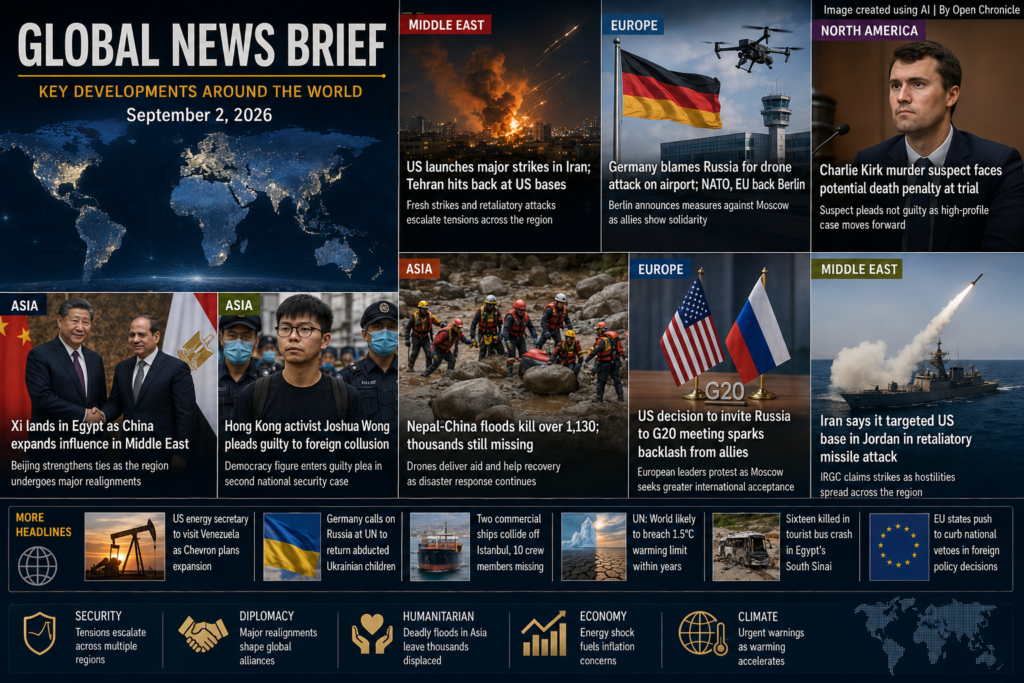
By Open Chronicle
The renewed escalation between the United States and Iran dominates the international agenda on September 2, with fresh American strikes followed by Iranian missile and drone attacks against US positions across the Middle East. At the same time, Europe is confronting renewed tensions with Russia, Asia is dealing with the devastating aftermath of the Nepal and China floods, and major diplomatic movements involving China, Russia and India are reshaping the geopolitical landscape.
Here are the principal developments around the world, organized by region.
Middle East
US and Iran Exchange New Strikes
The confrontation between Washington and Tehran has entered another dangerous phase following fresh US attacks inside Iran.
US forces carried out what President Donald Trump described as a major new series of strikes, with reports indicating that targets in Iran’s Khuzestan province were among those hit. Iranian reports said at least seven people were killed and several others wounded in attacks there, while other reporting put the overall casualties from the latest American operations at at least 12 dead and dozens injured.
Trump warned Tehran against retaliation, suggesting Iran would face substantially greater destruction if it continued attacking American forces.
Iran nevertheless responded.
The Islamic Revolutionary Guard Corps said US military positions in Jordan had been targeted in retaliation, while Iranian forces also claimed drone attacks against American bases in Iraq.
The renewed exchange comes after several weeks of comparatively reduced hostilities and raises the possibility of another sustained phase of the conflict.
Iran War Spreads Across the Gulf
The latest fighting is no longer confined to direct exchanges between the United States and Iran.
Military installations across Jordan, Iraq and elsewhere in the Gulf have become part of the confrontation, increasing pressure on governments attempting to avoid becoming direct participants in the conflict.
Iran’s leadership continues to characterize its operations as retaliation for American attacks, while Washington says further action will follow if US forces or regional partners are targeted.
Iranian Supreme Leader Ayatollah Ali Khamenei has meanwhile issued new messages directed toward Washington and emphasized the role of what Tehran calls the “Resistance Front.”
China Deepens Middle East Diplomacy
Chinese President Xi Jinping has arrived in Egypt as Beijing seeks to strengthen its position in a Middle East transformed by the Iran conflict.
The visit places China in one of the region’s most important Arab states at a moment when governments are reassessing security partnerships, energy routes and their relationships with Washington.
China’s diplomatic activity is increasingly significant because Beijing maintains extensive economic relations with both Gulf Arab states and Iran.
Syria Nuclear Questions Resurface
A United Nations assessment has reportedly concluded that Syria under Bashar al Assad had been constructing a nuclear reactor at Deir ez Zor.
The finding revives questions surrounding the facility destroyed by Israel in 2007 and Syria’s former nuclear ambitions.
Egypt Bus Crash Kills 16
At least 16 people have been killed and 28 wounded in a bus accident in Egypt’s South Sinai region, an area heavily visited by tourists.
Egyptian authorities are investigating the circumstances surrounding the crash.
Europe
Germany Blames Russia for Leipzig Airport Drone Attack
Germany has accused Russia of responsibility for the attempted drone attack at Leipzig/Halle Airport in August.
Berlin says the incident involved an explosive laden drone and has announced measures against Moscow, including the closure of a Russian consulate.
NATO and European Union leaders have expressed solidarity with Germany, further increasing tensions between Russia and Europe.
Ukraine Intensifies Drone Campaign
Ukrainian President Volodymyr Zelensky has warned civilian airlines to avoid Russian airspace as Ukraine expands its long range drone operations.
The warning comes as Kyiv demonstrates an increasing ability to strike targets deep inside Russian territory.
Russia has simultaneously intensified its own drone campaign against Ukraine, with humanitarian organizations reporting faster attacks and increasing daytime operations around Kyiv.
Germany Presses Russia Over Ukrainian Children
Germany used the United Nations to demand the immediate return of Ukrainian children allegedly transferred to Russian controlled territory since the beginning of the war.
The issue remains one of the most politically and legally sensitive aspects of the conflict.
Europe Protests Russian Return to G20
The participation of Russia’s finance minister in a G20 meeting has generated protests from European governments.
Washington’s decision to invite Russian participation has also created tensions with several US allies at a time when relations with Moscow remain deeply strained by the Ukraine war.
Eleven EU Countries Seek Foreign Policy Reform
Eleven European Union member states are reportedly pushing for restrictions on national vetoes in EU foreign policy.
The proposal addresses a longstanding problem in which individual governments can block collective European diplomatic decisions.
Any significant change could have important consequences for the EU’s ability to respond rapidly to international crises.
ECB Faces Renewed Inflation Pressure
European financial markets are again considering the possibility of higher interest rates after inflation reportedly reached 3.3 percent amid the latest energy shock.
Higher oil and gas prices associated with Middle East instability are complicating the European Central Bank’s attempts to control inflation without severely weakening economic growth.
Channel Migrant Crossings Reach Seven Year Low
Migrant crossings of the English Channel have reportedly fallen to their lowest level in seven years.
The decline has been linked to enhanced cooperation between France and the United Kingdom.
Asia Pacific
Nepal and China Flood Death Toll Reaches 1,130
The humanitarian catastrophe across Nepal and areas bordering China continues to worsen.
The reported death toll has climbed to approximately 1,130, while nearly 4,500 people remain missing.
Some missing foreign tourists have managed to establish contact with authorities, providing limited positive news as rescue operations continue.
Nepalese medical teams are processing large numbers of victims while holding out hope that more missing people could still be found alive.
Drones Become Essential to Nepal Rescue Operations
Unmanned aircraft are playing an increasingly important role in the disaster response.
Drones are being used to deliver supplies to isolated communities, survey inaccessible terrain and assist teams recovering bodies from areas that rescuers cannot easily reach.
The catastrophe is becoming an important real world demonstration of how unmanned systems can support humanitarian operations after extreme natural disasters.
Nepal is also considering seeking international compensation and greater assistance from major powers, including China, India and the United States.
China Rebuilds Nepal Road
Chinese teams have reportedly restored an important road connection to Nepal only a week after the catastrophic flooding.
Reopening transport infrastructure is essential for delivering humanitarian assistance and restoring trade across the mountainous border region.
Joshua Wong Pleads Guilty
Prominent Hong Kong democracy activist Joshua Wong has pleaded guilty to foreign collusion charges in his second national security case.
The proceedings represent another significant development in Hong Kong’s continuing transformation under the national security framework imposed by Beijing.
Xi, Putin and Modi Diplomacy Continues
The Shanghai Cooperation Organisation summit in Bishkek remains an important focus of Asian diplomacy.
India has reportedly drawn a clear distinction between its participation in the SCO and China’s Belt and Road Initiative, maintaining its longstanding objections to elements of the infrastructure programme.
Indian Prime Minister Narendra Modi’s interactions with Chinese President Xi Jinping and Russian President Vladimir Putin are being closely watched as the three powers attempt to manage their different interests while advocating a more multipolar international system.
USS Abraham Lincoln Arrives in Thailand
The aircraft carrier USS Abraham Lincoln has arrived in Thailand after an exceptionally long deployment at sea.
Its visit has revived attention on the longstanding military relationship between Thailand and the United States, while also providing shore leave for sailors following months of operations.
The carrier’s presence is another visible demonstration of continued American naval power in the Indo Pacific.
Possible Trump and Kim Meeting
South Korean intelligence reportedly believes another meeting between Donald Trump and North Korean leader Kim Jong Un could return to the diplomatic agenda.
No summit has been formally announced, but renewed speculation highlights the continuing uncertainty surrounding North Korea’s nuclear programme and Washington’s policy toward Pyongyang.
South Asia
India and Pakistan Clash Over Water
India has rejected a Hague ruling connected to the long running Indus Waters dispute.
Pakistan’s leadership responded by declaring that water must not be used as a weapon.
The disagreement adds another source of tension to relations between the nuclear armed neighbours, for whom the Indus river system is of enormous strategic and economic importance.
Pakistan has meanwhile reiterated its commitment to regional dialogue and stability.
North America
Charlie Kirk Murder Case Heads Toward Trial
The suspect accused of murdering conservative activist Charlie Kirk has pleaded not guilty, with a Utah judge allowing the case to proceed toward trial.
Prosecutors could seek the death penalty, ensuring the proceedings will remain a major national story in the United States.
Times Square Stabbing Kills Bank Executive
A Bank of America vice president has reportedly been killed in a stabbing in Times Square.
The attack has renewed attention on violent crime and public security in one of New York City’s busiest districts.
Lake Ontario Becomes “Lake America” on US Maps
Apple Maps and Google Maps are displaying “Lake America” for users in the United States following the Trump administration’s decision to rename Lake Ontario domestically.
The change has intensified political controversy between Washington and Canada and illustrates how the broader bilateral dispute is increasingly extending into symbolic questions of geography and national identity.
Americans’ Confidence in Government Falls
A survey reports that 89 percent of Americans believe government corruption is widespread, an unusually high measure of public distrust in political institutions.
The finding adds to broader evidence of political dissatisfaction as the United States approaches the November midterm elections.
Latin America and the Caribbean
Washington Looks Toward Venezuela’s Energy Sector
The US energy secretary is expected to travel to Venezuela as Chevron considers expanding its activities there.
The development could signal another shift in Washington’s complicated relationship with Caracas, particularly as the Iran war and disruption around the Strait of Hormuz increase the strategic importance of alternative sources of crude oil.
Maduro Remains Part of Venezuela’s Political Debate
Nicolás Maduro’s son has publicly discussed the circumstances surrounding the first photograph of his father following his detention, keeping Venezuela’s political upheaval in the regional spotlight.
Africa
Egypt Faces Regional and Domestic Pressures
Egypt is emerging as one of the day’s most important African diplomatic actors following Xi Jinping’s arrival.
Cairo’s strategic position between Africa, the Arab world and the Mediterranean gives it particular importance as China expands its diplomatic engagement during the Iran conflict.
At the same time, the fatal South Sinai bus accident has brought a domestic tragedy into the national agenda.
African Integration Debate Continues
Discussions surrounding deeper African political and economic integration remain active as governments confront security challenges, infrastructure gaps and increasingly complex relationships with global powers.
Global Security
Russia Reportedly Assisting Iranian Missile Development
Russia is reportedly providing assistance to Iran in the development of supersonic cruise missile technology.
If confirmed, such cooperation would represent an important deepening of the Moscow Tehran defense relationship and could have significant implications for Middle Eastern missile defense.
The development would also demonstrate how the wars involving Russia, Ukraine, Iran and the United States are increasingly interconnected through weapons technology, intelligence and defense industrial cooperation.
Russian Missile Industry Under Scrutiny
New reporting is also examining networks that allegedly allow Russia’s missile industry to continue obtaining critical components despite Western sanctions.
Maintaining access to electronics, machine tools and specialized industrial components remains central to Moscow’s ability to sustain long term weapons production.
Istanbul Maritime Collision
Two Turkish flagged commercial vessels have collided near Istanbul in the Sea of Marmara.
Initial reports indicated that contact had been lost with crew members, triggering a search and investigation by Turkish authorities.
The incident comes at a time of heightened attention to maritime safety throughout strategically important waterways connecting the Black Sea and Mediterranean.
Climate and Environment
World Expected to Breach 1.5°C Threshold
A new United Nations assessment warns that global temperatures are likely to exceed the internationally recognized 1.5°C warming threshold within years.
The report also emphasizes that exceeding the threshold does not necessarily mean it is permanently lost, provided global emissions fall sufficiently to bring temperatures back down over time.
Nevertheless, the finding represents another major warning about the accelerating effects of climate change.
Himalayan Disaster Highlights Climate Vulnerability
The Nepal and China catastrophe has become one of the clearest examples of the risks facing mountain regions.
Scientists and humanitarian organizations are increasingly warning that parts of the Himalayas may be approaching or exceeding their ability to adapt to rapidly changing climatic conditions.
Australian Dugong Population Falls
Australian researchers have reported an approximately 50 percent decline in a monitored dugong population, adding to concerns about the health of marine ecosystems and coastal habitats.
Global Economy and Diplomacy
Energy Shock Returns to Global Markets
The renewed US Iran confrontation is again placing pressure on energy markets.
Higher energy costs are feeding inflation concerns in Europe and elsewhere, complicating decisions for central banks that must balance price stability against slowing economic activity.
Russia and US See Potential for Financial Relations
Despite profound geopolitical tensions, Russia’s finance minister has said Moscow and Washington see grounds for some future financial cooperation following discussions around the G20.
The comments contrast sharply with continuing confrontation over Ukraine and European opposition to Russia’s renewed participation in international forums.
Thailand Business Confidence Improves
Thailand’s business sentiment strengthened in August as tourism continued its recovery.
The improvement provides a more positive economic signal from Southeast Asia amid considerable uncertainty elsewhere in the global economy.
The World on September 2
The international picture entering September 2 is dominated by the return of high intensity confrontation between the United States and Iran.
What had appeared to be a period of reduced hostilities is rapidly deteriorating as American strikes inside Iran trigger retaliatory attacks against US positions across the Middle East.
At the same time, the Russia Ukraine war is expanding further into the drone domain, while Germany’s accusations against Moscow over the Leipzig airport incident demonstrate how security concerns are increasingly extending beyond Ukraine itself.
Asia faces a different emergency. The Nepal and China floods have become one of the year’s worst natural disasters, with more than a thousand people dead and thousands still missing.
Behind these immediate crises, a broader geopolitical transformation continues. China is strengthening its diplomatic presence in the Middle East, Russia is attempting to restore international economic contacts, India is balancing relationships with competing powers, and the United States is simultaneously managing conflicts and commitments across Europe, the Middle East and the Indo Pacific.
September begins with several of the world’s major crises becoming increasingly interconnected, leaving military escalation, energy security, climate disasters and great power competition at the center of the global agenda.