
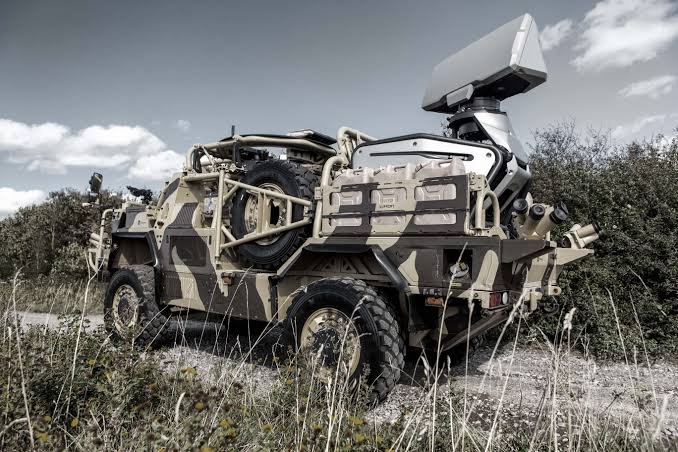
Image: from International Defence Analysis X @Defence_IDA
By Open Chronicle Newsdesk with agencies
The Royal Air Force has received Saab Giraffe 1X radar systems to strengthen its ability to detect and track drones during deployed operations, as the growing proliferation of uncrewed aerial systems continues to reshape military air defence requirements.
Saab UK confirmed that the systems were delivered following what the company described as an urgent operational requirement from the RAF. The radars are being incorporated into the service’s broader counter-drone architecture, providing surveillance and tracking information that can be used alongside other systems responsible for defeating airborne threats.
The procurement reflects the increasing importance of detecting small, low flying and relatively slow moving drones, which have become one of the most widespread threats facing military forces and critical installations.
🇺🇸🇸🇪 The U.S. Army has awarded Sweden’s Saab a $46 million contract to supply Giraffe 1X lightweight surveillance radar systems.
📍Specifications:
🔹3D air surveillance with 360° coverage
🔹High mobility for rapid deployment
🔹Advanced target detection capabilitiesThese radars… pic.twitter.com/Cu2tVSltsO
— Defence Index (@Defence_Index) October 1, 2025
Urgent requirement from the RAF
According to Saab, the delivery builds upon previous cooperation between the company and the RAF in the counter UAS field.
The British service said Saab had rapidly mobilised its international production network to meet the requirement.
“As the customer, we have been impressed with how Saab were able to mobilise their global production capacity to rapidly satisfy our Giraffe 1X requirement in support of Counter Drone operations on deployed operations,” an RAF spokesperson said.
The service described the equipment as critical to reducing the danger drones pose to personnel.
Saab has not disclosed how many radar systems were supplied, the value of the procurement or where the equipment will be deployed.
The urgency surrounding the acquisition nevertheless illustrates how rapidly counter drone capabilities are becoming an essential component of modern force protection.
What is the Giraffe 1X?
The Giraffe 1X is the smallest member of Saab’s wider Giraffe radar family.
It is a compact three dimensional surveillance radar designed to detect and track airborne targets, including small drones that can prove difficult for conventional air surveillance systems to identify.
Its relatively small footprint allows the radar to be rapidly transported and deployed.
The system can operate from fixed locations but can also be installed on vehicles and other mobile platforms, allowing units to reposition their surveillance capability as operational requirements change.
Saab markets Giraffe 1X for several missions, including counter UAS operations, ground based air defence and battlefield surveillance.
Its significance lies not simply in detecting an object in the air, but in providing accurate tracking information that can be distributed to a wider defence network.
The radar is only one part of the defence
Giraffe 1X is not itself a weapon.
Instead, it acts as a sensor within a broader defensive architecture.
Once a drone has been detected and classified, tracking information can be passed into command and control systems. Commanders can then determine the appropriate response using whatever countermeasures are available.
Depending on the threat and operational environment, those measures could include electronic warfare, specialized counter drone systems or conventional air defence weapons.
This layered approach has become increasingly important because drones vary enormously in size, speed, altitude and capability.
A small commercial quadcopter carrying explosives presents a very different challenge from a long range one way attack drone, yet both may threaten military personnel or infrastructure.
Small drones present a difficult radar problem
Detecting small uncrewed aircraft can be technically demanding.
Traditional air defence radars were primarily developed to identify comparatively large targets such as aircraft, helicopters and missiles.
Small drones can have much smaller radar signatures. They may also fly slowly and at very low altitude, where buildings, terrain, vegetation and other objects can complicate detection.
Systems such as Giraffe 1X are designed specifically with these increasingly important targets in mind.
For deployed forces, early detection is crucial.
A relatively inexpensive drone can conduct reconnaissance, identify troop positions, direct artillery or carry an explosive payload. Giving personnel additional warning can therefore make the difference between intercepting a threat and allowing it to reach its target.
Drone warfare reshapes force protection
The RAF acquisition comes as armed forces around the world reassess air defence following the extraordinary expansion of drone warfare.
Recent conflicts have demonstrated that relatively inexpensive unmanned aircraft can threaten equipment and installations worth many times their own cost.
Drones are increasingly being used for surveillance, precision attack, electronic warfare and long range strikes against infrastructure.
Large numbers can also be launched simultaneously in an attempt to overwhelm defensive systems.
This creates an economic as well as operational challenge.
Using an expensive surface to air missile against every inexpensive drone is unlikely to be sustainable during prolonged operations.
Modern counter UAS architectures therefore increasingly combine radars with electronic warfare, guns, missiles and other effectors, allowing commanders to select a response appropriate to each threat.
Reliable detection remains the foundation of that defensive chain.
Designed to operate as part of a network
One of the important characteristics of Giraffe 1X is its ability to contribute information to wider command and control networks rather than functioning as an isolated sensor.
Modern air defence increasingly relies upon multiple sensors sharing information.
A radar detecting a target can provide tracking information to another system positioned elsewhere. That data can then contribute to a broader picture of the airspace and support decisions about whether and how to engage the threat.
This concept becomes particularly important when defending large military bases or distributed forces where no single radar can necessarily provide complete coverage.
The Giraffe 1X can therefore serve as one component within a larger network of sensors and defensive systems.
Saab highlights UK industrial footprint
Andy Fraser, Group Managing Director at Saab UK, said the rapid delivery demonstrated cooperation between the company’s British operations and its wider international organization.
“This delivery showcases the dedication and expertise of teams across Saab, from our UK manufacturing operations through to colleagues across the wider business, who worked together to support delivery of this capability,” Fraser said.
He added that the programme demonstrated Saab’s ability to bring together manufacturing and technical resources to meet urgent customer requirements.
“We are proud to provide British and coalition forces with the capabilities they need to carry out their mission and to keep people and society safe,” he said.
Part of a much larger transformation
The arrival of Giraffe 1X represents a relatively focused procurement, but it forms part of a much larger transformation taking place across Western militaries.
For decades, sophisticated air defence concentrated primarily on hostile aircraft, cruise missiles and ballistic missiles.
The drone revolution has added an enormous number of potential threats at the lower end of the airspace.
Military forces increasingly need sensors capable of detecting everything from small commercial drones flying close to the ground to larger attack drones approaching from considerable distances.
The challenge is particularly significant for expeditionary forces because defensive equipment must often be transported rapidly and operate from temporary locations.
Compact systems such as Giraffe 1X are intended to provide that flexibility.
For the RAF, the latest delivery therefore strengthens more than its ability to track drones. It contributes another sensor to the increasingly complex network required to protect British and coalition forces in an era when even the smallest aircraft in the sky can represent a potentially serious threat.