
By Open Chronicle Newsdesk with agencies
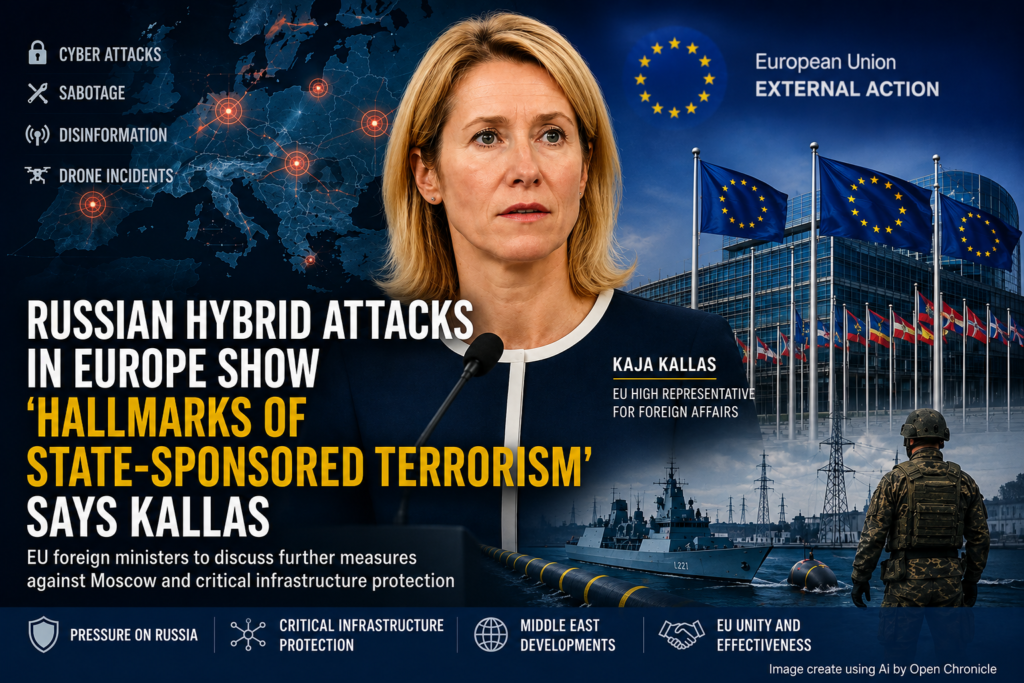
Russian hybrid attacks across Europe bear “all the hallmarks of state sponsored terrorism”, EU foreign policy chief Kaja Kallas said on Wednesday, as European governments consider further measures against Moscow and strengthen the protection of critical infrastructure.
Speaking ahead of an informal meeting of European Union foreign ministers in Ireland, Kallas said recent incidents had demonstrated the need for a coordinated European response.
Several EU member states have summoned Russian ambassadors over alleged attacks and sabotage operations, while the bloc is preparing additional measures targeting Russia’s military and industrial capabilities.
Kallas said around 1,600 listings connected to Russia’s military industrial complex were already in the pipeline, with further entities potentially being added.
No formal decisions are expected during the informal ministerial meeting.
Leipzig Attack Raises European Concerns
Kallas pointed specifically to the alleged Russian drone attack at Leipzig Airport in Germany in August as an example of the growing security threat.
German authorities have accused Russia of responsibility for the attempted attack, which involved a drone carrying explosives.
According to Kallas, Berlin’s reaction sent “a very strong signal”, while Germany welcomed the solidarity expressed by other EU countries.
“I think this is the unified response that we need to take,” she said.
The incident has become part of a wider European debate about Russian hybrid operations, which Western governments say can include sabotage, cyberattacks, interference with critical infrastructure, espionage, disinformation and covert operations.
Moscow has repeatedly rejected accusations that it is conducting a coordinated sabotage campaign against European countries.
Kallas Calls Incidents ‘Wake Up Calls’
Kallas argued that the latest incidents should serve as “wake up calls” for EU countries that have previously favoured a less confrontational approach toward Russia.
Ukraine will participate in part of the discussions in Ireland, with ministers expected to consider ways of increasing pressure on Moscow.
Kallas said the talks would take place against the background of intensified Russian attacks on Ukrainian civilians.
The meeting will also examine whether the EU’s foreign policy decision making mechanisms remain adequate in an increasingly volatile geopolitical environment.
Foreign policy decisions in several important areas currently require unanimity among the bloc’s member states, which can delay or prevent collective action when governments disagree.
“In this geopolitical context, we have to be more agile, and we have to really be able to react to situations that are upcoming,” Kallas said.
Critical Infrastructure Moves Up EU Agenda
Protection of European critical infrastructure will form another major part of the discussions.
Energy networks, communications systems, ports, airports, pipelines and undersea cables have become increasingly important security concerns since Russia’s full scale invasion of Ukraine.
Recent suspected sabotage incidents have reinforced fears that infrastructure could become a central battlefield in a confrontation conducted below the threshold of conventional warfare.
European governments are consequently examining new surveillance and protection technologies.
According to Kallas, discussions will include the use of underwater drones and lessons that European countries can learn from Ukraine’s rapid development of unmanned systems.
Ukraine has become a major testing ground for drone technology during the war, deploying increasingly sophisticated aerial, maritime and underwater systems for reconnaissance and attack missions.
European governments are studying some of those innovations for potential applications in monitoring ports, offshore energy installations, submarine cables and other vulnerable infrastructure.
EU Considers Further Pressure on Moscow
The discussions come as Brussels considers expanding its measures against Russia.
Kallas said approximately 1,600 listings related to the Russian military industrial complex were being prepared, although she left open the possibility that additional targets could eventually be included.
The objective is to increase the economic and technological pressure on industries supporting Russia’s military capabilities.
At the same time, European officials face the challenge of maintaining political unity as the confrontation with Moscow increasingly extends beyond the battlefield in Ukraine.
For Kallas, coordinated responses to suspected hybrid attacks are essential to demonstrating that pressure against individual European countries will produce a collective reaction.
Strait of Hormuz and Red Sea Also on Agenda
Russia and Ukraine will not be the only major security issues discussed by EU foreign ministers.
Developments in the Middle East are also expected to feature prominently, particularly threats to international shipping.
Ministers will discuss freedom of navigation in the Strait of Hormuz and the Red Sea, two waterways of enormous importance to global energy supplies and international trade.
The Strait of Hormuz has become a particularly dangerous flashpoint amid the conflict involving the United States and Iran, while security in the Red Sea remains strategically important for traffic connecting Asia, the Middle East and Europe through the Suez Canal.
EU ministers will examine potential cooperation with a Saudi led multinational initiative intended to strengthen maritime security.
Developments in the occupied West Bank will also be discussed.
Europe Confronts a Wider Security Challenge
The agenda in Ireland reflects how European security policy is increasingly being shaped by several interconnected challenges.
The war in Ukraine remains central, but governments are simultaneously confronting suspected sabotage operations, threats against infrastructure, rapidly developing drone technology and instability along crucial maritime trade routes.
For the EU, the challenge is not simply identifying individual incidents but developing mechanisms capable of responding collectively and quickly when threats emerge.
Kallas’s description of suspected Russian hybrid attacks as bearing the hallmarks of state sponsored terrorism represents particularly strong language from the bloc’s foreign policy leadership.
It also signals that Brussels increasingly views hybrid warfare not as a peripheral consequence of the Ukraine conflict, but as a direct security challenge for the European Union itself.